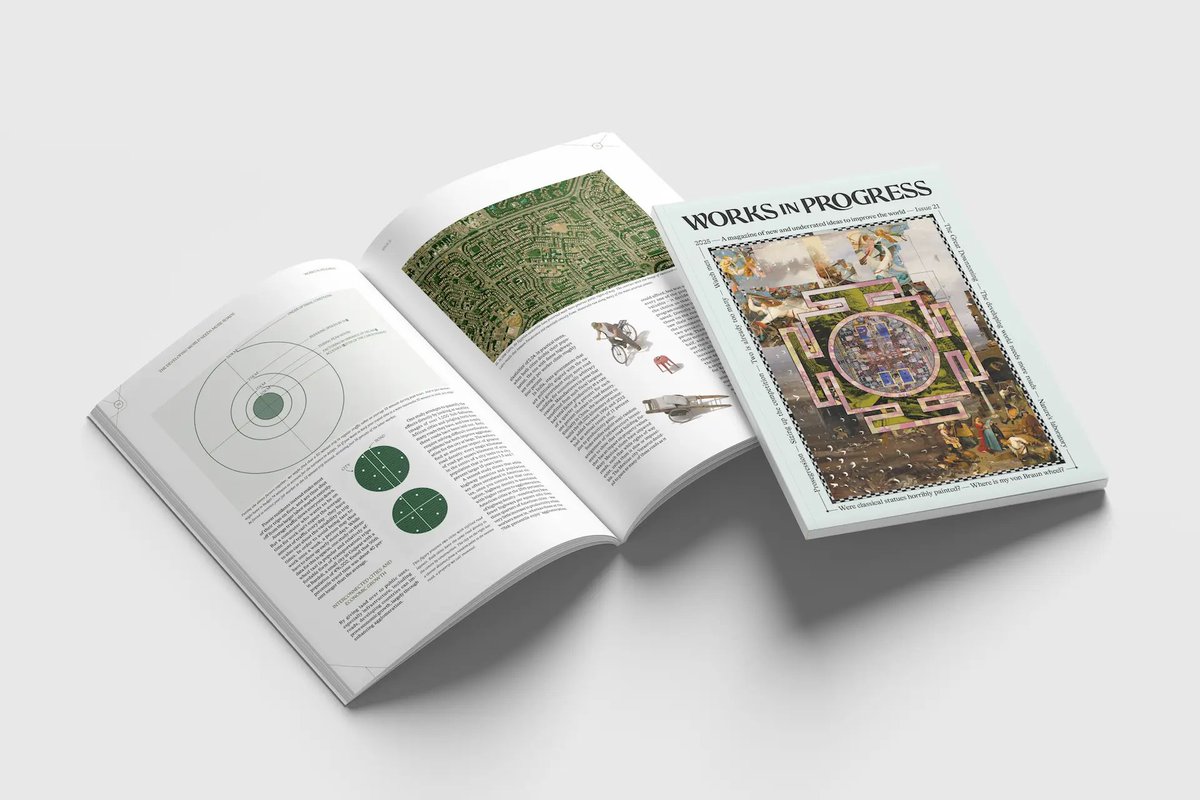
Works in Progress is a magazine of new and underrated ideas to improve the world. Subscribe to our new print edition now. We are proud to be part of @Stripe.
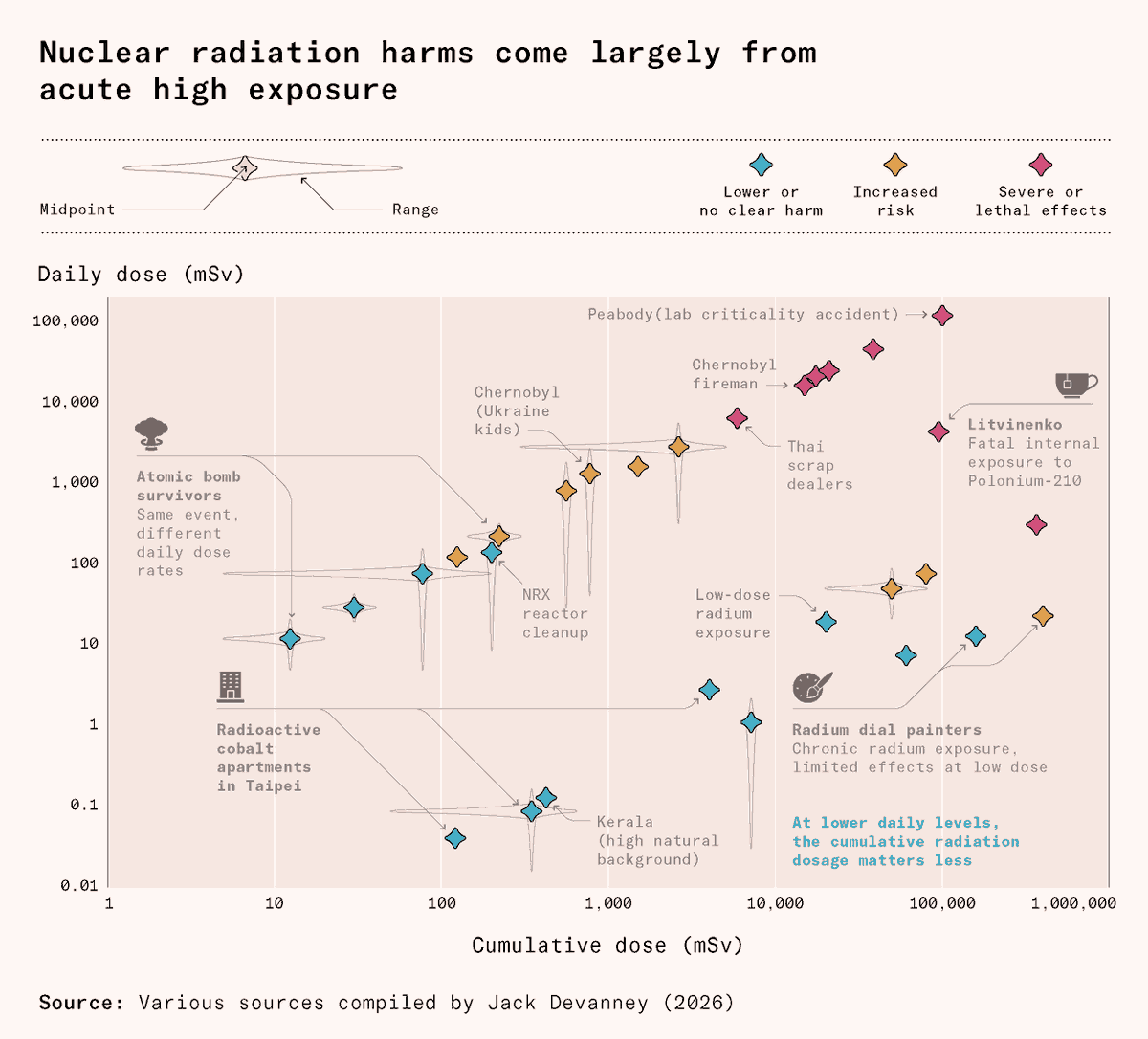
Nuclear power is regulated worldwide on the basis of one important belief: that the harm from radiation doses is cumulative, so even low levels of exposure can hurt you.
There’s one problem with this: the evidence overwhelmingly suggests it’s wrong.
Would you rather be exposed to the radiation of 1,000 CT scans all in one go, or be hit with the same cumulative amount of radiation, but over the course of a lifetime?
https://t.co/krJx47qKAh
Hopefully you will not have to take that decision, but if you do, make sure it's spread out over your lifetime.
There is now overwhelming evidence that low-dose-rate ionizing radiation is not that harmful. Even Chernobyl, by far the world's worst nuclear disaster, exposed millions yet has likely killed 60 or so people. A total of 200 may die early. The other bad civil nuclear disasters – Windscale, Fukushima, and Three Mile Island – likely killed nobody at all.
The evidence is rolling in:
---> Many residents of Kerala are exposed to seven full-body CT scans' worth of ionizing radiation every year. But multiple studies find no effect on their health.
---> Taiwanese apartment dwellers were unwittingly exposed to up 100 CT scans per year because their apartments were made with radioactive cobalt rebar. But dwellers suffered much lower cancer rates than other age-comparable Taiwanese.
---> Between 1915 and 1950, women in factories painted radium onto watch dials to make them glow in the dark. Those licking the brushes sometimes suffered severe cancers. But non-lickers had lifetime doses equivalent to nearly 1,000 CT scans with no effect.
---> At 58 in 1945, Albert Stevens was injected with an enormous amount of plutonium, exposing him to a radiation dose equivalent to 300 CT scans every year. He lived to be 79.
These and many other studies show that ionizing radiation's harms are primarily about concentrated acute doses, not low doses over a long time. Yet nuclear regulatory systems are based around the principle that any radiation exposure is totally intolerable. This leads to rules like 'ALARA' – as low as reasonably achievable – which continually ratchet up regulatory requirements, making nuclear power slow and expensive.
Read my new piece with @chalmermagne for @WorksinProgMag.
"Every major American city has a land shortage. But we have more than enough shallow water, dredging capacity, and market incentive to make more land, just like we did 150 years ago. The only obstacle is our own choice to make making land illegal."
Read the full story in Issue 24 of Works in Progress Magazine.
Half the land area of Boston, a quarter of NYC, and 15% of San Francisco were raised from the sea before 1970.
Since then, land values have grown by 30x but land reclamation has ground to a halt.
This failure follows the spread environmental law around the world rather than any geographic, technological, or economic constraint.
Thus, our lack of land reclamation and the severe land constraints in our most important cities are self-imposed and avoidable. We should make more land!
https://t.co/J9zghvLkz2
Land reclamation was common practice in American cities in the 19th and 20th centuries. Seattle, Chicago, Boston, Charleston, San Francisco, New York, Philadelphia, Norfolk, DC, Oakland, and LA all had major land reclamation projects that extended residential living space or infrastructure or both.
The Bay Area alone reclaimed an area of land equivalent to ten Manhattans between 1850 and 1957, at an inflation-adjusted cost of $330,000 per acre. Today, an acre of single-family-zoned land in San Francisco County averages $24 million. Even if the cost of land reclamation grew faster than inflation, despite technological leaps in dredging and construction technology, there should be plenty of room for profitable arbitrage.
And yet, land reclamation is extinct in the Bay Area as well as in every other American city. This isn’t because we ran out of good spots to reclaim: Two thirds of the San Francisco Bay is shallower than Boston’s Back Bay was when it was reclaimed in the 1860s. Nor is it because of better transportation: We’ve used up all of the easy suburban expansions enabled by the train and the automobile so prices are rising even in outlying suburbs.
Instead, land reclamation’s death is due to environmental law. Evidence for this claim shows up in the coincident timing of land reclamation’s demise across dozens of cities in the US and in the environmental compliance process of the few reclamation projects still inching along today, but the best evidence is found internationally.
No country has more experience or more reason to reclaim land than the Netherlands. The Dutch built 5% of their country out of the sea over the first half of the 20th century and by 1975 they had another artificial lake in the Zuiderzee ready to drain at the flip of a switch, which would have made tens of thousands of acres of land just east of Amsterdam. But a 1969 environmental review law, similar to NEPA in the US, stopped the project before it was finished and the site is now a protected bird sanctuary. Their one major reclamation since, the Maasvlakte 2 extension of the port of Rotterdam, took 11 years and 6,000 pages of environmental review before construction began.
Inversely, countries without these laws, like China, Singapore, and Japan have continued major land reclamation projects into the 21st century. China has reclaimed over 5,000 square kilometers since 2000, including a city of half a million outside Shanghai and Singapore has grown by a quarter since 1975.
Every major American city has a land shortage. But we have more than enough shallow water, dredging capacity, and market incentive to make more land, just like we did 150 years ago. The only obstacle is our own choice to make making land illegal. The benefits of more land in our most productive cities are large enough to justify the effort of reforming the laws that currently prevent it. Let’s make more land!
Today we're launching Intercept: a $500M philanthropic initiative to make respiratory infections, like the common cold and flu, a thing of the past.
We treat respiratory infections as a minor nuisance, but that’s really not the case. Most of us will spend 5% of our lives (!) sick from these viruses, they kill 1M people a year, cost $600B annually in productivity, and periodically threaten civilization through pandemics.
So, if they’re such a big problem, why haven’t we dealt with them yet? Last year we convened ~40 leading scientists, pharma R&D leaders, biotech investors, and regulatory experts to better understand that.
We heard two main reasons:
(1) First, it’s just technically very challenging: respiratory viruses represent hundreds of distinct, mutating strains across several families. Fortunately, recent breakthroughs make this newly possible.
(2) Second is a lack of funding: broad-spectrum solutions have historically been underfunded, in part because they’re not a great fit for most philanthropic or commercial funding (and while COVID generated a burst of activity around preventing and understanding respiratory infections through an influx of new funding, that hasn't been sustained).
We think that with enough focus and funding, this might be solvable. Intercept is a $500 million philanthropic initiative that will take advantage of new tools to catalyze the development and deployment of two types of products: broad-spectrum preventatives and air cleaning technologies.
This problem is undoubtedly difficult. But it’s more tractable now than it’s ever been. We think we should give it our best shot.
We’re enormously grateful to our anchor funders: @stripe, @AnthropicAI, @TheFluLab, @FoundationOAI and individuals from Jane Street.
And, I’m very excited to be building this with @incredutility and the rest of the team.
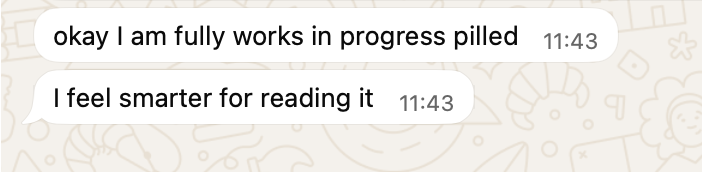
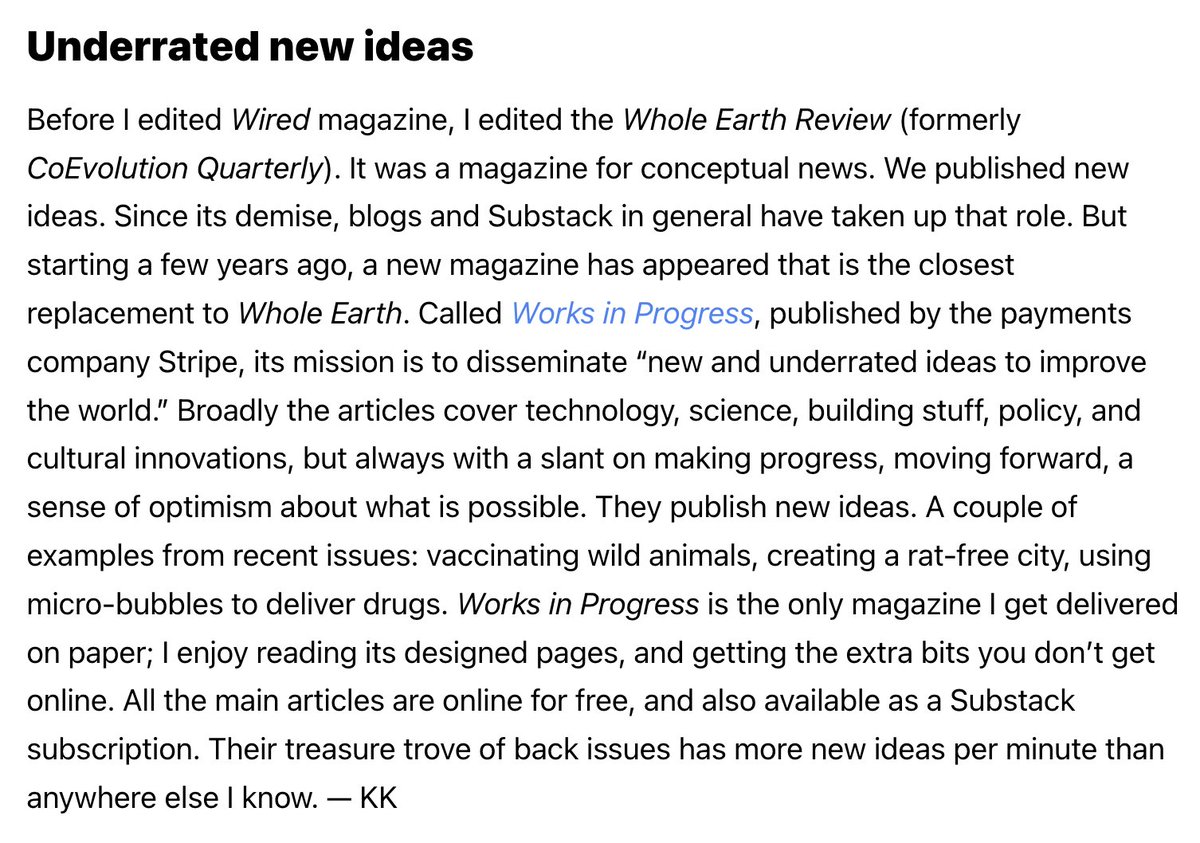
A very kind endorsement of @WorksInProgMag from the peerless and inspiring @kevin2kelly. https://t.co/iE6P1PO2h7
You can (and should!) subscribe over at https://t.co/lqpiAsucr2.
We are looking for journalists and other writers to write reported features for Works in Progress.
There are a lot of important stories in the world that we’d like to cover that don't work as our typical essays, because they require on-the-ground information and insights that only a reporter can uncover. Things like:
• Why has crime dropped so much in Washington, DC?
• What is really happening in Milei’s Argentina? What about Bukele's El Salvador?
• Why don't ASML and TSMC raise their prices?
The type of person we are looking for will have already published features like these at a major publication. The work will be on a freelance basis (although we may offer salaried staff writer positions in the future) and pay will be competitive with major publications.
If you’re the right person to do this, please send a hundred words on yourself and a story you'd like to cover, as well as examples of previous work, to [email protected]
Works in Progress Issue 24 is arriving with our subscribers now. In it, you can read about:
- What ultra-Orthodox Jews can teach us about boosting fertility.
- How we can start claiming land from the sea again.
- Why the Glorious Revolution shows us how to abolish today's "Stakeholder State".
- How Alberta became the only place in the world without rats.
- Why and how we can vaccinate the world's wild animals against disease.
- How Vancouver's Squamish people might solve the city's housing crisis.
@pietergaricano, @Aria_Babu and I sat down to discuss all this and MORE from the new issue. Listen now.
Spotify: https://t.co/9ei9TebV6e
Apple: https://t.co/mW4cCpna0j
YouTube: https://t.co/v3MlhJFGvs
Very much enjoyed this piece in the latest @WorksInProgMag about how Alberta became a rat-free sanctuary and the only significant human-inhabited place on earth that is free of them. Excellent "you can just do things" energy.
"William Lobay, a crop protection supervisor at the Alberta Department of Agriculture, came up with the idea of a buffer zone focused on the area of prairie and parkland that was most vulnerable to penetration. In late 1950, Albertan officials approved his Rat Control Zone, a roughly 600-by-29-kilometer strip along the part of its eastern border with Saskatchewan. In the zone, William Lobay and his colleagues surveyed cargo and vehicles that entered the province, and inspected vulnerable sites like farms, grain elevators, feed stacks, barns, sheds, and abandoned buildings, where food and shelter made rat establishment most likely."
https://t.co/t8sGM5BTJI
One City Might Have Just Cracked the Housing Crisis by @BCAppelbaum
“We think that building housing is part of the solution. We think net zero is part of the solution. We think a car-light development is part of the solution. We think building a sense of place and community is part of the solution. It’s us saying to the world that we want to be part of the solution.”
https://t.co/iDNgFoyyjb via @NYTOpinion
"This is a look into a potential future. Every one of us that is not a US citizen is at risk." @s8mb on the policy implications of the Mythos/Fable blackout.
This is, perversely, good news for Britain, Australia, Japan, Europe, and other countries being cut off that would once have seen themselves as close allies of the United States.
It shows us what the future may hold if AI is the strategically and economically decisive technology of the 21st century and is controlled by the US and China. It is good news because *it may be happening early enough to give us time to act.*
I think this will be rescinded pretty soon, but it’s a sign of things to come. In a future where frontier models cannot be used outside the US, our industries and economies will fall behind and American businesses may not be able to operate overseas. We won’t be able to defend ourselves militarily with defence systems built on obsolete software. Europe 2031 is a good scenario of what a future like this could mean: https://t.co/AMc5LrFJeS
Some of the things we need to do are ‘no regrets’ measures we should do anyway. But some are genuinely costly and risky.
We need cheap electricity – powered by gas, coal (this is costly, coal is very bad), deregulated nuclear fission – whatever can provide *cheap, reliable, 24/7* power. This almost certainly excludes wind power, which is enormously expensive and unreliable. We need projects to be able to connect to the grid in days rather than years by paying for fast-track connections.
We need to make it incredibly easy to build data centres, with the property taxes retained locally and hypothecated for local tax cuts so there is some direct benefit for locals. This doesn’t need to be nationwide.
We need to create new regulatory regimes for innovative businesses that give them the right to hire and fire staff with ease. The difficulty and cost of firing staff is one of the main reasons Europe has fallen behind so badly. We need to create a parallel employment regime that companies and workers can opt in to: https://t.co/YaNOXK1Po2
Even though I think it will probably fail, I think we should probably try to create a good, non-American frontier AI lab. I am quite pessimistic about this – even extremely well-resourced, innovative software companies are struggling to do this. But the stakes are so high that not trying seems foolish.
One thing that might work in our favour is the number of brilliant AI engineers who are not US citizens, who under the current export controls do not have access to Mythos/Fable even if they live and work in the US. What happens to Demis Hassabis, Ilya Sutskever, Andrej Karpathy, and the many other Europeans, Canadians, etc who are working on AI models in Britain and America who are affected by this?
I do not think we should force our own companies to use model, because this would exacerbate their economic weakness – this lab should have to compete on an even playing field. I am deeply sceptical that this can work, but we cannot rule it out. If we do it, it has to be able to pay US salaries, operate without political constraints. https://t.co/Um05rUF4Vq
It is cope to tell yourself that Trump is an aberration or that these export controls are a one-off. To repeat, I think these specific controls will be lifted quickly and it will be easy to move on and forget it happened. But this is a look into a potential future. Every one of us that is not a US citizen is at risk. The standard political divides do not apply here; the question is whether you grasp the enormity of AI as a technology. We have to act!
Final artwork and behind the scenes on how my colleague Magnus made it - for the @WorksInProgMag article on How bacteria solved the mystery of inheritance
Love this story about how the Squamish Nation did what seems almost impossible for everyone else, and managed to densify a portion of Vancouver, one of the most regulation-constrained cities for housing anywhere in the world
The race to discover a new drug is often less important than the race to test it in humans. American medical research is falling behind China due to excessive barriers to conducting clinical tests. @RuxandraTeslo and Amol Punjabi recently wrote for us on the story of CAR-T therapy, an extremely promising treatment for some of the world’s most painful cancers: invented in America, developed and perfected in China. https://t.co/uSph9nAXba
China is winning the drug discovery race. There's no better example of this than multiple myeloma.
https://t.co/YaJSUquRoa
It's one of the most painful cancers, destroying bone from within. For decades, patients endured cycles of brutal treatment and relapse. Then came Carvytki: a one-time CAR-T infusion that appears to cure some patients who have failed multiple treatments.
Its development story, beginning in 2016, was an early signal of a shift now making headlines: the US is losing biotech dominance to China. Though the foundational science was largely American, a nimble Chinese company moved faster with a better molecular engineering idea.
Unless the US addresses clinical-trial bottlenecks slowing early in-human data, more breakthroughs will be developed elsewhere, weakening the ecosystem American biopharma depends on.
Some key points from my article for @WorksInProgMag, with my friend Amol Punjabi, of @EvidenceOpen:
1) Multiple myeloma is not only extremely painful in and of itself, but also one of the most brutal cancers to treat. As first-line therapy, patients endure four drugs simultaneously, then a stem cell transplant, followed by continuous maintenance therapy. And most still relapse, with each treatment round carrying worse chances.
2) A drug called Carvykti, approved in 2022, is changing the treatment landscape. Carvytki acts as a single, one-time infusion. It's a CAR-T therapy, part of a new wave of transformative immunotherapies: made from the patient's own immune cells and reprogrammed to hunt cancer. In patients who had already failed 4+ other treatments, 33% were still disease-free after 5 years. The results as earlier line therapy look even more promising.
3) Most of the foundational science was American. Decades of CAR-T research, and in 2013 the NCI showed BCMA-targeted CAR-T cells could kill myeloma in the lab.
4) But the drug that ultimately changed myeloma, Carvytki, originates from China. Carvytki beats Abecma (the American CAR-T for myeloma) by a wide margin: 36 months of progression free survival in heavily pre-treated patients versus Abecma's 9 months.
5) In 2016, Legend Biotech was just beginning clinical trials. This was the same year the American team was publishing their first-in-human results. Legend started later, but moved faster. Clever engineering and China's ability to get drugs into humans quickly gave them the edge. Large American biopharma J&J ended up striking a deal with Legend and developing the therapy.
6) Never underestimate the llama: US-developed Abecma used mouse antibody fragments to target BCMA. Chinese startup Legend used llama nanobodies instead. These are smaller, more stable and bind more cleanly to BCMA. The usage of llama as opposed to mice antibodies is what is believed to lead to Carvytki's superior efficacy.
7) In retrospect, Carvytki should have been an early warning. China is winning the drug discovery race through deliberate policy. Their first-in-human clinical trials can launch in 6 months vs 18+ months in the US, letting them iterate faster between lab and clinic. The @nytimes recently reported that ~50 percent of major drug deals this year involve Chinese-origin drugs, up from nearly zero a decade ago.
8) The US still leads in late-stage development, as shown, but the pipeline feeding it is increasingly Chinese. The worry is that this will mirror what happened in solar, batteries, and EVs, where early-stage dominance eventually became control of the entire chain.
9) A proposal to streamline early stage trial regulatory requirements to keep the US competitive has made it into the President's 2027 budget for the FDA. But Congress has to act to make it a reality.
It was great to meet so many of our NYC subscribers, where WiP Art Director @thinkaboutglue gave a talk on how she designs the graphics to illustrate the world's most important ideas. We're looking forward to seeing more of our readers this week in Washington DC at the Issue 24 launch party!
Flags designed by modern vexillologists are clean, simple, and utterly banal. @Ned_Donovan writes in praise of the flags that tell you exactly where you are, by violating every rule of design.
https://t.co/Mrrx3HoxN3
“The most clearly authoritarian features of 19th century cities are streets and drains.” Samuel Hughes explains why private enterprises were great at providing public transport, and much less good at providing road networks for them to travel through.
AI is the future, and Europe is missing out on it. We’re delighted to have Simon joining us, to write about how Europe can become a genuine force for good in the development of AI.
I’m excited to share that I’ve joined @WorksInProgMag as an editor, where I’ll be focusing on AI and European progress.
At Works in Progress, I’ll focus on a topic that is both important and underrated: how Europe should grapple with the changes brought by artificial intelligence.
Europe is in a challenging position. But I also believe it is crucial that Europe remains able to influence how the coming years and decades play out. It is one of the world's most liberal regions, and has been central for the world's moral progress.
Right now, the number of people working on European AI policy is really low. Many things need to happen for the continent to be adequately equipped for what's to come: data center construction, ensuring frontier AI adoption in governments, better risk-tracking across European capitals, and a broader policy agenda that ensures Europe can capture more of AI’s surplus.
I’ve recently started writing up my thoughts on AI in Europe at https://t.co/TWTYZflEOm, with a much larger piece coming out soon.
Works in Progress is an amazing home for this type of work. It has published many canonical pieces on big challenges of our time, economic stagnation first among them. But it has also covered lead elimination, far-UVC for pandemic prevention, organ donation, and many other important ideas. If one wants to paint a picture of how Europe can succeed in the age of AI, Works in Progress is the ideal place to do so. (If you haven't subscribed yet, do it; you'll be in great company.)
Joining Works in Progress also means leaving the US, and the project I’ve spent the past three years working on: the Nucleic Acid Observatory, now SecureBio Detection. At MIT and SecureBio, we built a pathogen early warning system that I’m incredibly proud of. The people I was lucky to work with in Cambridge were among the smartest, most mission-driven, and most focused people I’ve ever spent time with. The impact SecureBio is having on biosecurity is immense, and we are all safer for it.
I’m proud to be joining Works in Progress as the next step in my career, and I’m looking forward to working with such talented colleagues during such a turbulent, fast-moving time.
I’m excited to share that I’ve joined @WorksInProgMag as an editor, where I’ll be focusing on AI and European progress.
At Works in Progress, I’ll focus on a topic that is both important and underrated: how Europe should grapple with the changes brought by artificial intelligence.
Europe is in a challenging position. But I also believe it is crucial that Europe remains able to influence how the coming years and decades play out. It is one of the world's most liberal regions, and has been central for the world's moral progress.
Right now, the number of people working on European AI policy is really low. Many things need to happen for the continent to be adequately equipped for what's to come: data center construction, ensuring frontier AI adoption in governments, better risk-tracking across European capitals, and a broader policy agenda that ensures Europe can capture more of AI’s surplus.
I’ve recently started writing up my thoughts on AI in Europe at https://t.co/TWTYZflEOm, with a much larger piece coming out soon.
Works in Progress is an amazing home for this type of work. It has published many canonical pieces on big challenges of our time, economic stagnation first among them. But it has also covered lead elimination, far-UVC for pandemic prevention, organ donation, and many other important ideas. If one wants to paint a picture of how Europe can succeed in the age of AI, Works in Progress is the ideal place to do so. (If you haven't subscribed yet, do it; you'll be in great company.)
Joining Works in Progress also means leaving the US, and the project I’ve spent the past three years working on: the Nucleic Acid Observatory, now SecureBio Detection. At MIT and SecureBio, we built a pathogen early warning system that I’m incredibly proud of. The people I was lucky to work with in Cambridge were among the smartest, most mission-driven, and most focused people I’ve ever spent time with. The impact SecureBio is having on biosecurity is immense, and we are all safer for it.
I’m proud to be joining Works in Progress as the next step in my career, and I’m looking forward to working with such talented colleagues during such a turbulent, fast-moving time.