I fired off a side by side Opus 5.5 vs Sol 6 one shot comparison using one of my spare side project briefs (visualisation of the mongol conquest, dataset already researched). I was half expecting it to be close. it is not close.
there are a lot of benchmarks that suggest 5.6 sol is the best model in the world right now, but the most reliable way to tell is that elon is obsessed with me again
As a result of a US government directive, we are suspending access to Claude Fable 5 for all users. You can continue to use all other Claude models.
Here’s what this means for you:
Across Claude products, new sessions will run on your selected default model or Opus 4.8, and existing Fable 5 sessions will end with an error.
On the Claude Platform, requests to Fable 5 will also return an error. Please update your integrations to other Claude models.
We know this is a disruption to your workflows; we appreciate your patience and support.
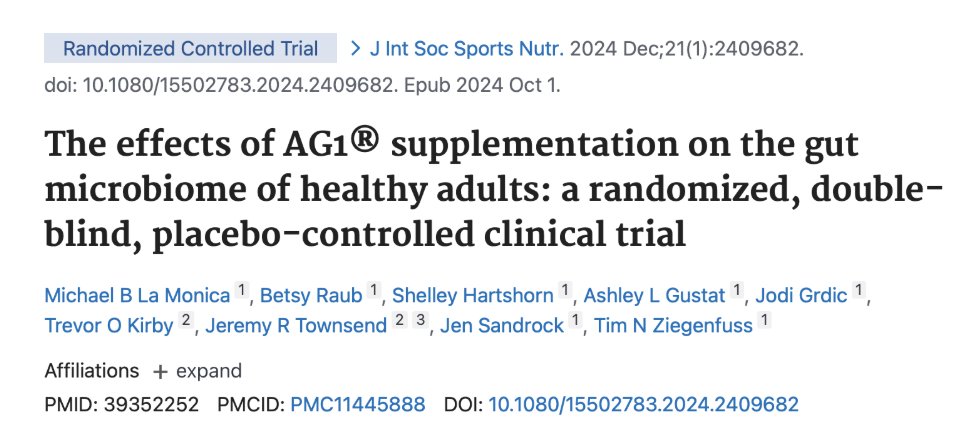
I’d cancel your AG1 subscription. They just completed a clinical trial and the results show no clinical benefit.
This has been obvious for years. AG1 has no real product substance and is fundamentally an influencer heist.
Two simple alternatives (75% and 56% less $), outperform AG1 in randomized clinical trials.
Two simple mono-ingredient alternatives that outperform AG1:
1. Chicory inulin 12 g daily ($20/mo)
2. Resistant starch 30 g daily for 12 weeks ($35/mo)
AG1 is not worth $79/mo.
AG1 study results (4-weeks, N=30):
+ No significant changes in blood biomarkers compared to placebo (CBC, CMP, lipids).
+ No statistically significant improvement in digestive quality-of-life scores (p = 0.058).
+ No significant metabolic or inflammatory biomarker benefits of any kind within the scope of what was measured in the trial.
+ Only small shifts in microbiome taxa but clinically irrelevant at this stage.
+ The intervention did not increase microbiome diversity compared to placebo. Alpha diversity was unchanged, and the taxa changes seen were only from pre- to post-analysis within each group. Between-group differences were limited, and the placebo actually showed similar or even potentially larger shifts. This means the observed changes fall within normal placebo-driven variability, not a real treatment effect. No global microbiota shifts were detected.
Chicory inulin 12 g in constipation patients
+ 12 g of chicory inulin daily for 4 weeks (compared to maltodextrin placebo)
+ Global microbiota shifts: enrichment in butyrate-producing Bifidobacterium and Anaerostipes, and depletion of the pro-inflammatory Bilophila.
+The effect was seen by comparing intervention vs placebo in a cross-over setting, a very rigorous type of clinical analysis in which each person serves as their own control, eliminating a lot of individual random noise.
+ The trial also met its primary objective by improving constipation symptoms in the targeted patient group.
Resistant starch daily 30g for 12 weeks in older adults
+ Significant increase in Bifidobacterium in both middle-aged and elderly participants, with an increase in the beneficial microbiome byproduct butyrate, and reductions in Proteobacteria (including inflammatory Escherichia–Shigella) in the elderly.
+ Resistant starch also significantly reduced blood glucose, and produced greater reductions in blood insulin and insulin resistance (HOMA-IR) in the elderly group.
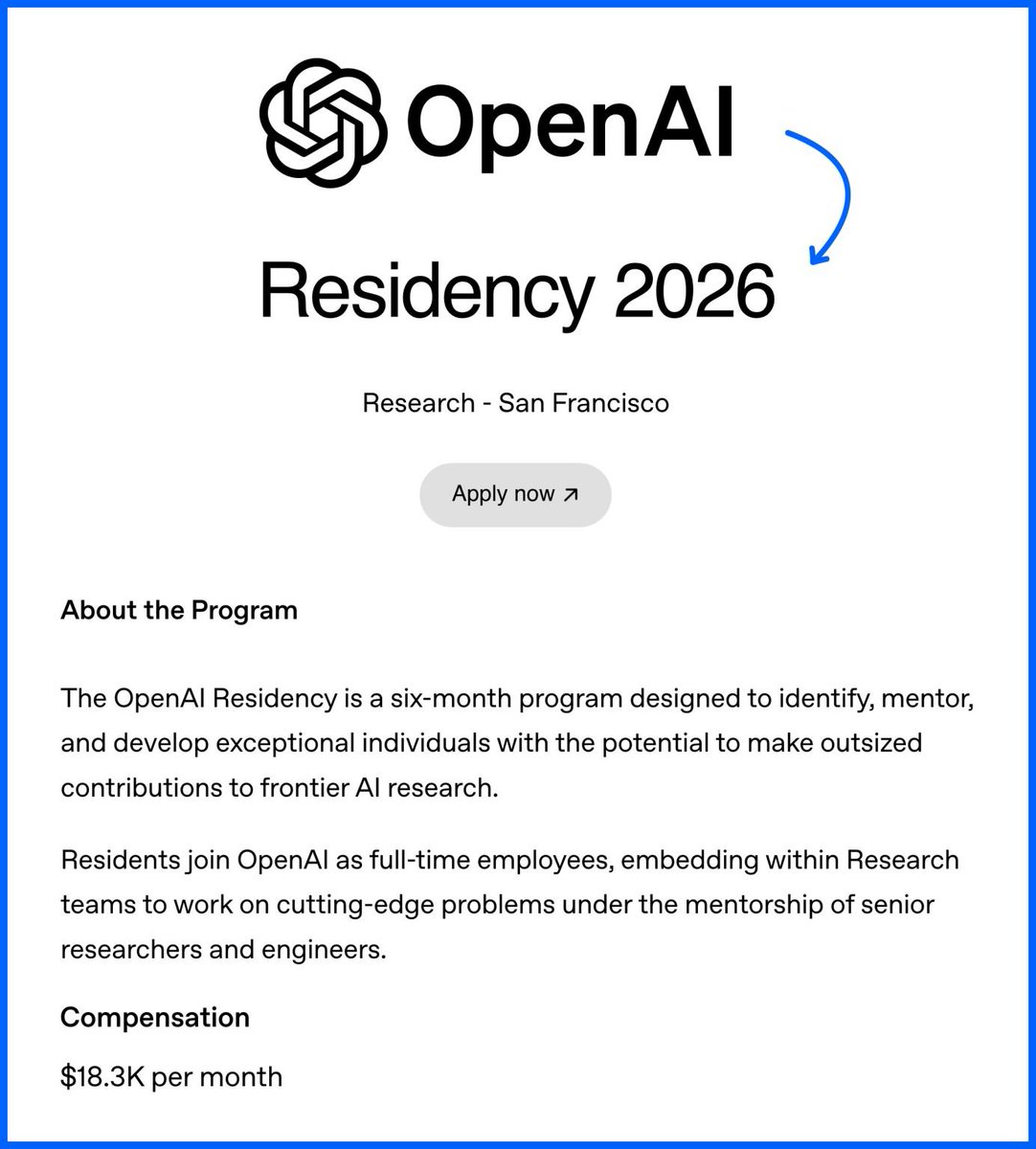
OpenAI Residency 2026 applications are OPEN btw
- 6-month full-time paid research gig in SF
- ~$220K annualized ($18.3K/month) + relocation
- NO prior ML/AI experience required, just strong technical fundamentals & fast learning
- Work on frontier AI with top researchers
Interviews starts in Jan 2026
Apply: https://t.co/cwd6zf9ap2
We are hiring a Head of Preparedness. This is a critical role at an important time; models are improving quickly and are now capable of many great things, but they are also starting to present some real challenges. The potential impact of models on mental health was something we saw a preview of in 2025; we are just now seeing models get so good at computer security they are beginning to find critical vulnerabilities.
We have a strong foundation of measuring growing capabilities, but we are entering a world where we need more nuanced understanding and measurement of how those capabilities could be abused, and how we can limit those downsides both in our products and in the world, in a way that lets us all enjoy the tremendous benefits. These questions are hard and there is little precedent; a lot of ideas that sound good have some real edge cases.
If you want to help the world figure out how to enable cybersecurity defenders with cutting edge capabilities while ensuring attackers can't use them for harm, ideally by making all systems more secure, and similarly for how we release biological capabilities and even gain confidence in the safety of running systems that can self-improve, please consider applying.
This will be a stressful job and you'll jump into the deep end pretty much immediately.
https://t.co/bnFRnDE4O7
OpenAI just released Prompt Packs for every job. Using these prompts, ChatGPT by @OpenAI can do any job like a human would:
* Engineering
* Manager
* Product Developer
* Marketing
* Artist
* Plumber
...and much more!
My cult is better than your cult. Join my cult.
Be jacked.
Feel amazing.
Look great.
Be clear-headed.
Have high energy.
Maintain a stable mood.
Be ambitious as fuck.
Six diets were evaluated for their effect on speed of aging, plant-based and health-conscious diets slow aging the most, while fast food accelerates it.
Diet defines your speed of aging, even in our early 20s. Genetics also play a big role in modulating diet’s effect on biological aging.
Published today, a report shared the results of nutritional tracking of 413 twins (n=826, aged 21-25, 58.2% females) from the famous FinnTwin study.
Based on detailed self-reporting a data-driven statistical model identified 6 nutritional patterns among participants (instead of theoretically assuming dietary patterns, a data-driven approach was used to cluster participants into patterns).
Dietary patterns identified:
1. High fast-food, low fruits and vegetables
2. Plant based
3. Health conscious
4. Western with infrequent fish
5. Western with fish
6. Balanced average of all
The effects of each the dietary patterns were compared population wise, and then within-paid analysis for 363 twin pairs (206 dizygotic, and 157 monozygotic) compared pairwise for the effect of their dietary choices and patterns on their biological age (GrimAge clock) and speed of aging (PACE clock)
Twins are a precious clinical data mine, since they make perfect genetic controls on the case of monozygotic (real) twins, dizygotic (fraternal) twins share only 50% of their genomes (similar to normal siblings) but still offer the perfect control for all early environmental exposure in the womb and normally through childhood and adolescence.
Comparing the effects in monozygotic vs dizygotic twins is a great tool to determine the genetic contribution to the phenomenon being studied.
Three statistical models were used to evaluate the data, with increasing stringency of eliminating confounding variables:
Model 1: adjusted for family relatedness, total nonalcoholic energy intake, and sex
Model 2: Model 1 + smoking status and alcohol intake
Model 3: Model 2 + BMI and the Baecke sport index
Findings:
i. The plant based diet was associated with highest reductions in the speed of aging, both on an entire population basis and in the pairwise comparisons of mono- and di-zygotic twins.
ii. All dietary patterns also reduced the speed of aging compared to the high fast food low fruits and vegetables diet.
iii. Plant-based diet association with a reduced PACE score held across all 3 models, with gradual decreases in PACE reduction 0.134, 0.109,and 0.08 for models 1,2, and respectively. This pattern held across most diets, with few exceptions.
iv. In pair-wise comparisons between twins, plant-based and health-conscious dietary patterns were associated with the highest speed of aging reductions in both monozygotic and dizygotic twins, across all three confounder adjustment models. All other patterns reduced the PACE score in twin comparisons as well, similar to the whole-cohort analysis.
v. Plant based and health-conscious patterns associated with slightly larger speed of aging (PACE score) reductions in monozygotic compared to dizygotic twins, unlike all other patterns, whose effects dwindled in monozygotic twins. This could indicate that unlike other diets plant based and health-conscious dietary patterns can reduce the speed of aging in a more genetically-independent manner than other diets.
(caveat: the study authors warned from over interpreting the results with the twin-pairs analysis due to the small number of twins with distinct dietary patterns, the plant-based group had particularly a smaller number, which might have affected the results)
The effect of the diets on biological age (GrimAge clock) was also shown in the study, general patterns were comparable, one difference was that the health-conscious pattern exceeded the plant-based in reducing biological age. We focused on the speed of aging in our analysis here due to two reasons i) the younger age of the participants, ii) the lack of a follow-up in the study.