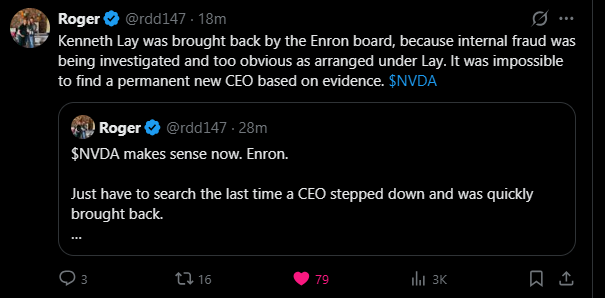
$NVDA makes sense now. Enron.
Just have to search the last time a CEO stepped down and was quickly brought back.
Kenneth Lay returned as CEO of Enron on August 14, 2001. Just 110 days later, Enron filed for bankruptcy.
His return is one of the most consequential CEO comebacks in American corporate history. However, Lay had not been fired. He had voluntarily handed the CEO position to Jeffrey Skilling six months earlier while remaining chairman.
1. Why Lay returned
Lay had led Enron since its creation in 1985, transforming a natural-gas pipeline business into a massive energy-trading company.
In February 2001, he transferred the CEO position to Jeffrey Skilling.
But on August 14, Skilling unexpectedly resigned, citing personal reasons.
Enron’s board immediately asked Lay to resume his CEO responsibilities.
In the company’s official announcement, Lay expressed confidence in Enron’s business and growth prospects.
The board that brought Kenneth back had knowledge of the fraud and found liable. They were personally sued for $13 million. Insurance covered the other $168 million.
Is the $NVDA board insured? 🧐
In July 2002, the Senate Permanent Subcommittee on Investigations concluded that Enron’s directors:
Failed to protect shareholders.
Allowed high-risk accounting practices.
Approved transactions involving conflicts of interest.
Failed to address warning signs.
Permitted extensive undisclosed off-balance-sheet activities.