Today is Dmitri Mendeleev’s birthday! He is best known for creating one of the most iconic emblems in all of modern science: the periodic table of the elements.
Born in 1834 in Siberia, Russia, Dmitri Mendeleev overcame a challenging childhood to become both a teacher and an academic chemist in St. Petersburg, publishing 400 books and articles throughout his life.
In 1860, he was invited to Karlsruhe, Germany for the first-ever international chemistry conference, which highlighted the need to standardize chemistry and had a great influence on Mendeleev’s work. Determined to find a better way to classify elements, he formulated the periodic law, which states that many properties of elements tend to recur in a systematic manner with increasing atomic number. Although not immediately accepted, his work gained international attention when elements he predicted were discovered. His diagram, known as the periodic table of elements, is widely used today and is a cornerstone of modern chemistry.
The table has grown over time, but Mendeleev’s periodic law has held true.
The public has a distorted view of science, because children are taught in school that science is a collection of firmly established truths. In fact, science is not a collection of truths. It is a continuing exploration of mysteries.
- Freeman Dyson
Einstein’s Vision for a Unified Cosmos: 100 Years Since the 1925 Presentation
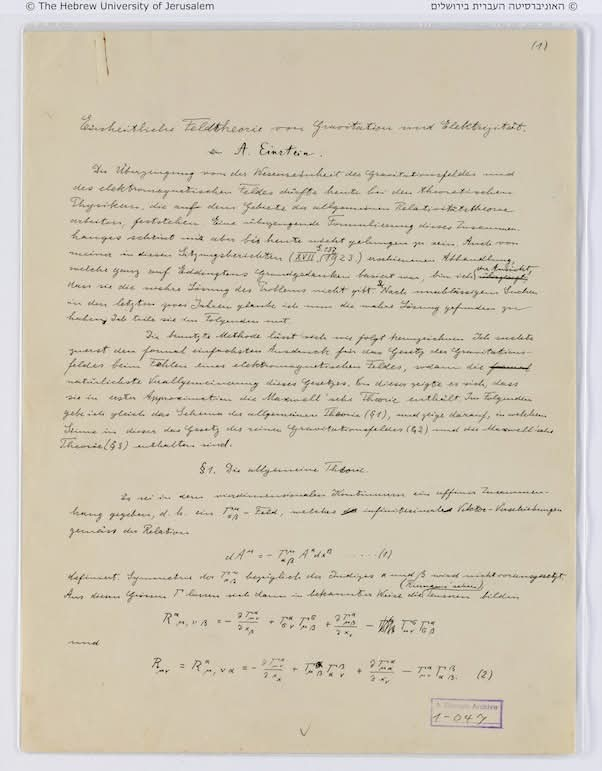
Exactly a century ago, on July 9, 1925, Albert Einstein stood before the Prussian Academy of Sciences in Berlin and presented one of the most ambitious theoretical papers of his life — the "Unified Field Theory of Gravitation and Electricity." This moment marked a critical milestone in his lifelong quest to unify the forces of nature under a single mathematical framework — a dream that would captivate and challenge him for the rest of his career.
The document he submitted — in his own careful, slanted handwriting — was not just a technical manuscript, but a bold philosophical statement. Einstein had already changed the face of physics with his General Theory of Relativity (1915), which redefined gravity as the curvature of spacetime caused by mass and energy. But he was not satisfied. While relativity explained gravitation, it stood apart from Maxwell’s equations, which described electromagnetism. Einstein believed that the true laws of nature must merge both, revealing a deeper symmetry in the universe.
In the 1925 draft, Einstein laid out early mathematical structures that attempted to weave together these two fundamental forces. Though this version of his unified field theory would eventually prove incomplete — lacking the quantum insights that were just emerging at the time — it represented a turning point: the first major step in his decades-long attempt to reconcile gravity and electromagnetism.
It is important to note that Einstein was working in relative isolation on this project, even as the rest of the physics community began to embrace the revolutionary ideas of quantum mechanics. But Einstein remained steadfast, convinced that a more elegant, deterministic order underpinned reality. His unified field theories were rarely accepted during his lifetime, but they inspired generations of physicists who later pursued similar goals in string theory, loop quantum gravity, and grand unified theories (GUTs).
Today, on its 100th anniversary, Einstein’s 1925 presentation is remembered not just for its scientific content, but for its sheer courage — an act of intellectual ambition driven by the belief that the universe is ultimately understandable. The handwritten draft remains preserved as a symbol of one man’s tireless pursuit of unity in the cosmos — an endeavor that, to this day, continues to shape the frontiers of physics.
#Einstein #theroyofrelativity #100Years
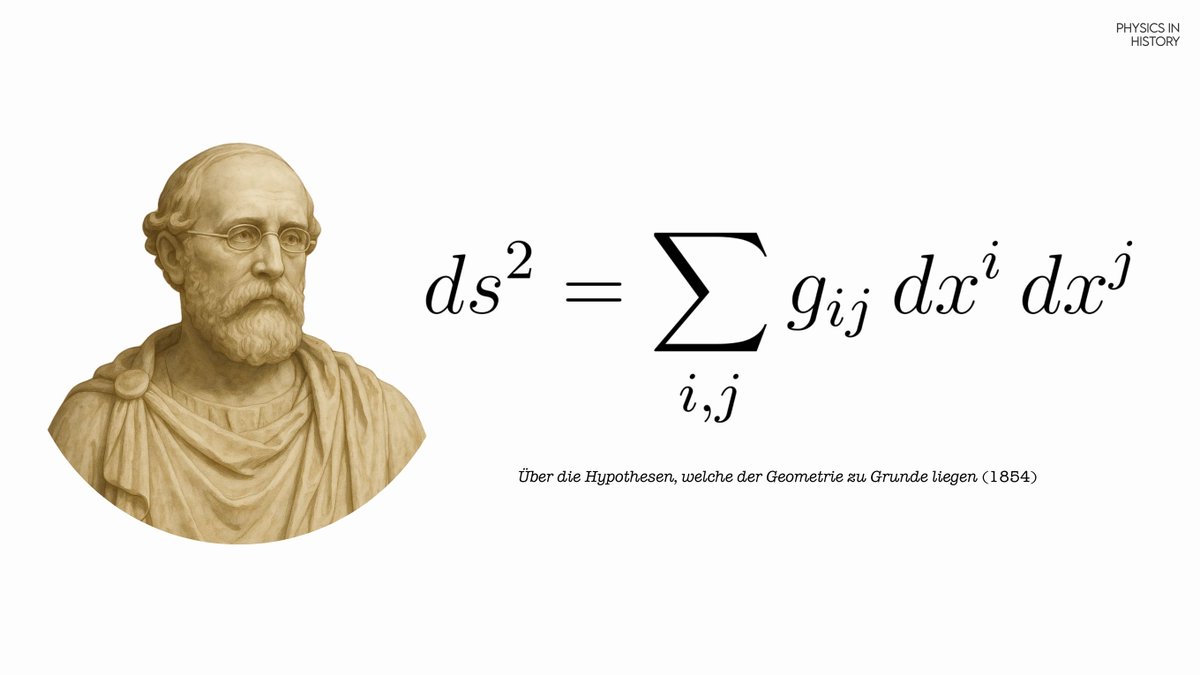
Bernhard Riemann's 1854 habilitation lecture introduced the idea of a manifold with a smoothly varying positive-definite metric tensor—well before the formal definition of tensors existed.
Maryna Viazovska, a mathematician from Kyiv, was awarded the Fields Medal in 2022—one of the most prestigious honors in mathematics—for solving the problem of sphere packing in eight-dimensional space.
Notably, before her breakthrough, the problem had only been solved in three dimensions, and that solution spanned 300 pages. Viazovska’s proof, in contrast, was just 23 pages long and stood out for its remarkable elegance.
She also holds the distinction of being only the second woman ever to receive the Fields Medal.