Four years ago, FDNY firefighter and football player Joe Herman was the subject of an ESPN story about 9/11 and memory. He died a week ago in a motorcycle accident on the Southern State Pkwy., and left behind a daughter, Lacey, who is almost two years old. The Herman family is raising money for Lacey. Here are links to the FDNY's charity and to the story itself.
https://t.co/rp1ayfo5z1
https://t.co/M6FkcmBL0k
Rick Rescorla: The Man Who Would Not Leave His Post
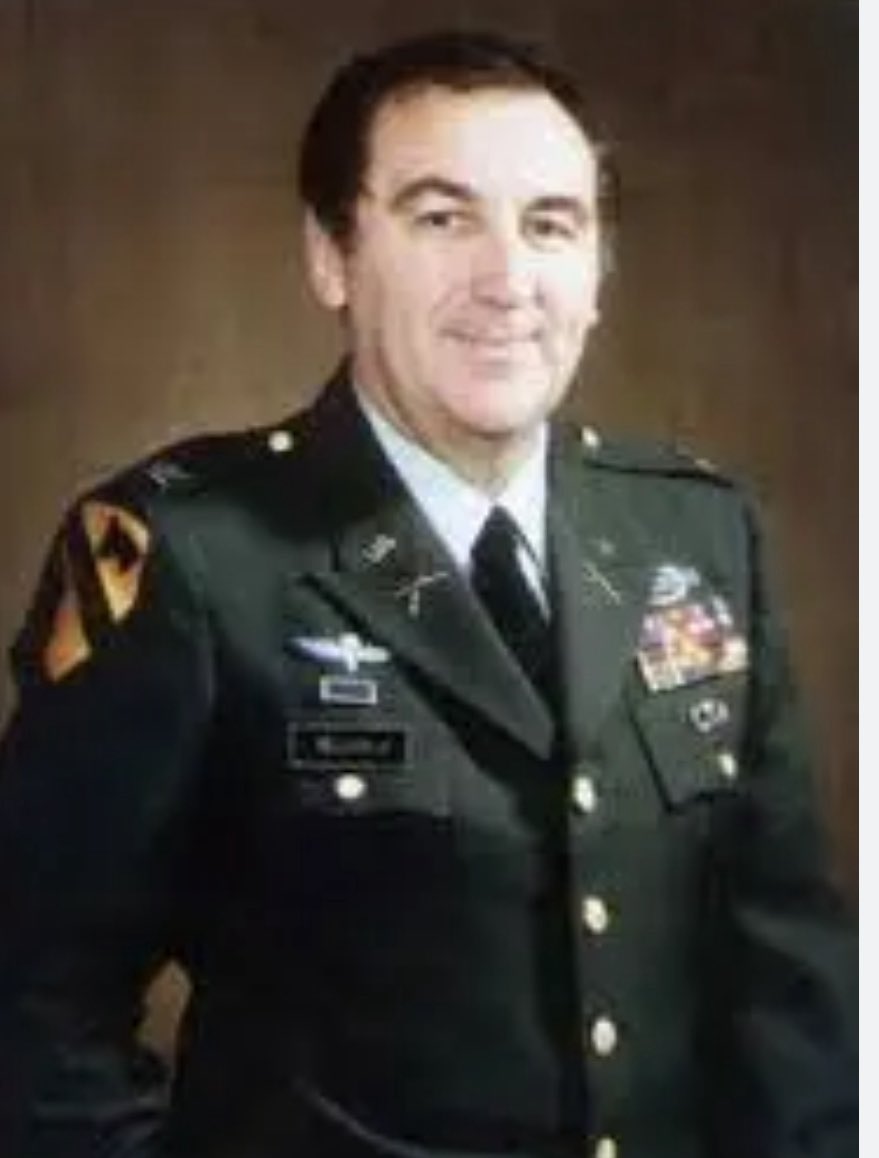
Cyril Richard “Rick” Rescorla’s life was defined by duty, courage, and a fierce determination to protect those around him. Born in 1939 in Hayle, Cornwall, England, he grew up during the Second World War, idolizing the American soldiers stationed nearby. That admiration led him to serve first in the British Army, then in the Rhodesian police, and finally across the ocean in the United States, where he joined the U.S. Army and became an officer in the 7th Cavalry Regiment, 1st Cavalry Division.
It was in Vietnam that Rescorla first proved himself a legend. At the Battle of Ia Drang in 1965, his bravery and leadership inspired his men under relentless fire. A photo of him, M-16 in hand, became one of the enduring images of that brutal fight and was later immortalized in the book We Were Soldiers Once… and Young. To his troops, he was more than a commander—he was “Hard Core,” a rock who refused to let fear break discipline.
After retiring from the military as a highly decorated officer, Rescorla built a new life in corporate security. By the 1990s he was head of security for Morgan Stanley Dean Witter, then based in New York’s World Trade Center. He took the job as seriously as combat. After the 1993 bombing of the Twin Towers, Rescorla became convinced another attack would come, this time from the air. He drilled Morgan Stanley’s thousands of employees relentlessly, forcing them down the stairwells during surprise evacuations. Some grumbled at the interruptions, but he would only say: “When the real thing happens, you’ll thank me.”
On September 11, 2001, the real thing came. After the first plane struck the North Tower, Rescorla sprang into action. Against official instructions to “stay put,” he ordered the immediate evacuation of Morgan Stanley’s offices in the South Tower. Calm but forceful, he shepherded thousands toward the exits, bullhorn in hand. To steady frightened workers, he sang old Cornish songs and military marching tunes as they descended the stairwells:
“Men of Cornwall, stand ye steady; It cannot be ever said ye for the battle were not ready…”
Because of those drills and his refusal to hesitate, nearly 2,700 Morgan Stanley employees survived that morning.
Rick Rescorla was last seen on the 10th floor, heading back up to search for stragglers after already ensuring so many had made it out. He never returned. At 62 years old, the soldier who had survived Ia Drang and a lifetime of war gave his last full measure of devotion in a burning tower.
Today, Rick Rescorla is remembered as the “man who predicted 9/11,” but more than that, he is remembered as the man who refused to abandon his duty. His foresight, discipline, and courage saved thousands of lives. His sacrifice is a reminder that true leadership is measured not by words, but by action—even when the cost is everything
In this image from the Museum's Digital Collections, taken August 25, 1944, US Army engineers are shown ferrying a truck across the Seine River near Montereau, France, while under fire.
You're a 19 year old kid.
You are critically wounded and dying in the jungle somewhere in the Central Highlands of Viet Nam .
Its November 14, 1965 . LZ (landing zone) X-ray.
Your unit is outnumbered 8-1 and the enemy fire is so intense from 100 yards away, that your CO (commanding officer) has ordered the MedEvac helicopters to stop coming in.
You're lying there, listening to the enemy machine guns and you know you're not getting out.
Your family is half way around the world, 12,000 miles away, and you'll never see them again.
As the world starts to fade in and out, you know this is the day.
Then - over the machine gun noise - you faintly hear that sound of a helicopter.
You look up to see a Huey coming in. But.. It doesn't seem real because no MedEvac markings are on it.
Captain Ed Freeman is coming in for you. He's not MedEvac so it's not his job, but he heard the radio call and decided he's flying his Huey down into the machine gun fire anyway.
Even after the MedEvacs were ordered not to come. He's coming anyway. And he drops it in and sits there in the machine gun fire, as they load 3 of you at a time on board.
Then he flies you up and out through the gunfire to the doctors and nurses and safety. And, he kept coming back!! 13 more times!!
Until all the wounded were out. No one knew until the mission was over that the Captain had been hit 4 times in the legs and left arm.
He took 29 of you and your buddies out that day. Some would not have made it without the Captain and his Huey.
Medal of Honor Recipient, Captain Ed Freeman, United States Army, died at the age of 81, in Boise, Idaho.
God bless our vets!
Sgt. Jake McNiece paints the face of Staff Sgt. Mariano Ferra moments before boarding a C-47 for the jump into Normandy. 🇺🇸
@PieceJake on the colorization 🎨
@Jason_R_Burt I’m sad to read this. I had the great pleasure of meeting and speaking with Frank a few years ago at the Armor Museum on Long Island. A very nice man. If I recall correctly, he was at La Fiere in Normandy, and was a detective after the war.