THIS IS LITERALLY THE BEST LLM EXPLAINER I'VE EVER COME ACROSS.
And it's free. Interactive. 3D. Step-by-step.
Watch a real token move through every transformer layer live:
→ Embedding
→ Layer Norm
→ Self-Attention
→ MLP
→ Transformer layers
→ Softmax
→ Output
Stop reading. Start seeing.
Link in comments.
A Japanese dev open-sourced a drop-in replacement for NumPy that runs on your GPU.
It's called CuPy. Change one line import “numpy as np” → “import cupy as cp” and the same code runs up to 100x faster on CUDA.
→ Works with existing NumPy/SciPy code
→ No rewrite. No new syntax.
→ Also supports AMD ROCm
100% Open Source.
How Dice Actually Predict Pi Perfectly!
Can you really find the value of Pi just by rolling dice? This video demonstrates a fascinating mathematical relationship between the Normal Distribution and Pi. By summing multiple dice rolls and applying the Central Limit Theorem, we can approximate a standard normal distribution. Using the expected value formula for the absolute value of X, we derive a unique method to estimate Pi. Watch as we simulate over 3,000 trials to see the live estimate converge toward the true value of 3.1416. This is a perfect example of how randomness leads to mathematical constants.
#math #pi #probability #statistics #manim
Volume of a Sphere using Spherical Coordinates
Spherical coordinates:
x = ρ sinφ cosθ
y = ρ sinφ sinθ
z = ρ cosφ
dV = ρ² sinφ dρ dφ dθ
Limits: 0 ≤ ρ ≤ R, 0 ≤ φ ≤ π, 0 ≤ θ ≤ 2π
V = ∭ dV = ∫₀^{2π} ∫₀^π ∫₀^R ρ² sinφ dρ dφ dθ
Integration steps:
> ρ first: [ρ³/3] from 0 to R → R³/3
> φ next: ∫ sinφ dφ from 0 to π = 2
> θ last: ∫ dθ from 0 to 2π = 2π
Final result: V = (4/3) π R³
This derivation is fundamental in physics, astronomy, fluid dynamics, and engineering for calculating volumes of spherical objects such as planets, droplets, cells, and particles.
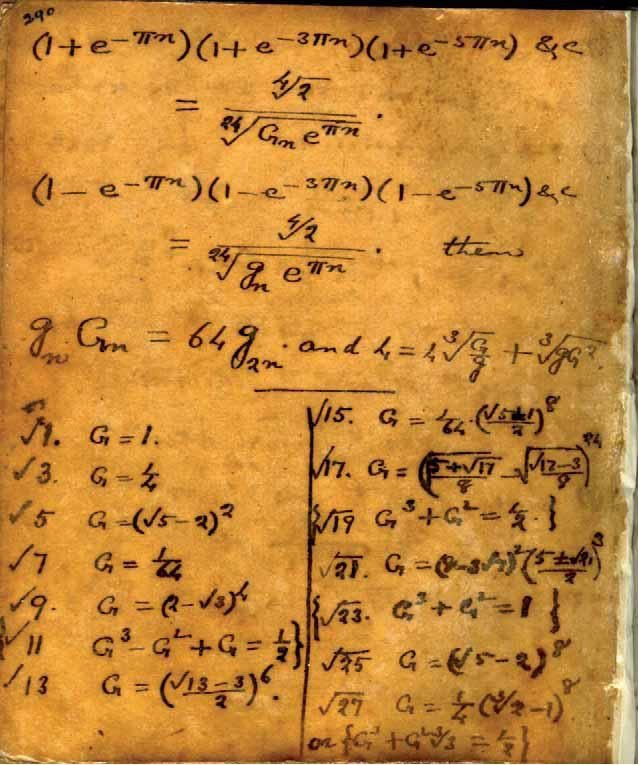
>"mathematicians don't believe in God"
>isaac newton: deeply devout christian; he spent more time on theology than on physics or mathematics.
>blaise pascal: profoundly religious (jansenist), author of the pensées.
>leonhard euler: devout christian; he wrote several defenses of the christian faith.
>carl friedrich gauss: a believer (though reserved), he viewed mathematics as “the queen of the sciences” with a divine origin.
>bernhard riemann: devout christian.
>georg cantor: strong believer; he explicitly linked his theory of infinities with god.
>srinivasa ramanujan: devout hindu; he attributed his mathematical ideas to the goddess namagiri.












![mathemetica's tweet photo. Volume of a Sphere using Spherical Coordinates
Spherical coordinates:
x = ρ sinφ cosθ
y = ρ sinφ sinθ
z = ρ cosφ
dV = ρ² sinφ dρ dφ dθ
Limits: 0 ≤ ρ ≤ R, 0 ≤ φ ≤ π, 0 ≤ θ ≤ 2π
V = ∭ dV = ∫₀^{2π} ∫₀^π ∫₀^R ρ² sinφ dρ dφ dθ
Integration steps:
> ρ first: [ρ³/3] from 0 to R → R³/3
> φ next: ∫ sinφ dφ from 0 to π = 2
> θ last: ∫ dθ from 0 to 2π = 2π
Final result: V = (4/3) π R³
This derivation is fundamental in physics, astronomy, fluid dynamics, and engineering for calculating volumes of spherical objects such as planets, droplets, cells, and particles.](https://pbs.twimg.com/media/HJbF-AfaQAAZ5uM.jpg)