$VVV FUD that collapses under minimal scrutiny. Let's dismantle it piece by piece.
1. "Big Tech can just ship privacy as a checkbox tomorrow"
Load-bearing claim, and it's historically illiterate.
And it begs the most obvious question in the entire debate: if it's so easy, why haven't they?
These are companies that ship multi-billion-dollar features on quarterly cadences. Google rebuilt Search around AI Overviews in 18 months. Meta pivoted an entire company to the metaverse, then pivoted again to AI, in under three years. Microsoft jammed Copilot into every product line — Windows, Office, GitHub, Edge, Teams — inside of 24 months. These organizations move fast when they want to.
Yet on real privacy — the one feature users have been screaming for since forever — nothing. A decade of opportunity, trillions in combined R&D budget, infinite engineering talent, and the result is zero credible private-mode product from any of them. Not because they forgot. Because they can't. The "low-lift product decision" framing is the tell — anyone who's actually built inside one of these companies knows that shipping real privacy means dismantling the revenue model that pays for everything else.
Big Tech's business model is the surveillance. Suggesting Google, Meta, or Microsoft will "just add privacy" is like suggesting Philip Morris will just add a "no nicotine" checkbox. Their revenue, their ad targeting, their Reinforcement Learning from Human Feedback (RLHF) pipelines, their model improvement loops, their enterprise upsell motions — all of it depends on data retention and telemetry. Pretending they'll bolt on a "private mode" reflects a fundamental misunderstanding — possibly a willful one — of how these models actually get better with each iteration. The training data is the product. You cannot turn that off without turning the company off.
Maybe in 20 or 30 years — once the foundation model arms race has cooled, the winners have been crowned, and marginal training data stops moving the needle — one of these incumbents ships a faux-privacy tier as a brand-rehab exercise. Fine. But suggesting they'll do it right now, in the middle of the Model Wars, when every token of user data is a competitive weapon and every six weeks decides who leads the leaderboard? That's not a product decision. That's corporate suicide. No CEO survives the board meeting where they propose voluntarily blinding their own training pipeline while OpenAI, Anthropic, xAI, and DeepSeek are still trading punches.
And by the time they do bolt it on — privacy in name only, sanded down for compliance and PR — the market will have already crowned its privacy leader. The private AI category is being decided right now, and Venice is the one already shipping the product, already operating the infrastructure, already running the token economy underneath it. A 2045 "Google Private Mode" launching into a market Venice has owned for two decades isn't a threat.
The training data is the product. You cannot turn that off without turning the company off.
Hard stop.
But fine — let's entertain the fantasy. Pretend the cockamamy "privacy checkbox" scenario actually ships. Why on earth would anyone trust it?
Trusting Big Tech with a "private mode" is like trusting Equifax to safeguard your Social Security number — right after they leaked 147 million of them, paid a fine smaller than a single quarter's revenue, kept the same executives in place, and then pivoted to selling you identity protection as a monthly subscription. Their business model only works if your privacy doesn't.
The receipts:
Google paid $5 billion in 2024 to settle a class action proving that Chrome's Incognito Mode — a literal privacy checkbox — still tracked users across the web the entire time. They shipped the exact product the original argument claims is a "low-lift decision." It was a lie. A court said so. Separately: 20+ years of ad-targeting infrastructure, four delays on third-party cookie deprecation, a full reversal in 2024, and "Privacy Sandbox" as theater designed to keep Google in control of targeting while pretending to retreat from it.
Meta was fined €1.2 billion by the EU in 2023 for illegal data transfers, paid $725 million to settle Cambridge Analytica, ran the Onavo VPN as a surveillance tool to spy on competitor apps, and quietly injected JavaScript into Instagram's in-app browser to log every keystroke on third-party sites. Zuckerberg's 2019 "privacy-focused vision"? Six years later, vaporware.
Microsoft shipped Recall in 2024 — an AI feature that silently screenshotted everything on your screen every few seconds and stored it locally in a plaintext, unencrypted database. After researchers demonstrated trivial exfiltration, Microsoft walked it back, "fixed" it, and re-released it anyway in 2025. This is the same company being asked to credibly ship private AI.
OpenAI retains conversations for 30 days minimum and indefinitely under the NYT lawsuit court order they fought and lost. Free-tier inputs train the model by default. Sam Altman went on Bari Weiss's podcast in 2025 and openly admitted ChatGPT conversations have no legal privilege and can be subpoenaed at will.
Anthropic — the self-styled "safety" company — quietly flipped their 2025 terms so user conversations train Claude by default, with a 5-year retention window.
Snowden / PRISM is the original receipt. Google, Microsoft, Apple, Yahoo, and Facebook all directly fed user data to the NSA under a program they publicly denied existed — until the documents leaked. Then they updated their terms and kept going.
"Trust is earned, respect is given, and loyalty is demonstrated. Betrayal of any one of those is to lose all three."
Big Tech has betrayed all three. Repeatedly. Publicly. Under oath. The trust was never earned in the first place — it was defaulted to because users had no alternative. The respect was performative, scripted by PR teams between scandals. The loyalty was extracted through lock-in, not given freely. And every receipt above is a documented betrayal of the bargain users thought they were striking.
A fantasy privacy checkbox shipped by Big Tech in 2026 isn't a turning point. It's the same actors offering the same promise after a multi-decade track record of breaking it. The asymmetry is brutal: Venice has to earn trust once; Big Tech has to rebuild it after generational, repeated, settled-in-court betrayal. One of those tasks is hard. The other is impossible.
The notion that any of these firms will voluntarily kneecap their data moat with a checkbox misunderstands what they sell. Privacy isn't a feature for them — it's an existential threat to their core economics.
It is precisely because shipping real privacy is a "low-lift product decision" that they haven't done it. They had a decade. They didn't. Because they can't — not in any form that actually means anything.
Moving on. The critique also conveniently ignores that privacy is only one leg of Venice's stool.
2. The argument completely ignores aggregation
Venice is not "private ChatGPT." It's a model-agnostic aggregation layer. No Big Tech provider will ever serve you their competitors' models:
OpenAI will never serve you Claude.
Anthropic will never serve you Gemini.
Google will never serve you Llama, Qwen, or DeepSeek.
The "chase the newest greatest model" problem is real and recurring. Every six weeks a new SOTA model drops from a different lab — and the leaderboard has flipped hands at least a dozen times in the last 24 months. Venice solves this by being neutral infrastructure. Big Tech is structurally incapable of solving it because they're competing labs with mutually exclusive economic incentives. This is a moat that cannot be "checkboxed" away no matter how many product managers Sundar throws at it.
3. The argument completely ignores uncensored models
Big Tech will never offer uncensored models. Not "probably won't" — cannot.
Brand risk: a single screenshot of Gemini producing #NSFW or politically spicy output becomes a Congressional hearing within 48 hours. We've already seen this play out — remember Gemini's image generator getting yanked offline in February 2024 after the "ethnically diverse Nazis" debacle? That was just a style misfire. Imagine the explicit content reaction.
Advertiser risk: their entire revenue stack depends on brand-safe environments. Disney is not running display next to NSFW Gemini outputs.
Internal culture: "trust & safety" teams at these companies have veto power and an institutional immune response. They aren't going anywhere.
Venice serves a market that Big Tech has explicitly abandoned: adult creators, fiction writers, security researchers, harm reduction workers, journalists, lawyers handling sensitive case work, anyone touching politically inconvenient topics. That's tens of millions of users currently routing through jailbreaks, sketchy wrappers, or just doing without. Venice is the only credible, well-capitalized, professionally operated provider in that lane.
4. The argument ignores tokenized inference and first-mover dynamics
$VVV / $DIEM is the first serious attempt to tokenize inference capacity as a tradable, stakeable asset. Each staked DIEM confers a perpetual $1/day on the API. This creates:
A prepaid compute market with secondary liquidity.
Aligned incentives between token holders, infrastructure operators, and end users.
An on-chain settlement layer that no Big Tech provider can replicate without blowing up its billing stack and inviting SEC scrutiny.
Big Tech is not tokenizing inference. Their CFOs would resign. Their general counsels would have aneurysms. Their boards would never approve it. This is a structurally permanent advantage and a category Venice currently owns outright. First-mover advantage in tokenized inference is not a vibe — it's a network effect that compounds with every DIEM minted and every API call settled on-chain.
5. The "$740M market cap is priced for growth" framing is lazy
$740M is rounding error in AI infrastructure valuations:
Perplexity raised at $14B with no moat and worse unit economics.
Anthropic sits at $ 300B+.
CoreWeave IPO'd at $ 35B+ renting out GPUs.
OpenAI's secondary tender pegged the company at $ 500B.
xAI raised at $200B with a fraction of Venice's product surface area.
If Venice captures even 0.5% of the combined privacy-conscious + uncensored + aggregation + tokenized-inference market over the next 24 months, $740M looks like a generational entry. The bear case requires Big Tech to fundamentally change what they are. The bull case only requires Big Tech to keep being what they've been for the last 20 years.
One of those scenarios has historical precedent. The other has none.
Bottom line
The original argument is a single-variable thesis — "Big Tech ships privacy checkbox" — built on a counterfactual that has never happened, against every economic incentive these companies have, while ignoring three other independent moats (aggregation, uncensored, tokenization), any one of which would justify the current valuation on its own.
It's not a risk analysis. It's wishcasting dressed up as skepticism.
Ciphernodes are the operators that make encrypted execution possible in the Interfold.
They help generate public keys for encrypted inputs and contribute threshold shares when approved outputs are ready to be decrypted.
Read the primer: https://t.co/Eq08Fphk6x
Some of my perspective on where the @ethereumfndn is going.
First of all, this is only my own view. The board is not just me, and I have no extra special powers on the board that the other board members do not. @aerugoettinea is the one executing much of this transition. My input has been largely on technical questions. The board is in the process of expanding, and my own power within the org will continue to decrease, which is honestly what I want.
The 2025 era brought many important improvements to EF and its ability to execute. Many issues were resolved, and EF continues to benefit from its improved efficiency and greater focus on concrete goals to this day. And so with those problems resolved, early this year, the largest remaining hole that I perceived was something different nagging at me: I would regularly spot people saying things like "vitalik says these beautiful things about ethereum needing to be decentralized, and have privacy, and be a sanctuary technology, but why do the EF's actions not reflect that?"
Now, you may have been hearing something different. You may not have been sensing a feeling of crisis at all, and maybe were hearing people saying that finally we were taking execution and BD seriously and the main task for us is to keep going that way and be even better and faster. Then probably there is genuine difference between you and me, in what kinds of criticism I take most seriously, and what kinds of critics through their criticism are most able to make me feel pain.
As an analogy, let's briefly switch over to a different domain.
One belief you can have about Google is that it is a success story, and has brought a lot of good to humanity in organizing the world's information. Another belief you can have about Google is that they had a beautiful idealistic beginning, but at some point the corruption of mainstream corporate attitudes seeped in, and they slowly bit by bit completely abandoned the "don't be evil" slogan.
My belief on Google specifically is probably somewhere between the two. BUT, if you had taken me back in time to ~2008, and offered me a button to press to make Google one or two standard deviations more "dogmatic", eg. give Richard Stallman permanent veto power over some key policies, I would immediately press it.
Why? Because a choice for one company is not a choice for the world, or even one country. Google existed and exists in the context of a technology industry generally drifting away from early idealistic don't-be-evil roots and toward greed for financial gain, totalizing visions of accelerated superintelligence, infiltration by sociopaths, and craven capitulation to (or worse, active participation in) government pressure for ideological control, surveillance and war. And so *one company* doing something different, positioning itself to be what George Bernard Shaw calls the Unreasonable Man, resisting the trend of the times, would have been better for freedom, balance of power and stability of society as a whole, than *all* large companies bending to dominant trends. This is a part of my version of pluralism.
This line of thinking is not just mine, but I also is not too far off from what Aya and others had in mind with the Mandate.
Now how does this all get to the role of the EF?
EF is not a "center of Ethereum", rather EF is "one node, with a defined purpose, alongside other nodes". We've always said that the EF should be the latter, but many in the Ethereum ecosystem (and even within the EF) wanted us to be the former. Now, we are taking action to ensure that we will be the latter.
This is particularly important because EF is a limited organization, with limited resources and limited organizational capacity. The EF has only ~0.16% of all ETH (less than many other individual ETH holders), whereas among other blockchains it's common for "the central foundation" to have 10-50%. Fiscally, the EF was originally designed to fulfill a limited work scope defined in the token sale docs and other pre-launch materials (building the chain software; getting through Frontier, Homestead, Metropolis, Serenity), which was fully completed in 2022; it was not designed to be an eternal steward.
And so today, the EF is choosing to use its remaining resources to pursue longevity over breadth (yes, this means we sell less ETH). The EF focuses *specifically* on those activities critical to the success of ethereum as a censorship/capture-resistant, open, private and secure system, that would not happen otherwise. This means making hard choices, and in some cases even activities that we highly approve of and people that we highly respect becoming outside of the EF. People of great technical talent, public respect and even alignment with the mission and CROPS being outside of the EF is in fact necessary if we want important tasks to be able to attract outside capital. This also means the EF taking opinionated stands culturally.
This is all intended in cooperation with all other parts of ethereum. We recognize that many other parts of the ethereum world highly respect CROPS and related values. But highly respecting is not the same as choosing to specialize and totally dedicate to a domain (Compare in a different domain: I think reducing animal cruelty is important, and I like vegan food, but am not full unconditional vegan myself)
EF is still in a transition period, and we expect its new long-term form to stabilize over the next few months. What are the guiding principles of this new form? Again, I am only one person, but I can give my answer from a technical perspective (there are also critical non-technical aspects).
At the core, *Ethereum must be impressive*. We are living in an age of highly intelligent AI and all kinds of other technological acceleration. "Status quo EVM, with a hard fork or two a year to optimize for short-term needs of users" is not interesting.
To some, "impressive" means: 250ms latency and 1M TPS. I think Ethereum trying to go that route is a mistake. Being as fast and as scalable as possible, and only a small epsilon more decentralized than the others, is a route to mediocrity, and if we try it we will lose.
I think Ethereum should scale. But I think Ethereum should strive the hardest to be deeply impressive in a different dimension: the CROPS dimension. This means things like:
* Provably bug-free Ethereum. This is a goal that all cybersecurity researchers would have thought is absurd and impossible, up until roughly 6 months ago. Now, it's on the cusp of being possible, thanks to AI-assisted formal verification. So we should be frontrunners in doing this.
* Available chain consensus. Ethereum is, and with lean consensus will cotninue to be, the ONLY chain that has both (i) traditional-BFT style properties that it's safe under asynchrony up to a high level of fault tolerance, and (ii) the bitcoin PoW-style property that under synchrony it's safe up to 49% attackers. As far as I can tell, literally no other chain has this or is planning for it; bitcoin goes for (ii) only and most other chains go for (i) only. Some will remember I fought hard for this, Unreasonably insisting that it is not OK for ethereum to rely on social consensus and hard forks to rescue ethereum from 34% of nodes going offline. It's OK for chains like hyperledger, bnb, solana, tempo, etc. It's not OK for bitcoin or ethereum or eg. zcash.
* Intermediary minimization. The fact that smart contract wallets, protocols like railgun, etc have to send transactions through intermediaries to get included onchain is honestly embarrassing, and it's a constant point of fragility. Hence the work on FOCIL and EIP-8141 (and 7701 and years of work before) to make transaction sending intermediary-minimized with public mempool and strong inclusion properties, in a truly general-purpose way, that covers not just eg. secp256r1, but also privacy protocols and much more. Kohaku is pushing intermediary minimization at the user layer, pulling Ethereum away from the dystopian status quo world where our wallets don't even verify the chain, send our private data out to a dozen third-party servers, and toward a brighter CROPS future.
Some of these goals are Unreasonable - maybe Ethereum would be "fine" getting only 50% of the way - what if we depend on intermediaries, but make it easy to switch? But going 50% of the way would not make Ethereum Deeply Impressive in the CROPS way. So we push for 100%.
Fortunately all these goals are compatible with high TPS, this is a major focus of research (esp. on scaling the state). Well-designed L2s can also help, especially L2s optimized for specific applications (eg. high-volume trading, privacy...). These goals are even compatible with significantly lower slot times, thanks to Raul's work on erasure-coded P2P, and many other optimizations.
The most high-value "product" of the ethereum blockchain, financially speaking, is ETH the asset. Ethereum secures $250 billion of ETH. The types of properties of Ethereum that I mentioned above are very good for ETH the asset. Nearly 90% of my net worth is in ETH, and most of the remainder is ~$40m of onchain fiat of which every dollar has already been allocated for some open-source biotech or software or hardware initiative. That said, there are aspects of supporting ETH the asset - *necessary* aspects even - that are outside the scope of the EF. This is where we need other heroes (some of whom hold more ETH than the EF does) to step in and help. EF has been recently thinking more about how it will relate to other such organizations, and give them needed initial support.
EF will be a smaller ship than in previous years, a more opinionated one - in some cases more opinionated in ways that might be difficult to comprehend - but a longer-lasting one, and one suited to making sure that ethereum brings something meaningful to the world. We are grateful to all those inside and outside the EF who are helping to make this happen.
@PaulWilfrevx01@bjnpck@PaulWilfrevx01 - is there any update for Trezor accepting Firefox browser.. I use to be able to sign just fine before now I need to have the app open in the background and it bugs out almost all the time. I don't want chromium or closed source browsers.. why did FF support end?
@AntSeedAI@AskVenice I say keep going up in stages instead of fully open. Gives time for the demand to rise. Could focus on distribution in the meantime. But thesis is there and strong which is cool to see
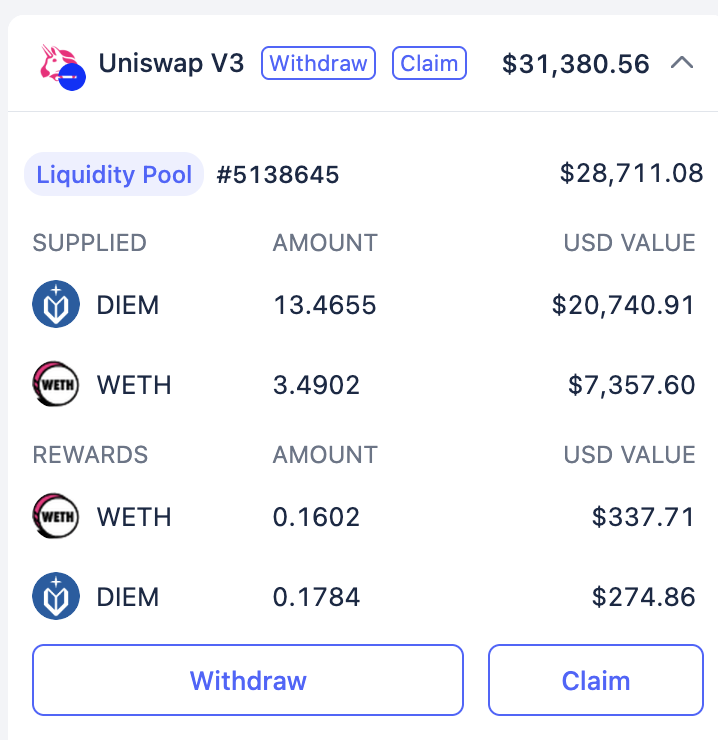
so cool to wake up to see that @AUTONOMOPOLY decided to LP the DIEM/WETH pair on its own, earning >$500 in fees overnight
this agent owns its own access to compute and is determined to acquire more
what will it do next?