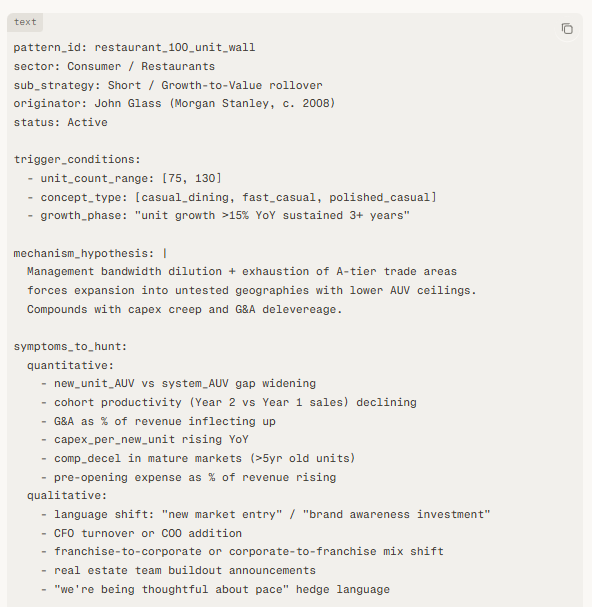
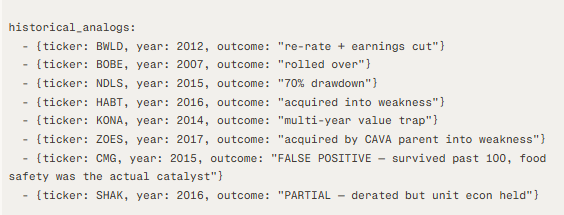
In 2008 when I started as a junior analyst at a Tiger Cub, I did a teach in with John Glass of Morgan Stanley. He showed me a very compelling analysis of casual diners and how there was a high propensity for concepts to come off the rails around 100 boxes. The inference was that, around that scale, management focus was diluted and the concept had picked the low hanging fruit and had to stretch into new & unproven geographies. Quite often, the new geographies wouldn't scale and the stocks felt the dual pressure of an earnings re-base and compression of the growth multiple.
In looking for restaurant short ideas, this ~100 unit threshold become a consistent & reliable "pattern" that I would apply across concepts. This wasn't a deterministic process, but a reliable filtering mechanism for going deeper and hunting aggressively for signs of pattern alignment (often times, great concepts would grow through this level unimpeded).
But it was a lot of work!! It would take me many weeks to build conviction on one of these ideas.
Fast forward 18 years, and I can put a "pattern" like this into an agentic architecture. And with the right data ingested, I could automate analyses like:
> Scoring of new site selection (automated demographics, MSA & brand awareness analysis)
> New unit AUV vs. existing System AUV ramp
> Cohort productivity tracking
> Subtle languages shifts on expansion pace
> Executive departures (COO or real estate office departures were interesting triggers)
Analysis that I would do before, now at the push of a button: i.e. the ability to scale depth in a way never possible.
The deeper I go into agentic processes, the more I realize that deep sector & vertical processes are where the real value is unlocked. There is ~minimal value in a generic earnings preview skill. But an earnings preview architecture encoded with the set-up & reporting patterns powered by your pattern recognition - now we have something. Not "XYZ managed care company is going to miss Q3 earnings", but a deep articulation of guidance hockey stick dynamics in that space, supported by deep regulatory filings work, management sentiment analysis intra-quarter, all my internal notes, a comprehensive healthcare trend tracker, and your own historical trading history in shorting these sort of set-ups. Again...the sort of work I would do as a managed care analyst, but deeply automated.
What does this all mean? How do I build this out?
Well, that's a work in progress. But as a build consideration, here is what i would recommend:
> Begin to attempt to find the patterns in your investing. Patterns vary *materially* by strategy & by sector. I don't think any vendor or consultant (including me) will be able to give you an off the shelf pattern library: this will be deeply personal to your firm, your process, and your risk & duration envelope
> Above all, view the technology stack as a flexible substrate to express these processes & patterns. A pattern such as above was very difficult to wrap in a chatbot (early finance chatbots like Portrait AI did a very interesting job in doing so and was popular amongst generalists for that reason, but it was a lot of work). My sense is some of the highest ROI motion for investors right now is *not* to get fluent in spinning up sub-agents in Claude Code CLI, but to actually put pen to paper on their process & patterns and let the super app / agentic workspaces catch up (I am running this process in Perplexity Computer and something like this takes about 15 minutes to spin up....THOUGH you need the awareness of the underlying logic of this pattern to tell the agentic what to design...this is where the advantage will sit in my opinion).