This represents 12.5% of candidates on the ballot.
In 2021, 21.1% of candidates were women.
One out of fourteen (14) candidates running for president is a woman.
End democratic authoritarianism!!!
#InclusiveElections#EndVAWE#NoBarriers#HerTimeIsNow
Women's representation in Zambia's 2026 elections has recorded a further decline for a second election in a row, according to numbers crunched by the NGOCC.
In Councillor elections at ward level, of 5666 candidates, 433 are women against 4666 men.
This represents a decline to 8.5% from 9.9% or 566 candidates in 2021.
Just 48 women are standing for mayor against 391 men, representing a drop from 14.7% to 10.9% in the previous elections.
At Parliament, 122 women are running against 973 men.
Until we find the courage to stand against oppression, the shackles of injustice may persist. Freedom is a hard-won treasure, not bestowed freely but earned through the currency of resilience and sacrifice. Every stride for freedom and justice, begins with the choices we make ✊
At independence 59 years ago, Zambia had zero women in its Cabinet. Today, with 50.5% of the population being female and women exceeding men by 400,000, it has just 3.
FAIR means removing all inequities that leave the majority behind.
Happy 59th birthday!🇿🇲
“African elections face a growing reliance on costly technology, which has its share of challenges. While technology promises efficiency, it often leads to opaque processes, distrust, and significant cost increases. Instead of relying on expensive foreign imports, Africa should invest in developing its own solutions and prioritize cost-effective, reliable methods to ensure democratic processes that work for the continent”, says election expert, @ckaheru .
#MonitorUpdates
All members of civil society who were arrested should be immediately and unconditionally released, and all property confiscated by the police should be immediately returned. https://t.co/6S6fSI4M5D
Africa is hosting tonnes of elections in 2023/2024. #Zambia is on the #SADC#Elections observation mission in #ZimbabweElections2023. To guarantee inclusive and disability-accessible elections, missions must also assess whether deliberate space was made for women and PWDs. #Malo
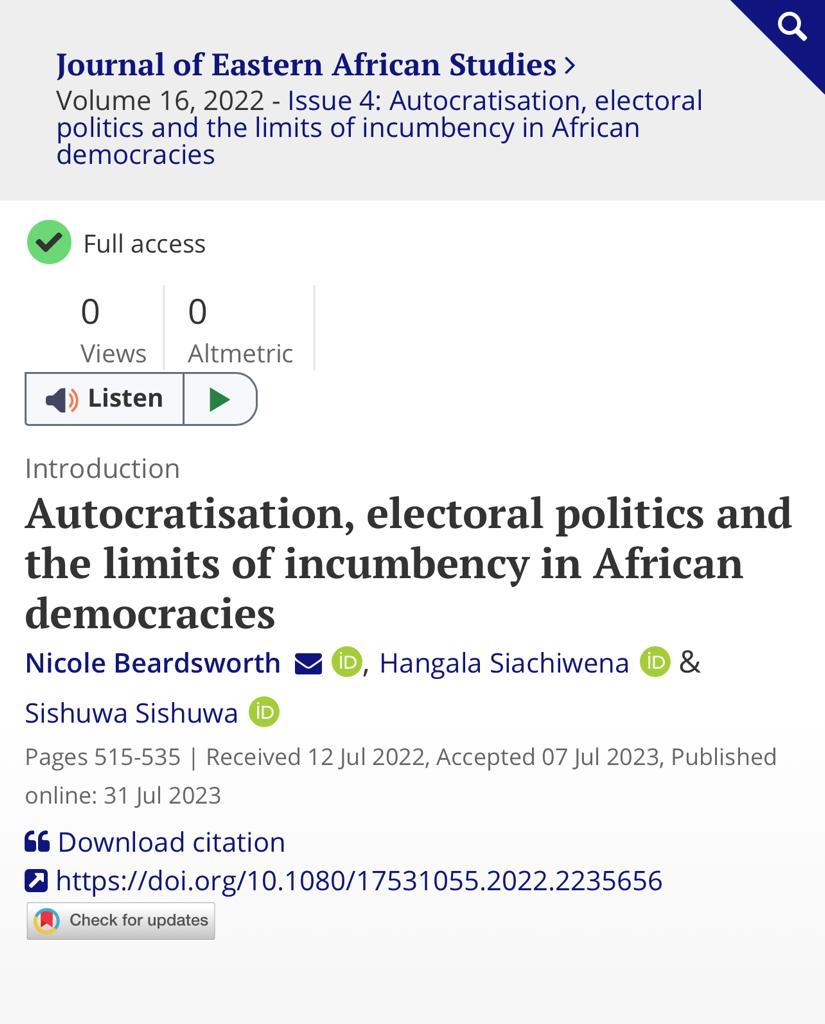
Why are sitting presidents in Africa’s multiparty democracies losing elections more frequently than before? In this newly published article, @NixiiB, @HSiachiwena and I provide answers.
The article is free-to-read.
https://t.co/RyLlIXyb7t
Why did President Edgar Lungu lose Zambia’s 2021 election? And what explains the victory of the main opposition candidate Hakainde Hichilema? My latest article, published in @JEASjournal, provides the answers.
The article uses a longitudinal comparative perspective to analyse the 2021 transfer of power. It takes the previous elections since the transition to multi-party democracy in 1991 as a body in which patterns of incumbency failure can be seen. The article then identifies five pervasive patterns that seem present in all polls that have resulted in leadership change or turnovers: a struggling economy with a clear blame orientation, a unified opposition, a depoliticised military, a rather impartial electoral commission, and collective memory of incumbent defeat. The importance of each of these factors varies over time, but collectively they shape election outcomes in decisive ways.
I then apply these five variables to the 2021 election that resulted in the defeat of the incumbent President and the victory of the opposition candidate. I argue that the repeated failure of incumbency advantage in Zambia reflects the institutionalisation of democratic processes, notably embodied in competitive elections, an increasingly independent electoral commission, effective opposition parties that can devise robust campaign strategies, and a military that continues to choose non- intervention whenever an incumbent is defeated. More broadly, I demonstrate why alternation is becoming routine while the power of incumbency is in decline.
The article draws from in-depth interviews with the key actors who were centrally involved in the 2021 election and additional ad hoc discussions with ordinary citizens, voters, and employees. These included interviews with political, military, and electoral officials, the defeated incumbent Lungu, as well as former presidents of #Zambia (Rupiah Banda), Tanzania (Jakaya Kikwete) and Sierra Leone (Bai Koroma) who helped manage the transition. The interviews are supplemented with contemporary newspaper articles from the Zambian press. Although Hichilema, now President of Zambia, was unavailable for interviews, I was able to draw upon his pre-election speeches.
The first 50 downloads are free:
https://t.co/0NDRVjvnqb