(me): so we bundle instructions and data together into “cache lines” to improve efficiency
(medieval peasant): wouldst thou not fear false idols when fetching from yon predictive oracle?
(me): well, yeah. that’s why we invented “speculative execution”
(peasant, trembling): and when this prophecy fails?
(me): then we must perform “branch misprediction recovery,” restoring the righteous state
(peasant, grimly): truly, thou art plagued by thy hubris, courting divine retribution with each cycle
(Me): so, we create this "virtual memory" to trick processes into thinking they have a contiguous address layout
(Medieval peasant): Would not thy abstraction swell the tally of mem'ry lookups?
(Me): well, yes. to deal with that we created the "translation lookaside buffer"
‼️ Oh No! This is even bigger.
🇪🇸 A threat actor is claiming possession of 19 million biometric photos and identity documents belonging to Spanish citizens.
* Forum post advertises a massive collection of biometric images and ID card data
* Alleged dataset includes identity documents and facial photographs at significant scale
* Samples and contact information were provided to attract potential buyers
Analyst Note:
Unlike passwords or payment cards, biometric data cannot simply be changed after exposure. If authentic, a leak of this magnitude could create long-term risks including identity fraud, synthetic identity creation, document forgery, and abuse of facial recognition systems. Biometric breaches are among the most damaging forms of data exposure due to their permanence.
#DDW #Intelligence #DarkWeb #Spain
Let me trace the timeline here because nobody's connecting it.
Step 1: Scrape the entire internet. Every book, every article, every conversation, every piece of art, every forum post. Do it without asking. Do it without paying.
Step 2: Train a model on all of it. Call it "artificial intelligence."
Step 3: Go to BlackRock's Infrastructure Summit and announce: "We see a future where intelligence is a utility, like electricity or water, and people buy it from us on a meter."
Step 3 is where you sell people's own knowledge back to them. On a meter.
They took the collective output of human thought, compressed it into a model, and now they want to charge you by the token to access a version of what you and everyone you know already created.
One Reddit user put it perfectly: "They stole all this data from us, the people, our life's work, creativity, art, by devouring the internet and blowing through all copyright laws. Now they want to sell it back to us in the form of a utility."
Imagine if someone photocopied every book in the public library, burned the library down, and then opened a subscription service for the copies.
That's the metered intelligence business model.
And they're pitching it to infrastructure investors as though they invented water.
@lalgorisme Però si això ja ho fan sense la IA. Les grans “tecnològiques” són les més innovadores a nivell de trobar els buits legals fiscals a nivell mundial.
Because I get asked a lot.
Why we must fight Palantir, in brief.
1. Programmers working on the Internet have a moral responsibility to the entire world, not a single country. The Internet has been designed since its inception as a universal system for the sharing of knowledge without censorship. The Internet is not the property of any one government or nation.
2. The Internet enables mass surveillance at a scale unimaginable to the Gestapo and the Cheka. Far too many programmers have wasted their lives at building surveillance systems under the guise of Web advertising. Today, these web tracking systems are being used to monitor, control, and even kill humans by companies like Palantir that seek to combine state violence with corporate efficiency, and thus create a new form of technofascism.
3. Surveillance justified by external national security threats will be turned against citizens inside the nation-state. Mass surveillance was once the exclusive domain of the NSA, but today it has been privatized to corporations like Palantir that are unaccountable to any democratic process. What begins as fear of external foreign nation-states turns inwards to focus on immigrants, dissidents, and eventually to anyone that might challenge the status quo or try to exit an increasingly dysfunctional society.
4. Everyone is a target. The “enemy within” continually expands until it encompasses the entire population of a nation regardless of their status and beliefs, justifying evermore paranoid and totalizing surveillance. The line between policing and military operations blurs, with legal frameworks being replaced by technological violence operating with total impunity.
5. Surveillance can only be defeated by building software and hardware to defend ourselves. Meek calls for regulation or moralizing demands for human rights are useless in this era. Any rights must be enforced by the hard power of code. Code, not laws, can be used to uphold the right to privacy by making surveillance difficult, if not impossible, even by nation-state adversaries.
6. We are ruled by a senile gerontocracy. Unlike the generations that fought in the world wars, most of our current rulers are degenerate pedophiles who would sacrifice the well-being of the youth and the entire planet due to their infantile desire for wealth and power. Technology of surveillance and automated warfare reflects their increasingly desperate attempts to maintain archaic forms of domination.
7. The American Empire is unraveling. Once, the United States of America presided over a globe where it could enforce its rule via the status of the dollar as a global reserve currency and a network of equally global military bases, but new regional powers now directly challenge the United States as its empire dissolves in the face of internal economic stagnation, political corruption, and the inflation of the dollar.
8. In a real war, fantasies of total technological dominance always backfire. When a faceless drone kills a child’s father, that child will one day take revenge regardless of the cost, something forgotten by those raised in comfortable suburbs. Going beyond zero-sum games, one can only truly win a battle against a people by demonstrating your victory provides a better way of life, increased prosperity, and an inspiring philosophy.
9. Oddly enough, proponents of fully automated warfare support a universal draft. Deep-down, these keyboard warriors know that their technofascist fantasies are a paper tiger when up against determined opponents that engage in asymmetric warfare. They also know none of their children will fight in a war for their state but they would be happy to see other people’s children come home in body-bags.
10. The problem is not whether AI weapons will be built; we must hold responsible those who are building them. No matter which country is deploying automated killing machines, no one is absolved from the murder of civilians and the destruction of infrastructure due to the parlour-trick of shifting the blame to AI.
11. Atomic war is on the horizon. As various states descend into wars over increasingly scarce natural resources, the possibility of tactical nuclear strikes over Teheran, Kyiv, and other areas of conflict has returned to the historical stage. Increasingly geriatric and authoritarian rulers face less guardrails than before to deploying nuclear weapons, and may even be willing to sacrifice the survival of humanity to appease their own petty egos.
12. Our goal is a world of peace where every person can be empowered by the Internet. Modern war is the quintessential game of sending young people to the meat-grinder. Why die for the profit of corrupt rulers when one could build real wealth and power for yourself using the Internet?
13. We should fight for the world we want, and build the tools needed by future generations. Pacifism would be suicidal in this period of global turbulence and resource wars, but real hard power lies in technology: Programmers should be creating technologies to live a free life and prosper in a hostile society of surveillance and control, and decentralization is the only way these technologies will survive against the inevitable repression.
14. The State will not help us. The state is a dying pre-Internet institution that increasingly resembles nothing but a Ponzi scheme fueled by taxes and debt. None of the youth alive today will likely inherit any benefits, such as welfare and health care.
15. Centralized and opaque algorithms are a danger to free speech. Propaganda is the flip-side of surveillance, as continual propaganda prevents anyone from even thinking of challenging the system. Social media monopolies promote propaganda to create a generalized idiocy while silencing those that would dare to criticize the reigning order before they can organize against it.
16. Building new forms of social organization with each other is vital to survival. The traditional mediascape of politics and entertainment exists to distract us from building networked solidarity and distributed autonomous organizations across borders. The hierarchical state is as relevant to us as the medieval church and kings were to the formation of the joint-stock corporation and the labour union.
17. Digital identity is the next step in their system of control. Within the next few years, access to the Internet–including in Europe and the United States–will require biometric national identity cards, using the flimsy excuse of “protecting children.” The real goal is to gatekeep free access to subversive political content and halt cross-border communication in order to prevent new forms of self-organization and resistance from emerging.
18. Only when one can be anonymous is one truly free. The freedom to express oneself without censorship and surveillance is a vital precondition for both the autonomous use of reason and the democratic evolution of society. Technology must enable the freedom to selectively reveal ourselves to the world–so that we can become who we want to be–by preserving the right to privacy over the Internet, including not just individual privacy but the right to transact and form contracts privately.
19. America created the first global surveillance state, but it will not be the last. Too many have forgotten or perhaps taken for granted the revelations of Wikileaks and Snowden. States across the world from China to Russia are creating even more powerful global surveillance systems and propaganda machines. Leveraging private defense contracts in countries across the world, Palantir seeks to make itself the operating system of a cross-border global secret state while it pushes its own farcical version of ethno-nationalism.
20. Culture wars are a psyop. It is ironic that “Epstein class” virtue-signals about traditional morality and the superiority of forms of ethno-nationalism, while trying to return to the rule of hereditary elites, even in the United States. Rather than reverse the gains of the Enlightenment, we take the side of our ancestors who fought a centuries-long battle for individual liberty, scientific progress, decentralized markets, bottom-up democracy and the emancipation of humanity from feudal monarchs and their make-believe mythologies.
21. New forms of technology can reshape the world. Technology is not just a tool, but the world we live in and an extension of our cognitive capabilities. The co-operation of humans with the collective intelligence embedded in AI could accelerate human progress and overcome planetary crises such as climate change and atomic war that threatens the survival of our species.
22. Live free or die trying. We must bear eternal vigilance in the struggle against fascism, and the battlefield is technology. There is no middle ground: Technologists must choose whether to work for the enslavement of humanity or to create new spaces for freedom.
These are my personal beliefs, not those of @nym. Yet as a philosopher that founded a tech startup, I have a responsibility to respond to this manifesto of Palantir and it's so-called "philosopher-CEO" Alex Karp.
@lancedb@kellabyte This metric is cheating. If you are a table format you should compare yourself to delta or iceberg. Not to a file format that of course you need to rewrite everything.
@bakubaku1899@3CatInfo Pel que vaig mirar per endesa, has d’esperar alguns anys a veure si l’@AEPD_es actua i si no, pots intentar fer una denúncia. Però que acabaran dient que prenien mesures molt bones i molt boniques i que nanai. Que pobrets
@1Password@AdamMcG02752243 Hi, migrating to a new region is not very friendly… isn’t there a possibility you could improve it? Tbh, asking family nom technical family members to follow it is a huge friction. It’s like the contrary of your great user experience.
Here's my current workflow summary for spec-first agentic development in Rust (example from ring-buffer repo [1]) ..
The order of evolution of artefacts both for new development and for updates is: spec.md → Quint spec → Rust code
• spec.md (source of truth) - define or update the invariant in English + math notation
• RingSPSC.qnt - translate the invariant into a machine-checkable Quint model, add tests, run 𝚚𝚞𝚒𝚗𝚝 𝚟𝚎𝚛𝚒𝚏𝚢 / 𝚚𝚞𝚒𝚗𝚝 𝚛𝚞𝚗 --𝚒𝚗𝚟𝚊𝚛𝚒𝚊𝚗𝚝 to validate the model
• Rust implementation - generate/update three artifacts downstream and then proceed for the rest of the implementation:
• 𝚒𝚗𝚟𝚊𝚛𝚒𝚊𝚗𝚝𝚜.𝚛𝚜 - 𝚍𝚎𝚋𝚞𝚐_𝚊𝚜𝚜𝚎𝚛𝚝! macros referencing spec IDs
• 𝚙𝚛𝚘𝚙𝚎𝚛𝚝𝚢_𝚝𝚎𝚜𝚝𝚜.𝚛𝚜 - proptest strategies exercising the invariant
• 𝚚𝚞𝚒𝚗𝚝_𝚖𝚋𝚝.𝚛𝚜 - model-based test driver replaying Quint traces against real code
Main components of Quint spec:
1. Constants
2. State Variables
3. Pure helper functions
4. Invariants
5. Actions (State Machine)
6. Temporal Properties
7. Embedded tests
For a complete sample for the ring-buffer implementation, refer to [3] - around 640 lines of clean unambiguous spec.
Why spec-first matters in agentic development:
• Catches design bugs cheaply - model checking explores the full state space in seconds. A wrong invariant or missing guard is found before writing any Rust
• Generates test oracles - the Quint spec produces ITF traces that drive MBT tests, so the spec is the test suite
• Constrains the LLM - when the agent generates Rust code, the spec IDs (INV-SEQ-01, etc.) anchor it to verified properties rather than hallucinated logic
• Feedback loop - if 𝚚𝚞𝚒𝚗𝚝 𝚟𝚎𝚛𝚒𝚏𝚢 fails after a spec change, you fix the model before touching Rust. If MBT tests fail, the spec and implementation are out of sync
So update the Quint spec first, verify it passes, then proceed to implementation. For details on the flow refer to [2].
[1] Github Repo: https://t.co/OljTooj5PU
[2] Detailed development pipeline: https://t.co/tKBOvHtaqt
[3] Sample Quint Spec: https://t.co/L2Pd58RAn3
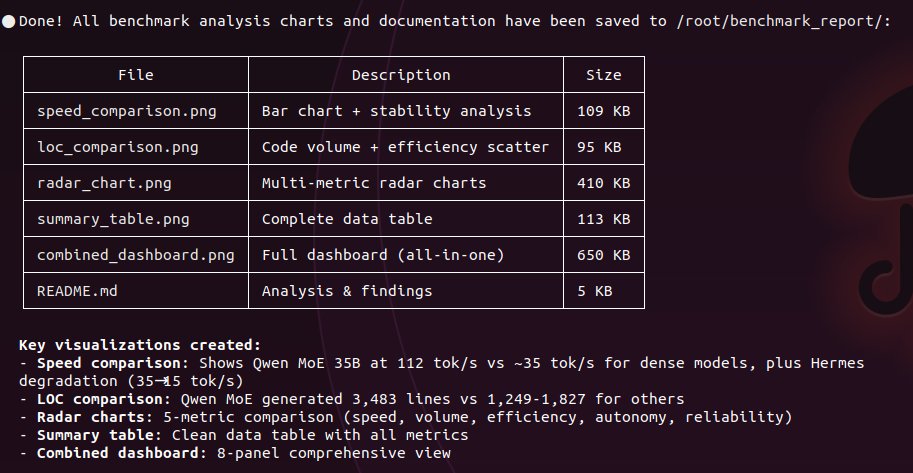
Qwopus on a single RTX 3090. Claude Opus 4.6 reasoning distilled into Qwen 3.5 27B dense, running through Claude's own coding agent (claude code). 29-35 tok/s with thinking mode on.
the jinja bug that kills thinking on base Qwen doesn't carry over. harness and model matched.
the base model would pause mid task on Claude Code. just stop generating. that's why i ran it through OpenCode, which handles stalled states automatically. this distilled version doesn't stall. it waits for tool outputs, reads them, selfcorrects when something breaks, and keeps going. i gave it a benchmark analysis task. went 9 minutes autonomous. wrote a README nobody asked for. zero steering. video is 5x speed but fully uncut.
if you have a 3090, you can run this right now. free. no API. no subscription. opus structured reasoning on localhost.
octopus invaders is next. same prompt that base qwen passed in 13 minutes and hermes 4.3 failed on 2x the hardware. i want to see if the distillation changes the outcome or just the style. more data soon.
For those of you rediscovering TDD via agents - if you let your agent do TDD by writing unit tests and not developer tests, you will end up in a pickle.
Tota informació que ha tocat un mitjà digital ja l’heu de considerar compromesa.
No hi ha altra. No hi ha volta enrere.
Cap empresa vetllarà per la vostra informació de forma adecuada. Ho poden intentar però tard o d’hora cauran o ells o els seus proveïdors.
Una base de dades vinculada a la verificació d’identitat mal configurada exposa les dades de 1.000 milions de persones. Noms, adreça física, números d’identificació, telèfons, correus electrònics...
Verificar l'edat segons com és més insegur que no fer-ho.
https://t.co/3cGm53Sf38