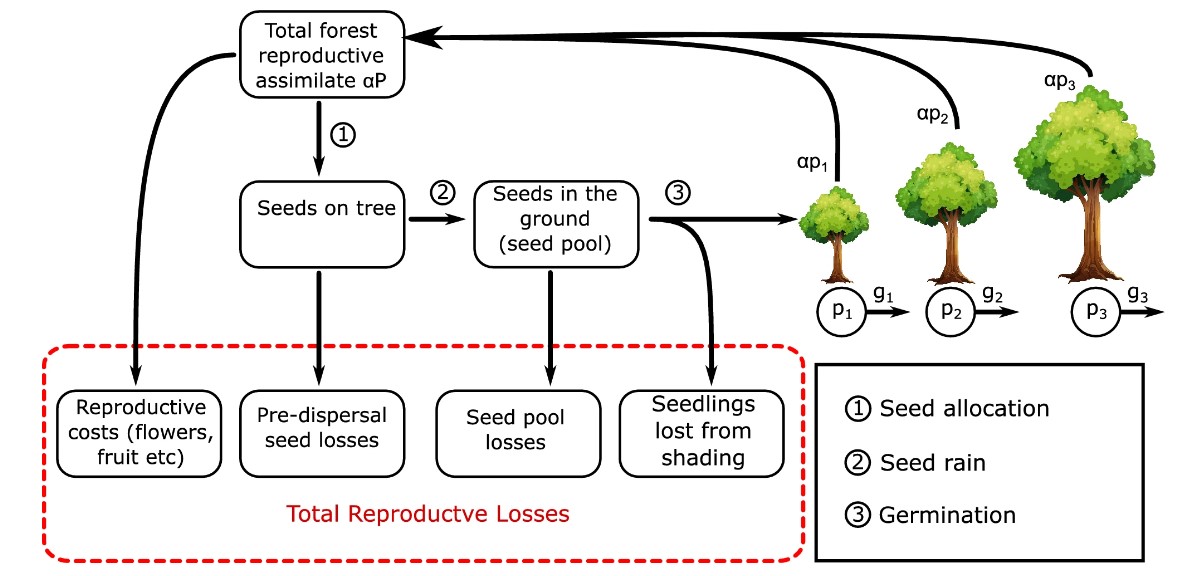
Very happy that @JonClimateMoore got out our hypothesis that forests are “optimised" to maximise their stem and biomass density wrt to the drivers of life: births, growth and death. I would really recommend having a read through the methods: https://t.co/uO1X0IHo0b. (1/7)
Yesterday the first paper from my PhD, 'Tipping Mechanisms in a conceptual model of the Atlantic Meridional Overturning Circulation' was published online, and can be read here: https://t.co/OLnwXZTDDA
@SachaSinet@PDLRitchie@ExeterUniMaths@UofE_Research@RMetS
Our ambitious experiment in the Amazon rainforest - @amazonface
6 rings of towers: 3 will keep CO2 levels within them high so we can study how rainforest trees respond. eg. does growth keep increasing at high CO2?
Crucial knowledge for calculating future carbon budgets
Important new paper by Mark Williamson @ExeterUniMaths addressing the question: "Why does the emergent constraint on ECS from global temperature variability work for CMIP5 and not CMIP6?" @FemkeNijsse @GSI_Exeter@UK_CEH
https://t.co/5hBjQDrYN0
I may go on about non-structural carbohydrates but you have to admit they do quite neatly explain declines in nocturnal plant respiration.
Read more in my new paper with @coxypm, Lina Mercado, Dan Bruhn and @NinaRaoult published with @SpringerNature. https://t.co/OXNfRQyDV7
The vegetation model Robust Ecosystem Demography (RED) updates plant #demography. The population is partitioned into mass classes and updated via a continuity equation. This allows for the size-dependence of growth and mortality to be modelled.
https://t.co/FnUuG92inq
(1/2)
An interesting theoretical hypothesis of #forest demography called "#Demography Optimality" by
@coxypm. https://t.co/6xX82aptvW.
He has been named as a highly-cited author every year from 2014 onwards.
More at his #esiStateOfTheArt talk on 25 March
👉 https://t.co/nxxTzyEUiU
Climate change and deforestation risk an Amazon tipping point
Our new @nature paper led by @BernardoMflores
On current trends, we estimate that by 2050, 10 - 47% of Amazonian forests will exposed to compounding disturbances risking critical transitions
https://t.co/ldZCT8KIea
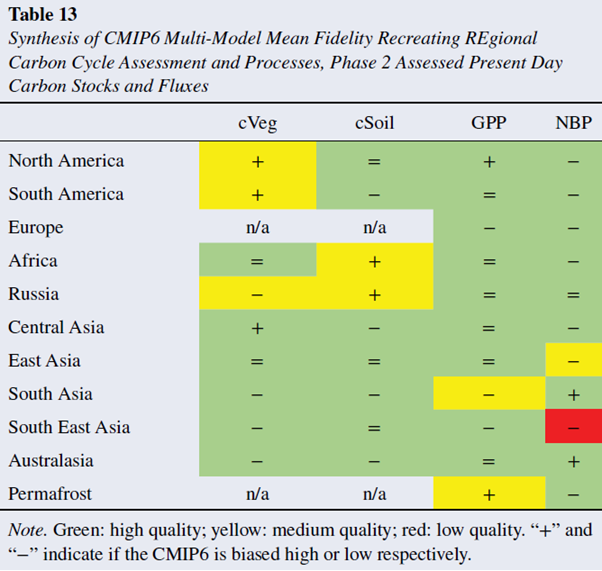
Ever wondered how good CMIP models are for regional scale carbon cycle? Actually not too bad. Based on regional assessment of present day carbon balance from RECCAP2, we assessed CMIP6 models. The multi-model mean did very well (green boxes)
https://t.co/fFmuDuFbVE
This is a paper to be proud of @JonClimateMoore & @AArgles! A really elegant piece of work which hypotheses that there is an optimum mortality rate for a forest which depends on the growth-rate of the trees. 'Live fast, die young' now has a theoretical basis!
What spatial structure and dynamics emerge in tropical forests affected by fires at their edges? We explored this question theoretically by modelling fire and forest spread as contagion processes on grass patches. 1/n https://t.co/SU7rPwdPDp
Very happy that @JonClimateMoore got out our hypothesis that forests are “optimised" to maximise their stem and biomass density wrt to the drivers of life: births, growth and death. I would really recommend having a read through the methods: https://t.co/uO1X0IHo0b. (1/7)
I want to pass on special thanks to @JonClimateMoore and @coxypm , a fitting amalgamation of all work for your time at the University of Exeter. @UofE_Research@MetOffice_Sci@SciReports (7/7).