🌿 How can we make land surface models more accurate for better climate predictions? Check out our new preprint exploring data assimilation for parameter estimation and how machine learning can help: https://t.co/1azDQzejuT @AIMES_IPO#LandSurfaceModelling#MachineLearning
If you are attending #EGU24 and want to learn more about this work:
- I will be presenting the paper tomorrow (Wednesday, 10:45-12:30, 🟨 Hall 4, X4.103)
- Simon will be taking about how we can apply this technique to adjust the carbon balance on Friday (12:05-12:15, 🟩 N1)
Check out our new preprint highlighting the power of history matching for land surface model calibration by comparing it to the more traditional variational data assimilation approach @jm_salter@ExeterUniMaths#ORCHIDEE#LSCE ⚙️👇https://t.co/wOm5yMXlQs
I may go on about non-structural carbohydrates but you have to admit they do quite neatly explain declines in nocturnal plant respiration.
Read more in my new paper with @coxypm, Lina Mercado, Dan Bruhn and @NinaRaoult published with @SpringerNature. https://t.co/OXNfRQyDV7
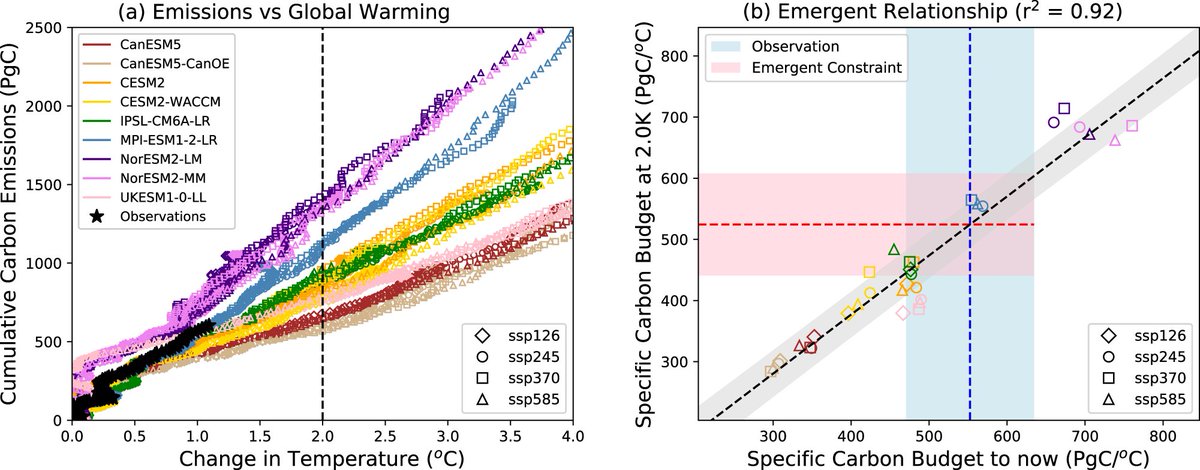
Emergent complexity is fascinating, but emergent simplicity is often more useful. I am blown away by the linearity between cumulative emissions and global warming that we see even in the most complex Earth System Models! @GSI_Exeter@MetOffice_Sci https://t.co/37jpzOshaQ
Latest paper by @coxypm, combining #climate simulations with observations to estimate better constrained #CarbonBudgets and finds them >10% larger than the mean from CMIP6 models https://t.co/JHlpDqgFNe.
More at his #esiStateOfTheArt talk on 25 March
👉 https://t.co/nxxTzyFs8s
Excited to have been part of this awesome new study led @coxypm - we use emergent constraints to calculate carbon budgets consistent with Paris targets 🎯👇
Our new emergent constraint paper is now out in @NatureComms! This one reduces uncertainty in arguably the most policy-relevant numbers to come from climate science: the global carbon budgets consistent with the Paris targets. @GSI_Exeter@exeter
https://t.co/ZSPgh4kfGc
Check out our new paper showing how manipulation experiments can be used to ensure calibrated parameters capture different model responses under a changing climate @ExeterUniMaths#LSCE@EGU_BioGeo@as_lanso 🌳🌲 https://t.co/R4064tr2FI
Check out our new preprint highlighting the power of history matching for land surface model calibration by comparing it to the more traditional variational data assimilation approach @jm_salter@ExeterUniMaths#ORCHIDEE#LSCE ⚙️👇https://t.co/wOm5yMXlQs
Join the discussion in the International Land Modelling Forum's second webinar: Parameter Estimation Methods for Land Models - next Tuesday 10 October 🗓️
Find out more and register here: https://t.co/LkbKmEDNwE
#ILMF
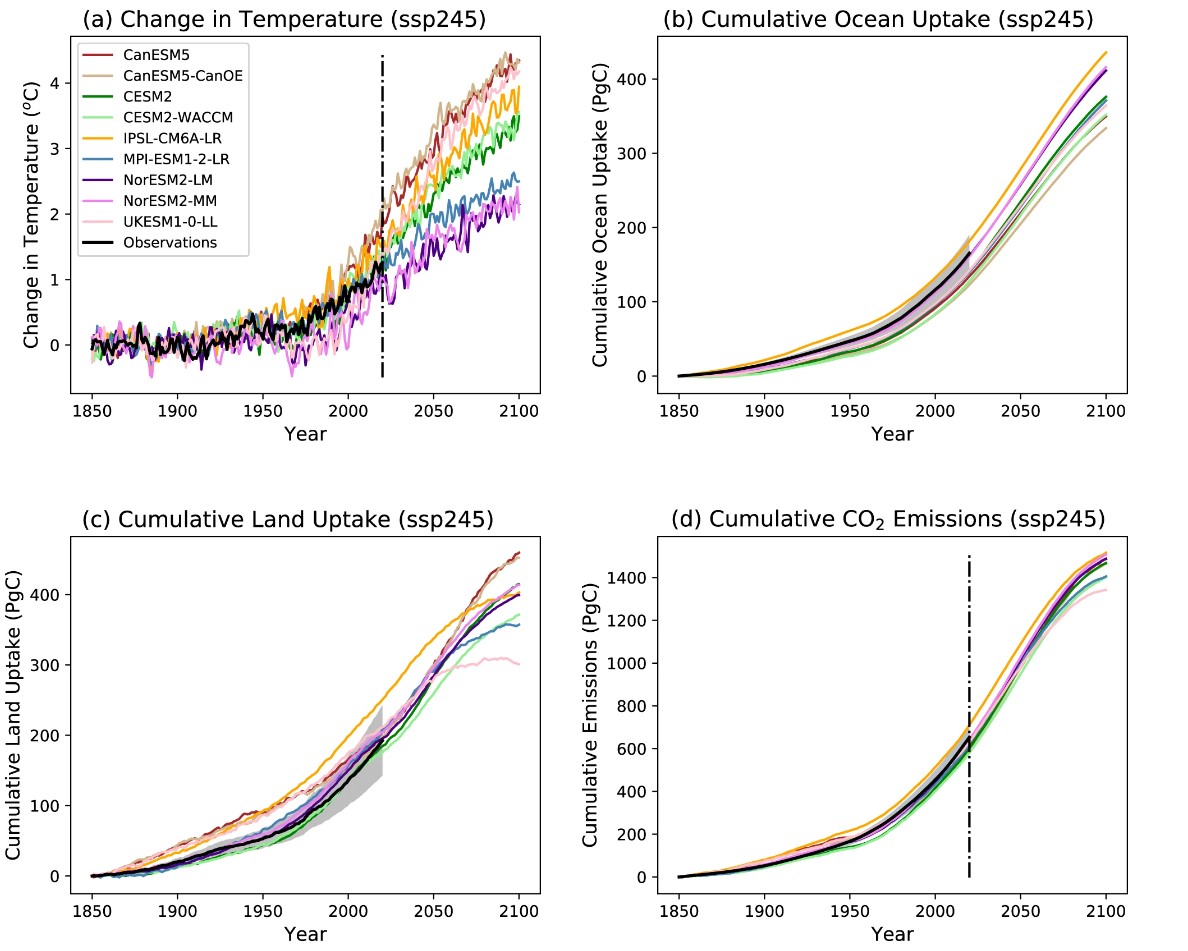
Check out our neat little study showing how parameter optimisation and emergent constraint techniques can be used together to constrain global climate-carbon cycle projections 👇
With high levels of Greenland melt this year, never has it been more important to accurately simulate snow processes in land surface models. Our latest publication looks at how we can improve the representation of snow albedo over Greenland: https://t.co/BLqmpB6u78 @LSCE ❄️❄️❄️
We show how observations of carbonyl sulfide (a trace gas that tracks photosynthesis) can be used to improve the representation of #carbon and #water fluxes over boreal needleleaf forests in land surface models🌲
Registration is open for the 3rd Annual Land Data Assimilation Community Virtual Workshop: “Recent Technical Developments in Land Data Assimilation!” The workshop will take place 20-21 June from 9:00 - 13:00 EDT (note revised dates!). https://t.co/nF6zNZVhjj
Interested in understanding water-carbon dynamics? Come to our session bright and early tomorrow (8:30 CEST, Room 2.95 or online). We are looking forward to all the exciting talks! @vwhumphrey @JuliaKGreen1 @mallory_barnes@ZhengFu_eco @Novick_Lab https://t.co/H27YBVr7hg #EGU23