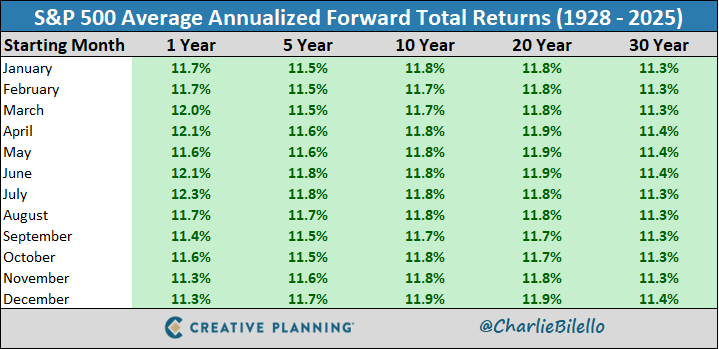
𝗧𝗵𝗲 "𝗮𝘃𝗲𝗿𝗮𝗴𝗲" 𝟴–𝟭𝟬% 𝘀𝘁𝗼𝗰𝗸 𝗺𝗮𝗿𝗸𝗲𝘁 𝘆𝗲𝗮𝗿 𝗮𝗹𝗺𝗼𝘀𝘁 𝗻𝗲𝘃𝗲𝗿 𝗮𝗰𝘁𝘂𝗮𝗹𝗹𝘆 𝗵𝗮𝗽𝗽𝗲𝗻𝘀.
My conversation with Ben Carlson (@awealthofcs) covered that and more:
• Pick the worst asset class every single year and you still make money
• "Bob," his world's worst market timer, only bought at all-time highs and still retired a millionaire
• Average up year is +21%; average down year is -15%
• More 20%+ up years than down years over the last century
• The 1970s: cash, bonds, AND stocks all lost to inflation
Sponsor: Ivy Invest
We just updated our Global Rent Price Index.
In Europe, the strongest rent growth over the past 15 years has been recorded in:
🇪🇪 Estonia: +208%
🇱🇹 Lithuania: +192%
🇮🇸 Iceland: +136%
🇭🇺 Hungary: +131%
🇮🇪 Ireland: +123%
🇷🇸 Serbia: +111%
🇲🇪 Montenegro: +98%
🇵🇱 Poland: +92%
🇦🇹 Austria: +79%
🇸🇮 Slovenia: +72%
While the total rent increases since 2011 may look dramatic, annualized compound growth over the last 15 years was much lower:
Estonia: 7.8% per year
Lithuania: 7.4% per year
Iceland: 5.9% per year
Hungary: 5.7% per year
Ireland: 5.5% per year
Serbia: 5.0% per year
Montenegro: 4.7% per year
Poland: 4.4% per year
Austria: 4.0% per year
Slovenia: 3.5% per year
Meanwhile, a number of European markets have recorded remarkably weak rent growth over the same period:
🇩🇪 Germany: +26% (1.5% per year)
🇮🇹 Italy: +19% (1.2% per year)
🇨🇭 Switzerland: +18% (1.1% per year)
🇫🇷 France: +17% (1.0% per year)
🇪🇸 Spain: +15% (0.9% per year)
🇨🇾 Cyprus: +14% (0.9% per year)
🇬🇷 Greece: -6.2% (-0.4% per year)
The gap largely reflects differences in wage growth, economic convergence, housing supply, demographics, rent regulation, property taxes, and the stage of the housing cycle each market is currently in.
NOTE: The data is sourced from national statistics offices and other official organizations that publish local rent or housing price indices on a quarterly basis.
No More Chemotherapy!
#Israeli researchers at the Technion developed tiny nanoparticles that slowed aggressive breast cancer tumors without carrying chemotherapy, antibodies, or any cancer drugs.
Instead of attacking the tumor directly, they changed its environment - blocking the harmful signals that help cancer grow.
In preclinical studies, tumors shrank significantly, and researchers showed that even these "empty" particles could stop cancer from developing.
Sometimes the biggest breakthrough isn't adding more medicine.
It's finding a smarter way to heal. #Israel #Cancer
Okay, this is genuinely insane.
A startup called Panthalassa just raised $140 million to build AI data centers in the ocean.
Not on a ship. Not on the coast.
Floating out in open water, with no power grid and no land at all.
It's called Ocean-3, and the idea behind it breaks your brain.
Land-based AI data centers are hitting a wall. Not a chip wall. A grid wall. Not enough power. Not enough land. Not enough cooling water to keep building them fast enough.
So Panthalassa's answer: skip land entirely.
Giant floating steel orbs bob up and down with the waves. That motion spins a turbine inside and makes electricity. No grid needed. Cold seawater wraps around the chips and cools them for free.
And here's the wild part: the whole thing runs itself. No crew on board. No cables to shore. Results beam back to land through satellites in orbit.
Backed by Peter Thiel. The company is now worth almost $1 billion.
Land is running out of room and power for AI. The next move is the ocean. Literally.
Do you think it's a great and long-term solution for AI Data Centers?
Complete Article below: ↓
🚨TESLA JUST FOUND A WAY TO BUILD THE WORLD'S BIGGEST AI SUPERCOMPUTER WITHOUT BUILDING A SINGLE DATA CENTER
The answer was sitting in millions of driveways the whole time… your parked car.
The entire AI industry has hit a wall.. And it's not chips.. It's power..
Building AI data centers now means waiting years for grid connections.. The Stargate project from OpenAI and Oracle is spending up to $500 billion to build 7 gigawatts of capacity.. And it'll take years to come online..
Tesla just realized it already has 7 gigawatts.. Sitting in its Supercharger network.. Already built.. Already connected to the grid.. Already permitted..
So on June 18, 2026, Tesla quietly filed a trademark for something called MEGAPOD.. Modular AI data center hardware designed to drop straight into existing Supercharger sites..
No land to buy.. No years-long grid queue.. No new power plants.. They just bolt compute onto infrastructure they already own..
But that's the small idea..
Here's the radical one..
The average car sits parked and unused about 95% of its life.. And every modern Tesla already has a powerful AI chip inside it.. Built for self-driving..
So Tesla wants to link millions of parked cars into one massive distributed supercomputer..
The math is staggering.. If Tesla hits 100 million vehicles, and each contributes about 1 kilowatt of compute.. That's 100 gigawatts of AI processing power..
That dwarfs every data center on earth combined.. And the real estate, the power, and the cooling were all already paid for.. By the people who bought the cars..
Your Tesla is liquid-cooled.. Plugged in overnight.. Doing nothing.. It's basically a sleeping computer in your garage..
And Tesla's plan is to let you rent it out..
Owners could earn passive income, free Supercharging, or discounts on Full Self-Driving in exchange for leasing their car's idle computing power while they sleep..
Your car stops being a depreciating asset.. And starts earning money while parked..
This is the part competitors can't copy..
OpenAI has to spend half a trillion dollars and wait years for power.. Tesla already has the grid connections, the batteries to stabilize them, the chips, and millions of cooled computers sitting idle in driveways worldwide..
Everyone else is trying to build a giant brain in one place..
Tesla is turning the entire planet into one.
“There’s nothing fair about Marlene Dietrich having great legs we all want to watch” is a line that should open every Econ 101 book.
More to the point, the price system is a coordination mechanism.
People have different skills, ambitions, temperaments, and desires.
The price system routes those differences to where they’re valued most.
Muhammad Ali didn’t get rich by taking anything from anyone unjustly.
Millions of people voluntarily paid to watch him box because he was the best at what he did.
The price was simply the meeting point between what fans were willing to pay and what Ali required to perform.
The more exceptional he was, the richer he became.
His “inequality” by being exceptional was the feature that made people line up to see him.
So how exactly is it a moral failure when someone grows wealthy because other people freely chose to give him their money?
Why must we destroy the price mechanism that satisfies both parties in the transaction?
Because effectively, punishing excellence for creating unequal outcomes punishes the very people who reward it.
But the egalitarian project destroys this diversity (inequality).
“Equality” under this vision means dragging everyone down to the lowest common denominator because the only way to make everyone the same is to stop anyone from rising too far above the rest.
As Milton Friedman observed, we might as well clone one of us, get rid of everyone else, and put that single copy in a museum.
We all perish and we’ll be remembered by the worst of who we were.
Bill Maher asks how the government is “failing the poor so badly” when he pays “60 PERCENT” of his earnings in taxes.
“Last week was tax day… I paid the government probably almost 60% of what I earn. That’s a lot.”
“And I… wouldn’t mind if Bernie Sanders would stop saying the rich don’t pay taxes.”
“The top 10% pay 72% of all federal income taxes. And the bottom half, 3%.”
“The Democratic Socialists talk about socialism like we don’t already have a lot: Social Security, unemployment, Medicare, nutritional assistance, Medicaid, Obamacare, disability, housing subsidies.”
“How can you be soaking the rich and failing the poor so badly? How can it be that the federal government alone took in over 5 trillion in taxes last year, and we still need that?”
“Are we really this incompetent and corrupt?”
A British biologist looked at 200,000 years of human history and found that the entire reason humans broke out of poverty was not intelligence, not language, not even agriculture, but one mechanism so simple a 6-year-old could explain it.
His name is Matt Ridley.
He is a zoologist by training, an evolutionary biologist by career, and in 2010 he wrote a book called The Rational Optimist that quietly argued the most important fact about human progress had been hiding in plain sight for the entire history of economics.
Naval Ravikant has been telling people to read everything Ridley has ever written for the last 15 years. The reason is the argument inside this one book.
For 200,000 years, anatomically modern humans walked around with the same brain you have right now. Same skull size. Same neural architecture. Same raw capacity for language, planning, and abstract thought.
For roughly 190,000 of those years, almost nothing happened. Generation after generation lived and died inside the same Stone Age toolkit their great-great-grandparents had used. Then somewhere around 50,000 years ago, the line on the chart of human progress started to tick upward. Then it bent. Then it exploded.
The question Ridley spent years on was the only question that mattered. What changed.
It was not the brain. The brain had been the same for 190,000 years. It was not language, which had existed long before the takeoff. It was not even agriculture, which arrived only 10,000 years ago and was actually preceded by the upward bend, not the cause of it.
What changed was that humans started trading with strangers.
This sounds too small to be the answer. Ridley argues that it is the answer to almost everything. The moment one human exchanged a useful object with another human from a different group, something happened that no other species on earth had ever done.
Two ideas that had developed in isolation came into contact. The flint knapper learned what the spear maker had figured out. The fisherman from the coast learned what the hunter from the forest had figured out. The two pieces of knowledge fused into something neither side could have produced alone.
Ridley calls this ideas having sex. The phrase sounds frivolous and it is meant to. The point is that ideas, like genes, get better when they combine with other ideas from different lineages.
An idea sitting inside one head, no matter how brilliant the head, eventually hits a ceiling. The same idea exposed to ten thousand other ideas does something genes do under sexual reproduction. It mixes. It recombines. It produces offspring nobody planned.
The cleanest proof of this argument is the most uncomfortable case study in the book. Tasmania.
Around 10,000 years ago, rising sea levels cut Tasmania off from mainland Australia. A population of roughly 4,000 humans was now isolated on an island, with no possibility of contact with the rest of humanity. They had the same brains. The same language. The same starting toolkit as their cousins 150 kilometers north. The natural experiment was now running.
What happened next is something no economist or geneticist had ever predicted.
The mainland Australians kept inventing. Boomerangs. Spear-throwers. Fishing nets. Bone needles for sewing fitted clothes. Watercraft with paddles. Their technology compounded slowly across the centuries.
The Tasmanians went the other way. They did not just fail to invent the new tools their cousins were developing. They started losing the tools they already had. Fishing was abandoned within a few thousand years. Bone tools disappeared. Fitted clothing disappeared. They forgot how to make fire from scratch and started carrying lit firebrands from camp to camp instead, relighting their fires from a neighbor's whenever their own went out.
By the time European explorers arrived in the 17th century, the Tasmanians had the simplest toolkit of any human society ever recorded. Their material culture had gone backward for 8,000 years.
The archaeologist Rhys Jones called it a slow strangulation of the mind.
Joseph Henrich at Harvard later proved with formal mathematical models that there was nothing wrong with Tasmanian brains. There was something wrong with their network. A toolkit requires a critical mass of people exchanging skills to maintain itself.
The act of teaching a skill is imperfect. Every generation loses a small percentage of what the last generation knew. If your population is large enough and trading widely enough, those losses get caught and corrected by someone else who still remembers.
If your population shrinks below a certain threshold and stops mixing with outsiders, the small losses compound until entire technologies disappear.
This is the part that should haunt anyone reading this in 2026.
Intelligence is not a property of the individual brain. Intelligence is a property of the network the brain is connected to. A genius in isolation will produce less than a mediocre thinker inside a dense exchange of other mediocre thinkers.
The thing your ancestors needed in order to break out of 190,000 years of stagnation was not better brains. It was better connections between brains they already had.
The implication for any individual is direct and uncomfortable. If you are smart and isolated, you will be outproduced by people half as smart who are connected.
The most successful people in any field are almost never the smartest people in it. They are the ones positioned at the intersection of the most idea flows. They are reading more authors than their competitors. They are talking to more people from more disciplines. They are in the rooms where ideas from different lineages bump into each other.
Ridley ends the book on the line that sounds optimistic but is actually a warning its this "The future will be invented by people who connect ideas, not by people who guard them."
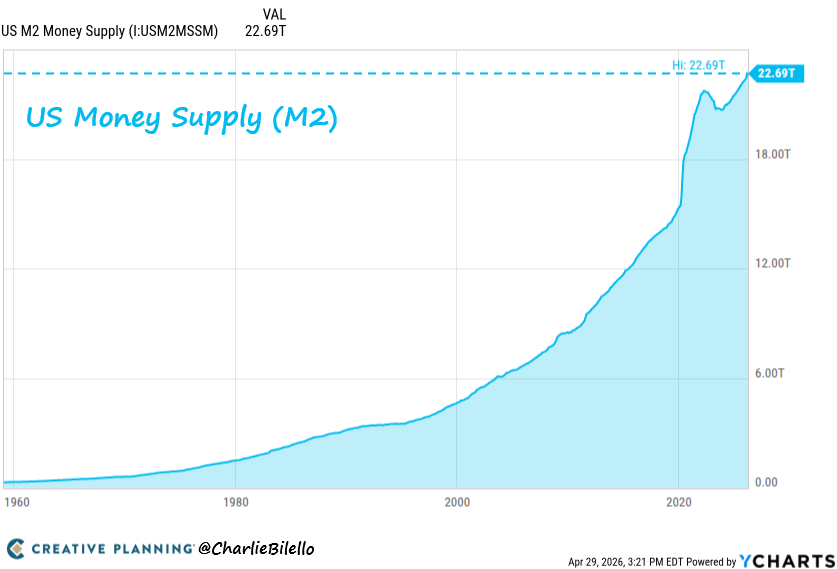
The Fed expanded the money supply by nearly $9 trillion under Powell.
Inflation has averaged >4% per year over the past 6 years.
Powell's explanation? It was nearly all due to rolling “supply shocks" over which the Fed has no control.
The truth: this inflation was made in Washington as it always is - from too much government borrowing/spending and too much government creation of money.
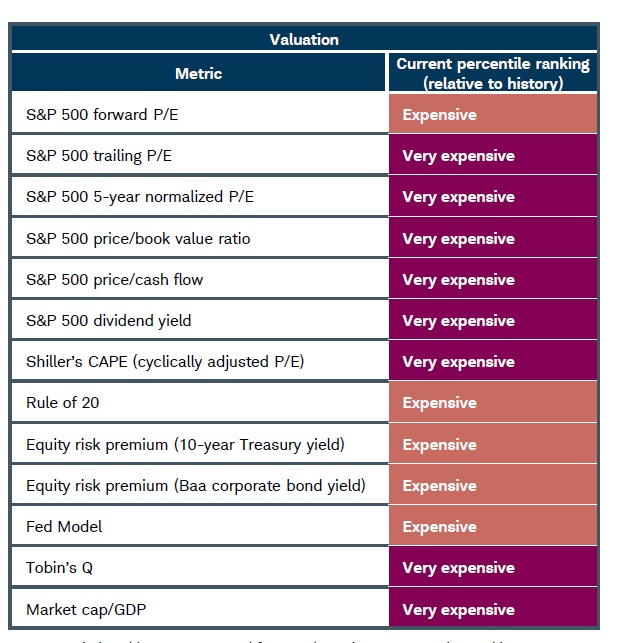
The S&P 500's CAPE Ratio has moved up to 41, its highest level since 2000 and now above 99% of historical valuations. $SPX
Video: https://t.co/8sftndQio4
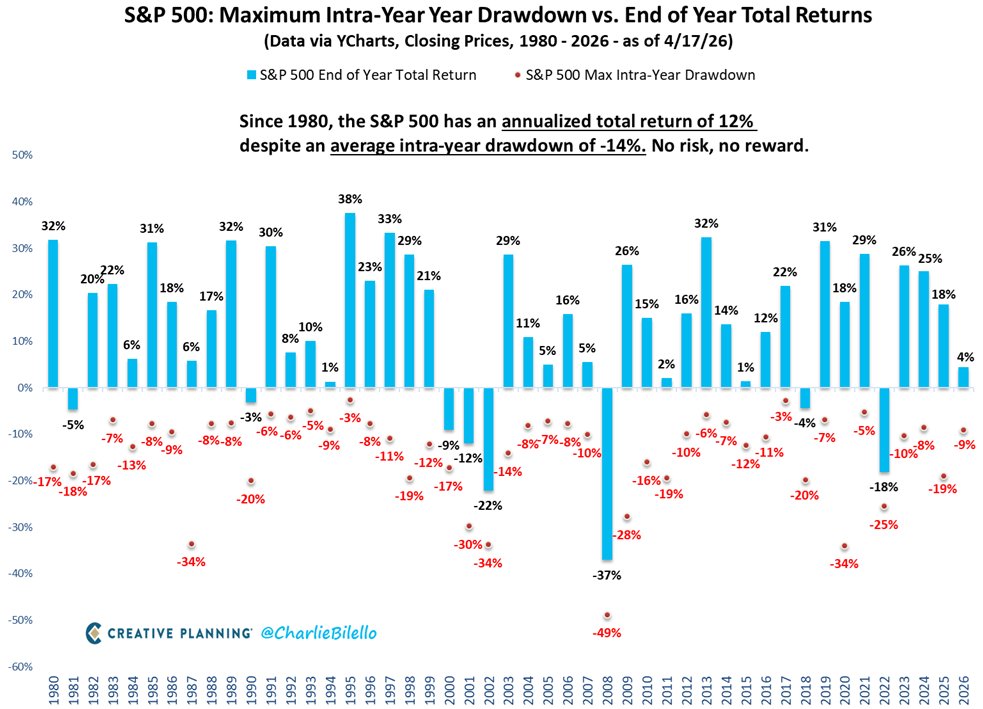
The S&P 500 has returned an average of 12% per year since 1980 and has done so despite an average intra-year drawdown of 14%, and often drawdowns that are much worse.
The lesson? Volatility doesn’t equal a permanent financial loss unless you sell.
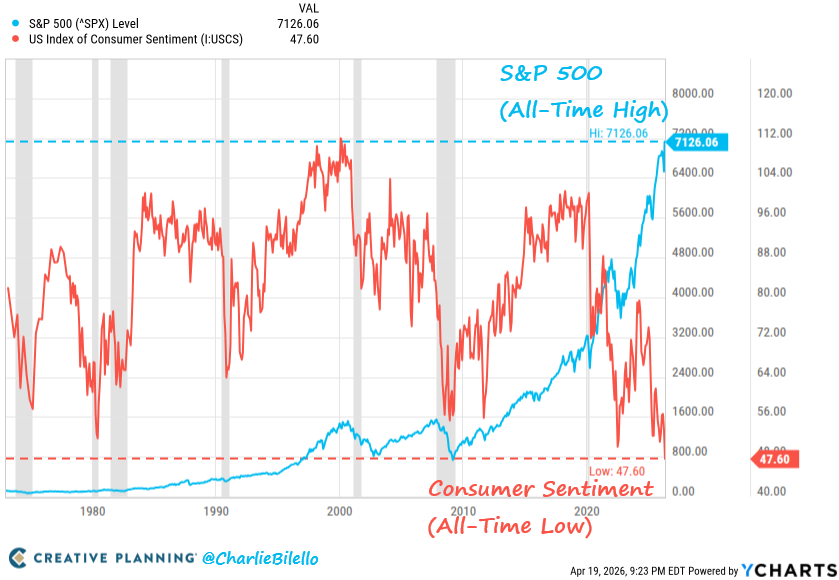
The S&P 500 is at an all-time high while Consumer Sentiment is at an all-time low.
We've never seen a gap this wide between Wall Street and Main Street.
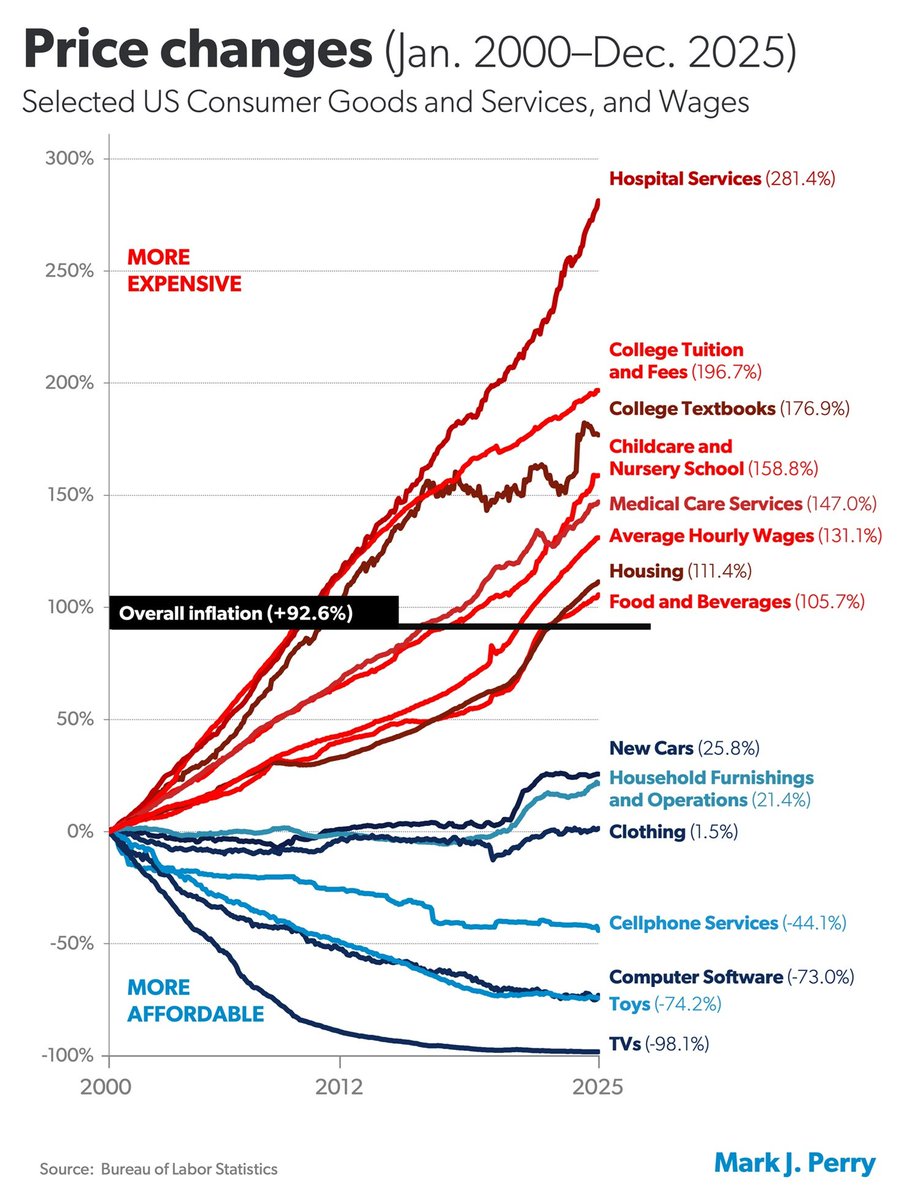
The inflation story in one chart:
Where government spending and subsidies are highest, prices rise the fastest.
Where competition is highest, prices fall.
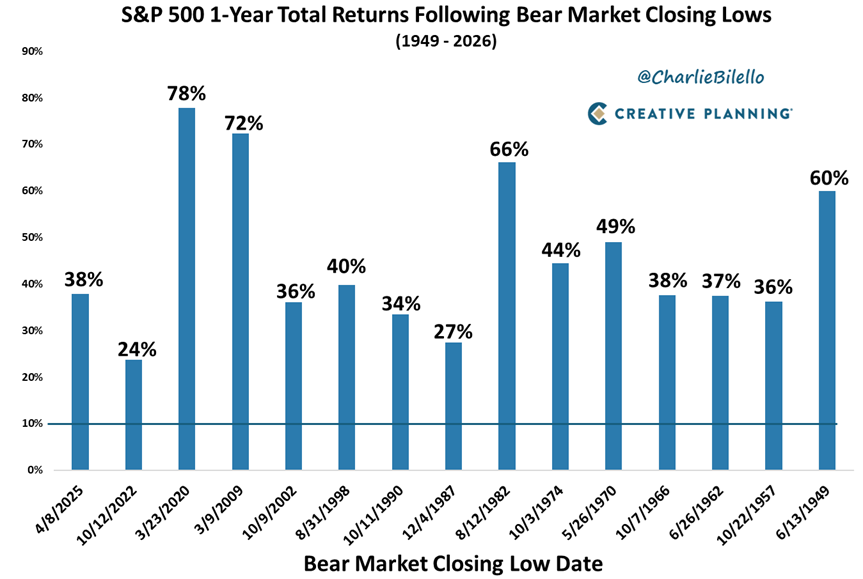
Every time the market feels the worst, it’s the beginning of something better.
Since 1949, the S&P 500 has returned +38% on average in the year after bear market lows.
The hardest time to invest is when the biggest opportunities appear.