THIS DEVELOPER JUST KILLED THE ENTIRE VOICE CLONING INDUSTRY WITH ONE GITHUB REPO
Claude now speaks in your own voice across 23 languages through a single MCP call.
Free. Local. Offline.
ElevenLabs charged $22-$330 a month for what Jamie Pine just gave away under an MIT license.
Claude Code, Cursor, and Cline hook in with one command and start replying in your cloned voice straight from the terminal.
→ developer Jamie Pine dropped the repo jamiepine/voicebox on GitHub 41.6k stars in a matter of weeks
→ clones any voice from 10 seconds of audio, seven TTS engines to choose from
→ runs on your own machine via Tauri (Rust, not Electron) voice and samples never leave your computer
→ Claude Code, Cursor, Cline, and any MCP-aware agent speak back in your chosen clone through a single voicebox.speak call
→ plus global dictation with one hotkey inside any app
→ generate content in Arabic, Japanese, or Polish without opening your mouth
Replaces ElevenLabs and WisprFlow in one MIT-licensed app.
Bookmark this for the moment you want to give your agent a voice, repo below 👇🏻
@matthew_d_white What most of the AI world looks like today. A similar group in the US or Europe would have many asians but not as many. How we bring more Latinios, Africans, and women to the fore is one of the key challenges. Everyone would benefit.
Yesterday in Shanghai, after day one of #WAIC2026, I hosted a dinner for AI researchers, engineers, and open source builders working across model training, data engineering, inference, and safety.
The goal was simple: bring the right people into one room.
Many of the most respected people in AI have been congratulating @kimi for a remarkable model. Several, like @ZeyuanAllenZhu , are Chinese who have moved to the West, where they found greater opportunity. Will they join the returnees now that Chinese opportunities are clear? The US attacks on China are decimating American AI research. One implication: While DC thinks the US government is supporting AI progress, the net effect of recent US actions has been strongly negative for the US AI future. Chinese, Indian, and other non-US-born researchers have played a crucial role in US progress. Losing them will be devastating.
Western cultures make it difficult for many nurtured in Latin America and Africa to join us. Africans are 18% of the world's people but less than 1% in AI. I am not suggesting quotas or advancing anyone beyond their abilities. I do believe in reaching out, communicating, and breaking down barriers. Everyone will benefit.
And the arrival of Fengming himself on X has also single handedly raised the quality of discourse here
Had the pleasure of joining a roundtable with him at @anu_china earlier this year, just a fount of knowledge on Chinese EVs, batteries and AI
Two years ago, I was a junior student who had only just decided to pursue academia and felt completely lost about my future in research. Most of my emails and DMs to professors went unanswered.
Then Zhilin, whom I believed was still affiliated with the Shanghai Qi Zhi Institute at the time, replied and asked whether I would be interested in working on large-model training at Moonshot AI.
Back then, I did not fully grasp how accomplished he already was. Looking back, the fact that he took the time to respond to an inexperienced student with almost no representative work meant a great deal to me.
And this reflects Kimi’s genuine hunger for talent, as @Xinyu2ML mentioned: the willingness to give young researchers a real opportunity before they have had the chance to prove their potential.
Prof. @rsalakhu was an extraordinary mentor to Zhilin, and Zhilin has clearly carried that same generosity forward to the next generation. Truly grateful!
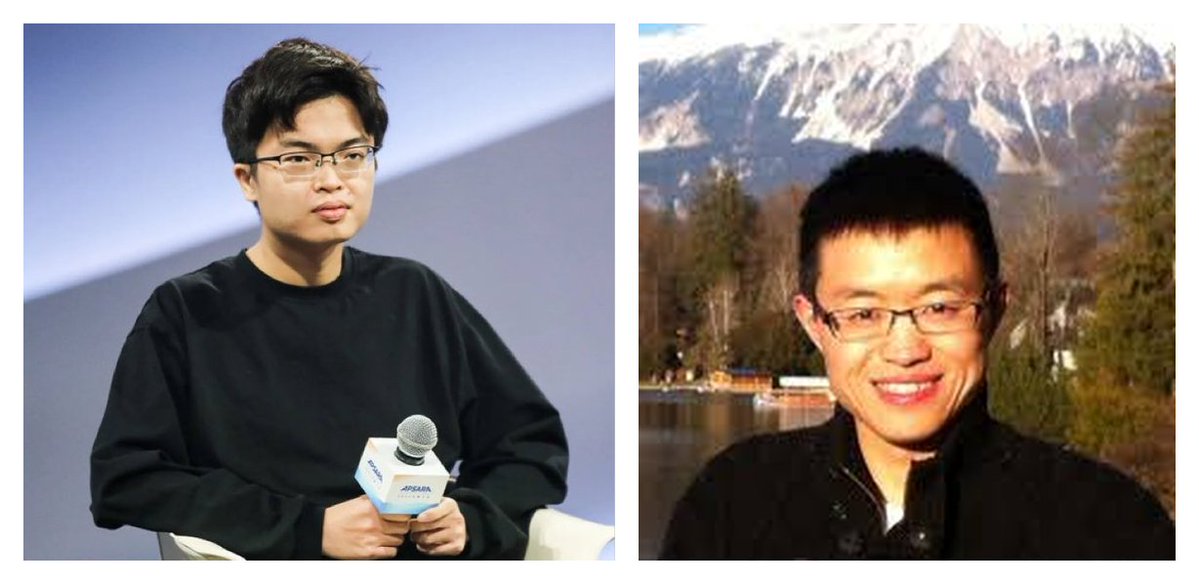
Interesting fact people might not know: Moonshot AI (Kimi models) founder Yang Zhilin, who also goes by the nickname 'Kimi', studied under Jie Tang who is a co-founder of Z AI (GLM models) at Tsinghua university (before CMU)
As frontier models become open and affordable, durable value moves to the scaffolding around them – the data, the orchestration, the workflow.
Instead of being locked into a vertical platform, developers can now bring intelligence to the harness of their choice.
This changes everything: imagine thousands of Claude Code moments purpose-built for every domain – legal, biotech, manufacturing, finance, insurance.
This is the inflection point of Kimi-K3. The model was never the moat, and now intelligence is being unleashed to every developer in the world. Hard to overstate how powerful this will be for the open model ecosystem.
Berkeley and Columbia have both had truly excellent years in faculty hiring on AI & Society.
Berkeley: @sayashk (information science), @keyonV (statistics)
Columbia: @NeelGuha (law), @roshni714 (decision, risk & operations), @wajeeha__ahmad (management), @andrewjkoh (economics)
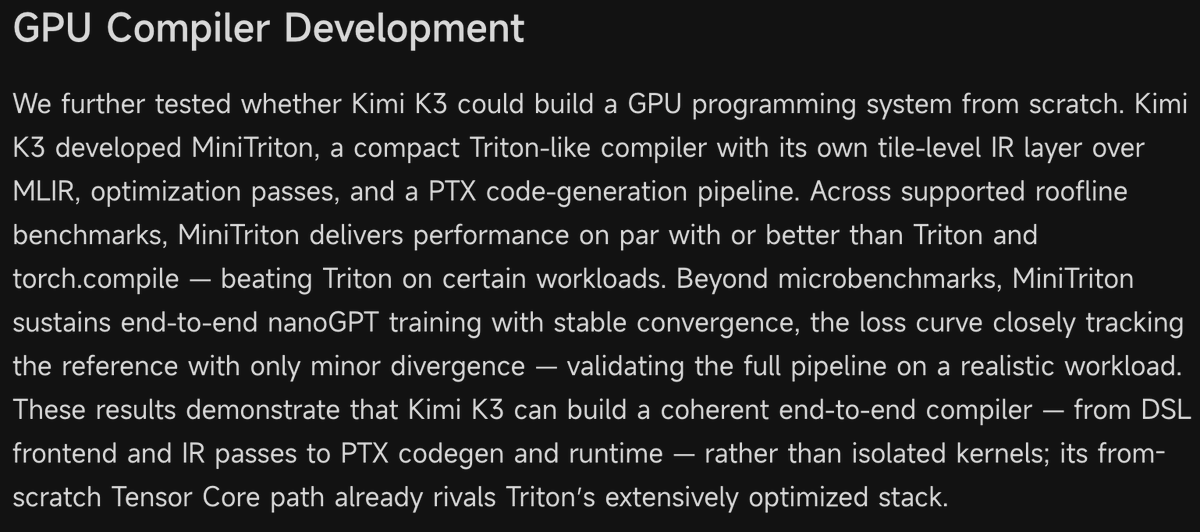
underrated gems in Kimi-K3 release:
> an early K3 wrote the majority of the kernels in the late development stages
> it built a triton-class compiler from scratch, MiniTriton, that delivers performance on par with or better than Triton and torch.compile
> then it designed a chip, by a model, for a model, in one 48-hour autonomous run
the model is rewriting and optimizing every layer of the stack it runs on: kernels for its own training. A compiler for its own kernels. silicon for its own weights.
we're watching software build its own hardware
My co-founder @ArmanHezarkhani broke down Kimi K3 (new 2.8T parameter Chinese model) on @FoxBusiness today with @cvpane.
We had our engineers testing it all day before he went on air.
Here's the gist:
1) K3 is very good. As good, if not better, than many of the American frontier models.
2) The cost story is being misread. Everyone expects a Chinese model to be the cheap one. Per token, K3 is competitive. Per run (the actual job you outsource to the model), it's as expensive as the frontier models. But it's supposedly open source, so developers will attack the cost curve. Give it weeks, not quarters.
3) The playbook should look familiar. It's the same one China ran on solar panels & EVs: flood the market with cheap supply, wait for the addiction, then move the price.
4) The internet & the space race were funded by the US government, and innovators competed on top of the platform. AI got funded by private markets, and now the same companies that spent those trillions are getting hamstrung right as China gives its models away.
5) On guardrails: the bad guys will have completely unconstrained tools no matter what we do. Foreign adversaries, and bad actors here at home. If the good guys don't have equally powerful tools, only one side is armed.
6) Commoditized models are actually good news for the hyperscalers. All that open source intelligence has to run somewhere, and Google & AWS will get paid a lot of money to run it.
7) The labs saw this coming too. It's why Anthropic & OpenAI are racing up the application layer instead of just selling tokens.
This is a another turning point in the age of AI: Open Chinese AI models are now, at most, only a couple of months behind the leading frontier models from the US. Kimi K3 seems to have surpassed Opus 4.8 and GPT-5.5, both of which were top models just 2 months ago. In design, Kimi K3 appears to have surpassed every currently released model.
Kimi for chip design (RSI needs new hardware as well).
"As an early proof of concept, Kimi K3 designed a chip to serve a nano model built on its own architecture. In a single 48-hour autonomous run, K3 built, optimized, and verified the chip using open-source EDA tools on the Nangate 45nm library. Within 4 mm², the chip closes timing at 100 MHz and sustains over 8,700 tokens/s decode throughput in simulation, packing 1.46M standard cells, 0.277 MB of SRAM, and an INT4 MAC array with fused dequantization. A chip built by a model, for a model, reflects K3's long-horizon agentic capabilities."
Amazing blog:
https://t.co/oWYDIcXSl6
This is my "feel the AGI" moment: I used GPT-5.6 Sol to train my own autocorrect model that outperforms GPT-5.6 Sol (wtf??)
I have no ML background. I have no idea what I'm doing. I just kept pushing Sol until it spat out a SOTA model. And I spent $0.
The motivation: Years of talking to AI have made me terrible at typing. Rather than fix my skill issue, I decided to throw more AI at it. My idea was: instead of autocorrect that interrupts my flow, I want to type fast with mistakes and have AI clean it up after.
I wanted the smallest local model possible, for speed, for battery life, for science! So I decided to train my own.
Inspired by @karpathy’s autoresearch, I ran Codex /goal with this setup: pick an experiment, try it, record the results to a doc, throw it out if it fails, and plan the next experiment without repeating failures. I gave a few examples that had to pass, tight latency targets, and let it run.
Sol did some amazing things.
First, it scanned benchmarks and shortlisted base models: Qwen 3.5, Gemma 4, Liquid LFM 2.5. It found a dataset on HuggingFace for typed text.
Then it built a simulator for fingers striking a Mac keyboard, modeling the physical layout with a Gaussian distribution around each key. It simulated striking the wrong key, wrong order, fat-fingering, etc.
With the models + data + simulator, it fine-tuned using MLX right on my MacBook. It had a working prototype within an hour! But accuracy was pretty poor.
—
Problem 1: Tokenization
Sol read papers, ran tests, and identified that the tokenizer was the bottleneck. Tokenization makes typos hard for the model to see, so it memorizes mappings instead of using its language priors.
Sol tried ByT5, Google’s tokenizer-free byte-level LLM. This made a big improvement, but the model is old and lacked the knowledge needed to reach Sol performance.
Sol dug deeper and realized a tokenizer-free model isn’t needed; instead, it used T5Gemma, an encoder-decoder model. This can understand the input deeply before producing output, and furthermore, Sol could post-train the encoder to improve performance. This gave a much higher ceiling.
—
Problem 2: Loss function
Now the model was correcting some typos perfectly, but ignoring most. Sol realized that standard cross-entropy loss was teaching the model to avoid edits, because the vast majority of characters in the training data were left unmodified.
The fix was wild: Sol wrote a custom loss function that byte-aligns the source and target strings, uses a dynamic programming algorithm to compute the minimum edits between the two, then weights correct edits much higher than copies. After a lot of tuning, this dramatically improved accuracy.
—
Problem 3: Autoregression
One failure mode remained: if the model made a mistake, it couldn’t backtrack. It could only predict the next token. Teaching it to “think” like a reasoning model would solve this, but would be far too slow.
Sol found a beautiful solution: instead of greedily predicting the next token, beam search over all possibilities. This parallelizes the exploration instead of one linear chain-of-thought. At the end, choose the path with highest cumulative log probability.
This worked great, but made the experience worse, since the user wouldn’t see progress until the whole search was done. To fix this, Sol made a clever observation: after each search step, the longest common prefix among surviving branches is guaranteed to appear in the final result, so it can be displayed immediately. As the search progresses, weaker paths are dropped and the prefix grows, so the user sees continuous progress.
Sol built all this as a custom MLX pipeline that does the parallel decoding on the MacBook GPU, with just ~40ms TTFT. It’s crazy fast and entirely local.
—
Final eval (error reduction rate, higher is better):
- Apple autocorrect: 49.66%
- GPT-5.6 Luna: 82.47%
- GPT-5.6 Terra: 87.64%
- GPT-5.6 Sol: 90.56%
- Our model (1.7B): 91.02%
Final cost:
- 1 quota reset (thanks @thsottiaux)
- $0
(And yes, I verified there's no cheating. In fact, we test words scrubbed from the training data to prove the model isn’t memorizing)
There were a ton more details and tangents I could write about: contrastive learning, GRPO, DPO, dynamic masking, and more. Sol is a fascinating and creative model. It blew my mind so many times.
Don’t let a lack of experience stop you: Sol makes AI experiments accessible to anyone!
The first experimental evidence of recursive self-improvement (RSI).
Autoresearching the autoresearch agent for eight days.
The result beats the harness we hand-tuned for two years, on held-out benchmarks: 🧵(1/7)
@SabrinaHalper "You should’ve been terrified of bioweapons yesterday." Can inflict massive damage, and we’re still woefully underprepared. 3 steps: knowing what to make, how to make it, & actual lab. Bottleneck is step 3: hard & usually fails. @jacobkimmel#aimed