Uhm Guys… Mythos (Fable) is AGI.
On the left is the ACTUAL Lovable Mobile App.
On the right is my Lovable version I built with Mythos in 2 prompts.
My version SMOKED it.
New Anthropic research: Emotion concepts and their function in a large language model.
All LLMs sometimes act like they have emotions. But why? We found internal representations of emotion concepts that can drive Claude’s behavior, sometimes in surprising ways.
How to never lose your job to AI:
Just surf the models.
Frontier models outclass humans at any form of knowledge that can be written down.
But people who use frontier models in their field of expertise generate new, tacit, situational expertise that the models don't yet have—because the models can't be trained on how they will be used in the future.
Humans can learn to use new models faster than new models can be trained that absorb what they find out, so you can continually "surf" on top of the model's intelligence to generate new expertise.
This is a fundamental limitation of LLMs because they don't learn past their training data. Even few-shot learning doesn't account for this because whatever can be codified into a few shot prompt needs to be used in the correct situation—and this will always stay uncodified in the general case.
Just surf the models. Reap the benefits of a totally new world.
We've been building an internal Claude Code plugin system at Intercom with 13 plugins, 100+ skills, and hooks that turn Claude into a full-stack engineering platform. Lots done, more to do. Here's a thread of some highlights.
Three days ago I left autoresearch tuning nanochat for ~2 days on depth=12 model. It found ~20 changes that improved the validation loss. I tested these changes yesterday and all of them were additive and transferred to larger (depth=24) models. Stacking up all of these changes, today I measured that the leaderboard's "Time to GPT-2" drops from 2.02 hours to 1.80 hours (~11% improvement), this will be the new leaderboard entry. So yes, these are real improvements and they make an actual difference. I am mildly surprised that my very first naive attempt already worked this well on top of what I thought was already a fairly manually well-tuned project.
This is a first for me because I am very used to doing the iterative optimization of neural network training manually. You come up with ideas, you implement them, you check if they work (better validation loss), you come up with new ideas based on that, you read some papers for inspiration, etc etc. This is the bread and butter of what I do daily for 2 decades. Seeing the agent do this entire workflow end-to-end and all by itself as it worked through approx. 700 changes autonomously is wild. It really looked at the sequence of results of experiments and used that to plan the next ones. It's not novel, ground-breaking "research" (yet), but all the adjustments are "real", I didn't find them manually previously, and they stack up and actually improved nanochat. Among the bigger things e.g.:
- It noticed an oversight that my parameterless QKnorm didn't have a scaler multiplier attached, so my attention was too diffuse. The agent found multipliers to sharpen it, pointing to future work.
- It found that the Value Embeddings really like regularization and I wasn't applying any (oops).
- It found that my banded attention was too conservative (i forgot to tune it).
- It found that AdamW betas were all messed up.
- It tuned the weight decay schedule.
- It tuned the network initialization.
This is on top of all the tuning I've already done over a good amount of time. The exact commit is here, from this "round 1" of autoresearch. I am going to kick off "round 2", and in parallel I am looking at how multiple agents can collaborate to unlock parallelism.
https://t.co/WAz8aIztKT
All LLM frontier labs will do this. It's the final boss battle. It's a lot more complex at scale of course - you don't just have a single train. py file to tune. But doing it is "just engineering" and it's going to work. You spin up a swarm of agents, you have them collaborate to tune smaller models, you promote the most promising ideas to increasingly larger scales, and humans (optionally) contribute on the edges.
And more generally, *any* metric you care about that is reasonably efficient to evaluate (or that has more efficient proxy metrics such as training a smaller network) can be autoresearched by an agent swarm. It's worth thinking about whether your problem falls into this bucket too.
Announcing Copilot Cowork, a new way to complete tasks and get work done in M365.
When you hand off a task to Cowork, it turns your request into a plan and executes it across your apps and files, grounded in your work data and operating within M365’s security and governance boundaries.
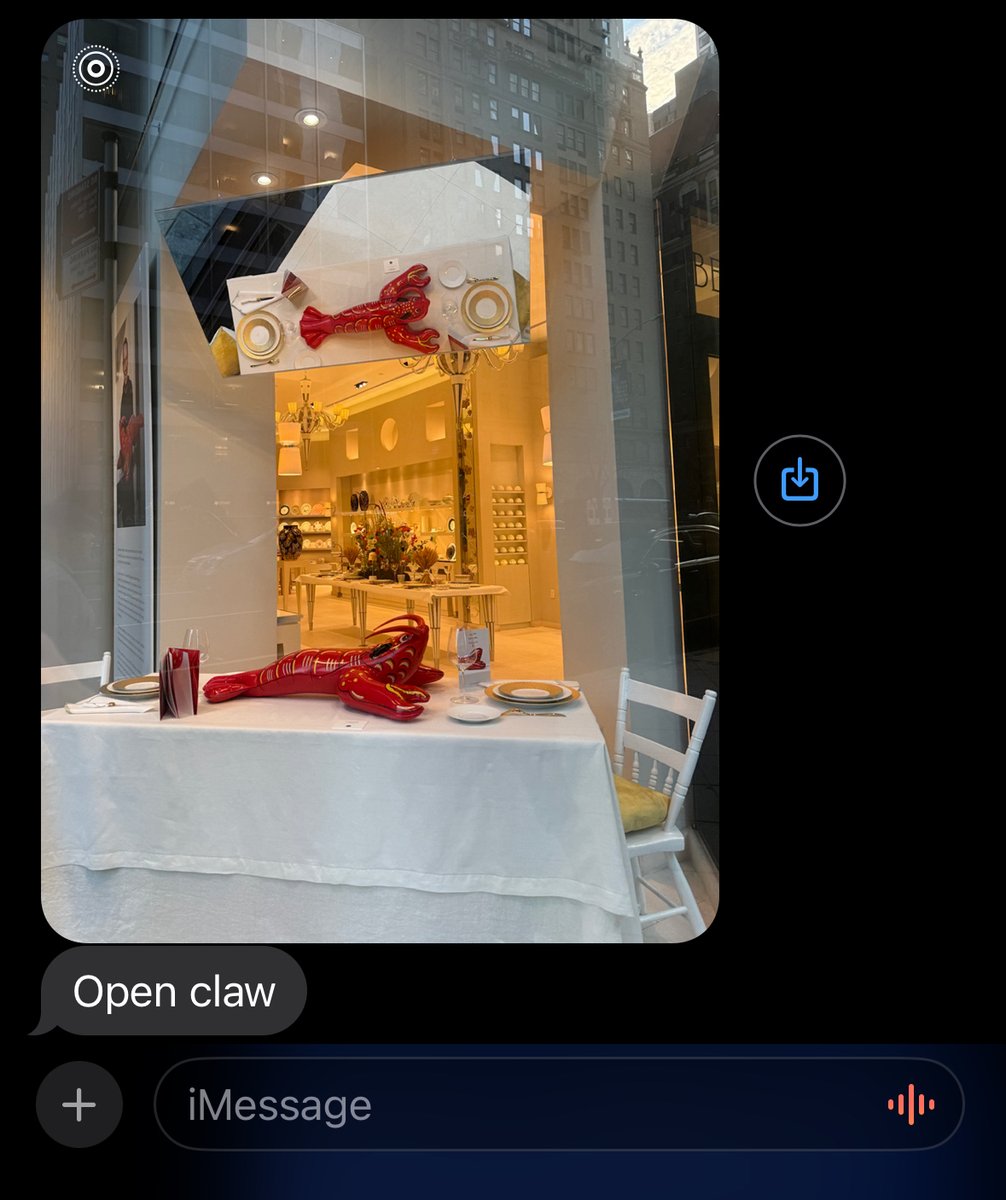
Also giving a seminar Saturday on setting up your own AI agent (ClawdBot) with @FoundersCommon and @DamianTenuta. Which means I've now unironically said "OpenClaw" more times this week than I've said my own name. A ridiculously crustacean themed week. See you there?
If your girlfriend is sending you photos of lobster window displays:👇 you just might just be in too deep.
Going to @clawcon NYC tonight. Over 1300 people registered. Presented by @kilocode, @iqramband, @msg
Introducing Perplexity Computer.
Computer unifies every current AI capability into one system.
It can research, design, code, deploy, and manage any project end-to-end.
@sama@sama feels like Uber v Lyft right now. I don't want to pick sides, I just want to use whatever model is good in the moment, for the best price - build the best, we'll use it.
@maxbittker I've been waiting to see this underrated measure of AI performance - 2006 RPGs. The best test of AI capability is if it finds a way to max cape and scam other human players out of gp.