El baile más mexicano del mundo nació en Andalucía. La composición del jarabe tapatío tiene sus orígenes en el jarabe gitano, baile del siglo XV originario de Andalucía, España, que llegó a México después de la Conquista. La palabra "jarabe" se deriva de "xarab", que significa mezcla de esencias y hierbas, y que se relaciona con la mezcla de las danzas de los diferentes estados de la República. Eso es exactamente lo que es: una mezcla de sones de distintas regiones de México cosidos en una sola pieza con acento jalisciense. Durante el periodo colonial, autoridades religiosas y civiles veían el jarabe tapatío como un baile ofensivo y provocador, especialmente por la cercanía y los movimientos sugestivos entre los bailarines, y fue considerado un "peligro para la moral pública". Lo prohibieron. Lo que los españoles no calcularon es que prohibirlo fue el mejor favor que pudieron hacerle: durante la Independencia de México, bailar el jarabe gitano se convirtió en un signo de libertad y rebeldía. Lo que era pecado en la Colonia se volvió patriotismo en la República. Lo que lo consagró definitivamente como símbolo nacional no fue ningún decreto gubernamental sino una bailarina rusa. En 1919, en una gira por México de la bailarina de ballet rusa Anna Pávlova, después de que ésta expresara su gusto hacia la cultura y las vestimentas, incorporó el Jarabe Tapatío en su repertorio permanente, utilizando el original traje de china poblana, bailándolo en puntas ante más de 30,000 personas en la Plaza de Toros de la Ciudad de México. El momento en que México decidió que el Jarabe Tapatío era su baile nacional fue cuando una rusa lo bailó en puntas con traje de China Poblana. La identidad cultural es así de impredecible y de hermosa.
Ocho minutos sublimes… 😍😍😍
Claude Monet no pintaba el mundo; pintaba el aire que se interpone entre él y las cosas.
Su pincel era un sismógrafo de la luz, capaz de registrar los latidos cromáticos de la atmósfera en un instante fugaz.
Para Monet, la realidad no estaba compuesta de formas sólidas o contornos definidos, sino de la vibración pura del color bajo el impacto del sol.
Este es un corto animado o animación digital estilizada inspirada por el uso del color de Monet.
Juana Catalina Romero, la Didjazá, la Flor de Tehuantepec, tenía 21 años y vendía cigarros a los soldados liberales frente al cuartel del convento de Santo Domingo cuando conoció al capitán Porfirio Díaz en 1858. Era hermosa, altiva, dominaba las armas de fuego, hablaba zapoteco y español con igual soltura, y era curandera con suficiente reputación entre la comunidad indígena del Istmo para que los conservadores la temieran. Díaz la convirtió en su informante secreta: ella le pasaba información del campo enemigo mientras seguía vendiendo sus productos con la misma naturalidad de siempre. Cuando Díaz llegó a la presidencia, Juana Catalina ya era la comerciante más importante del Istmo, con una fábrica de puros y cigarros, haciendas cañeras que ganaron medallas en exposiciones universales en San Luis Missouri y Londres, tiendas de abarrotes e importación de artículos europeos que abastecían toda la región, y escuelas públicas para niños y niñas que ella misma financió. Fue la primera empresaria industrial del continente americano. Con su propio dinero pagó la nómina de las tropas de Díaz cuando el gobierno no tenía fondos. Gestionó ante la Santa Sede la fundación de escuelas en el Istmo, tuvo dos audiencias con el Papa León XIII, estilizó el traje tradicional tehuana incorporando encajes y muselinas europeas que las bordadoras locales convirtieron en el huipil que Frida Kahlo inmortalizó en sus retratos.
El investigador Carlos Tello Díaz revisó el archivo completo de Porfirio Díaz en la Universidad Iberoamericana y no encontró una sola carta de amor entre los dos. Ninguna. El mito del romance surgió durante la Revolución Mexicana, y la hipótesis más documentada es que fueron sus adversarios políticos quienes lo fabricaron precisamente para destruirla, porque una mujer zapoteca sin marido que tenía ese poder económico y esa cercanía con el hombre más poderoso de México resultaba insoportable para muchos. La redujo a amante el mismo sistema que nunca supo cómo clasificar a una mujer que no necesitaba a nadie para ser lo que era.
Murió el 19 de octubre de 1915, tres meses después que Porfirio Díaz, en Orizaba, durante un viaje hacia la Ciudad de México. La historia los enterró juntos en el rumor. Ella merecía mejor epitafio.
@F1 Este es un hecho glorioso para todos los que amamos este deporte. Solo aclara por favor que #Moët & Chandon no puede patrocinar a un menor de edad en los Estados Unidos.
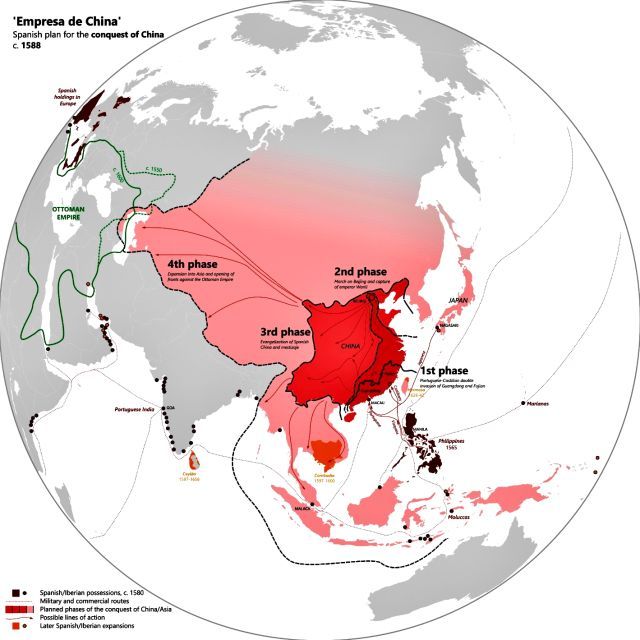
In the 1580s Spain seriously considered conquering China. The plan was to invade via the Philippines, enlist Japan, and then march west to crush the Ottomans. Eventually Madrid realised this was a bit much and abandoned the plan. Source: https://t.co/XSmV9fpWlS
From launch to lunar flyby to splashdown, Artemis II has delivered a defining moment for human spaceflight.
@NASA's Orion spacecraft, built by our team, carried astronauts around the Moon and safely home, proving we’re ready for what comes next.
Newly released video footage from the splashdown of NASA’s Artemis ll in the Eastern Pacific on Friday, April 10, 2026, shows the moment that U.S. Navy Divers cracked the door open and entered the Orion to greet the Astronauts, welcoming them back to Earth after their journey around the Moon.
A Soviet psychologist walked into a café in 1927 and watched a waiter do something impossible.
He remembered every open order at every table. Perfectly. Without notes. Without effort.
Then a table paid their bill. She asked him to repeat the order.
He couldn't remember a single item.
She spent the next two years figuring out why. What she found is now the operating system underneath every platform fighting for your attention.
Her name was Bluma Zeigarnik, and she was a graduate student at the time, sitting with her professor Kurt Lewin, watching the waiters work the room. What caught her attention was something so ordinary that it had been happening in restaurants for centuries without anyone asking why.
The waiters could remember every open order with perfect accuracy. Table four wanted the schnitzel with no sauce. Table seven had changed their wine twice. Table twelve owed for three coffees and a dessert. Every detail, held without effort, without notes, without any visible system at all.
But the moment a table paid their bill, the information vanished. Completely. Lewin tested it on the spot. He called a waiter back minutes after a table had settled up and asked him to recite the order. The waiter could not do it. Not partially. Not approximately. The information was simply gone.
Zeigarnik went back to her lab and spent the next two years turning that observation into one of the most replicated findings in the history of psychology.
Here is what she proved, and why it changes how you think about attention, memory, and almost every piece of media you have ever consumed.
She gave participants a series of tasks. Some tasks they were allowed to finish. Others were interrupted before completion. Then she tested recall across both groups.
The unfinished tasks were remembered at nearly twice the rate of the completed ones.
Not slightly better. Nearly twice. The brain was holding the incomplete work in a state of active tension, returning to it, keeping it warm, refusing to file it away. The finished tasks were closed, archived, released. The unfinished ones were still running.
She called it the resumption goal. When the brain commits to a task and cannot complete it, it opens a file that stays open until resolution arrives. That open file consumes a portion of your cognitive bandwidth whether you are thinking about it consciously or not. It surfaces in idle moments. It pulls at the edge of your attention during other work. It is the thing you find yourself thinking about in the shower when you were not trying to think about anything at all.
This is not a flaw in human cognition. It is a feature. The brain evolved to finish things. An open loop is a signal that something important is unresolved. Keeping that signal active increases the probability that you will return to it and complete it. In an environment where most tasks had real survival stakes, this was an extraordinarily useful mechanism.
In the modern world, it is the most exploited vulnerability in human attention.
Netflix did not invent the cliffhanger. But it industrialized it in a way no medium before it ever had. When a show ends on an unresolved question, it does not just create curiosity. It opens a file in your brain that stays active until the next episode closes it. The autoplay countdown that begins at 15 seconds is not a convenience feature. It is a precise calculation about how long the average person can tolerate an open loop before the discomfort of not knowing overrides every other intention they had for the evening. One more episode is not a choice. It is your brain doing exactly what it was designed to do: return to what is unfinished.
The writers who built Lost, Breaking Bad, and Succession understood this intuitively without ever reading a psychology paper. Every episode ended on an open question. Every season finale answered three things and opened five more. The entire architecture of prestige television is a Zeigarnik machine running at industrial scale.
But television is not where this gets dangerous.
Every notification on your phone is an open loop. Every unread email is an open loop. Every task you wrote on a list and have not yet crossed off is an open loop. Each one is consuming a small but real portion of your available attention, pulling fractionally at your focus, degrading your capacity to be fully present in whatever you are actually doing right now. TikTok's algorithm does not just serve you content you like. It serves you content that ends one loop and immediately opens another, keeping the resumption system permanently activated so the cost of stopping always feels higher than the cost of continuing.
The research on this accumulation effect is striking. Psychologists studying cognitive load have found that unfinished tasks do not sit passively in memory. They actively interrupt. They surface at the wrong moments. They are the reason you are reading something and suddenly remember an email you forgot to send. The brain is not malfunctioning. It is running its resumption system exactly as designed. It is just running it across forty open loops simultaneously, in an environment that generates new ones faster than any human nervous system was built to process.
The most important practical implication Zeigarnik's research produced is one that most people use backwards.
David Allen built his entire Getting Things Done system on the insight that the only way to close a cognitive open loop is to either complete the task or make a trusted commitment to complete it later. Writing something down in a system you actually trust has the same effect on the brain as finishing it. The file closes. The bandwidth is released. This is why writing a task down feels like relief even before you have done anything about it. You have not solved the problem. You have simply told your brain that the loop is registered and will be returned to, which is enough for the resumption system to stand down.
The inverse is equally true and far more destructive. Every task that lives only in your head, unwritten and unscheduled, is an open loop burning cognitive resources around the clock. The mental cost is not proportional to the size of the task. A tiny nagging obligation consumes the same active tension as a major project. Your brain does not discriminate by importance. It discriminates by completion.
Zeigarnik published her findings in 1927. The paper sat in academic literature for decades before anyone outside psychology paid attention to it.
Then television got good. Then the smartphone arrived. Then the entire attention economy was engineered, largely by people who understood intuitively what she had proven scientifically: an open loop is the most powerful hook available to anyone who wants to hold human attention.
Netflix knew it. Instagram knew it. Every designer who ever made a notification badge red instead of grey knew it.
The café in Vienna is long gone.
The mechanism she discovered there is now the operating system underneath every platform fighting for your time.
Every "to be continued."
Every unread notification.
Every thread that ends with "part 2 tomorrow."
All of it is the same waiter, the same unpaid bill, the same brain refusing to let go of what it has not yet finished.
Zeigarnik noticed it over coffee in 1927.
A century later, it is the most valuable insight in the history of media.
And nobody taught it to you in school.
This incredible footage captures a $14000 RC B-2 Spirit stealth bomber making a breathtakingly low pass over the rugged, snow-dusted mountains of Nevada.
📹: https://t.co/QEo1zFQT5t(IG)