robert engle won the nobel prize in economics for proving something hedge funds already knew
they never bothered to mention it to retail
price direction is mostly noise. but volatility? predictable. mathematically, provably, across every liquid market ever studied
it clusters - that's not a pattern someone found, it's a structural law. high vol today predicts high vol tomorrow with 70%+ historical accuracy
the model is called GARCH. published in every econometrics textbook on earth, chapter 4, about 60 lines of python to run
quant desks at citadel and D.E. Shaw don't ask "will it go up?" - they ask "will the next move be large or small?"
because sizing correctly inside a vol regime is worth more than being right on direction
a trader right 48% of the time who sizes with vol awareness beats someone right 62% of the time sizing blindly - every time, over any long enough sample
run it on 10 years of SPY data:
> low vol state -> 74% chance next session stays low vol
> vol spike -> 81% chance next session is also elevated
now you're not predicting markets. you're reading a state machine the market keeps filling in for you every single session with real data
the predictable part of markets was never price direction
it was the distribution of price. the size of the moves. which regime you're currently inside
math is free, data is free, implementation is free
you were just told to stare at candlesticks instead
Bookmark this before the feed buries it
Surfing luxury Airbnb listings from expensive areas and stalking the people who drop 5 star reviews is one of the creepiest (yet smartest) strategies for finding rich mfs that love to splash cash
This is the OG method for discovering wealthy founders, trust fund kids, high-income professionals, investors etc that happily spend $10k/night on Ibiza villas
The idea:
Choose a location > use filter tab to find luxury properties > go through review section on each listing > gather profiles that show name and pfp > get va’s to find contact details online using the info shown from Airbnb profile > hit them up with a disturbingly accurate message
“Yo David, you stayed in my friend’s villa down in Malibu 5 days ago”
(Insert comment that opens a convo)
Pair this method with the right offer + pitch and you’ll speedrun a few million within a year. Fuck it up and you might catch yourself fighting a court case for invasive deanonymization…
Some offers/services this would cook well with include concierges, travel companies, private club offers, event biz, networking groups, online banking.
At least 100+ other ways to make money with this acquisition strategy too
Don’t ask how I discovered this
Do hard shit. Not because it’s fun. But because the win actually means something. You bled for it. You broke for it. You fucking earned it. Easy wins are forgettable. Hard ones change you. That’s the point.
A good read on edge in crypto.
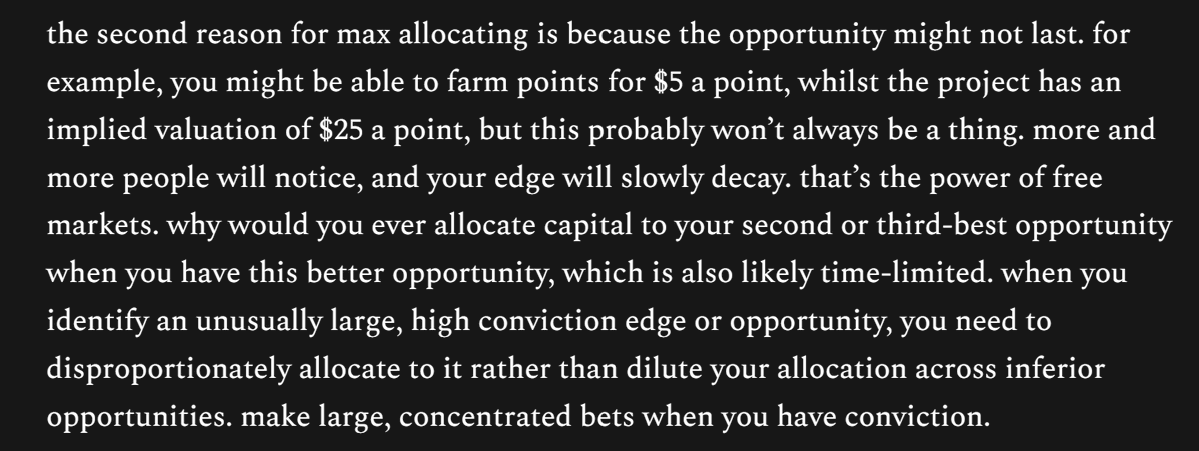
When you have a hot hand (asymmetric opportunity), go more or less all in. Like, why would you allocate money into your 5th best idea?
Back in 2021, and 2023-2024, I more or less sacrificed my health in order to make it. I wasn't working out, barely left the house, and didn't pay attention to my gf. I was selfish, but I saw this as an opportunity that had a tight window, like if these easy conditions would never come back.
My favorite line from Atomic Habits has been living in my head rent-free:
“It doesn’t make sense to continue wanting something if you’re not willing to do what it takes to get it. If you don’t want to live the lifestyle, then release yourself from the desire. To crave the result but not the process is to guarantee disappointment.”
I think ambitious people should treat life in “seasons” rather than trying to balance everything every day.
A few years massively overallocated to work. A period getting seriously fit. A year or two nomading. Then family takes priority for a while. Then maybe at 35 you go completely insane again and spend four years building a new company, and so on.
The mistake is thinking every metric needs to stay green all the time. Most great outcomes (building a company, writing sth serious, training for an event) need uninterrupted runs, not daily moderation. Sometimes work should suffer cause you’re travelling, sometimes your social life should suffer cause you’re building, sometimes career progression should slow cause family matters more. That’s fine.
And tbh it probably makes life more fun too. You get actual chapters and completely different versions of yourself instead of spending 40 years maintaining the same perfectly optimised routine. A few intense years in one city, a weird nomad phase, an obsession that takes over your life, then something completely different. Probably much more memorable than one very long well-optimised Tuesday.
It's why I encourage everyone to think of balance in years, not days. A good life can look horribly unbalanced on some random Tuesday and still be very balanced over 10 years.
Lee Ainslie on sell discipline and "The Sheet of Shame"
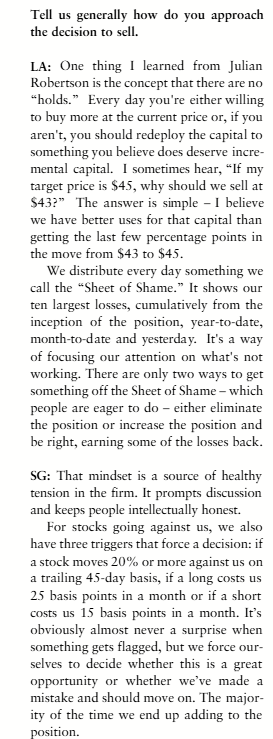
Q: How do you approach the decision to sell?
LA: One thing I learned from Julian Robertson is the concept that there are no “holds.” Every day you’re either willing to buy more at the current price or, if you aren’t, you should redeploy the capital to something you believe does deserve incremental capital. I sometimes hear, “If my target price is $45, why should we sell at $43?” The answer is simple – I believe we have better uses for that capital than getting the last few percentage points in the move from $43 to $45.
We distribute every day something we call the “Sheet of Shame.” It shows our ten largest losses, cumulatively from the inception of the position, year-to-date, month-to-date and yesterday. It’s a way of focusing our attention on what’s not working. There are only two ways to get something off the Sheet of Shame – which people are eager to do – either eliminate the position or increase the position and be right, earning some of the losses back.
SG: That mindset is a source of healthy tension in the firm. It prompts discussion and keeps people intellectually honest.
For stocks going against us, we also have three triggers that force a decision: if a stock moves 20% or more against us on a trailing 45-day basis, if a long costs us 25 basis points in a month or if a short costs us 15 basis points in a month. It’s obviously almost never a surprise when something gets flagged, but we force ourselves to decide whether this is a great opportunity or whether we’ve made a mistake and should move on. The majority of the time we end up adding to the position.
It's when we're truly negatively surprised that we typically exit the position. If we're surprised, that usually means management is also and that there's something more fundamentally wrong with the business than we thought. (VII 12/22/06)