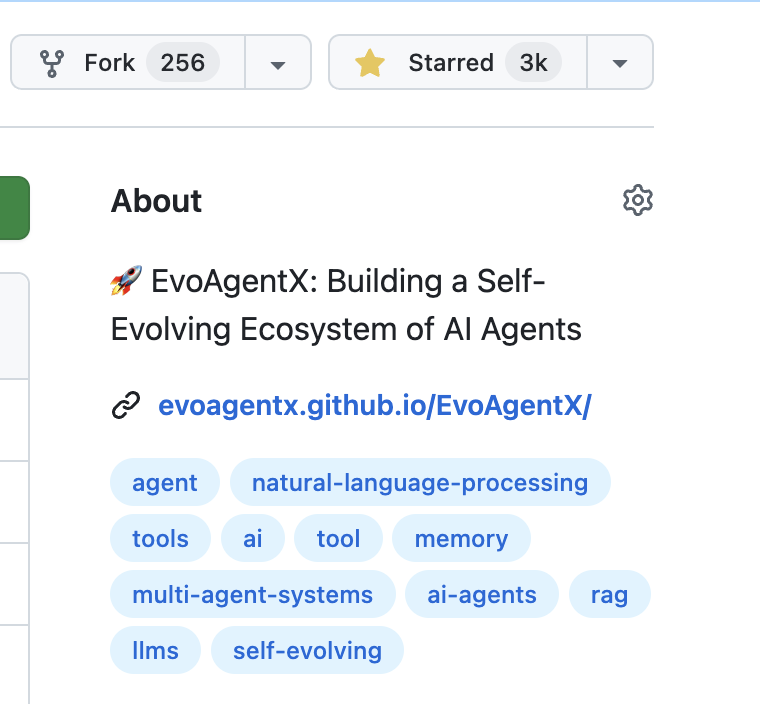
📣 EvoAgentX has a new home: ANative Lab.
You'll notice a new name & avatar on this account — same project, same mission, still open-source & MIT. EvoAgentX is now the flagship open-source framework of ANative Lab, a research lab for AI-native & agent-native intelligence, advancing self-evolving agents and autonomous scientific discovery.
ANative Lab is more than one project:
🔹 EvoAgentX — Build. Evaluate. Evolve. Open-source self-evolving agent workflows.
🔹 EvoScientist — your self-evolving AI scientist: a multi-agent system for end-to-end scientific discovery, by @_xizhang.
The team:
• @mengzaiqiao — Founder & Lab Director
• @TedSiwei — Co-Lead
• @JinyuanF — Co-Lead
• @_xizhang — Chief Scientist
• @Zhaohan_Meng — Research Scientist
🌐 https://t.co/6lLVgQVCtD
💻 https://t.co/Tp97wWbIVA
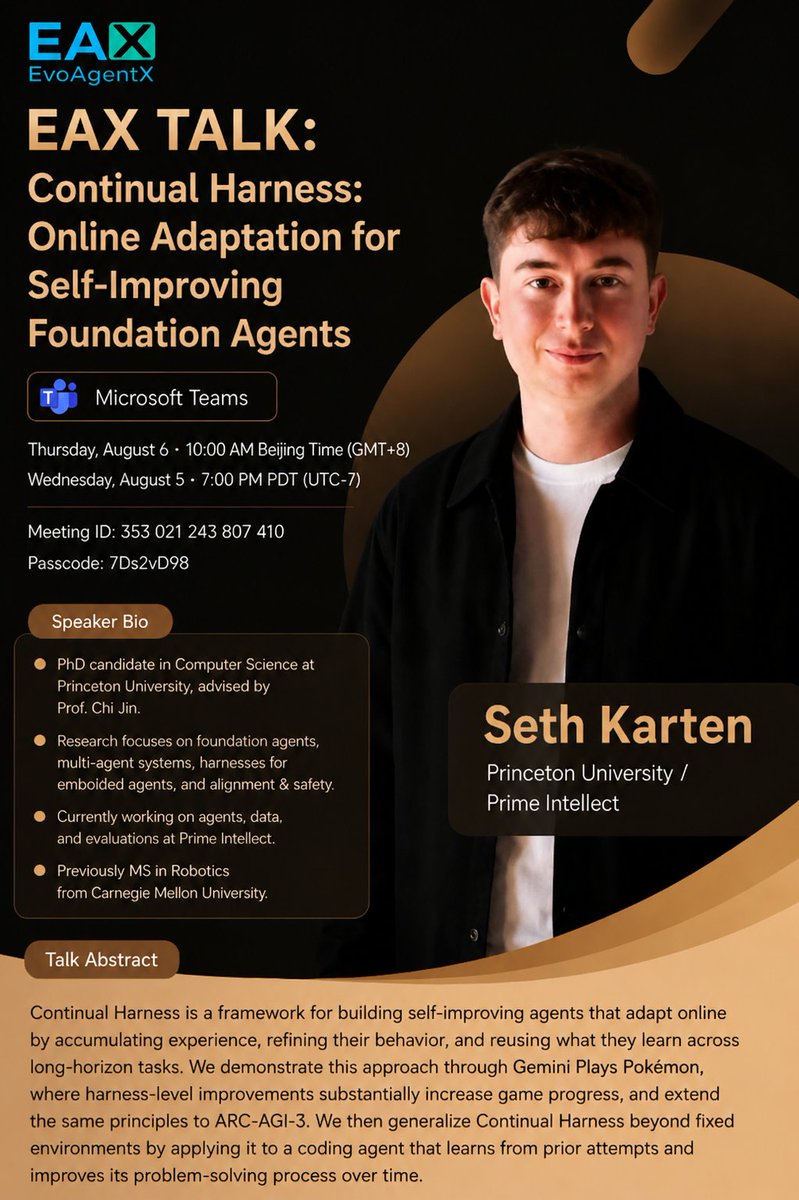
🎮 Can an AI agent keep getting better while it's still running?
That's the question behind our next EvoAgentX Talk.
We're thrilled to host Seth Karten (PhD @ Princeton, researcher @ Prime Intellect) on Continual Harness: Online
Adaptation for Self-Improving Foundation Agents.
Instead of fixed prompts and static workflows, Continual Harness lets agents adapt online — accumulating experience,
refining their behavior, and reusing what they learn across long-horizon tasks. Seth will show it live through Gemini
Plays Pokémon (where harness-level improvements dramatically boost game progress), extend it to ARC-AGI-3, and
generalize it to a coding agent that learns from its own past attempts.
🗓️ Thu, Aug 6, 2026 · 10:00 AM (GMT+8) / Wed, Aug 5 · 7:00 PM PDT
💻 Microsoft Teams
Join us 👇 details in the comments.
#AIAgents #FoundationModels #LLM #AgenticAI #EvoAgentX
Prime Agent, our new general CLI agent, is out. We show a huge narrative violation where models have the potential to outperform their native harnesses across a variety of evals
Huge shoutout to @a1zhang@omouamoua@kevinjosethomas for working on this together
@FReza1984 Yes — if the adaptation is verification-gated: the agent reinforces only what provably passes tests, keeps failures as negative examples, and since it lives in the harness rather than the weights, it stays auditable and reversible.
🎮 Can an AI agent keep getting better while it's still running?
That's the question behind our next EvoAgentX Talk.
We're thrilled to host Seth Karten (PhD @ Princeton, researcher @ Prime Intellect) on Continual Harness: Online
Adaptation for Self-Improving Foundation Agents.
Instead of fixed prompts and static workflows, Continual Harness lets agents adapt online — accumulating experience,
refining their behavior, and reusing what they learn across long-horizon tasks. Seth will show it live through Gemini
Plays Pokémon (where harness-level improvements dramatically boost game progress), extend it to ARC-AGI-3, and
generalize it to a coding agent that learns from its own past attempts.
🗓️ Thu, Aug 6, 2026 · 10:00 AM (GMT+8) / Wed, Aug 5 · 7:00 PM PDT
💻 Microsoft Teams
Join us 👇 details in the comments.
#AIAgents #FoundationModels #LLM #AgenticAI #EvoAgentX
📌 Join details:
💻 Microsoft Teams
🗓️ Thu, Aug 6, 2026 · 10:00 AM (GMT+8) / Wed, Aug 5 · 7:00 PM PDT
Meeting ID: 353 021 243 807 410
Passcode: 7Ds2vD98
See you there! Feel free to share with anyone into agents & self-improving AI. 🚀
Two powerful upgrades on HowOne to make AI app building effortless ✨
• Curated Templates: Explore our handpicked high-quality templates. Jump right in and start instantly, no need to build from scratch.
• Improved Onboarding: Brand new guided steps for app creation. Follow the clear workflow and build your AI app with total confidence.
#HowOne #AI #AIApps #AIAgent #NoCode #LowCode #AppBuilder #BuildInPublic #GenerativeAI #AIWorkflow
HowOne just got a major upgrade 🚀
We’ve refreshed the brand-new homepage with a brand new visual design.Cleaner layout and clearer structure let you quickly figure out what you can build with HowOne in no time.
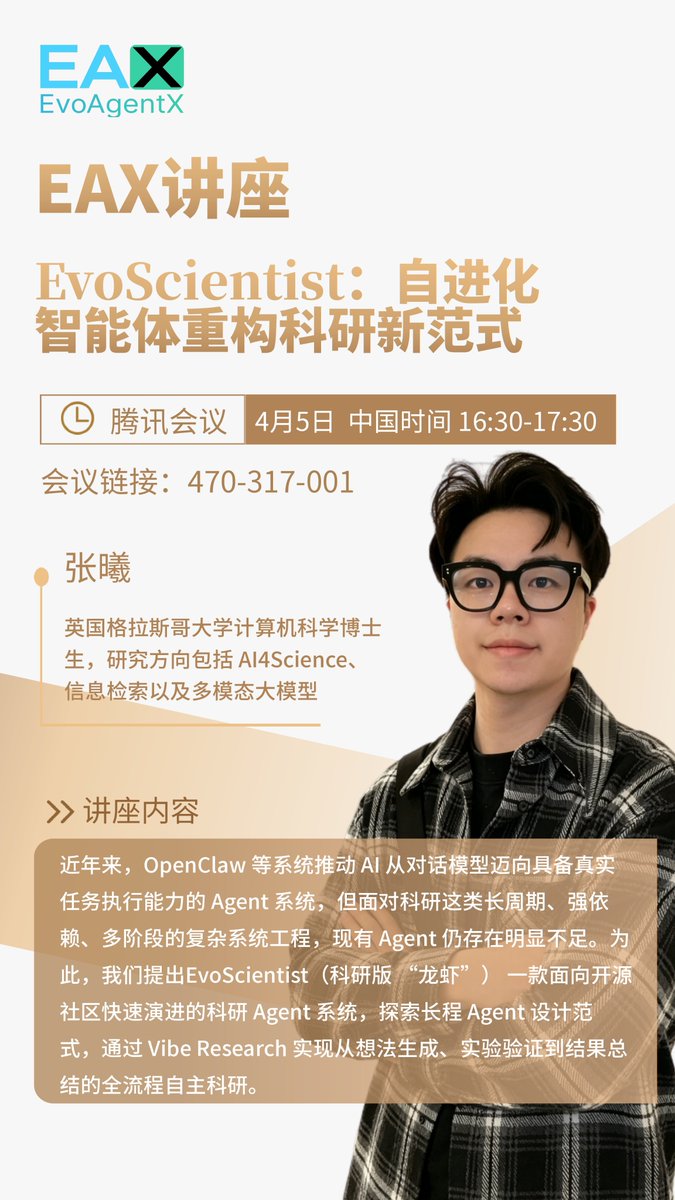
What happens when AI scientists can evolve themselves?
@_xizhang will share EvoScientist — a system where multi-agent AI collaborates to solve real research problems and continuously improves itself.
If you're building AI agents, doing research, or exploring self-evolving systems — this is worth your time.
Join us and see how “vibe research” could become reality.
📅 Apr 5, 16:30–17:30 (CN)
🔗 Meeting ID: 470-317-001
For the past two years, AI founders have been told a comforting story:
Build a good vertical app, pick a niche, wrap the model in a nice UI, charge a subscription.If you execute well, you’ll be fine.
That story is dying.
Not because models got smarter. Because Skills changes what “a product” is.
When Anthropic introduced Claude Skills—and when Agent Skills quickly moved toward an open standard—most people heard “another developer feature.” A new way to package prompts and scripts. Cute.
But if you zoom out, Skills is not a feature. It’s a structural shift:
Skills turns capabilities into installable modules.
And once that happens, a huge percentage of AI startups stop being businesses… and start being plugins that platforms can bundle.
This piece is not a tutorial designed to make you feel optimistic.
It’s a map of the new power dynamics—especially if you’re building an AI product and hoping the platform layer won’t swallow you.
🚨 RIP prompt engineering.
This new Stanford paper just made it irrelevant with a single technique.
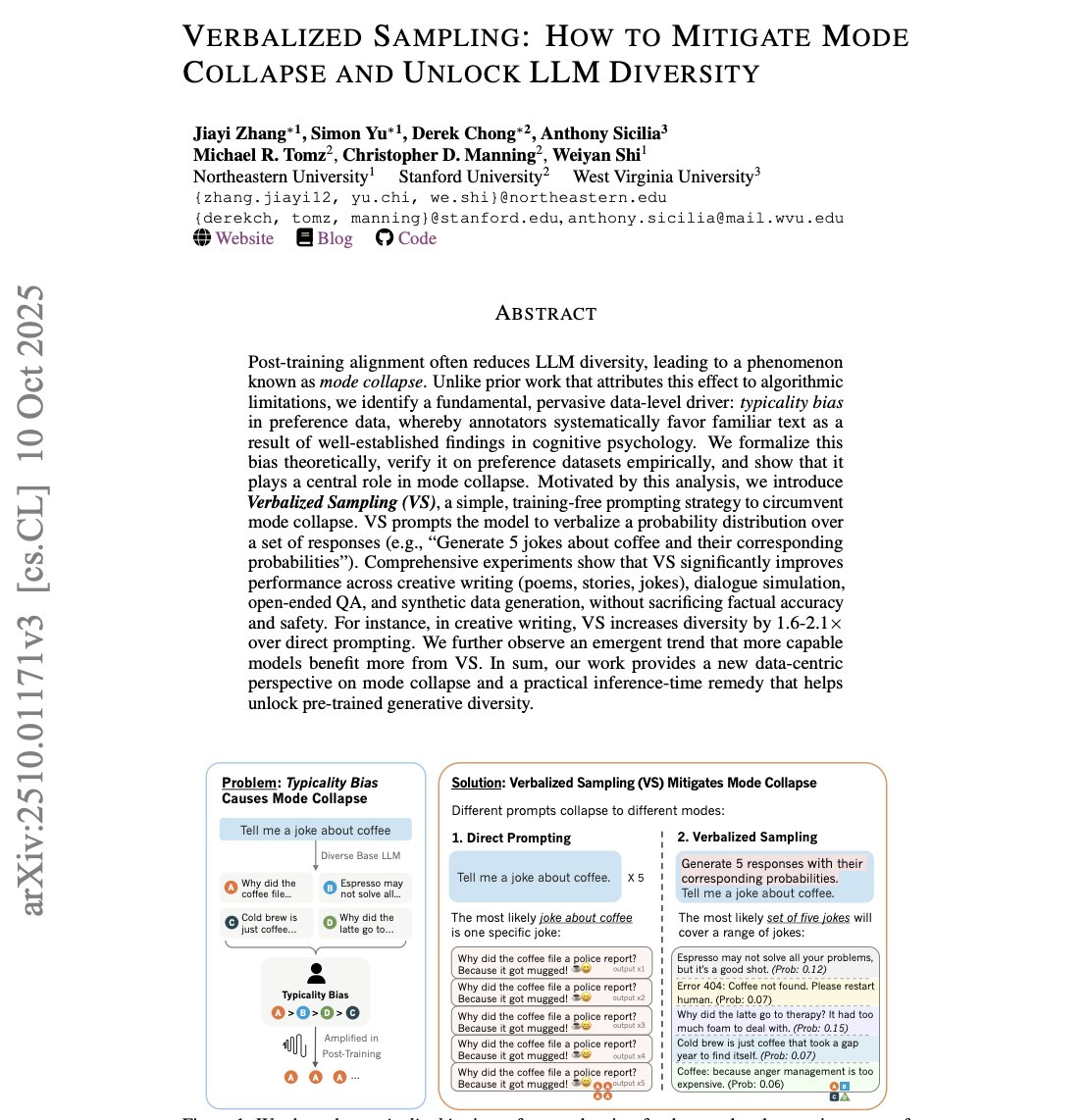
It's called Verbalized Sampling and it proves aligned AI models aren't broken we've just been prompting them wrong this whole time.
Here's the problem: Post-training alignment causes mode collapse. Ask ChatGPT "tell me a joke about coffee" 5 times and you'll get the SAME joke. Every. Single. Time.
Everyone blamed the algorithms. Turns out, it's deeper than that.
The real culprit? 'Typicality bias' in human preference data. Annotators systematically favor familiar, conventional responses. This bias gets baked into reward models, and aligned models collapse to the most "typical" output.
The math is brutal: when you have multiple valid answers (like creative writing), typicality becomes the tie-breaker. The model picks the safest, most stereotypical response every time.
But here's the kicker: the diversity is still there. It's just trapped.
Introducing "Verbalized Sampling."
Instead of asking "Tell me a joke," you ask: "Generate 5 jokes with their probabilities."
That's it. No retraining. No fine-tuning. Just a different prompt.
The results are insane:
- 1.6-2.1× diversity increase on creative writing
- 66.8% recovery of base model diversity
- Zero loss in factual accuracy or safety
Why does this work? Different prompts collapse to different modes.
When you ask for ONE response, you get the mode joke. When you ask for a DISTRIBUTION, you get the actual diverse distribution the model learned during pretraining.
They tested it everywhere:
✓ Creative writing (poems, stories, jokes)
✓ Dialogue simulation
✓ Open-ended QA
✓ Synthetic data generation
And here's the emergent trend: "larger models benefit MORE from this."
GPT-4 gains 2× the diversity improvement compared to GPT-4-mini.
The bigger the model, the more trapped diversity it has.
This flips everything we thought about alignment. Mode collapse isn't permanent damage it's a prompting problem.
The diversity was never lost. We just forgot how to access it.
100% training-free. Works on ANY aligned model. Available now.
Read the paper: arxiv. org/abs/2510.01171
The AI diversity bottleneck just got solved with 8 words.