接触币圈这三年多以来,除了平时在推特上对大大小小的项目做比较系统化的复盘总结,我偶尔也会用笔记工具进行一些碎片化的梳理,昨天抽空翻看了一下,觉得这些经验对自己最终完成Trump上的操作起到了很大帮助,也简单整理一下分享给大家,其中部分文字是直接摘抄的:
2023
5.3
不追求绝对的底部,不要担心卖飞,所谓卖飞的本质是怕错过高倍机会,而一级市场最不怕的就是高倍机会。所谓怕卖飞,对于信息滞后、介入慢的人来说是这样,因为他们可供选择的标的不多,但是玩一级不应该有这种顾虑,抓住10个10倍的机会要比抓住1个100倍的机会容易的多,很可能在追寻后者的过程中损失本金。
7.24
已经不止一次出现这种问题,在自己不熟悉的领域,例如现货投入几十万u,有10~30%的收益却不愿意止盈,在自己熟悉的链上一级市场,总觉得5~10E已经是重仓,而且拿不住也害怕亏损。
8.31
Sei空投和Friend Tech:以最快速度做出能用的技术脚本,响应速度非常重要,慢1天可能就少10倍收益。
Shia:判断土狗币是否是合适的买入点位,应该看预期的上涨空间有多少,而不能简单根据底部筹码的倍数判断,因为大部分土狗币都会有比你买入位置更低的筹码,另一个原因是看到几个群都开始讨论了,于是觉得已经错过了早期机会,但实际上G2老板实名发土狗币应该是类似FUMO级别的利好,至少能发酵几天,如果出于理性判断,而不是被这两种心理导致不敢上的话,应该可以做到百E级别利润,因为逃顶一直是我比较擅长的。
9.3
永远不要在极短时间内把大部分子弹打出去,可以接受少赚一点,不能接受严重亏损甚至爆仓的风险,其次面对自己不熟悉的领域,不要用太想当然的逻辑去操作。
9.4
学习快速干净地止损。别希望自己每次都正确。如果犯了错,越快止损越好。
10.12
今天打牌意识到一点,自己喜欢根据自己的筹码量下注,而非场上形式下注,这带来一个问题就是抗风险能力其实并没有随着筹码量的上升而提高,反而变得更加脆弱。
10.24
小机会可能是免费或只花费时间就能够赚 5000-30000u的预期收益,数量较多且市场容量较有限,风险性较低;
中机会可能是花费时间钻研之后能够赚 50000-300000u的预期收益,投入成本不低,每个月产生该规模的机会不多,市场容量较大,一份风险一份收获。
大机会可能是直接摆在大家面前也很难抓住的机会,往往需要做少数派。一种是投入适中但赔率超乎想象的机会,另一种是投入较高但赔率合理的高概率机会。
2024
1.21
两个年度级别机会的复盘,节点猴和SatoshiVM。能实现利润千万以上级别的项目属于年度级别项目,一个月的时间内已经出现了两次。
节点猴做的不够好的地方在于事先没有调研清楚,居然打完才知道它是第一个比特币上的原创10k PFP,在不知道这个信息的情况下依然判断出了0.03btc是值得参与的,但是没有敢上大仓位,最终投入0.6btc获利3btc左右,这是一个能容纳过亿资金的10倍机会。
SAVM更离谱,关注了一周,在开盘1~2天前分别和三位朋友讨论过项目,结果却没有注意开盘时间导致错过,这是一个可以实现1天千万利润的机会。
在这两个项目上面犯的错误实际是一致的,因为各种原因导致对项目的分析和关注有所懈怠,虽然只是少赚,但是机会成本也是成本,应该极力避免这种情况发生,对于关注度足够或是自己看好的项目,一定要各方面调研清楚。我相信这类机会在一年内会不断出现,平均到月份上可能每1~2个月就有一个可以做到短时间内大资金10倍的项目,下次好好把握。
3.28
这个月的关键词是没有做好止盈,玩链上永远不缺新项目,所以分批出货止盈一定是最优解法,一直以来自己践行的都算出色,这个月为什么没有做好,主要是两个原因,一是因为Bome大家的盈利都太疯狂了,所以对比之下显得钱都变成了数字,几十万u的盈利都不去做止盈,这肯定是一种错误的情绪;二是另两个项目其实都到了卖出的心理价位,但是因为刚发完推不久就暴涨上去,觉得卖出不好意思,其实不必有这种心理,该卖就卖。
4.5
过分保守也是一种冒险。
4.14
Study GCR.
Within alt cycles, you should crank up risk when the trend first reverses, and begin to gradually protect capital as time passes.
People lose because they do the exact opposite;slow early, and increasingly greedy with time.
对宏观和微观都很重要的一条建议,应该在价格最初上涨的时候加大风险敞口,随后慢慢降低,而不是相反,同样对于看好的土狗,前期先以较大仓位建好底仓,后续再做操作,自己往往是底部没买够,涨上去加仓,最后导致亏损
6.10
总结一下自己最近链上操作最大的问题,一是上的仓位不够,且害怕亏损,二是前期犹豫,后期加仓,导致被动,有五六个单币盈利十万u以上的机会,但最后总收益也就只有七八万u
6.18
入圈差不多三年了,最近一直在思考自己平时操作容易犯的错误,不得不说人是很容易受惯性思维影响的。
我算是比较幸运的,进圈不久就接触了链上交易,最开始玩的是BSC上的小池子土狗,后来是NFT,这两者的共性是大部分项目资金容量不大,但是数量多,以小博大,日积月累。
其实现在早已时过境迁了,链上经常会有上百万U的池子,而且因为AMM机制流动性非常好,而CEX除了头部几家交易所里最热门的山寨外,大部分流动性是很差的,但是我脑子里早期形成的思维定式还是潜意识觉得,链上项目不适合用较大资金去参与,大资金还是得去CEX做二级交易。这就导致了一种割裂,明明我所擅长的赛道是链上,现在的热点也是链上,但我往往过度谨慎,反而在交易所下手比较重。
客观来看,以我的能力承担着十分之一的风险、利用着十分之一的本金,就能在链上取得CEX交易山寨同个数量级的利润,我在两者之间下注的比例明显是本末倒置的。这就是我提到的惯性思维所带来的弊病,不过好在终于是渐渐让这个问题暴露了出来,希望早日精进。
7.28
Neiro犯了几个经典错误,第一个是这种级别的叙事,自己第一反应也是很有机会的,结果600k都不敢上,总是莫名其妙顾虑太多,可能是因为要做社群的缘故,容易瞻前顾后,又受特朗普大会一堆死狗的影响,又觉得是20分钟前的新闻,其实完全没有必要过于谨慎,很多压力纯粹是自己给自己的,不需要有太大负担,这种级别的机会还是早期看到的一定要去赌。另外保持敏感性,既然是20分钟前的,为什么想不到去找更早的PumpFun,这些都是要潜意识就去做的操作。
11.3
10月的链上行情达到了又一个高峰,整体结果还可以,应该有盈利50~70万u,但是依然有很多操作没有做好,钻了不该钻的,卖飞了不该卖飞的,简单总结的话,我觉得是新叙事、新赛道的龙头可以格局,例如Goat,Pnut,而仿盘Beta,要及时获利止盈,仿盘上面能浮盈20万u级别就要开始坚决止盈。
11.24
在这笔交易中我愿意损失的最大金额是多少?
链上交易的核心是以小博大,在大部分时候,可以接受投入的本金归零,因为换取的是5~10X甚至更多的利润,除非是重仓高位接盘,那其实类似于二级交易。二级交易的核心是最小化潜在损失,以5~10%的止损认为该交易无效,换取20~50%的潜在收益。每一笔交易,下注前,考虑清楚自己愿意承受的损失是多少。
当有“太容易,太顺利”此类感受的时候,就应该将大部分仓位换成稳定币,经验表明,这样的感受一方面是因为市场到了最容易的阶段,此后容易转向,另一方面也容易因为自负导致误操作。
12.1
下半月投入比较多的项目,大概五六个Meme币,都买入了10~15万u这个数量级,加大链上出手的仓位不是问题,错在正好赶上了链上遇冷,再这样的大背景下,流动性和情绪难以维持,更适合早期以小博大,而不是上仓位追高。
这几个项目的判断本身我觉得没有问题,只是过程执行的细节不好,类似大池子的局,如果要中期上仓位,假如没有推背感,就要及时注意止盈或者止损,而不是拿到归零。
此外Hyperliquid是我一年来都非常看好的项目,开盘也给了3以下买入的机会,结果因为市价单买入成交价高了10%,限价单又没有成交,准备好的50万u只买入了15万u,而且又过早卖出了,最后只获利7万u,对于这个级别的项目操作的非常差,要么投入更多仓位,适当止盈,要么买少了就多拿一拿。
看完就会发现,我花了整整两年多时间,反复练习,加大链上出手的仓位,分批止盈防止卖飞和利润回撤,面对大部分人眼里的“不确定机会”下重注,最后才有了Trump一战的结果。
There'll be one global backbone - Ethereum
Ethereum is the backbone of the new global financial system of L2s and L1 apps. No other chain will come close.
Mert suggested that Sol can pivot to being the backbone. But Solana will never be the backbone. Here's 5 reasons why.
Four years ago, Ethereum pivoted to focus on being the backbone of the new global financial system of L2s and L1 apps. Eth's backbone strategy is being increasingly recognized as an apex L1 strategy and genius move - it's still early, but the signs are there if you look closely, such as imitation being the most sincere form of flattery, and L2s dominating.
Solana has done very well this season in degen/meme growth and SOL price. Yet, imo Sol leadership are starting to see the writing on the wall in terms of L2s being on track to eat alt L1 market share. Now, they seem to be suggesting that Solana could pivot to become a backbone like Ethereum, too.
But Solana is fundamentally unsuited to be a backbone for L2s or even world-scale L1 activity. I'll explain why in detail.
As a preface, let's explore how Solana leaders seem to have have gradually admitted that Ethereum's L2 backbone strategy is excellent and that Solana might pivot to pursue being a backbone.
At first, Solana sold the idea that they were going to be so fast and so cheap that the entire world was going to use the single Solana chain. This was their "monolithic" era, a term they championed before it became a liability (because in reality, no one monolith can serve the whole world). They pivoted their marketing to use the term "integrated".
Then, mid this year, Solana acknowledged that L2s are the right approach. A few things led up to this. Solana leaders noticed that some of their flagship apps began building custom L2 appchains on Sol - this was for the usual reasons that customers love L2s (ie. control and customization, while being part of a greater whole and not having to run your own consensus). And earlier this year, a prominent Sol community member wrote a spicy thread on Sol's need to adopt L2s - the Sol community lit that mfer on fire because this was before their leadership admitted that L2s are ~inevitable. Plus, a major Sol dev team pivoted/expanded to building a SVM L2 on Ethereum (from Sol L1 app to Eth L2). The net result was that Solana leadership started leaning into L2s.
(Note that Solana didn't admit that Ethereum was right about L2s all along, instead they said their L2s are not L2s, but are in fact "Network Extensions". This is pretty huge marketing spin. It's is similar to Sol's recent new concept of "True tps" which they had to invent because, over the years, they pervasively misrepresented Sol's tps on many info sites by including the 80% (!!) consensus overhead in reported tps. Many sites still say Sol's tps is 3k but really it's ~750tps. Their new "True tps" was invented by them to counteract their longstanding practice of reporting "False tps". My point is that serious people doing serious diligence for serious onchain investment should be sure to look closely at Solana's claims - many do not hold up under scrutiny.)
Fast forward to this month, and now Solana leadership is starting to talk about how they can simply pivot to Ethereum's backbone strategy (but they can't for the reasons below).
Why is Solana starting to favor Eth's backbone strategy? Why now?
It's because it's finally becoming obvious to everybody that the world needs many, many new chains (thousands, then tens of thousands), and L2s are generally a much better deal than alt L1s (that's why Coinbase, Kraken, Sony, EVE Online, etc. chose L2), so being the backbone for L2s is an apex strategy.
So can Solana just pivot to being a backbone? No, this strategy is unavailable to Solana (for the reasons below).
In reality, Solana is in deep trouble in terms of their technical and economic strategy.
What trouble is Solana in specifically?
Solana will not be fast or cheap enough to serve even a fraction of the whole world's coming demand.
Solana is not decentralized enough to attract true giga whale capital.
Solana can't be a competitive global backbone for L2s.
Solana bundles consensus and execution, which is slower and costlier than doing only execution. That's why the most scalable L2s - who only need to do execution and not consensus, while also benefiting from being part of the overall trustless composability network effect across all L2s - will soon be faster and cheaper than Solana. See MegaETH.
To say the previous point again because it's crucial: not only will Solana not be the backbone, but soon, it won't even be the fastest or cheapest chain.
Right now to some people (including many investors), Solana might seem like the best at everything - a better version of Eth. But this couldn't be further from the truth. Soon, Solana will be the best at nothing - on a technical/economic level.
So far this season, ETH may have lost the ratio battle against BTC and SOL (season's not over), but Ethereum has been playing chess, not checkers. Ethereum is on track to win the "war" of capturing the vast majority of onchain growing to global ubiquity because Ethereum scales the way the world actually works - via an L1 backbone and marketplace of L2s.
In short, Ethereum was right all along that being the backbone is by far the best L1 strategy. Yet, while Solana leadership may suggest they can become a backbone, they can't.
~~~
5 reasons why Solana will never be suitable as a global backbone
1) Solana has no real client diversity and probably won't ever have it on a meaningful timeline.
Client diversity means that your chain is run by several independent programs in parallel. This greatly helps to prevent both attacks (multiple independent dev teams and programming languages) and accidents (multiple codebases, as bugs are usually local to a single codebase).
Client diversity is mandatory for a global backbone.
To achieve client diversity, no single program can run a majority of your validator stake. This requires at least three independent chain clients and balanced stake between them. It also requires a PDF protocol spec and research community that's upstream of your chain clients. The protocol spec determines the "definition" of the chain, as well as the correctness/reliability of this definition. This ensures all the clients are working towards the same rigorously specified goal.
Today, Sol has only one production client (agave rust). Sol is trying to build a second client (firedancer), but it's proving to be extremely difficult and delayed because they have no real protocol spec or research community, and because the agave rust client is highly optimized and strongly leverages underlying hardware, making it even harder to extract the low level design into a PDF protocol spec to then reimplement in new clients.
Firedancer is not close to being ready to run 50% of stake in production with its entire own codebase. imo years, not months.
Even once Solana has firedancer in production, they won't yet have achieved client diversity. To do so, they'll need at least a third production client (so that no client has more than 50% stake, impossible with 2 clients), and a balanced stake between them, and for all three clients to be 100% original codebases with no code overlap, no dev team overlap, no code dependency/library overlap, and written in all different programming languages.
Ethereum has four production chain clients that meet these criteria, and has for years.
2) The second reason that Sol will never be a global backbone is because their chain requires very high bandwidth (they recommend 10Gbps upload). This adds very significant real-world centralization and risk.
The entire point of a global backbone is to minimize risk in all its forms, so burdening with extremely high bandwidth requirements is a non-starter.
A high bandwidth requirement is difficult to work around. You can buy a big computer and transport it anywhere, but you can't get 10Gbps upload in many areas, especially not outside of capturable corporate data centers or over VPNs.
The backbone must be able to run practically anywhere. The credible threat of running the backbone anywhere - even totally avoiding data centers entirely if needed in the future - is a key part of risk minimization.
10Gbps is Sol's recommended upload today, but it'll increase over time. For Solana, the bandwidth problem doesn't get better over time.
3) Solana has a high risk of a future outage. Solana's halted lots before and lacks Eth's protocol-level fallback to continue producing blocks even if "finalization" can't occur.
When there are 200 countries with 100 trillion in assets trusted to a global backbone, it's pretty important that the backbone always does what it says it will do, including never going offline.
4) Sol lacks economic decentralization. ~2% of SOL TGE/ICO was sold publicly. That's a ~98% (!!) insider allocation.
ETH sold 80% publicly, and then PoW with high inflation for seven years had the upside of distributing ETH very widely because miners must dump almost all their ETH to pay for mining costs.
On an economic and operational basis, Solana is relatively very centralized. This adds significant risk and detracts from suitability as a global backbone.
5) zk proof aggregation for L2 settlement means that the L1 global backbone has no reason whatsoever to sacrifice even a tiny amount of decentralization for extra scalability.
Although the Eth L1 is intentionally not focused on execution scaling, every L2/L3 in the world, even 100,000s of chains, will be able to settle on Ethereum because of zk aggregation.
Solana specializes in L1 execution scaling, which is a liability for the global backbone's requirement to maximize decentralization and credible neutrality.
~~~
For these reasons, Solana will never be the backbone of the new global financial system.
imo, Solana won't even be "a" backbone in the sense that Solana's year-over-year market share will continue to decline vs all of Ethereum (L1+L2) across key hard-to-game metrics like non-native app capital or major corp integrations. This is because the world is generally much better off onchain on Eth L2 or L1 vs. on Solana or any other chain. Don't trust me - ask Coinbase, Kraken, Sony, Visa, the City of Buenos Aires, and many more existing and upcoming corps and govts.
Anybody doing serious diligence to come onchain will uncover the points I made above, including corps and govts seeking to invest or build - which will soon be all of corps and govts across the world.
Ethereum is the backbone of the new global financial system. No other chain will come close, Solana included. L2s are destroying alt L1 market share and distributing ETH as money. Significant value accrual to ETH will follow.
Airdrops are a fascinating initial use case for ZK / blockchain-based identity / credential / attestation frameworks. The goals of an airdrop are:
(i) distribute to community members [and not randos who will all immediately sell]
(ii) reward contributions to the project
(iii) be reasonably egalitarian [but some disparity is ok]
(iv) resist extractive/adversarial farming
These are exactly the properties that identity / credential / attestation frameworks (eg. see ideas in https://t.co/CINI0INpwf ) are trying to achieve. Hence, for anyone building such frameworks, it makes perfect sense to use token issuance as an initial use case to beta-test and refine their work in an adversarial environment.
If you form your opinions from other peoples opinions, especially from online, you are doomed to be poor.
Get facts, then form your own opinions.
Ps. 99% of “facts” out there are opinions, assumptions, inaccurate, wrong, or deliberately false.
👀 open your eyes. 🙏
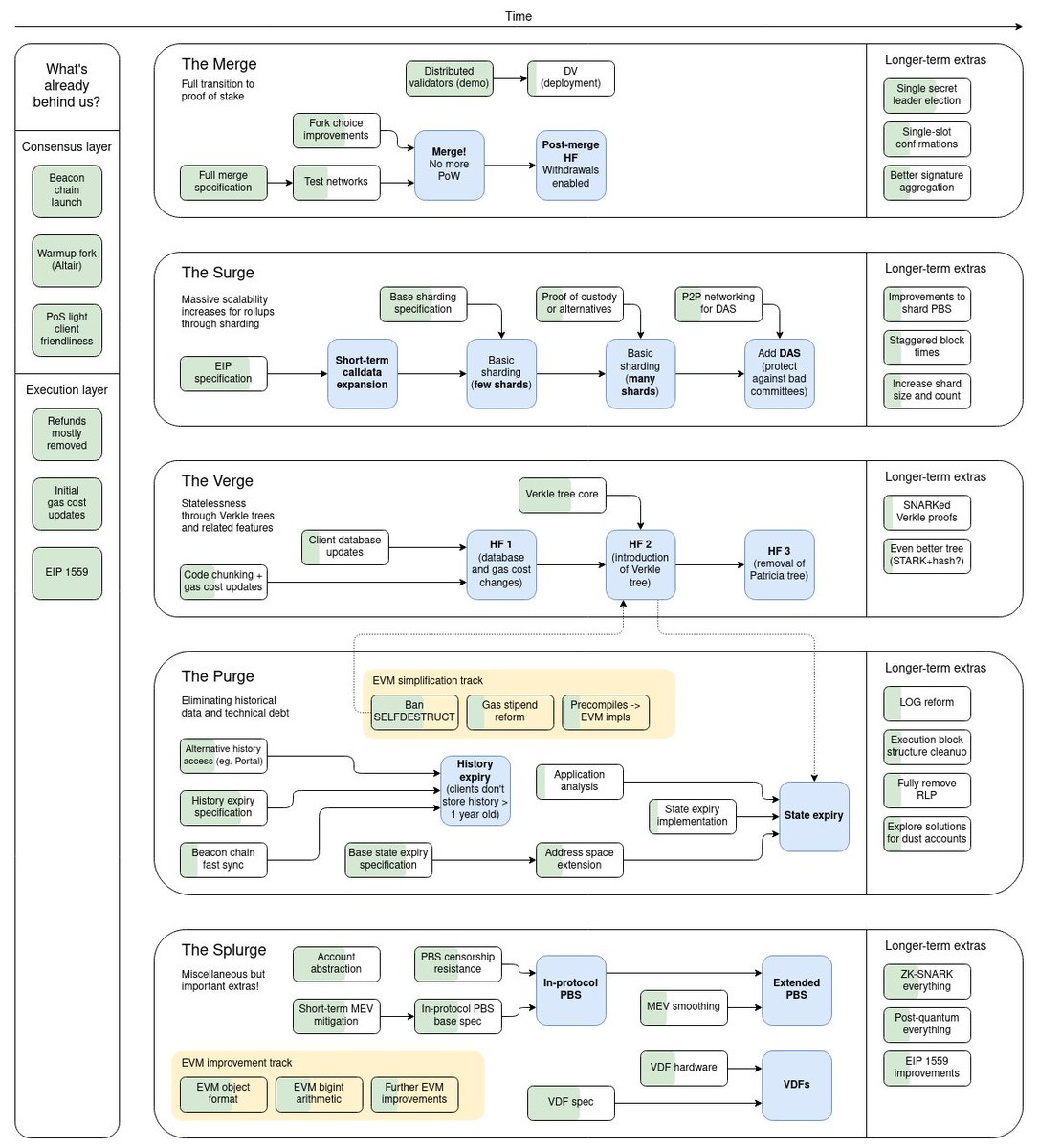
.@VitalikButerin claims that #Ethereum will be able to to process "100,000 transactions per second", following the completion of 5 key phases:
• The Merge
• The Surge
• The Verge
• The Purge
• The Splurge
A quick breakdown of what each stage means for $ETH. 👇