This is why $ASTS is different and better than anything $SPCX has cobbled together. Musk makes wild claims that have potential, but they are on Elon time and even he said 3 years to catch up...
LinkedIn Article by Ali Esswie, a senior director at $ASTS
🐾
Voice from space, where link budget becomes the business model!
The industry often talks about direct-to-cell as if all services are equally hard. Well, they are not.
A short best-effort message, a delayed app update, or a small data burst can survive weak geometry, retries, and uneven link quality. Voice is different. A real carrier-grade voice call needs a sustained two-way bearer. The uplink and downlink must stay alive continuously, packet loss and jitter must remain bounded, and the device cannot spend the call repeatedly searching, re-accessing, or recovering from timing drift.
That is why voice from space is not just “data, but smaller.” It is a much harder network problem.
The binding constraint is usually the handset uplink. A normal phone transmits with limited power, from a tiny antenna, toward a satellite hundreds of kilometers away and moving at orbital speed. At low and mid bands, the free-space path loss from LEO is already around the mid-150 dB range under good geometry, and can move higher at low elevation. That leaves very little room for mistakes.
This is where satellite architecture matters. A large and well-designed spaceborne aperture improves both sides of the link, higher downlink EIRP toward the phone, and more importantly, higher receive sensitivity on the satellite side to hear the weak handset uplink.
For voice, that margin must be held over the duration of the call, not just during a favorable burst. Every few dB matter because they decide whether the network can maintain a stable bearer or falls back into repetitions, lower reliability, or dropped sessions.
Doppler and timing are the second wall. A LEO satellite can introduce large frequency shifts and fast-changing delay. A phone should not be forced to behave like a satellite terminal. The network has to absorb the motion, compensate delay and Doppler per cell or beam, and make the satellite look as close as possible to a normal mobile cell. Without that, the modem may technically connect, but voice quality becomes fragile because the control plane, scheduling, and uplink timing are always chasing motion.
This is the key strategic distinction in direct-to-cell. D2C systems can be good at opportunistic connectivity, messaging, best-effort apps, short bursts, and limited data under favorable conditions. However, carrier-grade voice and broadband to unmodified phones require a different design center: large aperture, uplink margin, low/mid-band operation, tight Doppler and delay compensation, and integration with the mobile core so voice behaves like a real operator service.
That is how the AST SpaceMobile ecosystem is designed from the ground up, not as an adaptation, but as a unique architecture for sustained link margin, voice continuity, and broadband service to everyday phones.
#D2C #ASTspaceMobile #3GPP
$ASTS
https://t.co/iP3Irj2sE1
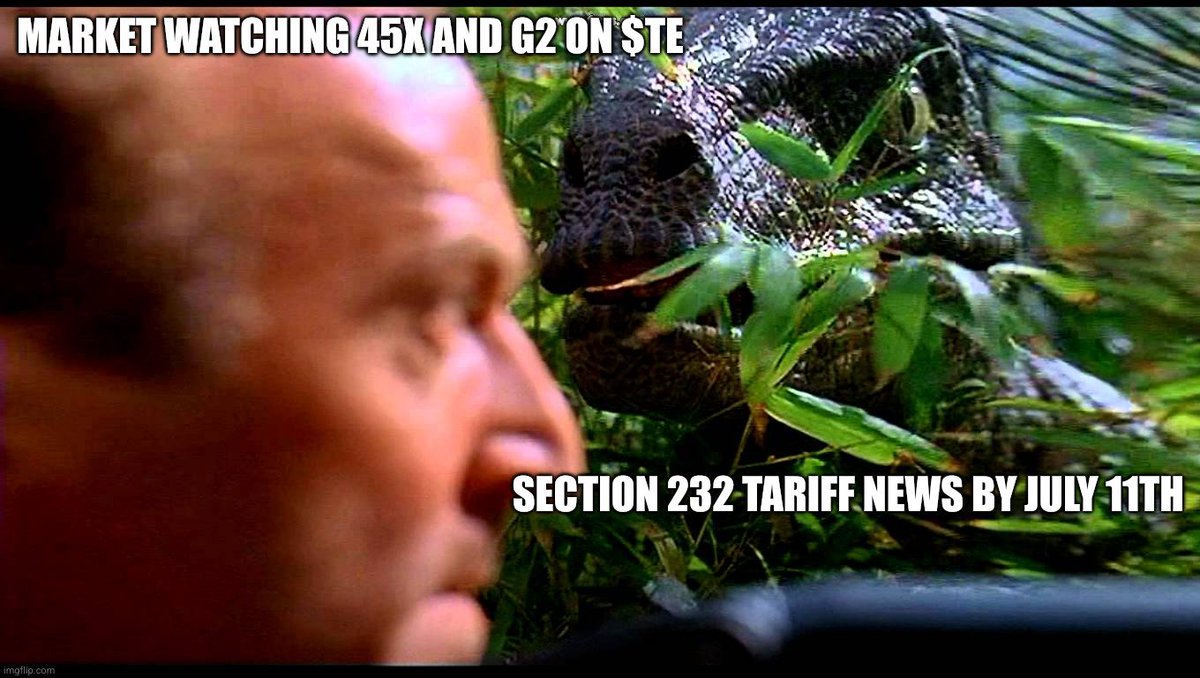
FYI on solar stocks $FSLR $TE. Next two weeks we’ll be due a decision on solar tariffs. Section 232 tariffs are stickier/based on an investigation. Steel stocks $NUE $STLD ripped earlier on a section 232 expansion this year
#Isro has successfully tested a new semi-cryogenic #engine, achieving 175 tonnes of thrust. This crucial step towards a more #powerful LVM-3 rocket is expected to significantly boost payload capacity for future launches. The engine's advanced #turbopumps also performed exceptionally. This development is vital for India's growing ambitions in space #exploration and commercial launches.
More details 🔗 https://t.co/Zrsi6K4hQA
Stay informed, stay ahead – download the TOI app today 👉 https://t.co/ogFaRsVinV
@bert_gilfoyle They seem to be mixing up a lot of things in that article. The presidents decision has to be made by June 26th, period.
The announcement period can be weeks later, I don't specifically recall, but want to say 6 weeks max.
@Ryan__Rigg And now G2 financing can be announced.
Section 232 tariff decision is due next week as well.
I wouldn't be surprised if this was your last chance to get $TE below 9 bucks
Space Force has issued new orbit data for the @AST_SpaceMobile sats launched yesterday, showing all three in their expected 525 x 530 km x 53.0 deg orbits, independently confirming successful launch.
Nobody is talking about Trump’s Section 232 polysilicon tariff decision that drops NEXT WEEK (June 26 deadline).
Tariffs move prices from $0.28/W to $0.40/W. An immediate 40% jump for plays like $TE, instantly inflecting FY0 & multi-year PPAs.
Profits up 250% in that scenario.
$TE
Shows whales dumping near-term TE calls (reduces MM pressure to sell to hedge near term) to aggressively load July & Sept $14-$17 OTM contracts.
Potential short squeeze is coiling.
@FuzzyPandaShort shorts would be screwed.