📣Índice Triglicéridos glucemia combinado con la edad
✅Entre los 12 índices lipídicos evaluados, TyG especialmente en combinación con la edad demostró el mayor valor predictivo para el envejecimiento vascular en esta amplia población china
@ATHjournal
https://t.co/endIfQFlKq
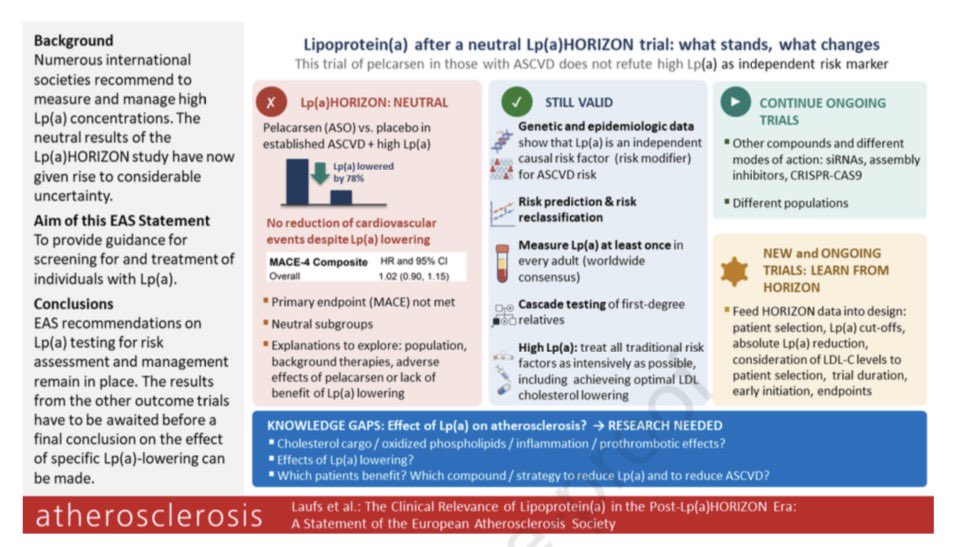
🧬 Lp(a)HORIZON: pelacarsen bajó la Lp(a) un 78%, pero no mostró ningún beneficio en reducción de eventos cardiovasculares (MACE HR 1,02; IC95% 0,90–1,15)
¿ Qué supone esto para toda la evidencia construida sobre la Lp(a) ? La @society_eas lo responde en @ATHjournal, con consejos prácticos 🧵👇
🔗 https://t.co/llEWQtNLqq
#Lpa #CardioTwitter
✅Screening hipercolesterolemia familiar mediante un perfil lipídico capilar es un método eficaz
❌50 % casos altamente sospechosos rechazaron seguimiento
➡️Punto corte deben adaptarse a la metodología y reevaluarse durante el cribado
https://t.co/egaqFqRye7
@ATHjournal
👉 MUST READ; A landmark EAS Statement in the post-Lp(a)HORIZON era in @ATHjournal
☝️The European Atherosclerosis Society @society_eas delivers a timely, evidence-based message following the neutral results of Lp(a)HORIZON.
1️⃣ 78% Lp(a) reduction ≠ cardiovascular benefit.
We must distinguish a causal risk factor from a validated therapeutic target.
2️⃣ Lp(a) remains a major cardiovascular risk factor.
Measure it at least once in every adult. Family screening remains essential.
3️⃣ LDL-C lowering is our strongest actionable strategy.
Intensive control of LDL-C and other risk factors can mitigate Lp(a)-associated risk.
4️⃣ Timing may be everything.
Can a few years of treatment reverse decades of cumulative atherogenic exposure?
5️⃣ The science is far from over. Ongoing RCTs with different Lp(a)-lowering agents are essential.
☝️My key takeaway: A negative trial should change our assumptions, not replace scientific evidence with speculation.
☝️ Measure Lp(a). Lower LDL-C. Control global risk.
Keep testing hypotheses with RCTs.
🔗 https://t.co/PkokhMCK0e
@BNordestgaard@ProfKausikRay@MeralKayikcoglu@KronenbergLab@j_rvl@SamiaMoraMD
El 21,3% de los pacientes con niveles controlados de LDL-C presentaban niveles de colesterol no-HDL por encima del valor objetivo (discordancia
@ATHjournal@TGijonConde@AMAREVA_Madrid
https://t.co/qyKmwIfbHj
Check out our latest publication in @ATHjournal Is elevated lipoprotein(a) associated with venous thromboembolism (VTE)?
Our meta-analysis found a borderline association driven mainly by case-control studies.
https://t.co/oxe39GoD8c
@MayoClinicCV@MayoAZCVFellows
📣A new era in atherothrombosis
👉Las nuevas terapias podrían transformar la enfermedad cardiovascular aterosclerótica, de ser afección propensa a la ruptura a enfermedad más crónica y controlada
➡️Revisión evidencias moleculares actuales @ATHjournal
https://t.co/x0MlBem0vk
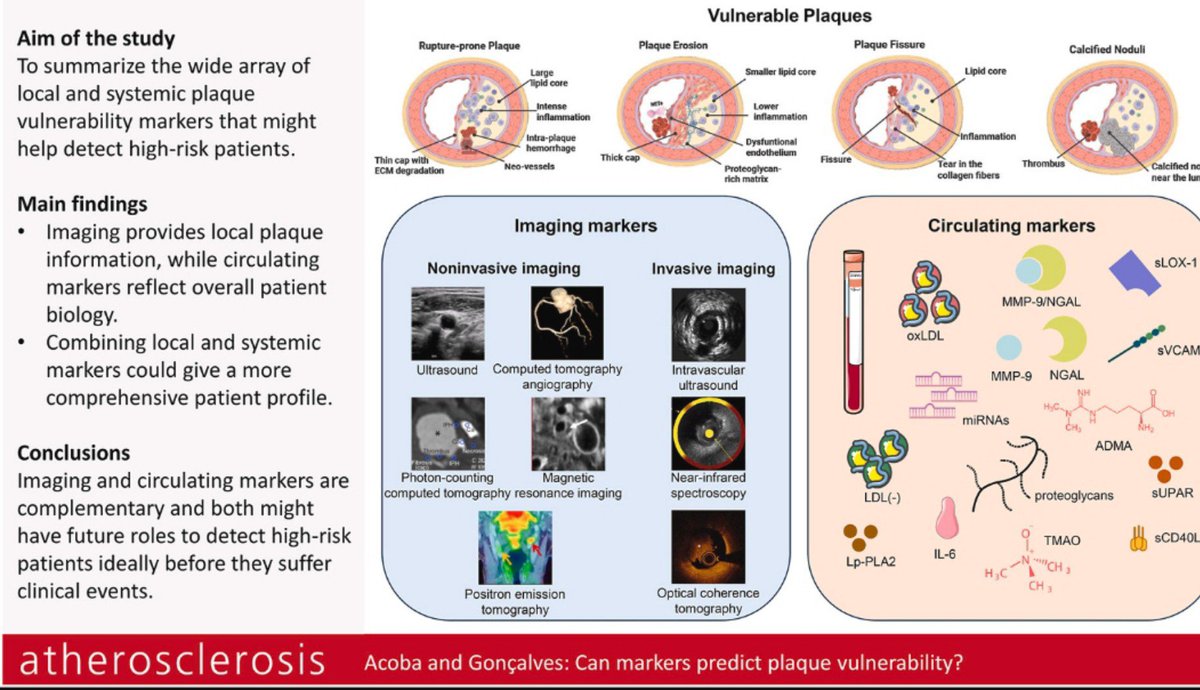
✅Los biomarcadores tradicionales suelen ser biológicamente asociativos en lugar de causales
✅Nuevos enfoques como la biología de sistemas, la medicina de redes y las imágenes moleculares están ampliando la atención cardiovascular de precisión
https://t.co/3oEOKumFkY
@ATHjournal
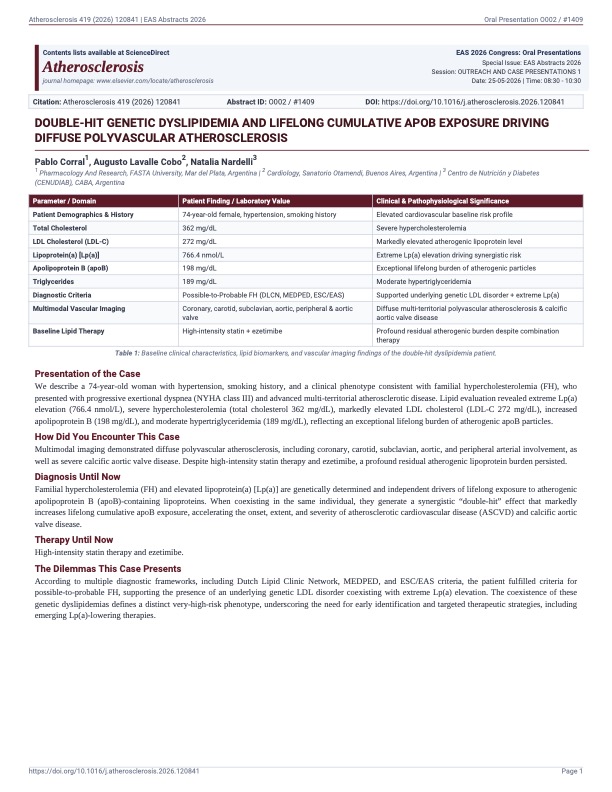
👆Just published in @ATHjournal — from our #EAS 2026 Oral Presentation
DOUBLE-HIT GENETIC DYSLIPIDEMIA: when two lifelong genetic drivers converge.
👉LDL-C 272 mg/dL
👉Lp(a) 766.4 nmol/L
👉apoB 198 mg/dL
🤔 Possible-to-probable familial hypercholesterolemia + extreme Lp(a)
👉The result:
An extraordinary lifelong cumulative apoB burden, with diffuse coronary, carotid, subclavian, aortic and peripheral atherosclerosis — plus calcific aortic valve disease.
👆The message is simple:
Atherosclerosis is about the magnitude × duration of exposure to apoB-containing particles.
When FH and extreme Lp(a) coexist, the vascular system faces a true genetic “double hit.”
With @alavallecobo & @natinardelli_@society_eas
#Atherosclerosis #LpA #FamilialHypercholesterolemia #ApoB #LDL #ASCVD #EAS2026
➡️➡️Los pacientes con síndrome coronario agudo sin ningún factor de riesgo previo: diabetes, obesidad , HTA o tabaquismo tienen peor pronóstico que los que tienen al menos uno⬅️⬅️
👉Interesante paradoja
@ATHjournal
https://t.co/17tVJyboW6
The interplay of genetics and modifiable risk in atherosclerosis
✅✅Interesante revisión
Curiosamente, se observó que el tratamiento para reducir los lípidos era aún más beneficioso cuando la predisposición genética era fuerte
El alto riesgo inflamatorio afecta a aproximadamente
✅30 % de los pacientes con enfermedad cardiovascular aterosclerótica (ECVA) a nivel mundial
✅40 % de aquellos con enfermedad renal crónica concomitante
📣Estudio POSEIDON
@ATHjournal
https://t.co/2QBWu7ENZi
Real-world variability and factors associated with individual low-density-lipoprotein cholesterol response to different doses of atorvastatin, rosuvastatin, and simvastatin
@ATHjournal
👉👉Variabilidad efecto estatinas
https://t.co/zS1VlyH5hv
I read Gonzalez et al. with great interest, especially alongside the newly published RISSCI-2 study in Atherosclerosis https://t.co/XNtphVqhF9
The observation of a median 53% LDL-C reduction with ezetimibe is certainly intriguing.
But we should be very careful about what this study actually demonstrates.
The 14 patients were retrospectively selected because they had already shown a marked LDL-C response to ezetimibe. They were not consecutive, there was no control group, and the prevalence of this response among unselected patients with ketogenic diet-associated hypercholesterolemia is unknown. Again the same problem!
Therefore, 53% is not an estimate of the expected effect of ezetimibe in ketogenic hypercholesterolemia. It is the response observed in a selected group of hyperresponders.
That distinction is fundamental.
The mechanistic interpretation is even less certain. The authors propose increased dependence on intestinal cholesterol absorption, yet sterol-balance markers did not show a uniform hyperabsorption phenotype. Negative testing for monogenic FH or sitosterolemia does not establish that the LDL elevation was caused by the ketogenic diet, particularly when pre-diet lipid values were frequently unavailable and formal clinical FH criteria were not systematically applied.
This becomes especially relevant in light of the new RISSCI-2 study in Atherosclerosis. In a prospective dietary intervention using stable-isotope tracing, differences in saturated-fat absorption did not explain interindividual LDL-C responsiveness, and changes in markers of cholesterol absorption and synthesis were remarkably similar between high and low responders.
RISSCI-2 does not directly refute Gonzalez et al. The populations and hypotheses differ.
But it provides an important reminder:
A striking pharmacological response does not prove the mechanism responsible for the underlying hypercholesterolemia.
Even more importantly, a retrospective case series of 14 selected responders cannot be used to ask why clinicians should prescribe statins or PCSK9-targeting therapies instead of a “$10 drug.”
That comparison confuses hypothesis-generating evidence with randomized cardiovascular-outcomes evidence.
Selecting patients because they had an exceptional response and subsequently presenting that exceptional response as evidence for treatment selection is not precision medicine; it is selection bias until prospectively validated.
Ezetimibe is an excellent, inexpensive, evidence-based drug. That does not require inflating what this study demonstrates.
The correct conclusion is actually the one contained in the paper itself: this is an interesting hypothesis-generating observation deserving prospective confirmation.
Precision medicine starts with phenotype. But rigorous science starts with knowing what the study design allows us to claim.
La expresión TRAF5 identifica fenotipo de placa estable y menos inflamatorio, y predice independientemente reducción del riesgo cardiovascular tras endarterectomía carotídea
Biomarcador potencial para estratificación personalizada del riesgo
@ATHjournal
https://t.co/Hne7OSy3l5
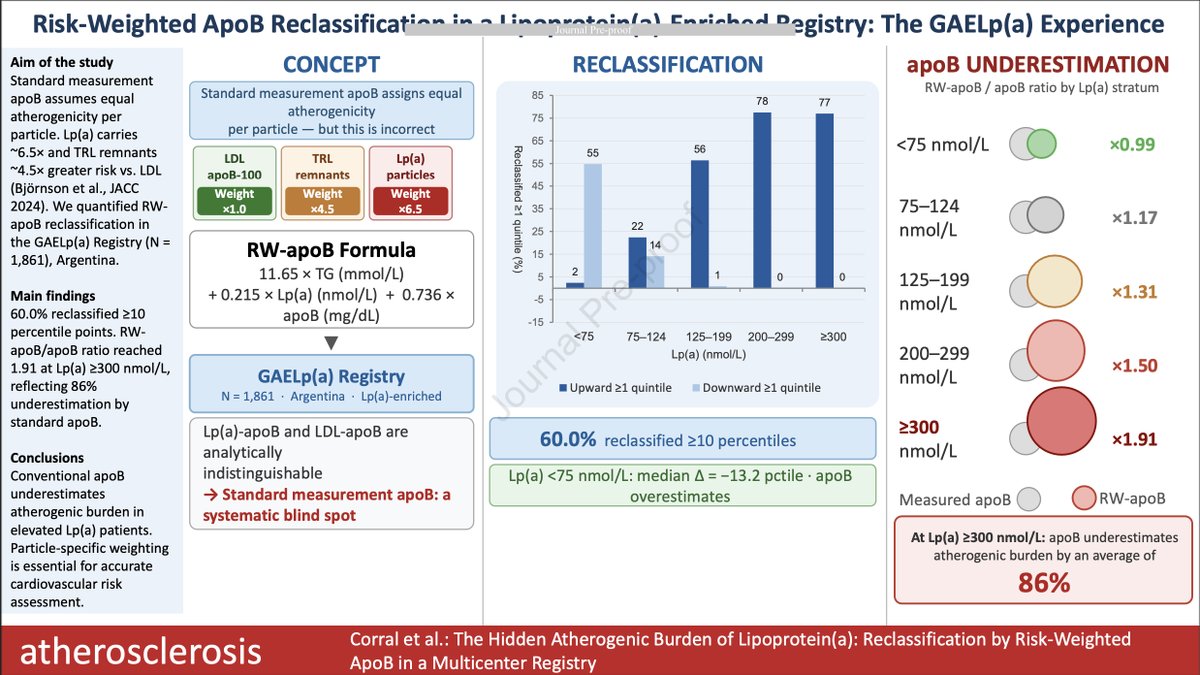
🇦🇷 Proud to share our latest publication in @ATHjournal from the GAELp(a) Registry.
Another important contribution from Argentina and Latin America to the global understanding of Lp(a) and cardiovascular risk.
👉 1,861 patients from a nationwide multicenter Argentine registry
👉 Risk-weighted apoB reclassified 60% of participants by ≥10 percentiles
👉 As Lp(a) increased, conventional apoB progressively underestimated atherogenic burden
👉 At Lp(a) ≥300 nmol/L, RW-apoB was 1.91× measured apoB — an 86% underestimation of weighted atherogenic burden
👉 The discordance was driven primarily by Lp(a), not triglyceride-rich lipoproteins
🙌 Beyond the findings, this is another milestone for the GAELp(a) collaborative network: high-quality, multicenter real-world evidence generated in Argentina and contributing to the international lipid field. 🇦🇷
💪 Proud of this team. Proud of Argentine science.
🪢https://t.co/fsx6KeZjzG
@society_eas@magabrielama83@lschreier1@alavallecobo@JSoumoulou@nicolasrennamd@lynchsantiago@natinardelli_@sebagz1
La apoB convencional subestimó sustancialmente la carga aterogénica ponderada en individuos con niveles elevados de Lp(a), y la discrepancia aumentó a concentraciones más altas
@drpablocorral@ATHjournal
We've long focused on Lp(a) molar concentration, but Lp(a) biology is more complex. In our new paper led by Kaloyan Takov and Manual Mayr @Vascular_Prot, shows that native Lp(a) carries an APOE-associated triglyceride signature. TG(52:3) and TG(52:4), enriched in polyunsaturated fatty acids, are linked to incident MACE and may represent oxidizable lipid cargo contributing to cardiovascular risk. Lots of new stuff on the way identifying specific components of Lp(a) (chol, TG, OxPL) and CVD risk @DavidErlinge@GreggWStone@society_eas https://t.co/XM1yYjMa6N