🐂🧬Genome-Wide Genomic Analysis and Evolutionary Insights into Bovine Coronavirus Strains in Southwest China
🔗https://t.co/fwXavbxrjz
#BCoV#VetSci#Zoonosis
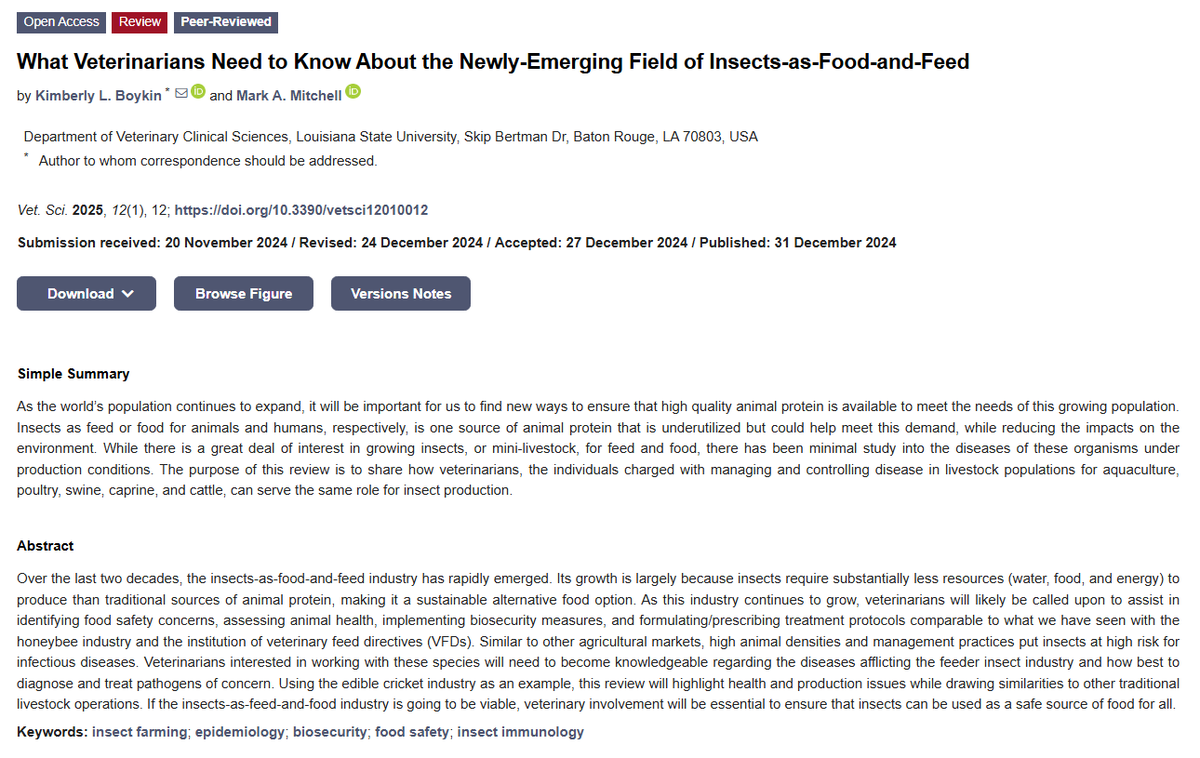
🐛🦗What Veterinarians Need to Know About the Newly-Emerging Field of Insects-as-Food-and-Feed
✍️by Kimberly L. Boykin * and Mark A. Mitchell
🔗https://t.co/fVGH1ibgdB
#VeterinaryMedicine#InsectProtein
Foot and mouth disease has recently caused unprecedented outbreaks in Southern Africa. The spread of New World screwworm, a flesh-eating parasitic fly, is also raising concern, with tens of thousands of cases reported across Central America. Lumpy skin disease reached Western Europe for the first time. Worldwide, avian influenza recorded over thousands of outbreaks in animals, spreading to new species and new areas.
At the same time, the financing landscape on which prevention programmes depend is contracting
significantly. What the evidence shows is not comfortable reading. More than 20% of global animal production is lost to preventable disease every year.
Annually, less than US$ 1 billion in development aid reaches Veterinary Services and zoonotic disease prevention. Less than 2.5% of a shrinking global health aid budget is currently directed at the frontline of pandemic prevention.
Read more about what we can do correct this imbalance in the State of the World's Animal Health report: https://t.co/FcT4qEcn7b
📢¡Investigación en ENZOEM @Univcordoba!📣
En colaboración con investigadores del @IQUEMA_ y del @cei_A3, analizamos cómo los compuestos orgánicos volátiles que libera la carne al almacenarse pueden utilizarse para evaluar de forma rápida su frescura y deterioro microbiológico.
October issue: Global vulnerability of small-scale fisheries, power representation in food systems, taxing food emissions... and more!
https://t.co/bbWDYxrMfF
🦟 Hoy empieza una semana intensa de debate, ciencia, establecimiento de redes colaborativas, y desarrollo de planes de acción en materia de vigilancia y control de #vectores a nivel europeo 🚀
#ESOVE2026VLC
https://t.co/pBq6va84P6
📰 #Noticia | El 16 de diciembre, fecha clave para la especialidad de #EnfermedadesInfecciosas.
El @sanidadgob afronta la fase decisiva para validar el expediente e iniciar la tramitación del Real Decreto, con el objetivo de que las primeras plazas puedan ofertarse en el #MIR2028.
Desde la SEIMC seguimos trabajando para lograr una formación especializada que garantice el relevo generacional y refuerce la respuesta ante las amenazas infecciosas.
Gracias a @GacetaMedicaCom por hacerse eco de ello.
#SíEspecialidadEI #SpainhasnoIDspeciality
https://t.co/6LfAQ3BgFs
Animals and plants use conceptually similar immune systems to detect microbes and activate defenses. In both lineages, pattern recognition receptors (PRRs) perceive pathogen- or microbe-associated molecular patterns (PAMPs or MAMPs) and host-derived damage-associated molecular patterns (DAMPs).
Whereas animals rely on specialized immune cells, plants harness individual cells expressing diverse PRRs. In the apoplast, which lies outside the plasma membrane and includes the cell wall, PRRs detect immunogenic fragments released from microbial proteins by plant hydrolytic enzymes. Conversely, pathogen-secreted enzymes can degrade constituents of the apoplast, generating DAMPs that activate immunity.
In three new Science papers, researchers report expansions of this surveillance, revealing receptor architectures and mechanisms that enable plants to discriminate immunogenic carbohydrates. The findings illustrate how ligand specificity and receptor assembly confine immune activation to the context of microbial challenge.
Learn more in a new #SciencePerspective: https://t.co/dbFk733jD5
#Opinión ✒️ | 'Hacia un tratado mundial contra los delitos medioambientales', por Lucía Sánchez-Tejado, veterinaria especializada en crimen ambiental y 'One Health'
https://t.co/PzqGTbtB69
🦇🇮🇩🦠 #Zoonoses : des virus proches de souches responsables d’infections respiratoires humaines détectés chez des chauves-souris vendues pour la consommation en Indonésie.
Deux orthoréovirus isolés chez une espèce jusqu’alors non identifiée comme hôte.
https://t.co/YZAZw2nx9b
🔬🐷 High burden of multidrug-resistant E. coli in #PigProduction systems in Calabar, Nigeria. The study underscores the need for strengthened antibiotic stewardship and improved farmer education to combat this One Health challenge. 🌍📚
https://t.co/5AyiE4EhUu
🦇 Et si la prévention des #zoonoses commençait par la protection des écosystèmes ?
🌍 Changement climatique, déforestation et perte de biodiversité modifient les contacts entre chauves-souris, élevages et humains.
#Nipah#Hendra#Ebola
https://t.co/Vbx6GNGcLU
"El cambio climatológico es una realidad y eso hace que se extiendan mucho los vectores, que son esos insectos que transportan virus"
@A_MateosAmann
Presidente de @AVESA2016 y @colvetbizkaia
https://t.co/wPiImgvEHh
Las autoridades europeas están llevando a cabo investigaciones para determinar si el virus causó o contribuyó a la muerte de un paciente en Francia y cómo se produjo el contagio
https://t.co/PeYQ2yzBj7
📢 The Special Issue “Early Diagnosis and Surveillance of Transboundary and Emerging Viral Diseases of Animals, 3rd Edition” welcomes research on rapid diagnostics, field detection, and improved surveillance methods.
📅 Deadline: 31 March 2027
📄 https://t.co/NIcWsQIU3j