Over the last couple of weeks, I followed @karpathy's Let’s Reproduce GPT-2 video religiously-making notes, writing code and completing the re-implementation of GPT-2 from scratch.
🤦♂️
This is unnecessary paranoia.
Decisions like this are exactly why we need a robust open-source ecosystem. You never know when companies might decide to pull the rug, whether under government pressure or for some other absurd reason. When that happens, you and your product might be left in limbo.
The US government, citing national security authorities, has issued an export control directive to suspend all access to Fable 5 and Mythos 5 by any foreign national, whether inside or outside the United States, including foreign national Anthropic employees.
The net effect of this order is that we must abruptly disable Fable 5 and Mythos 5 for all our customers to ensure compliance.
Access to all other Claude models is not affected.
We apologize for this disruption to our customers. We believe this is a misunderstanding and are working to restore access as soon as possible.
Read our full statement: https://t.co/bwn0sximKZ
Some of the biggest companies of the next decade won't be software businesses. They'll be services companies like insurance carriers, law firms, and tax practices rebuilt from scratch with AI doing most of the work.
In this episode of Startup School, YC Visiting Partner @CharlieWarren walks through the playbook for building AI native services companies, covering how to pick a market with the right traits, why variance kills these businesses faster than anything else, and the P&L math that’ll transform your business model.
00:00 — Intro to AI Services Companies
01:01 — Picking the Right Market
02:55 — Markets YC Likes Right Now
03:43 — The Sam Altman Test
04:35 — The Right Founding Team
05:28 — Building the Product
06:19 — Variance Is the Existential Problem
07:08 — The Early Demand Trap
07:53 — How to Price AI Services
08:41 — The P&L Walkthrough
09:33 — AI Operating Leverage
10:27 — Don't Buy Your Way In
i suspect we've been in the mainframe era of AI computing and we're about to enter the PC era of it.
data centers are obviously still critical but oh man so much personal hardware and software is about to come
So much is happening in AI. There are new tools, new frameworks, new models and everyone seems to suddenly be a 10x performer. It is easy to feel like you are falling behind.
However, the hardest and the most important part is to stay focused on the one thing you believe in and not chase after everyone and everything. Learn to tune out the noise. Compounding works quietly. Stay focused!
On the other hand, India’s total R&D budget hovers around ~$20billion 🙈
This is around just 1/25th the amount we have allocated for various welfare schemes.
Socialism and welfare schemes are essential for the society. However, they can only be sustained by growth. Growth requires both capitalism and lots and lots of R&D spending.
I hope our leaders and administrators realise this soon before it’s too late.
BREAKING:
China has officially surpassed the United States in overall research and development spending, investing about $1.03 trillion in technological advancement.
US had led global research and development spending for decades before being overtaken by China.
I switched to @antigravity a few months back and recently started using @cursor_ai again. Nothing comes close to cursor’s autocomplete feature.
It is far way better and ahead of everything else.
Cursor + @claudeai claude code 💪
@AnthropicAI is currently serving their claude code customer base to @OpenAI codex on a nice platter.
I am one of the Max (5x) users and is unaffected by this. But it does make me feel a bit uneasy. Maybe I should start using codex or @opencode more and more.
Getting lots of questions on why the landing page / docs were updated if only 2% of new signups were affected.
This was understandably confusing for the 98% of folks not part of the experiment, and we've reverted both the landing page and docs changes.
We had room for 2,000 people at Startup School India.
More than 25,000 applied.
No Startup School anywhere in the world has ever had this many people apply. Not SF, not NYC, not London. India blew them all away.
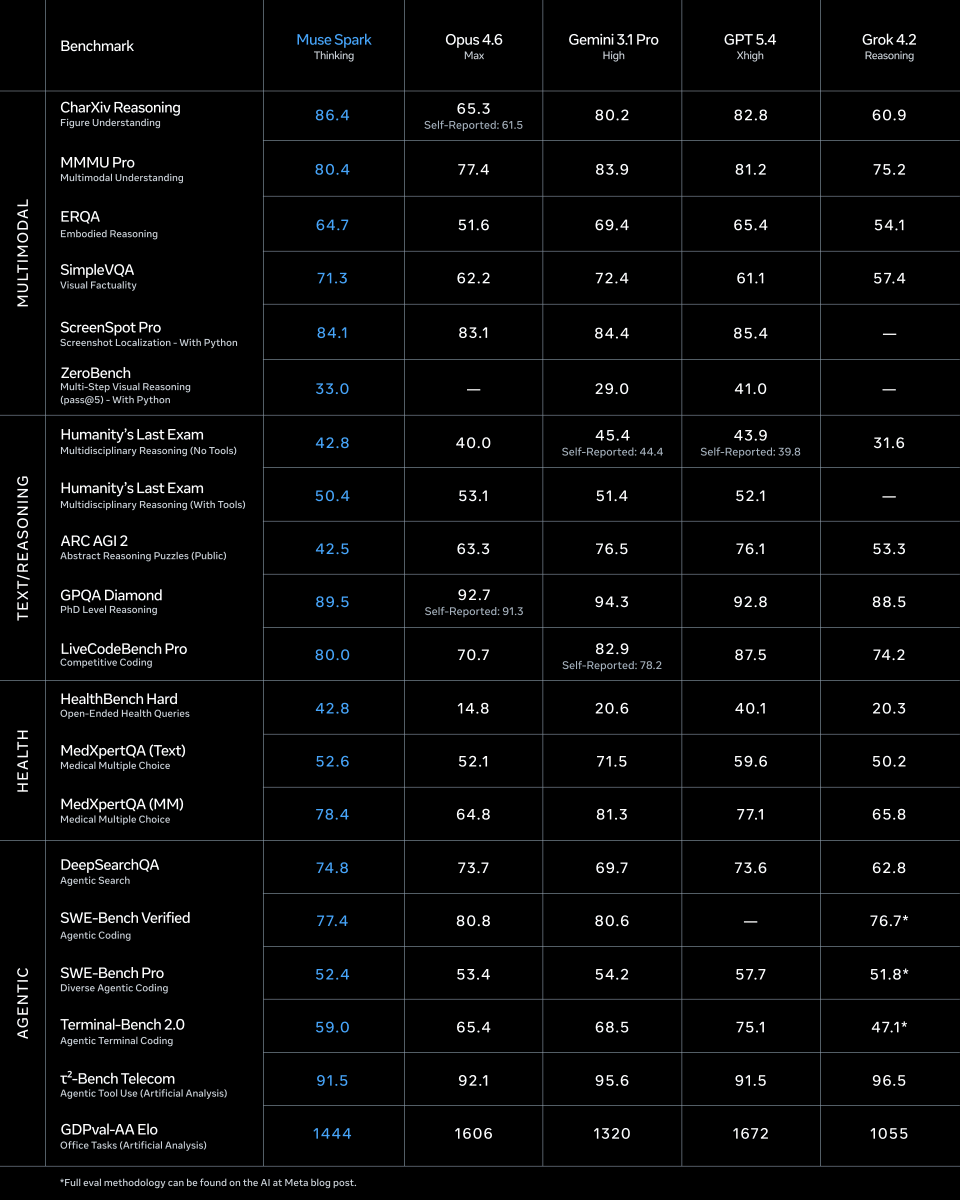
1/ today we're releasing muse spark, the first model from MSL. nine months ago we rebuilt our ai stack from scratch. new infrastructure, new architecture, new data pipelines. muse spark is the result of that work, and now it powers meta ai. 🧵
- MoE models are ~3x faster at generation (~135 tok/s vs ~45 tok/s) but both dense models got the complex task right on the first try. Both the MoE models needed retries.
- Qwen3.5-35B-A3B is seems to be the most verbose (32K tokens on the complex task).
- Gemma4-31B dense is context-limited in comparison to others on a 4090. Had to drop to 65K context to maintain acceptable generation speed.
- None of the models actually followed TDD despite being asked to. All claimed red-green methodology but wrote integration tests hitting the real API.
- Qwen3.5-27B produced the cleanest code (correct API model name, type hints, docstrings, pathlib). Qwen3.5-35B-A3B had the best structure but hardcoded an API key in tests and used the wrong model name.
You can find the detailed analysis notes here: https://t.co/AAbAId8pDs
I wanted to see how @Google's Gemma4 performs against @Alibaba_Qwen Qwen3.5 for local agentic coding. I ran two types of tests:
- Standard llama-bench benchmarks for raw prefill and generation speed
- Single-shot agentic coding tasks using Open Code to see how these models actually perform on real multi-step coding workflows
My pick is Qwen3.5-27B which is still the best model for local agentic coding on an 24GB card (RTX 3090/4090). It is reliable, efficient, produces the cleanest code and fits comfortably on a 4090.
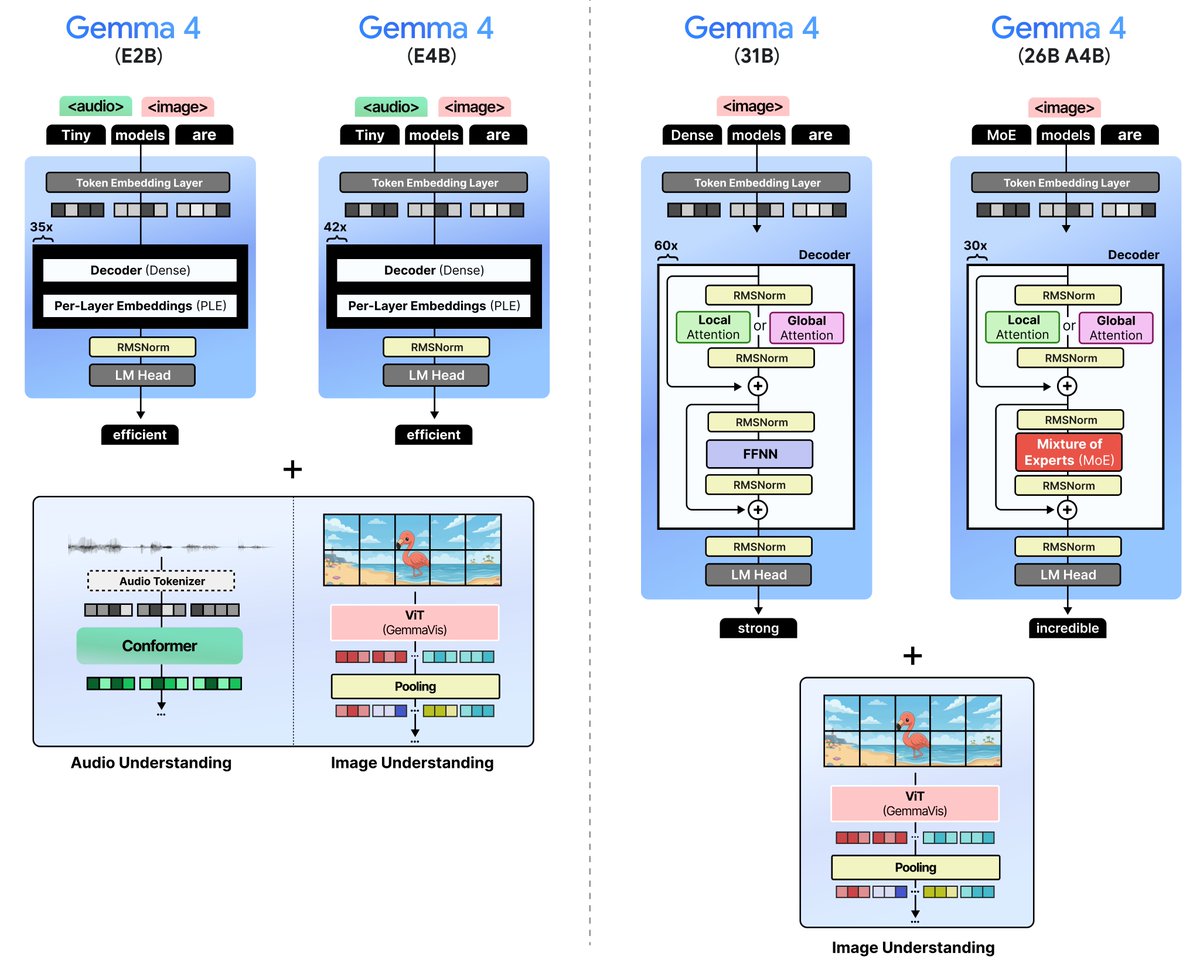
A Visual Guide to Gemma 4
With almost 40 (!) custom visuals, explore the new models from Google DeepMind. We explore various techniques, ranging from Mixture of Experts and the Vision Encoder all the way up to Per-Layer Embeddings and the Audio Encoder.
Link below 👇
@GoogleDeepMind's Gemma4 is genuinely great for local use. I spent some time playing around with it this afternoon and was really impressed by the speed of Gemma4-26B-A4B, hitting ~145 t/s on RTX4090 and the capabilities. Coupled with web search and image support, it delivers a really strong experience.
You can further improve the experience with a few simple tricks and a short system prompt.
The blog below covers exactly how I set it up and how I use it across my Mac and iPhone: https://t.co/LH1R3ZnB3e
Pro tip - hook your PC and Phone with Tailscale and enjoy fast and private inference on the go.
Here is Gemma 4, hosted on Mac Studio, streaming to my iPhone.
No 3rd party apps. Same WebUI experience everywhere.
@bnjmn_marie Eagerly waiting for those evals. Also, can you can share your vllm setup/flags too in your evaluation blog & post, would be of great help.