If Everton are up for sale, the valuation and future capital needs of the club will surprise you. The reasons for selling are apparent (please note the independent qualification re the report): https://t.co/4afkOZj5t7
The 5 Layers of AI: Why Most People Only See the Tip of the Iceberg
Everyone is obsessed with ChatGPT. But most people miss where the real value (and money) is actually hiding. This graphic breaks down the entire AI Ecosystem, and it’s a total game-changer for understanding how the industry really works. The "free" part is at the bottom!
✓ Layer 1: The Foundation (AI & ML)
This is the brain behind the magic. We’re talking about Machine Learning, Deep Learning, and Neural Networks (Transformers, CNNs, LSTMs). This is where the heavy lifting of pattern recognition happens.
✓ Layer 2: The Engine (Deep Learning)
This is where "intelligence" really gets created. Large Language Models (LLMs) and Computer Vision learn to process data, turning raw information into predictions and coherent text.
✓ Layer 3: The Creator (Generative AI)
This is the layer everyone sees! Here, we have Prompt Engineering and RAG (Retrieval-Augmented Generation). This is where AI starts generating new content—text, code, and even images—based on the data.
✓ Layer 4: The Doers (AI Agents)
This is where the real shift happens. AI stops generating and starts acting. We are looking at Multi-Agent Systems where AI orchestrates tools, manages memory, and executes tasks autonomously to solve complex problems.
✓ Layer 5: The Trust (Agentic AI & Governance)
This is the "boring" part that makes it safe. This includes Observability, Guardrails, and Explainable AI (XAI). Without this layer, you don’t have an autonomous system—you have an expensive coin flip.
🆓 WHICH PARTS ARE FREE? (The "Open Source" List)
If you are trying to build something without a massive budget, here is where you can leverage Open Source tools:
· Frameworks: Tools like Kubernetes and PyTorch for managing and training models.
· Models: Open-source LLMs and Transformers (like Llama or Mistral) that you can self-host.
· Generation: RAG (Retrieval-Augmented Generation) typically relies on open-source vector databases (like Chroma or Milvus) to provide context.
· Code: Code Generation tools (like Codex or Cursor alternatives) often use open-source models.
The competitive advantage for the next decade isn't just picking the best model, it's mastering the Ecosystem (Layers 4 and 5). If you can build an AI system that is reliable, safe, and autonomous, you win.
Follow @sanjeevSab17827 for more deep dives into AI Architecture and Tech.
#AIEcosystem #AIAgents #MachineLearning #GenerativeAI #FutureOfAI #TechTrends #LLMs #DigitalTransformation
The AI ecosystem is much bigger than just ChatGPT.
If you’re learning AI, building AI products, or working with AI agents, understanding the different layers can save you a lot of time.
Here’s a simple breakdown of the modern AI tools ecosystem:
01 — LLMs
The foundation of most AI applications.
Tools like ChatGPT, Claude, Gemini, Llama, Mistral and DeepSeek provide the intelligence behind AI applications.
02 — AI Frameworks
These help developers build applications around LLMs.
LangChain, LlamaIndex and Haystack can help connect models with data, tools, memory and workflows.
03 — Vector Databases
Useful when AI applications need to search through large amounts of information.
Chroma, Qdrant, Pinecone, Weaviate and similar tools store embeddings and support semantic search.
04 — Data Extraction
AI is only as useful as the information it can access.
Tools like Firecrawl, Crawl4AI and LlamaParse help collect and structure information from websites and documents.
05 — Open LLM Access
Want to run or experiment with open models?
Hugging Face, Ollama and Groq make it easier to access, deploy or experiment with open AI models.
06 — Text Embeddings
Embeddings convert text into numerical representations so AI systems can understand similarity and retrieve relevant information.
Examples include OpenAI, Voyage AI, Google and Cohere embeddings.
07 — Evaluation
Building an AI system is not enough.
You also need to test its accuracy, reliability and performance. Evaluation tools help identify where your AI system needs improvement.
The important lesson:
You don’t need to learn every AI tool.
First understand the ecosystem.
Then learn the tools that match what you’re trying to build.
Save this cheat sheet as a reference for your AI journey.
Follow @AamirAnsar94694 for more AI tools, AI productivity and practical insights.
#AI #ArtificialIntelligence #AITools #GenerativeAI #LLM #AIEngineering #MachineLearning #AIProductivity
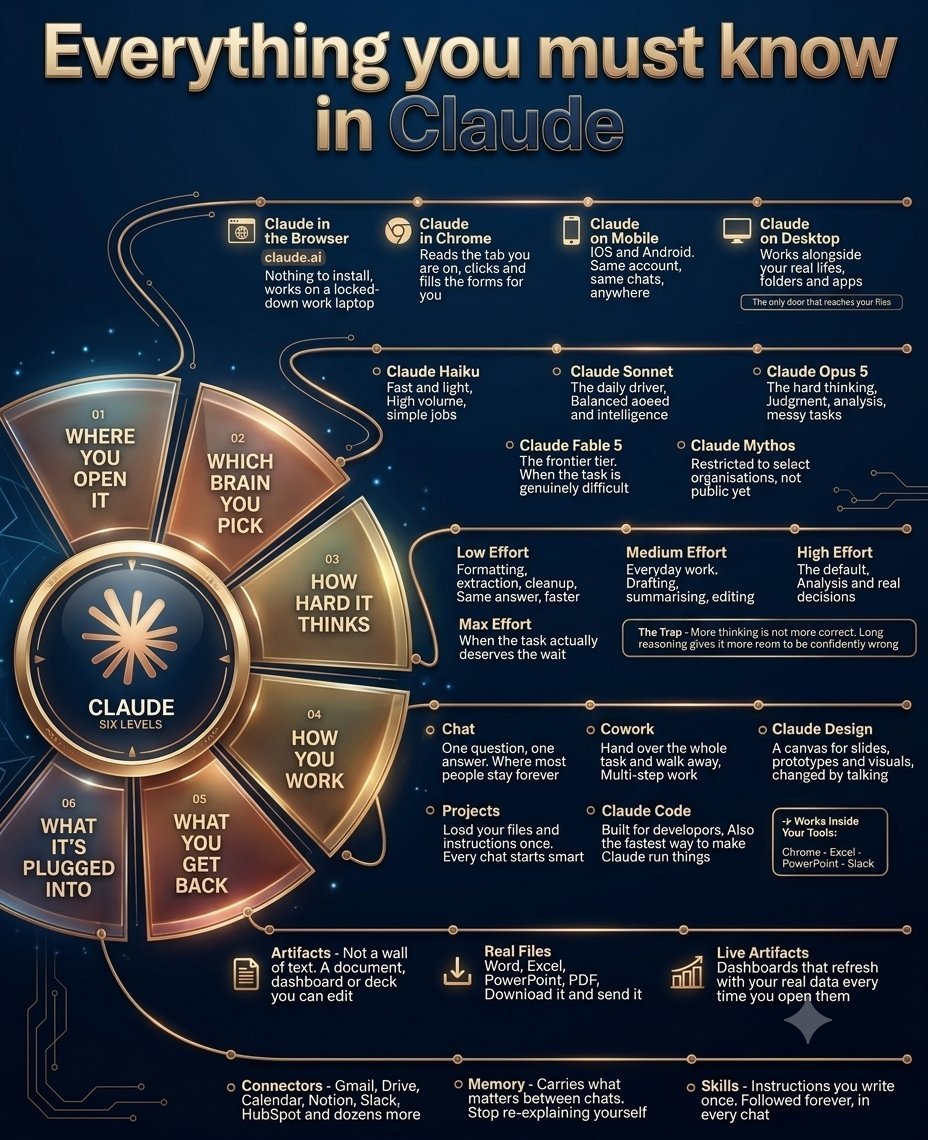
🔥 EVERYTHING YOU MUST KNOW ABOUT CLAUDE AI
Claude isn’t just a chatbot. It’s a complete AI workspace for thinking, writing, coding, research, files, projects, automation & more.
Here’s the ultimate Claude cheat sheet 👇
🧠 6 Levels of Claude • Where you open it
• Which brain/model you pick
• How hard it thinks
• How you work
• What you get back
• What it’s plugged into
⚡ Claude Models • Haiku — Fast & lightweight
• Sonnet — Balanced & intelligent
• Opus — Deep reasoning & complex tasks
• Max effort — For tasks that truly need it
💻 Ways to Use Claude
• Browser
• Chrome
• Mobile
• Desktop
• Chat
• Cowork
• Projects
• Claude Code
• Claude Design
📂 Powerful Features
• Artifacts
• Real files
• Live artifacts
• Connectors
• Memory
• Skills
🚀 Save this guide. If you use Claude regularly, this single image can help you understand the entire ecosystem.
Follow for more @Jara2426 tools, tips & hidden features.
Instead of watching Netflix tonight.
Spend a day mastering Claude here: https://t.co/Vn60ElPrcK
→ Level 1 - 30 min: The basics.
Claude For Dummies: https://t.co/Idmc95dbz2
Claude Certified: https://t.co/9jKsXWNVgy
Stupid simple Claude: https://t.co/SVGd966GXi
Prompting 101: https://t.co/BhdLRaBIG0
Claude & Mom: https://t.co/3V5H9Urile
AI Brain Rot: https://t.co/JxskcNiz9q
→ Level 2 - 70 hours: Real workflows.
27 Claude Tips: https://t.co/Uk66CN2Ttx
Claude Cowork: https://t.co/yAZqTVUrcR
Claude for Teams: https://t.co/U1JsBVC299
Claude Design: https://t.co/q1zjMfe2II
Claude Cowork + Projects: https://t.co/Q7AN9CZ2mg
Deslop Claude: https://t.co/FLZzLgvTz6
Claude Skills: https://t.co/d2g1gqc5Az
→ Level 3 - 54 minutes: The pro moves.
Claude to sound like you: https://t.co/kDGBpSEA6J
Stop hitting Claude limits: https://t.co/j5fEzSGxlT
Infographics: https://t.co/gj8asrTv5N
Claude replaced me: https://t.co/pNs1hPN5Ix
Detect AI: https://t.co/Tcc7YTSHc5
Excel with Claude: https://t.co/7g3CFNccBU
→ Level 4 - 31 minutes: Expert mode.
Claude Code: https://t.co/O2kJvFjIkP
Claude Connectors: https://t.co/TSAQqOp5pn
Don't use Claude at work: https://t.co/c6X55Th0gV
Pro tip: Don't binge it. Do one level per sitting.
Actually apply each guide before moving to the next
HARVARD JUST PUT THEIR ENTIRE AI CURRICULUM ON YOUTUBE FOR FREE.
This lecture alone is worth more than most $500 AI courses you almost bought last month.
Here is everything it covers in under 2 hours.
GENERATIVE AI AND CHATBOTS
How models like Claude actually work under the hood.
System prompts. User prompts. Prompt engineering.
The foundation behind every AI tool you use every single day.
Most people use these tools without understanding a single thing happening beneath the surface.
This fixes that permanently.
AI IN PROGRAMMING
A live demonstration of GitHub Copilot that shows exactly how AI reads context and writes code alongside you.
Not theory.
A working demo that shows you the gap between how most developers use AI and how the fast ones do.
DECISION MAKING ALGORITHMS
How AI actually makes decisions.
Decision trees. Minimax. The logic behind every competitive AI system ever built.
The part most people skip because it sounds technical.
The part that makes everything else make sense when you understand it.
DEEP LEARNING AND LARGE LANGUAGE MODELS
How neural networks actually process information.
What attention mechanisms are and why they matter.
Why AI hallucinates and what is actually happening when it does.
Explained clearly for the first time without a PhD required.
2 hours.
Free.
From Harvard.
The people who watch this tonight will understand something about AI that most daily users will never take the time to learn.
That gap compounds every single week.
Follow @cyrilXBT for the exact resources, courses, and systems I use to stay ahead of everything happening in AI right now.
Clip of my interview with Cyrus Janssen on why China is achieving such rapid AI acceleration and manufacturing automation. Full interviews at https://t.co/zrriFX22L3
ex-Goldman Sachs Quant ~$500k/year hired 8 juniors to outperform Goldman traders in 2 weeks
- they outperformed real hedge funds by 3% in just 2 months
all because he worked at Goldman Sachs and knows every mistake they make - you’ll learn the exact strategies from the world’s best funds
Watch this 40-minute masterclass from the founder of a $20B Chinese AI company instead.
It’s one of the clearest breakdowns I’ve seen on how agent swarms and large-scale AI systems actually work.
Beginner? You’ll understand the foundations.
Already using Claude or Kimi daily? You’ll see how to think in systems, not prompts.
I pulled the best ideas from the session and turned them into a practical guide for building with Kimi.
Full breakdown below ↓
Anthropic pays $750,000+ a year for engineers who know how to build LLMs from scratch.
Stanford just released the exact lecture that teaches it - 1 hour 44 minutes, free, straight from CS229.
Bookmark and watch it this weekend.
It'll teach you more about how ChatGPT & Claude actually work than most people at top AI companies learn in their entire careers.
And here's his pass map from the full game.
Utter dominance in the final third.
38 touches in the final third & penalty box... only 20 more than the next best for an Everton player.