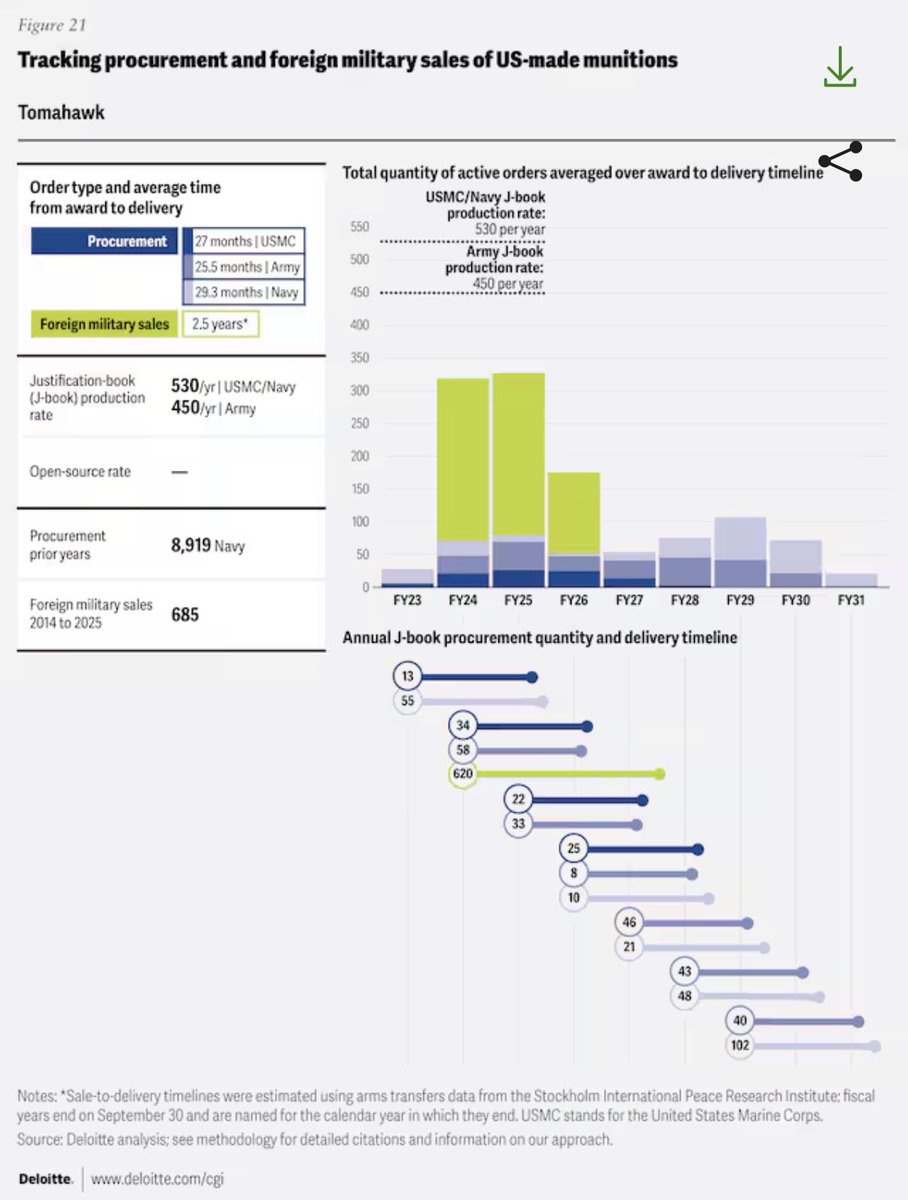
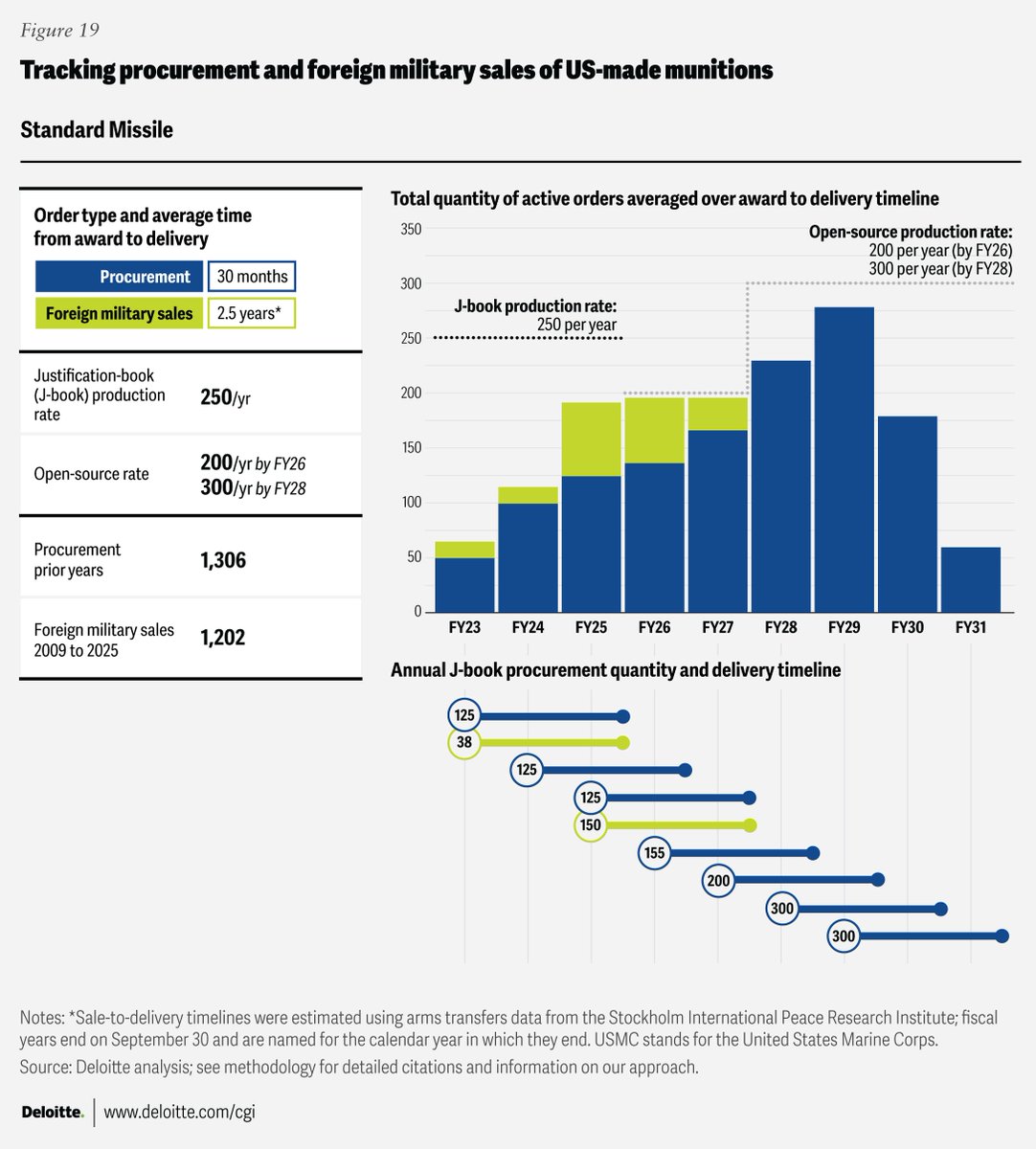
There’s been a marked increase in public discussion about U.S. #munitions#stocks and #production since operations against #Iran began — from reporting on accelerated consumption of precision weapons and air-defense interceptors to concerns about how quickly stocks can be replenished.
One thing our munitions research aims to contribute to that conversation is data and context rather than judgment.
Our analysis compiles procurement and foreign military sales data across 21 high-end munitions, anchored in PB25 J-Book figures, to make patterns visible — including timelines for ordering, delivery expectations, and how demand signals vary across systems. This isn’t a forecast; it’s a baseline that can inform discussions about capacity, consumption, and industrial response.
Two points from the data worth keeping in mind:
-- Procurement and production aren’t instantaneous. Many systems take more than two years from obligation to delivery, so what’s in the pipeline matters as much as what’s in stock.
-- Seeing the full picture means bringing disparate sources together — budget justification books, foreign military sales data, and open sources — into a repeatable framework that others can build on.
If you’re engaged in debates about readiness, industrial base resilience, or supply trends, I’d encourage you to explore the data and methodology here — and share what questions you’d like to see addressed as this baseline evolves. https://t.co/u34XjsdmUC
US destroyers launched Tomahawks at Iranian targets, but here’s the problem: America doesn’t have unlimited TLAMs. The Trump admin burned through big numbers in earlier strikes on Iran, Houthis, and Nigeria without replenishing stockpiles. TLAMs would be vital in a China fight.
Thoughtful analysis from @MEaglen@bradyafr that dovetails with what we saw in our munitions procurement analysis.
Our data on nearly two dozen high-end systems shows that procurement isn’t instantaneous and stocks matter. Many key systems take years to deliver once contracted, and supply constraints can meaningfully shape strategic options in crisis and conflict.
https://t.co/u34XjsdmUC
America's military magazine depth is too shallow.
Stocks must be replenished quickly & at scale in order to position our armed forces to succeed in wars big and small, long or short.
https://t.co/KHjgzqzVMf
There’s a lot of reporting right now about #munition requirements in potential #Iran contingencies.
One thing often missing from the discussion: once funded and placed on contract, delivery is measured in years—not weeks.
From contract to delivery, many systems take more than two years. For Standard Missiles, DoD data points to roughly 30 months.
That timeline matters. Procurement lead times shape what’s feasible in the near term, how production capacity can respond, and how risk is managed.
If you’re looking for data across nearly two dozen high-end munitions—including procurement trends and foreign military sales—our analysis is here: https://t.co/u34XjsdUKa
The average award-to-delivery timeline for many advanced munitions is more than 2 years. For SMs it’s 30 months. For more data on US munitions procurement, we compiled it here: https://t.co/kI0ma3C9u3
The Pentagon is raising concerns to President Trump about an extended military campaign against Iran, advising that war plans being considered carry risks including U.S. and allied casualties, depleted air defenses and an overtaxed force. https://t.co/brJCPMVSCM
“SM-2, SM-3 and SM-6 munitions have been rapidly consumed as the Navy has protected vessels in the Red Sea against Iranian-proxy forces in Yemen and defended Israel against ballistic missiles” https://t.co/0iZiOm1sJZ
Today, we’re releasing data on 21 U.S. munitions to establish a clearer, empirical baseline for procurement and demand. https://t.co/AFLRkWs1b9
The charts draw primarily from the PB25 Justification Book (J-Book) and DSCA foreign military sales data. This is not a forecast. It’s a foundation. We’ll update it with more recent J-Book and DSCA data in the future.
Why we did it:
Conversations about the defense industrial base are accelerating. The data underpinning those conversations is harder to see. It lives across budget justification books, FMS releases, and other open sources—rarely aligned in one place.
That fragmentation makes it difficult to assess demand signals, production expectations, and trends over time.
This is a starting point. Please read the methodology section for more information on our approach.
If you work with defense data and have dealt with its silos, I’d be interested in what questions you think a consistent baseline should answer.
Today, we’re releasing data on 21 U.S. munitions to establish a clearer, empirical baseline for procurement and demand. https://t.co/AFLRkWs1b9
The charts draw primarily from the PB25 Justification Book (J-Book) and DSCA foreign military sales data. This is not a forecast. It’s a foundation. We’ll update it with more recent J-Book and DSCA data in the future.
Why we did it:
Conversations about the defense industrial base are accelerating. The data underpinning those conversations is harder to see. It lives across budget justification books, FMS releases, and other open sources—rarely aligned in one place.
That fragmentation makes it difficult to assess demand signals, production expectations, and trends over time.
This is a starting point. Please read the methodology section for more information on our approach.
If you work with defense data and have dealt with its silos, I’d be interested in what questions you think a consistent baseline should answer.
Excited to share our new report exploring how to boost US commercial shipbuilding. https://t.co/qK8IcnLMAs
Our POV: Lead by creating, not copying. Utilize America's strengths in AI, IoT, and energy tech to lead emerging maritime markets--autonomous vessels, alternative fuels, and smart ports.
Our strategy relies on attracting more private capital to drive lasting demand & strength throughout the maritime chain.
Read it here:
@MattGialich@brianweeden Nice. Curious what your conversations with regulators (US and abroad) are like. Any issues being raised around safety (backward contamination concerns) or who will approve?
Most still think that you can order a Patriot interceptor and get it in a few months or whatever. One of the biggest hurdles my team has dealt with daily for many years is backing out the perception that military systems, especially advanced ones, are like Toyota Corollas. Just how expensive and long it takes to procure them and how finicky and expensive they are to operate, as well as how limited they are in numbers, is just a leap for many casually interested people to get their heads around. Hollywood paints a different picture with everything military and that is where most folks' understanding of military technology comes from. It's a challenge. Even those in Congress have to realize this and it's a process.
Some additional Standard Missile-6 data from FY26 DoD J-Books and the Defense Security Cooperation Agency:
DoD Procurement: FY24 97, FY25 78, FY26 10, procured all time 1,431
FY25 Foreign Military Sales announced: 150, FMS all time 1,202
Average time between award and delivery: 30 months (FY2017-2026 across variants; FY26 orders will be delivered in May 2027)
Max annual production rate: J Book lists “TBD”, production averages ~10 missiles/month; 2022 DoD Selected Acquisition Report notes production rate goals of 200 by FY26 and 300 by FY28.
@shelbyholliday@AnatPeled1@DrewFitzGerald
American missile-defense systems played a crucial role in protecting Israel during 12 days of fighting with Iran. But the war revealed alarming gaps in U.S. supplies and strategy. https://t.co/hrjnTzqVWY
Reupping PAC/MSE procurement/FMS data - @demarest_colin "You could never have enough": Militaries scramble for air defense interceptors
https://t.co/iA8XP694wF
Some additional PAC/MSE data from J-Books and DSCA:
DoD Procurement: FY24 230, FY25 214, FY26 233
FY24 FMS announced: 600
Average time between award and delivery: 29.9 months (note: MSE's procured in FY23 just started production in May)
Max annual production rate: 550 (650 planned by FY27)
Procured all time: 2047
Some additional PAC/MSE data from J-Books and DSCA:
DoD Procurement: FY24 230, FY25 214, FY26 233
FY24 FMS announced: 600
Average time between award and delivery: 29.9 months (note: MSE's procured in FY23 just started production in May)
Max annual production rate: 550 (650 planned by FY27)
Procured all time: 2047
The U.S. is taking meaningful steps to increase munitions production, but appropriating funds and building new assembly lines takes time. In the meantime, expending munitions at a rate unlikely to end the war only depletes U.S. stockpiles and undermines our ability to deter China. If a stronger Russia is a concern, then a stronger Russia combined with an unchecked China is far worse.
@AdamJRouth The West has had at least three years to start ramping up production. They appear to have done absolutely nothing except wish for it all to stop and the problem to disappear. There also appears to be no sense of collective urgency or collective will to fix these problems.