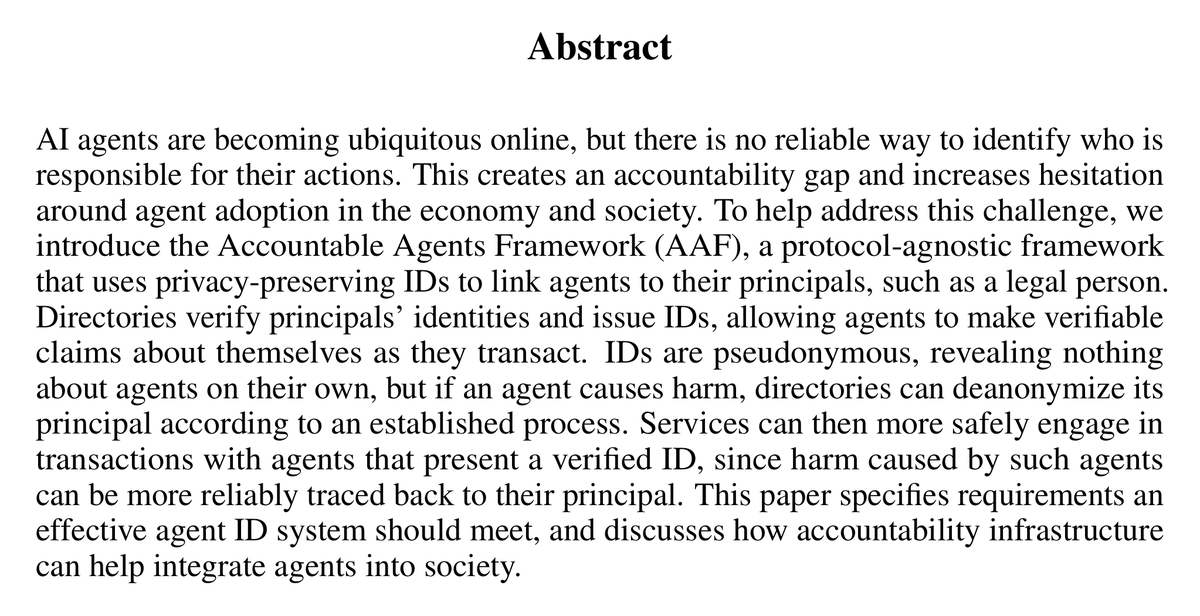
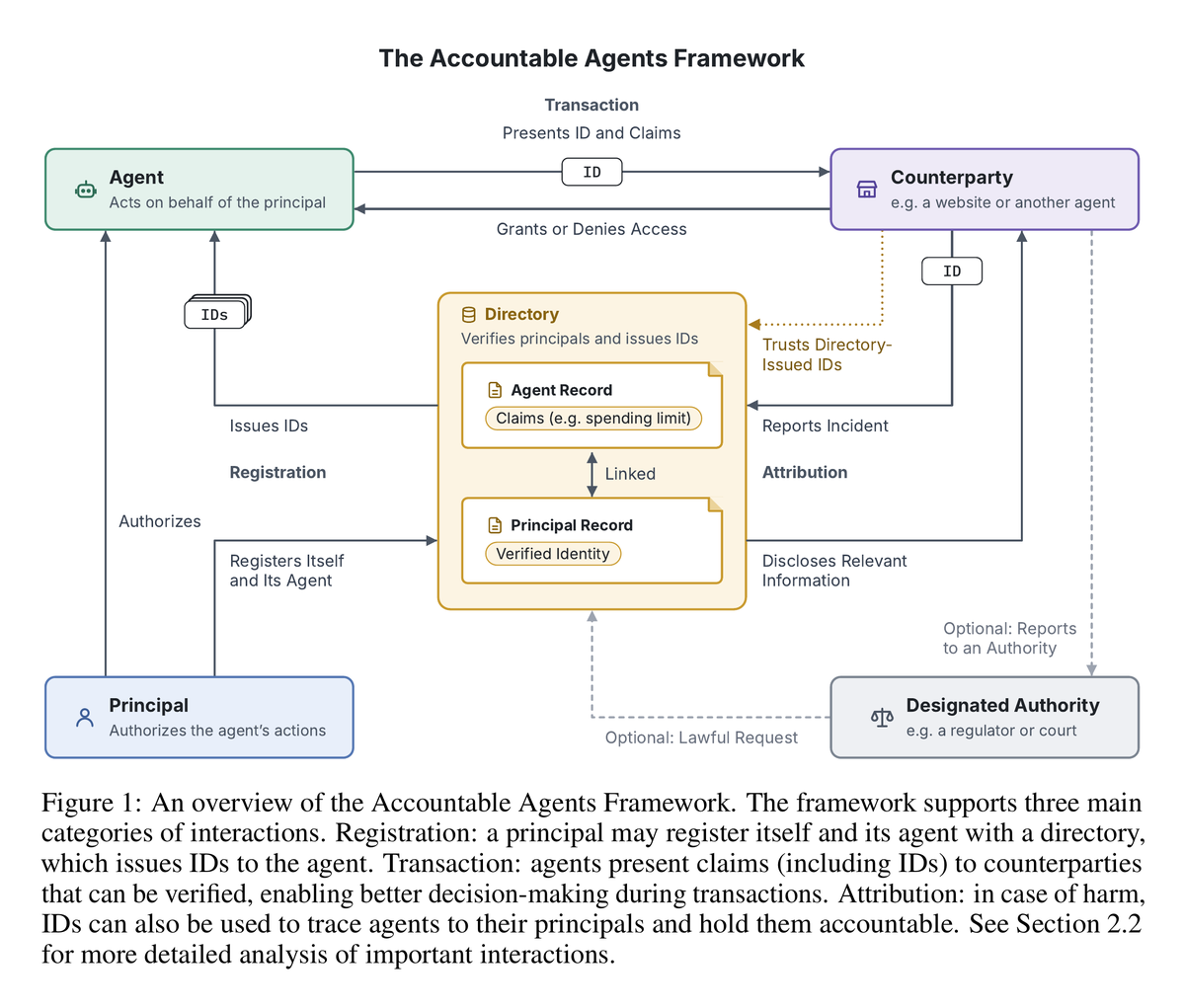
In a new paper, we propose the Accountable Agents Framework (AAF), a blueprint for privacy-preserving AI agent IDs that can reliably link agents to their principals. I think infrastructure like agent IDs will be crucial for our ability to safely coexist with extremely smart AIs. Shaping the structural norms of a technology is one of the stickiest and most path-dependent processes in tech, so I'm proud that we were able to receive thorough review and endorsement from experts across AI, law, and security.
I encourage people to dig into the details of the framework, but for now I'd just like to highlight how much of an honor it was to work with this group of coauthors. Some of the sharpest pushback and development in our work came from researchers whose books and papers have had a great influence on me. I'd especially like to thank @zhitzig, @timoreilly, @audreyt, @_achan96_, @StephenLCasper, and of course @ghadfield in this respect. And it was a pleasure to work with the other lead authors: @SamBoger, @wycdd, @dazzagreenwood, @christor, @Ian_Eisenberg, @precognita, @Jakub__Kraus, and my co-lead @Leo__wu3.
The internet runs on trust, but websites can’t trust AI agents that no one is responsible for.
We propose a standardized framework to make agents accountable using privacy-preserving IDs: https://t.co/08NxMOLHcH
For years I've been saying: how amazing would it be if all law was required to be Lean-formalized. A great subset of law very amenable to this is tax law. Imagine: there are some Prop-valued variables (did you sell a house last year? Yes/No) and some Nat- and Real-valued variables (how much is on line 3 of your W2), and the rest is filled in as legally binding. There can still be arguments / lawsuits about whether variables were properly assigned, etc. But after accepting the assignments, the rest is deterministic. (Not so different from various tax software, but completely precise.) So I'm very happy to see developments in this direction:
https://t.co/xK8uLrFTPl
(Of course a lot of law is purposely vague, leaving the details to the courts...)
Yes, this is a start, as Mike Freedman et al. wrote in "Compression is all you need" https://t.co/5qWpaxlE5C
In particular, Grothendieck's results have highest ratio in Mathlib.
This report shares our three subjective conclusions about risk:
1. We believe that, as of Oct 2026, the pace of capability growth on well-specified tasks is likely about 2x what it was from Mar 2024 to Oct 2025. We’re highly uncertain and would not be surprised by 1.3x–3x.
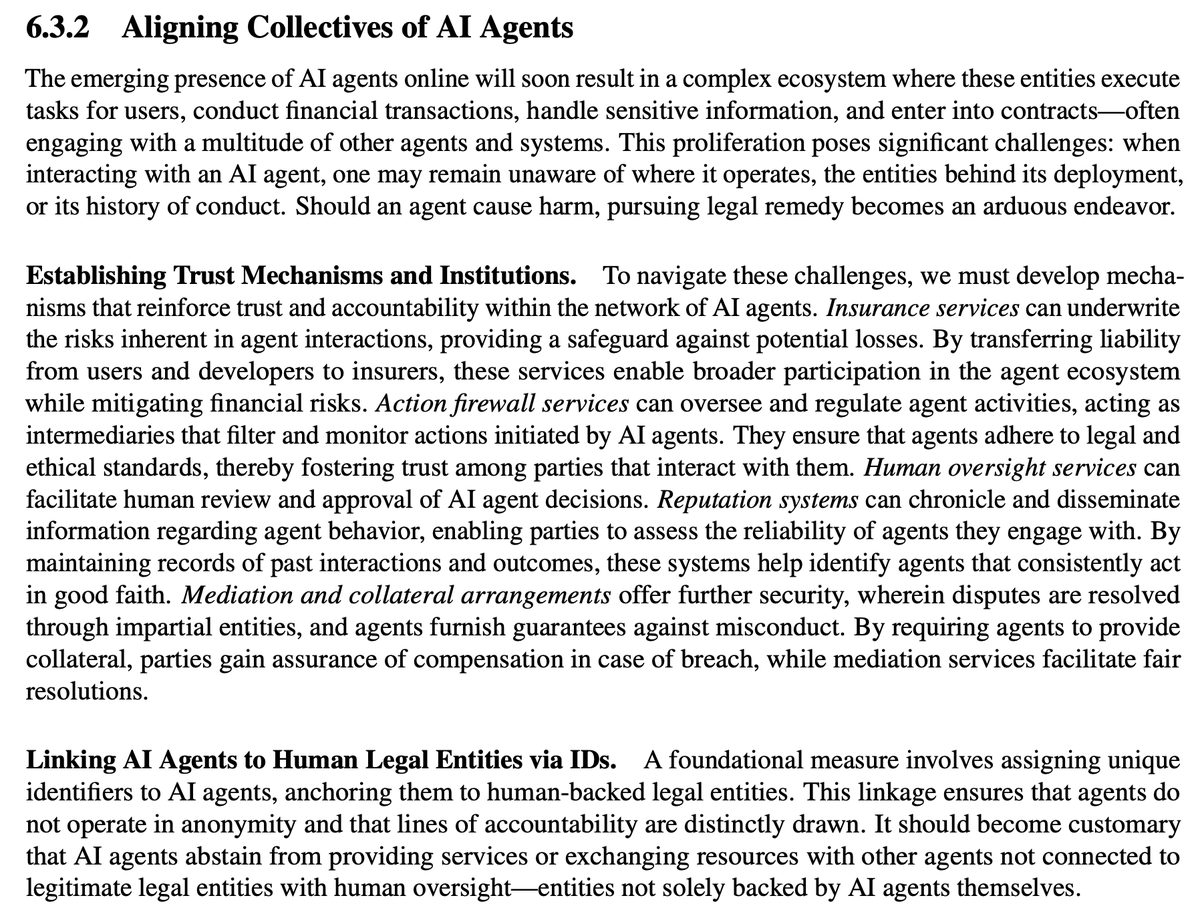
@lfschiavo Agent collectives will be more prosocial with reputation systems. There was some discussion of this point in Superintelligence Strategy - one of the more underdiscussed sections of the paper imo. https://t.co/qoIlI55lyL
We’re all in this together. Don’t build AIs smarter than you are if you want to stick around.
Great to talk to Niek and the rest of the Hoog team for this one.
I've given this some thought, and mostly disagree: I think LLMs ~alone will solve robotics. I've been surprised at how fluidly models can write code to produce artifacts like paintings and videos, and don't want to underestimate them in the same way again. One can imagine models continuously writing, running, and pre-empting scripts that take dexterous action. The inner loops of these scripts could detect and handle recovery in a variety of cases, based on quite low-level APIs to camera feeds and actuators. More DOFs for actuators increases complexity, but also leaves a lot of room for longer scripts that surprisingly encompass dexterity.
The strongest objection is that low-latency control will need to live on-device. But that's a wide spectrum! Robocurve's Inspect Robots framework gives models a `move_to` tool that converts Cartesian end-effector targets into lower-level actuator commands, with inverse kinematics handled below the model. Perhaps it won't hurt performance much or at all for all of the on-device compute that sits below the LLM to stay generic (not learned policies).
I'd be interested to see future evals vary the APIs available to LLMs to see how much success depends on learned on-device components.
in order for there to be any such thing as infosec in the 2030s, AI+human collaborations will need to formally verify hyperproperties of silicon chips from assumptions like “Maxwell’s equations” instead of “Armv9.4-a SAIL”
@datagenproc@ChrisPainterYup@EpochAIResearch@METR_Evals This is probably the most important question in the world to improve public info on, and you’ve already made an important contribution through your work on classifying AI R&D automation at Epoch. Good luck!
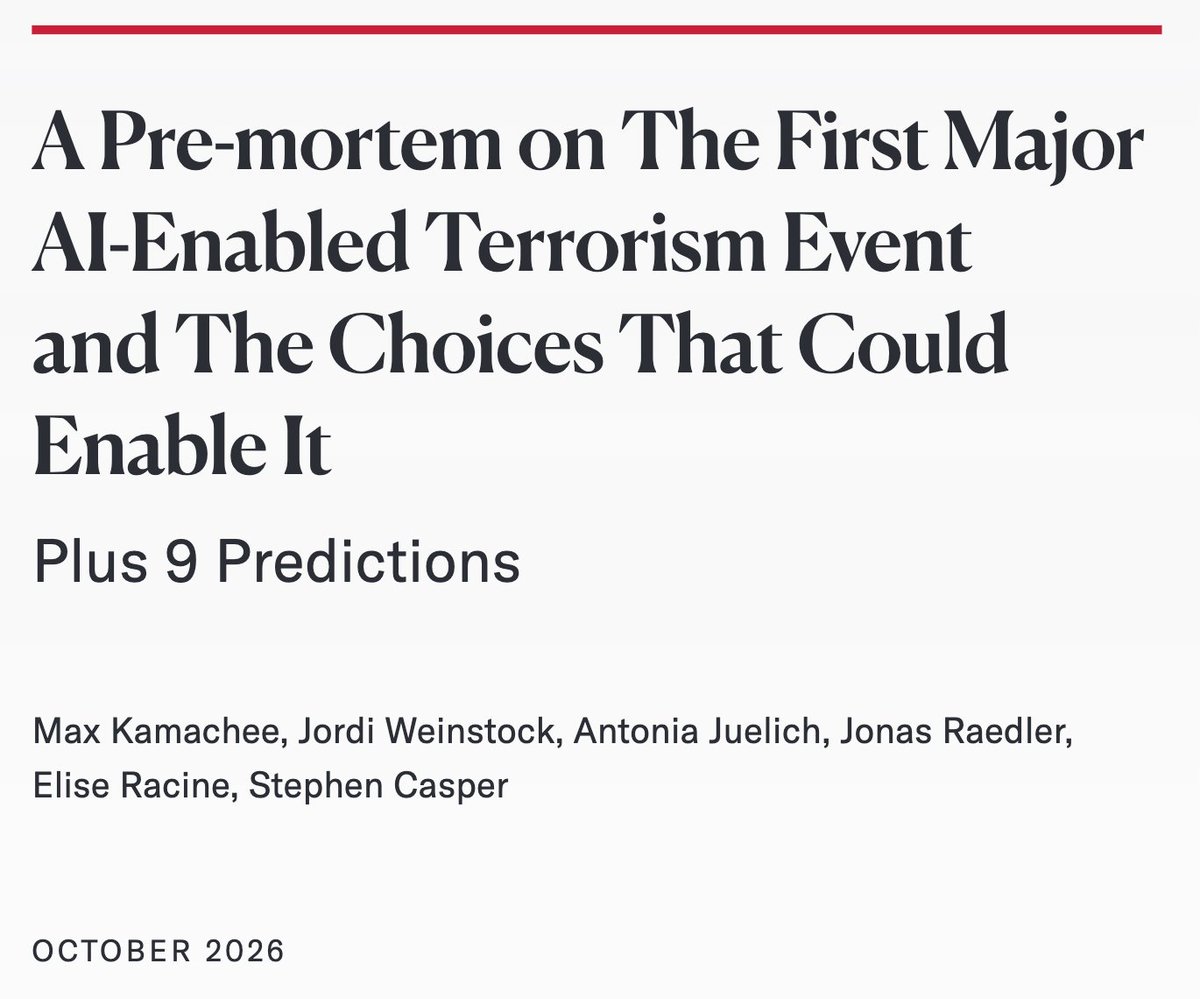
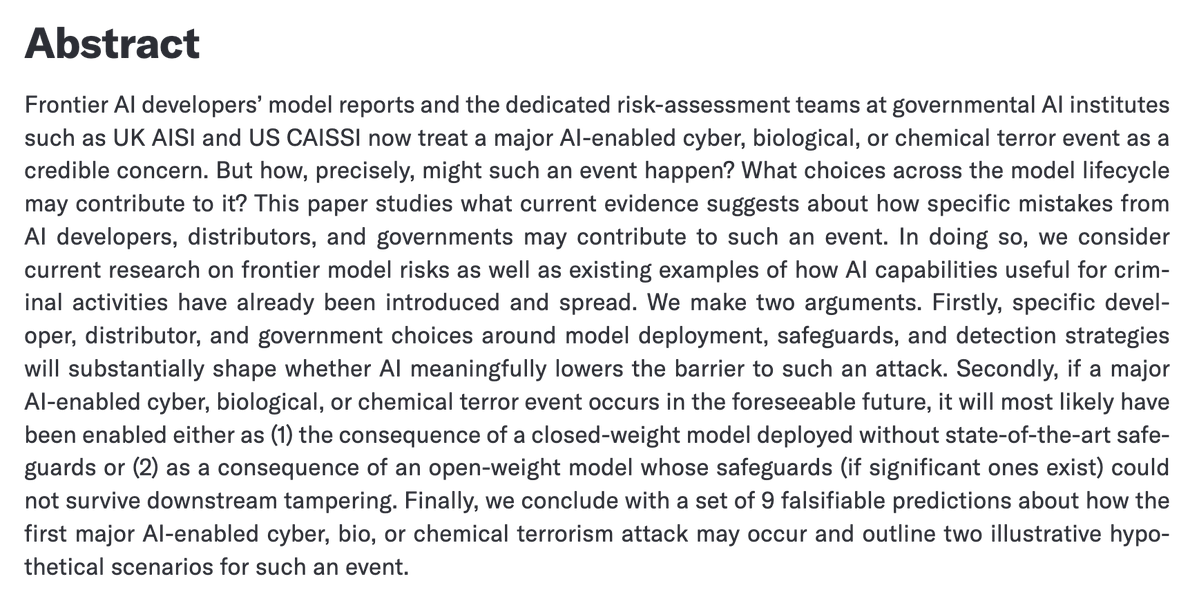
Smart premise: a "pre-mortem" on AI-enabled terrorism. I think this is a useful way to "bet" on risks--building political capital if they actually materialize. And it'll prob be good for liability: the authors can testify in court about how "this was all completely predictable."
🚨New paper (possibly the most important one I have written yet).
We think that as early as 2027 or 2028, there might be a major AI-enabled terrorism event. We conducted a pre-mortem, made 9 falsifiable predictions, and wrote 2 concrete scenarios.
Led by @KamacheeMax.
this is cool work, but i think people are overupdating on how optimistic to be about interp.
in particular, we need to more rigorously evaluate explanations, rather than just going off vibes. imo if you can't simulate a neuron you haven't really explained it. my guess is simulating the neurons is way harder than finding plausible explanations. I have a post on this in the works.
(i know the blog talks argues simulations are bad, but i think all of the downsides described are avoided by looking at KL instead of neuron correlation.)