@DomienVdE@Lemonade_Inc@SpaceX@Tesla Yeah it feels like Tesla is just in that business to lower cost of ownership, offloading this to lemonade seems more likely to me than other way around. Would be curious to know the operational efficiency of Tesla insurance tho, what’s their lae lol?
@PaperBagInvest One concern I’ve thought about is that all the new wave of AI products/software made from AI might eventually drive up B to C ad costs. Then IFP/CAC might be pressured from more expensive ads. Thoughts about this?
@bjmtweets@alphanopoly Why don’t they then?
I read only 26% of new customers in 2023 at statefarm have it?
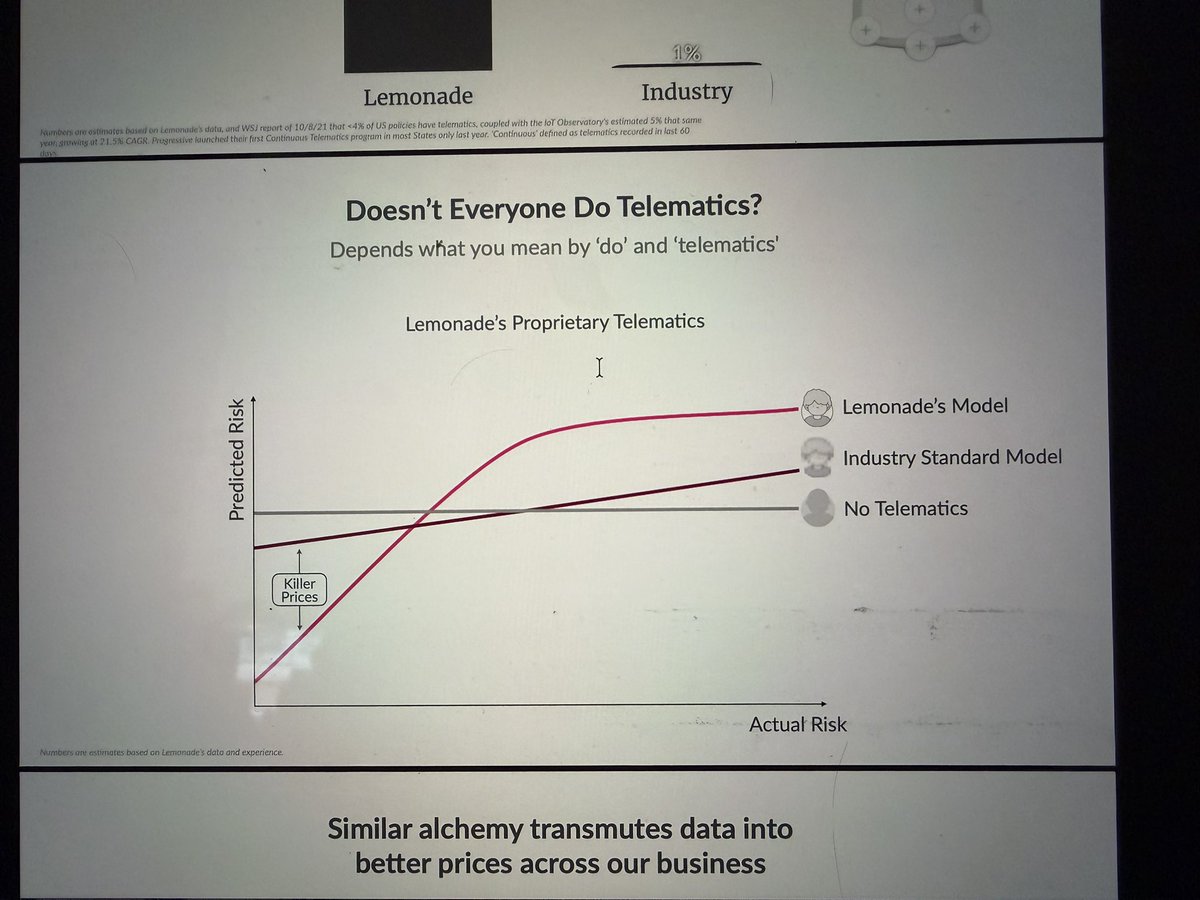
For modeling see investor day slide. I assume industry standard models means off the shelf models from Cambridge. So they have mentioned it, perhaps light on specifics.
@bjmtweets I think it really depends on how much they cut margin also. If we see lemonade car loss ratio tick up we can probably assume the are lowering rate to grow more/have more retention.
makes sense as a general benchmark, but ig this retention is probably for both multiline and monoline customers combined?
I’d expect churn to be lower for multiline customers so I guess we’d need to compare how much of progressives car book is multiline vs lemonade and est prg churn in that segment.
So if we assume this and then lighter growth in operating expenses excluding growth (given excluding OIE and moderating SBC growth Daniel hinted at) we are most of the way to a revised forecast.
If we now assume other insurance expense scales with IFP (mentioned in the call and @PaperBagInvest‘s interview), it basically has the same effect as adding about 7% to the GLR.
Here’s the math:
OIE this quarter was 26.7 million, and IFP was 1434 million.
If we annualize the OIE number (IFP is annualized):
(26.7 * 4 ) / 1434 = 0.074.
Do this for any other quarter in the last year and you will get similar results.
@nerdalert@Lemonade_Inc Any thoughts on the Other insurance line?
It grew from 21.4 million in Q2 2025 to 26.7 million (24%)
Nick also said he expects this to grow in line with IFP. OIE currently represents about 23% of the opex excluding growth this quarter.
I wanted to look a bit closer at the opex excluding growth spend this quarter
The headline numbers were:
79.5 million (Q2 2025) —> 117.8 million (Q2 2026) (48.1% increase)
However in Q2 2025, there was a 11.7 million ERC benefit to opex, so a more accurate comparison could be:
79.5 + 11.7 = 91.2 million (Q2 2025) —> 117.8 million (Q2 2026) (29.1% increase)
Digging into the SBC and synthetic agent interest:
SBC:15.4 million (Q2 2025) —> 24.5 million (Q2 2026) (+ 9.1 million)
SA interest: 4 million (Q2 2025) —> 7 million (Q2 2026) (+ 3 million)
So of the 29.1% increase in opex (26.6 million), we can attribute about half (12.1 million to SBC and SA interest).
We can’t split the 14.5 million remaining perfectly because the SBC is split into the opex lines, but roughly I would guess:
Other insurance cost: 21.4 → 26.7 (5.3 million)
This leaves us with an increase in G&A/Tech Dev/S&M fixed of 9.2 million which they gave at least 2 reasons for on the call:
•growth in personnel-related expense
•higher software costs supporting expanding AI capabilities
So broadly, I would think of the opex excluding growth increase as being driven by:
SBC + SA interest - 45.4%
Other insurance expense - 19.9%
G&A, Tech dev, S&M fixed - 34.5%
If you exclude other insurance expenses, SBC, and SA, we would have had a 10% increase in op-ex excluding growth spend.
Based on this I think there are 2 core question:
1. What are longer-term expectations of SBC?
2. How will G&A/tech dev/S&M fixed growth rate scale over time?