Thank you to all of my new followers for liking and sharing my recent art posts. For anyone new to me, I am an artist, critic and author. My income comes from art and writing. If you appreciate what I do and would like to support me, below are some ways you can do that. (1/5)
@cafecryptoart@metaburbia People reacted strongly against the Hogarth exhibition (show trial) because they don't like seeing a hero traduced by custodians. It makes you averse to supporting or attending an institution that pays the writers of these labels.
The bell tolls for National Gallery, London. Yesterday, the NG announced plans for sweeping changes. Phrases such as "taking an audience- and customercentric approach in everything we do", "removing barriers to engagement" and "reach new, more diverse visitors" will send a chill down your spine. (1/2)
@harbricht I think it might be possible to slow things down by protesting and raising legal objections. Ultimately, only the Arts Minister or Prime Minister could intervene to stop it and this programme is entirely in line with their politics...
For anyone sceptical about the social justice purposes and ESG component, I have added an article I published at the beginning of this year.
Make no mistake, the NG and the activist organisations behind these changes have not hidden their agenda. It is set out in the press releases.
"In September (2025) the National Gallery announced the breaking of a longstanding agreement with the Tate Gallery, namely that the NG would not own works after 1900. Even casual observers knew this move had long been on the cards. The newly launched Project Domani entails expansion of NG’s buildings and collecting remit. The NG has secured £375M out of a projected total £750M cost. The NG press release announced, “Project Domani will redefine the National Gallery” – a chilling phrase.
Current financial commitments come from the NG Trust, Julia Rausing Trust and Crankstart. Crankstart is a San Francisco-based activist organisation that lists as two aims “protection of civil rights and access to the arts”. If you think that these two points are unrelated and cannot see how they might affect Project Domani, you have not been following critical-theory-influenced teaching. Activist curators understand that “civil rights” does not mean literal civil rights (opposing legal barriers to participation, etc.) but social activism. It means wresting control of resources from one group and re-allocating it to others. In material terms, it means promotion of “modern liberal values” by downgrading object/document-based historical research in order to advance injustice-correcting political action. That is, “civil rights” done through “access to the arts”.
Ask any recent art-history graduates – current and future controllers of museums – whether the proper function of museums is preservation and study of objects and presentation of subsequent findings or if it is to effect social change by exposing (and remediating) inequities and engaging in social action, including community outreach, mental-health work, economic regeneration and multi-community inclusion. Ask the Museums Association.
The Guardian notes, “The gallery hopes it will go some way to addressing the huge gender imbalance in its collection: of the 2,300 paintings in its collection, only 27 are by women.” For both Guardian writers and NG staff “post-1900 art” means nothing more than DIVERSITY, in giant letters that dominate their mental universe.
Project Domani is part of an unco-ordinated movement to disrupt the canon (as embodied in the NG collection as it is now) by two means. Firstly, it is done by recovering minor female, non-Western and non-Christian artists and recasting them as marginalised (although no more marginalised than thousands of white male creators lost to historical obscurity) yet integral to the development of Western civilisation. Secondly, it is done by emphasising post-emancipation, secular, multicultural/multiethnic post-1850 art, prompted not by love of Modernism but borne of resentment towards the preceding eras, which are considered tainted by slavery, colonialism and other pre-liberal transgressions.
NG’s senior staff, Director and Board have been keen to earn progressive kudos by mounting shows of female artists (latest is an exhibition of very pedestrian Catharina van Hemessen (1527/8–after 1565)) and by acquiring anything painted by a female hand. Of late, they have packed the Artist-in-Residence programme with women and foreign artists, none of whom seriously engage with pre-Modern art. Latest is Ming Wong, Singaporean video artist. You, my fellow artists, will never be a NG artist-in-residence precisely because you respect Van Eyck, Titian, Stubbs and Seurat.
Project Domani will likely unleash the liberalism of NG senior staff who can set to work besmirching achievements of a culture that they resent. Great art is to be belittled by contextualising labels, diluted by addition of weak work by “the marginalised”, reduced in prominence and sidelined by more recent art. When Prime Minister Keir Starmer praises Project Domani as contributing towards “creating a better, fairer future for all”, he understands it is political action – an act of revenge on the dead.
As I have done for a decade, I repeat this axiom: what you revere will be degraded and destroyed precisely because it is beautiful and you love it. Those appointed to guard our heritage hate both that history and us, as legatees of oppression. They cannot be bargained with, reasoned with or accommodated. They must be resisted and (sooner or later) cast out."
The bell tolls for National Gallery, London. Yesterday, the NG announced plans for sweeping changes. Phrases such as "taking an audience- and customercentric approach in everything we do", "removing barriers to engagement" and "reach new, more diverse visitors" will send a chill down your spine. (1/2)
This is top-down steering. You have an aim, you set the terms for consultation, you select members, you guide them to the response that is entirely at one with your initial aim. Power politics distilled.
Give Michael a follow. You won't regret it.
The National Gallery Citzens' Jury was a cynical exercise in manufacturing support for transformational changes. An unrepresentative sample was hand-picked and given a narrow assignment. Then they were led to the answer by approved cultural entrepreneurs with no dissenting voice.
For anyone sceptical about the social justice purposes and ESG component, I have added an article I published at the beginning of this year.
Make no mistake, the NG and the activist organisations behind these changes have not hidden their agenda. It is set out in the press releases.
"In September (2025) the National Gallery announced the breaking of a longstanding agreement with the Tate Gallery, namely that the NG would not own works after 1900. Even casual observers knew this move had long been on the cards. The newly launched Project Domani entails expansion of NG’s buildings and collecting remit. The NG has secured £375M out of a projected total £750M cost. The NG press release announced, “Project Domani will redefine the National Gallery” – a chilling phrase.
Current financial commitments come from the NG Trust, Julia Rausing Trust and Crankstart. Crankstart is a San Francisco-based activist organisation that lists as two aims “protection of civil rights and access to the arts”. If you think that these two points are unrelated and cannot see how they might affect Project Domani, you have not been following critical-theory-influenced teaching. Activist curators understand that “civil rights” does not mean literal civil rights (opposing legal barriers to participation, etc.) but social activism. It means wresting control of resources from one group and re-allocating it to others. In material terms, it means promotion of “modern liberal values” by downgrading object/document-based historical research in order to advance injustice-correcting political action. That is, “civil rights” done through “access to the arts”.
Ask any recent art-history graduates – current and future controllers of museums – whether the proper function of museums is preservation and study of objects and presentation of subsequent findings or if it is to effect social change by exposing (and remediating) inequities and engaging in social action, including community outreach, mental-health work, economic regeneration and multi-community inclusion. Ask the Museums Association.
The Guardian notes, “The gallery hopes it will go some way to addressing the huge gender imbalance in its collection: of the 2,300 paintings in its collection, only 27 are by women.” For both Guardian writers and NG staff “post-1900 art” means nothing more than DIVERSITY, in giant letters that dominate their mental universe.
Project Domani is part of an unco-ordinated movement to disrupt the canon (as embodied in the NG collection as it is now) by two means. Firstly, it is done by recovering minor female, non-Western and non-Christian artists and recasting them as marginalised (although no more marginalised than thousands of white male creators lost to historical obscurity) yet integral to the development of Western civilisation. Secondly, it is done by emphasising post-emancipation, secular, multicultural/multiethnic post-1850 art, prompted not by love of Modernism but borne of resentment towards the preceding eras, which are considered tainted by slavery, colonialism and other pre-liberal transgressions.
NG’s senior staff, Director and Board have been keen to earn progressive kudos by mounting shows of female artists (latest is an exhibition of very pedestrian Catharina van Hemessen (1527/8–after 1565)) and by acquiring anything painted by a female hand. Of late, they have packed the Artist-in-Residence programme with women and foreign artists, none of whom seriously engage with pre-Modern art. Latest is Ming Wong, Singaporean video artist. You, my fellow artists, will never be a NG artist-in-residence precisely because you respect Van Eyck, Titian, Stubbs and Seurat.
Project Domani will likely unleash the liberalism of NG senior staff who can set to work besmirching achievements of a culture that they resent. Great art is to be belittled by contextualising labels, diluted by addition of weak work by “the marginalised”, reduced in prominence and sidelined by more recent art. When Prime Minister Keir Starmer praises Project Domani as contributing towards “creating a better, fairer future for all”, he understands it is political action – an act of revenge on the dead.
As I have done for a decade, I repeat this axiom: what you revere will be degraded and destroyed precisely because it is beautiful and you love it. Those appointed to guard our heritage hate both that history and us, as legatees of oppression. They cannot be bargained with, reasoned with or accommodated. They must be resisted and (sooner or later) cast out."
Don't be obtuse. This was flagged up last year. Here is an extract of an article I published at the beginning of this year. I have been writing articles in the press, collecting evidence from the NG and the NGOs involved.
"In September the National Gallery announced the breaking of a longstanding agreement with the Tate Gallery, namely that the NG would not own works after 1900. Even casual observers knew this move had long been on the cards. The newly launched Project Domani entails expansion of NG’s buildings and collecting remit. The NG has secured £375M out of a projected total £750M cost. The NG press release announced, “Project Domani will redefine the National Gallery” – a chilling phrase.
Current financial commitments come from the NG Trust, Julia Rausing Trust and Crankstart. Crankstart is a San Francisco-based activist organisation that lists as two aims “protection of civil rights and access to the arts”."
Newly available for sale are my novel "The Naked Spur" and non-fiction "How to Start a Dissident Art Movement" and (available for the first time) the novel "White Spirit". Each SIGNED. To purchase, click here: https://t.co/XRlgCNJaDT
Good advice. I recommend getting involved at ground level (or higher) to monitor and influence. Activists are very aware of "reverse capture", you are unlikely to gain full control. If you can do something is a non-captured space and are vigilant you will have more success.
If you want to save museums, you need to volunteer to be trustees of museums. You need to support/fund museums with restrictions on how the money may be used. Otherwise other people will do it instead. And change things.
Time for the British public to put its time and money where its mouth is.
@cafecryptoart That is what the Tate is for. Don't you understand the division in the British museum system? I warned when the Wallace and Courtauld started showing new art that they would ever more focus on new art because curators crave diversity and "relevance".
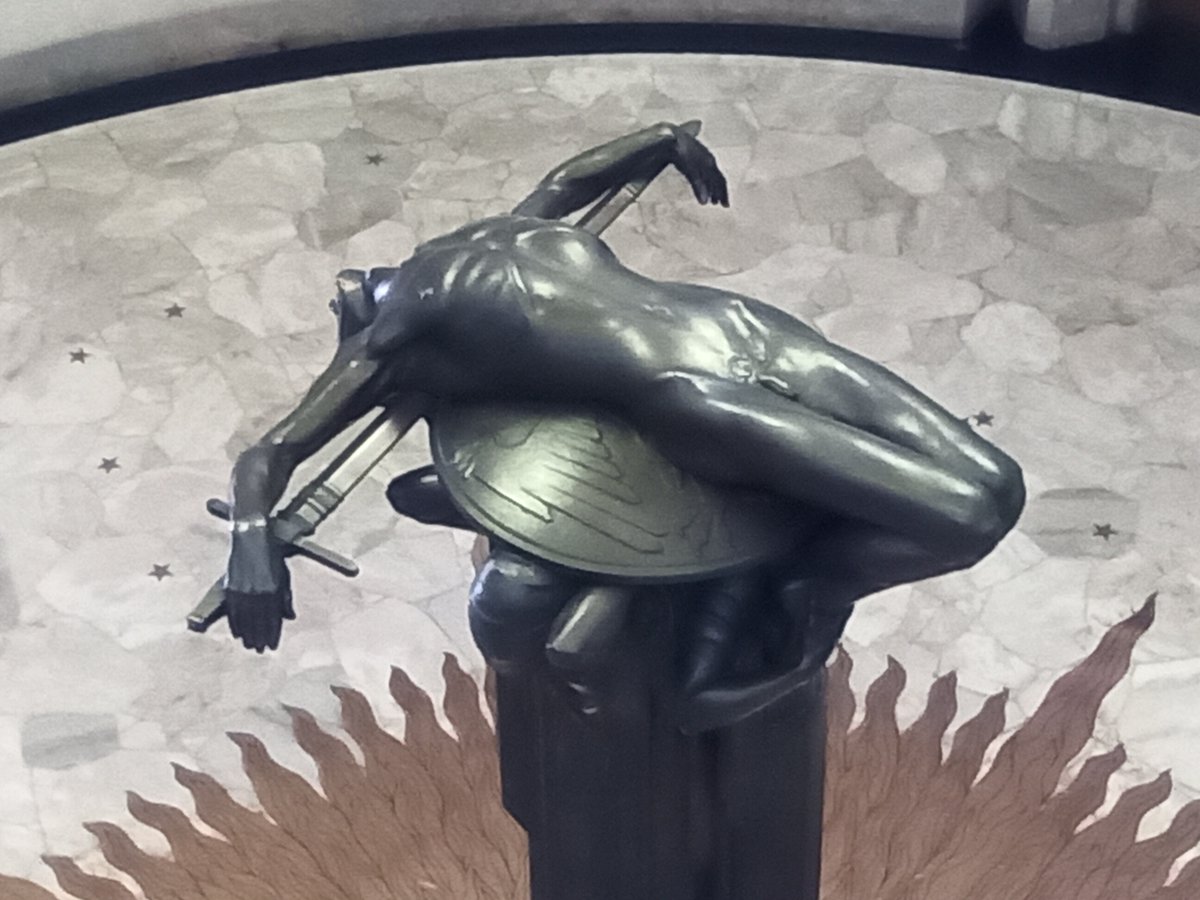
Discover that @BethWellsArt has written an excellent article on this very sculpture in the first issue of Solstice. Just received my copy (after returning to England), which looks very handsome!
@mutableos Not this year but I have Brisbane contacts, so if I visit again I will try to get up there. I should be more able to make it public in advance next time.
The cultural impact of the Scream movies in Australia is underestimated.
I'd like to thank everyone in Australia who made me most welcome over the last two months. I couldn't have achieved half of what I did without the goodwill of both Australian colleagues and strangers.
I'll be showing a little of my art that I made there over coming months but will be holding the majority back for now. One of my speeches will be published, info to come. Articles also to come.
(...and yes, I know the socket layout predates the Scream franchise)
Discover that @BethWellsArt has written an excellent article on this very sculpture in the first issue of Solstice. Just received my copy (after returning to England), which looks very handsome!
On this Remembrance Day, I'd like to share some images of the Anzac Memorial in Sydney. It is an amazing Art Deco style memorial to the dead of the Great War. It features an inner Hall of Memory inscribed with the theatres of the war and in the Hall of Silence crypt is a sculpture by Rayner Hoff of a fallen warrior. Supported on a shield by his wife and children, warrior's arms are outstretched on his sword forming a crucifix. One can view it from above in the Hall of Memory or approach it through the Hall of Silence.
It's extremely powerful and I was deeply impressed by how seriously Australians honour their war dead, even today.
My inadequate photos don't do it justice.