Mark Zuckerberg scaled Facebook in 2005 - without Kubernetes, Serverless Functions, Redis, Managed Auth, Rust, or Kafka.
No fancy orchestration.
No distributed event streams.
No cloud-native anything.
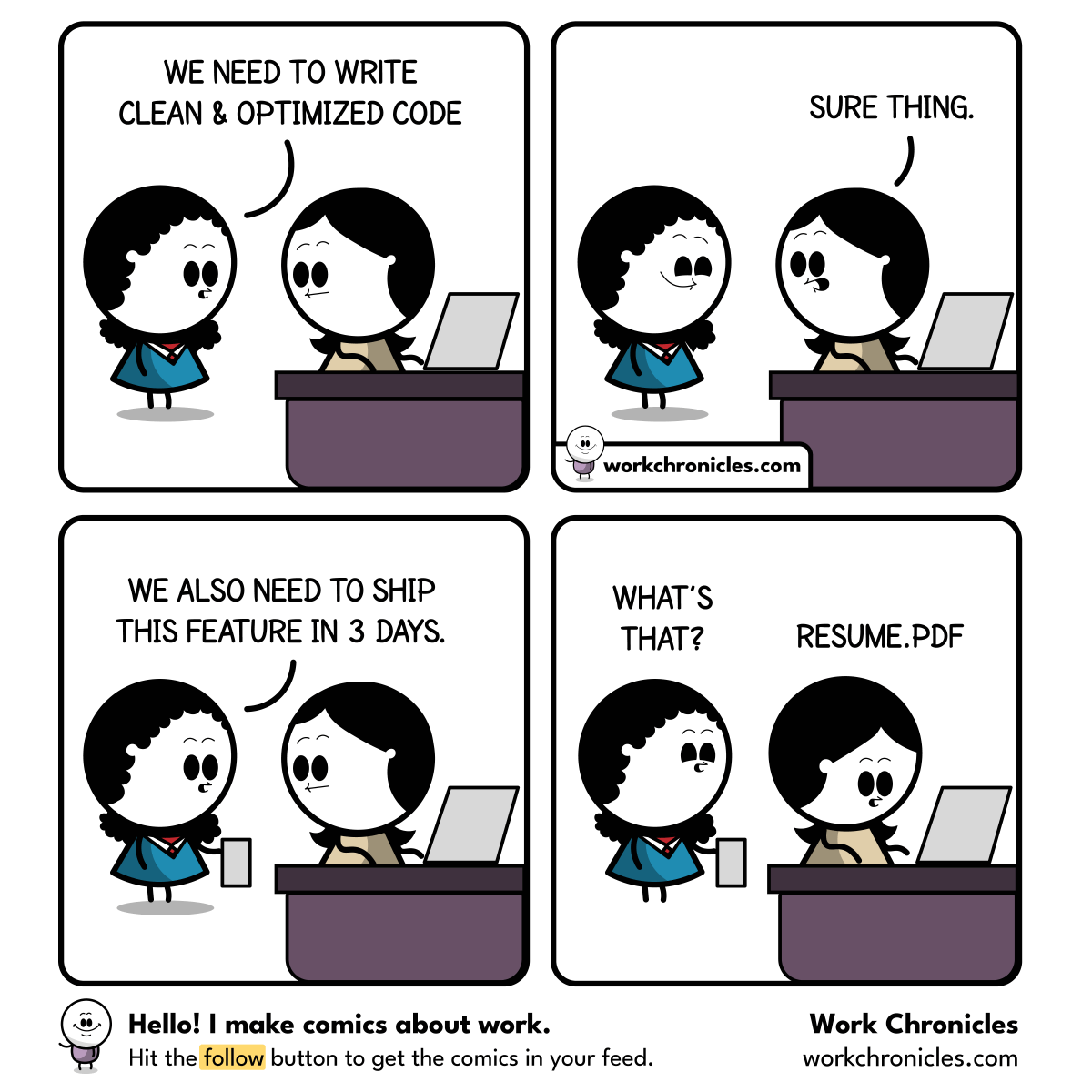
Modern devs love to over-engineer.
We build as if our projects will scale to 1 million users tomorrow.
But here's the truth:
Most apps die with 100 users, not 1 million.
We predict every possible future case:
→ So we add layers, queues, caches, and microservices...
for problems that don't even exist yet.
That's not architecture.
That's trend-driven engineering.
Always architect your apps based on current needs (not possible future guesses), leaving room for extension and evolution.
Complexity kills projects - simplicity scales.
Don't design your MVP like it's Facebook in 2025.
Design it like Facebook in 2005 - simple, fast, and focused on what matters most: value.
👉 Join 16,000 software engineers who learn how to build software based on current needs and not the trends:
↳ https://t.co/dajCViEeyi
𝗕𝗼𝗻𝘂𝘀: every subscriber gets a PDF with 650+ exclusive resources for mastering C#, .NET, ASP .NET Core, EF Core, and Microservices.
——
♻️ Repost to help others learn how to build software based on current needs
➕ Follow me ( @AntonMartyniuk ) to improve your .NET Skills
Evaluation of Oral Pregabalin as a Preemptive Adjuvant for Postoperative Pain in Patients Undergoing Coronary Artery Bypass Grafting With General Anesthesia and High Thoracic Epidural: A Randomized Controlled Study https://t.co/NRAzvCcbUe
The weekend is the best time to read new things.
Here are 16 articles that can help you get better at System Design:
[1] Practical Intro to Kubernetes
Why read it: To learn the basics of Kubernetes, its internal architecture, and code examples
https://t.co/dK0bH7foSa
[2] CAP Theorem with Tom the Prankster
Why read it: Understand CAP Theorem in a way you’ll never forget
https://t.co/EUvWBban69
[3] 5 Strategies for High Availability Systems
Why read it: Simple tips to improve your system’s availability
https://t.co/GCkXzcjYbe
[4] Change Data Capture and Microservices
Why read it: To learn how CDC can help implement Outbox and Strangler Fig pattern
https://t.co/ltbd8535E1
[5] 23 System Design Interview Tips
Why read it: To learn key principles to consider while designing a system.
https://t.co/5sjkaCPDo9
[6] Introduction to ACID Properties
Why read it: To learn about the basic guarantees provided by a database.
https://t.co/S7kGr3m5dM
[7] How DNS Works?
Why read it: To understand what happens when you open a website in the browser.
https://t.co/9Xyqfr87J4
[8] Intro Circuit Breaker Pattern
Why read it: Learn about the circuit breaker pattern of building microservices
https://t.co/Ni858Ns3vy
[9] Introduction to Pre-caching
Why read it: To understand the secret technique that can boost application performance
https://t.co/d1POnfwKuP
[10] Load Balancers
Why read it: To understand the types, algorithms, and high availability considerations behind a load balancer
https://t.co/iumQMuTIoH
[11] JSON Web Tokens and Authentication
Why read it: To learn how JSON Web Tokens help with user authentication
https://t.co/LJgZ4izW7I
[12] Database Caching Strategies
Why read it: To understand the various database caching strategies and how to choose one
https://t.co/oUAmzhgsOM
[13] Cookies and Sessions
Why read it: To understand the difference between cookies and sessions with regards to authentication.
https://t.co/dzZiXewgzw
[14] API Performance Strategies
Why read it: To learn about the best strategies to boost your API’s performance
https://t.co/8hfGoeIF2H
[15] Types of NoSQL Databases
Why read it: To learn about the most popular NoSQL database types and where to use them
https://t.co/QxnudjZIe3
[16] How to Scale a Component?
Why read it: Interview Tips on Vertical and Horizontal Scalability
https://t.co/sL0rr7tww4
You can now build API-driven applications visually.
Flows can chain requests, handle data, and integrate with other applications via webhooks.
And it's available on Postman's free plan.
Check it out: https://t.co/rfNVNsOSnH
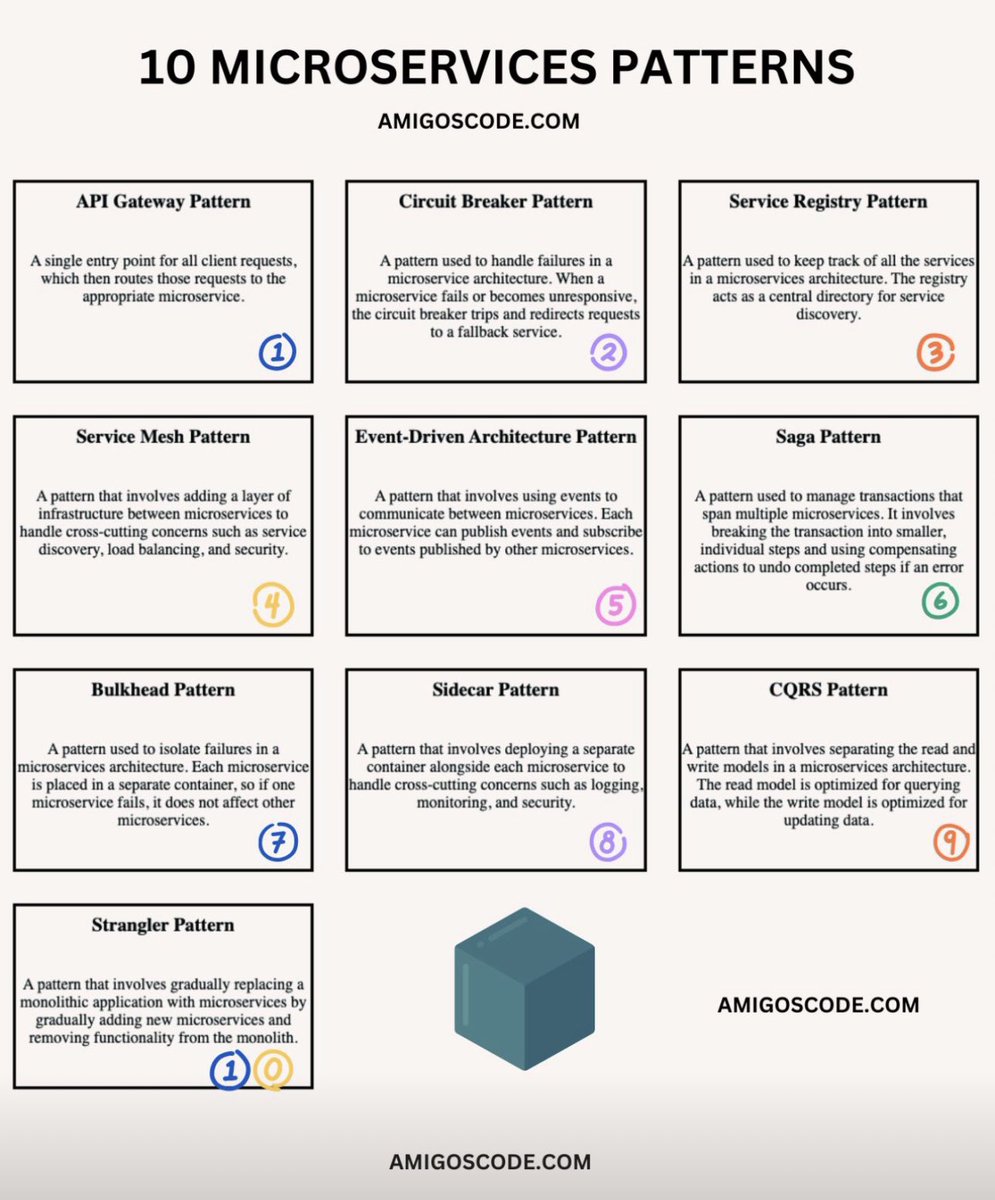
📚10 Microservices Patterns 📚
1. 🔍 Service Registry: This pattern involves managing the locations of services in a distributed system. It maintains a list of all available services and their locations, which can be queried by other services to find and communicate with them.
2. ⚡️ Circuit Breaker: This pattern is used to prevent cascading failures in a distributed system. It monitors the availability of a service and, if it detects a failure, it can quickly isolate the problematic service and prevent other services from being affected.
3. 🚪 API Gateway: This pattern provides a single entry point to a microservices-based system. It acts as a reverse proxy and routes incoming requests to the appropriate microservice. It can also perform authentication, rate limiting, and other security-related tasks.
4. 📝 Event Sourcing: This pattern involves capturing all changes to the state of a system as a series of events. These events can be used to reconstruct the current state of the system at any point in time. This pattern is useful for systems with complex business logic that require auditability, traceability, or compliance.
5. 🎭 Saga: This pattern is used to manage long-running transactions that involve multiple microservices. It ensures that all services involved in a transaction are completed successfully or rolled back in case of failures.
6. 📚 CQRS: This pattern separates the read and writes operations of a system. It uses separate models for reads and writes, which allows for the optimization and scalability of each. This pattern is particularly useful for systems with high read-and-write workloads.
7. 💾 Database per Service: This pattern involves using a separate database for each microservice. This ensures that each microservice has its own data store, which can be optimized for its specific needs. It also helps to prevent coupling between services.
8. 🕺 Saga Choreography: This pattern is similar to the Saga pattern, but instead of having a central orchestrator, each microservice involved in the transaction communicates directly with other services to coordinate the transaction.
9. 🕸️ Service Mesh: This pattern provides a dedicated infrastructure layer for managing communication between microservices. It adds features such as load balancing, service discovery, and security to the network layer, which can be used by any microservice in the system.
10. 🧳 Sidecar: This pattern involves deploying a separate process alongside a microservice, which handles certain tasks such as service discovery, load balancing, or communication with other services. This allows the microservice to focus on its core functionality, while the sidecar handles cross-cutting concerns.
👨💻 Join Amigoscode today for premium programming courses - https://t.co/Y65dNK5bQ6
ps: credits to the respective owner(s).
#programming #coding #webdevelopment #python #javascript #microservices #java #learntocode #beginnerprogramming #techindustry #opensource #developers
8 Key Data Structures That Power Modern Databases
In this video, we will briefly talk about:
🔹Skiplist
🔹Hash index
🔹SSTable
🔹LSM tree
🔹B-treeperformance
🔹Inverted index
🔹Suffix tree
🔹R-tree
Watch and subscribe here: https://t.co/ZejYA5vlOM
🎉The book "Understanding Docker in a visual way"is available since few minutes on Amazon! 😱🐳
https://t.co/IvNDMHcQXl
237 pages of illustrations, handwritten texts and code examples.
After 2 years of work, I hope you will like this book! ☺️
@Docker#Sketchnoting@AmazonKDP





![ProgressiveCod2's tweet photo. The weekend is the best time to read new things.
Here are 16 articles that can help you get better at System Design:
[1] Practical Intro to Kubernetes
Why read it: To learn the basics of Kubernetes, its internal architecture, and code examples
https://t.co/dK0bH7foSa
[2] CAP Theorem with Tom the Prankster
Why read it: Understand CAP Theorem in a way you’ll never forget
https://t.co/EUvWBban69
[3] 5 Strategies for High Availability Systems
Why read it: Simple tips to improve your system’s availability
https://t.co/GCkXzcjYbe
[4] Change Data Capture and Microservices
Why read it: To learn how CDC can help implement Outbox and Strangler Fig pattern
https://t.co/ltbd8535E1
[5] 23 System Design Interview Tips
Why read it: To learn key principles to consider while designing a system.
https://t.co/5sjkaCPDo9
[6] Introduction to ACID Properties
Why read it: To learn about the basic guarantees provided by a database.
https://t.co/S7kGr3m5dM
[7] How DNS Works?
Why read it: To understand what happens when you open a website in the browser.
https://t.co/9Xyqfr87J4
[8] Intro Circuit Breaker Pattern
Why read it: Learn about the circuit breaker pattern of building microservices
https://t.co/Ni858Ns3vy
[9] Introduction to Pre-caching
Why read it: To understand the secret technique that can boost application performance
https://t.co/d1POnfwKuP
[10] Load Balancers
Why read it: To understand the types, algorithms, and high availability considerations behind a load balancer
https://t.co/iumQMuTIoH
[11] JSON Web Tokens and Authentication
Why read it: To learn how JSON Web Tokens help with user authentication
https://t.co/LJgZ4izW7I
[12] Database Caching Strategies
Why read it: To understand the various database caching strategies and how to choose one
https://t.co/oUAmzhgsOM
[13] Cookies and Sessions
Why read it: To understand the difference between cookies and sessions with regards to authentication.
https://t.co/dzZiXewgzw
[14] API Performance Strategies
Why read it: To learn about the best strategies to boost your API’s performance
https://t.co/8hfGoeIF2H
[15] Types of NoSQL Databases
Why read it: To learn about the most popular NoSQL database types and where to use them
https://t.co/QxnudjZIe3
[16] How to Scale a Component?
Why read it: Interview Tips on Vertical and Horizontal Scalability
https://t.co/sL0rr7tww4](https://pbs.twimg.com/media/GMonuhrW4AAouQX.jpg)