#WCLC26 In DESTINY-Lung04, no OS signal yet. Toxicities led to discontinuation in 16% of both arms. Biggest concern here is the ILD at 20.8% - while most were grade 1/2 and resolved, these are still high rates. This will impact delivery and possibly subsequent therapies...
Identifying biomarkers to optimize treatment selection is crucial in EGFRm NSCLC.
Now fully published in @CCR_AACR, our study investigated the impact of baseline EGFR amplification & how it influences the molecular landscape at resistance to osimertinib.
https://t.co/r76D9Vd0zv
Striking new #lungcancer screening data:
You need to screen fewer high-risk never-smokers to catch a cancer than heavy smokers. #ASCO26#lcsm
Number Needed to Screen (NNS):
-TALENT (Never-smokers) =150
-NELSON (Smokers) = 222
-NLST (Smokers) = 320
For US #HCPs attending @ASCO‘s 2026 annual meeting: visit us onsite at booth #15093. Click below to view the timing of our presentations. #Oncology#ASCO26
https://t.co/q490kP6sMk
Today, the U.S. FDA approved a monthly dosing schedule for our subcutaneous treatment for patients with EGFR-mutated NSCLC. Grateful to the teams at @JNJInnovMed who made this possible.
Learn more: https://t.co/x29PLTvFnI
#MyCompany#JNJOncology
Subcutaneous Amivantamab now @US_FDA approved based off #PALOMA3 study: SubQ vs. IV Ami (with Lazertinib) in EGFR+ mNSCLC.
- SubQ was non inferior to IV Ami-Laz
- Fewer IRRs with SubQ
- PFS 6.1mos (IV) & 4.3mos (SubQ). BUT OS better with SubQ (HR: 0.62) 🤔
#OncTwitter#lcsm
FDA approves subcutaneous amivantamab - finally! This is a no-brainer switch in my opinion. Faster, decrease risk of infusion reaction, less risk of VTE. Even possibility of greater efficacy versus IV (needs confirmation). Will switch as soon as we can.
https://t.co/NMbP93ZzgE
Today’s approval of our sub-q treatment for EGFR-mutated #NSCLC raises the standard for what patients and their loved ones can expect from the treatment experience. Proud of the @JNJInnovMed team and what this means for patients. Learn more: https://t.co/F4YDuTtDao
#JNJOncology
Original Article: Overall Survival with Amivantamab–Lazertinib in 𝘌𝘎𝘍𝘙-Mutated Advanced NSCLC (MARIPOSA phase 3 trial) https://t.co/EPke9fSkiO
Editorial: 𝘌𝘎𝘍𝘙-Mutated Lung Cancer — Letting the Butterfly Out of the Cocoon https://t.co/BZaj67XSS6
#Oncology
In our “Challenging Cases” discussion on metastatic NSCLC mEGFR w/ @lungoncdoc we touch on:
✅ Rx options
✅ AE management
✅ Sequencing
Full discussion:
⭐️ https://t.co/XFMkB6kxmY
⭐️ Also on the “Oncology Brothers” podcast
#OncTwitter@OncUpdates
Updated data on combination options seen at #ESMO25 for metastatic non-small cell lung cancer w/ EGFR mutated disease. Stuck w/ cross trial comparisons for now! We touched on this data and our options 👇👇 with @lungoncdoc!
@EGFRSummit#OncTwitter#lcsm@OncoAlert@OncUpdates
Phase II study of amivantamab + lazertinib in patients with previously treated #EGFR NSCLC and brain metastases or leptomeningeal disease @JTOonline. In 20 pts with brain metastases, RR 50%, PFS 5.4m, OS 17.4m. With LMD, RR 33%, PFS 7.8m, OS 14.4m.
https://t.co/5OPkZdO32M
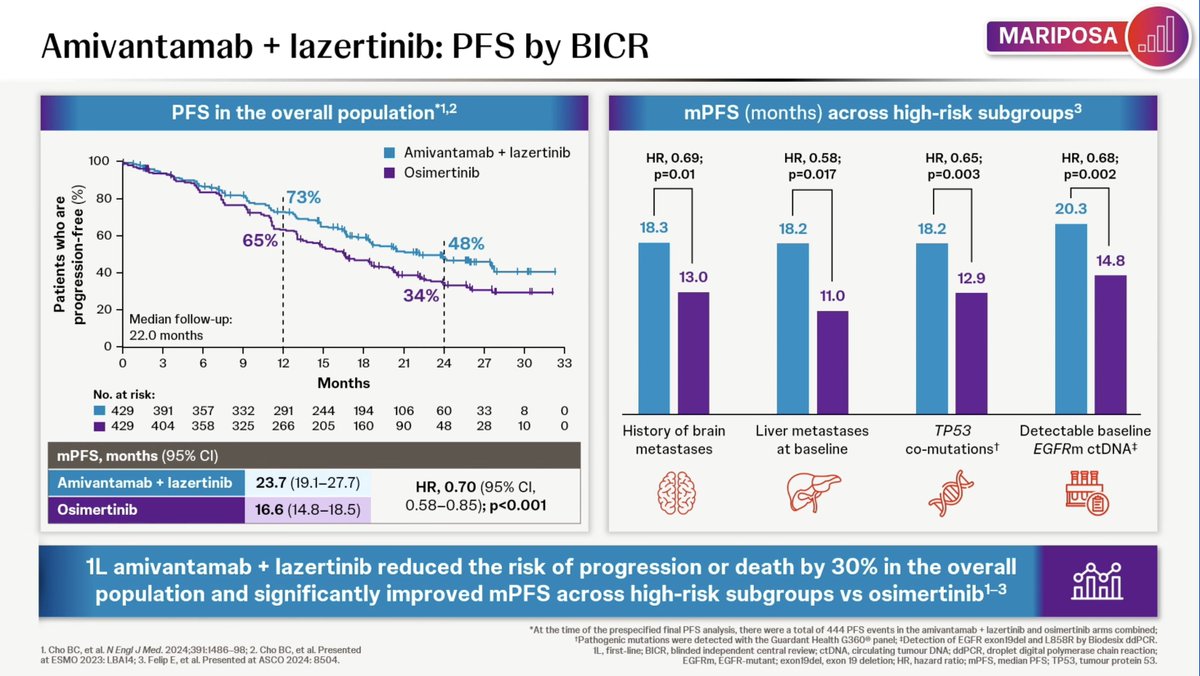
In advanced non–small-cell lung cancer with EGFR mutations, amivantamab–lazertinib led to longer overall survival than osimertinib but was associated with an increased risk of adverse events of grade 3 or higher. Full MARIPOSA phase 3 trial results: https://t.co/0bliKUZzXa
#WCLC25 | @IASLC
Dr. @APassaroMD discusses #EGFR NSCLC at the @LungSummit. Combination therapy should now be considered our standard for first-line therapy with OS advantages seen using osi + chemo (FLAURA2) and amivantamab + lazertinib (MARIPOSA). Learning about impact on acquired resistance.