Eight talks, a debate on first-line ES-SCLC and a panel on patient cases from the audience: ctDNA, targeted therapy, ADCs, early-stage IO and TCEs in SCLC, in one day.
That is the International Lung Cancer Summit (ILCS) 2026, chaired by Solange Peters (@peters_solange) and Alfredo Addeo (@Alfdoc2), in Lausanne on Friday 13 November and live online. Here is the trailer. Registration is free for healthcare professionals. We would be glad to see you at CHUV, and just as glad to see you on the stream 🙂
ILCS 2026 faculty: @DasMillie11@HHorinouchi@TelmaSequeiraMD@christine_lovly@dplanchard@PatelOncology@ACortelliniMD@g_mountzios@a_dingemans
Registration is open: https://t.co/ckjgERXFP4
#ILCS2026 #LungCancer #NSCLC #SCLC
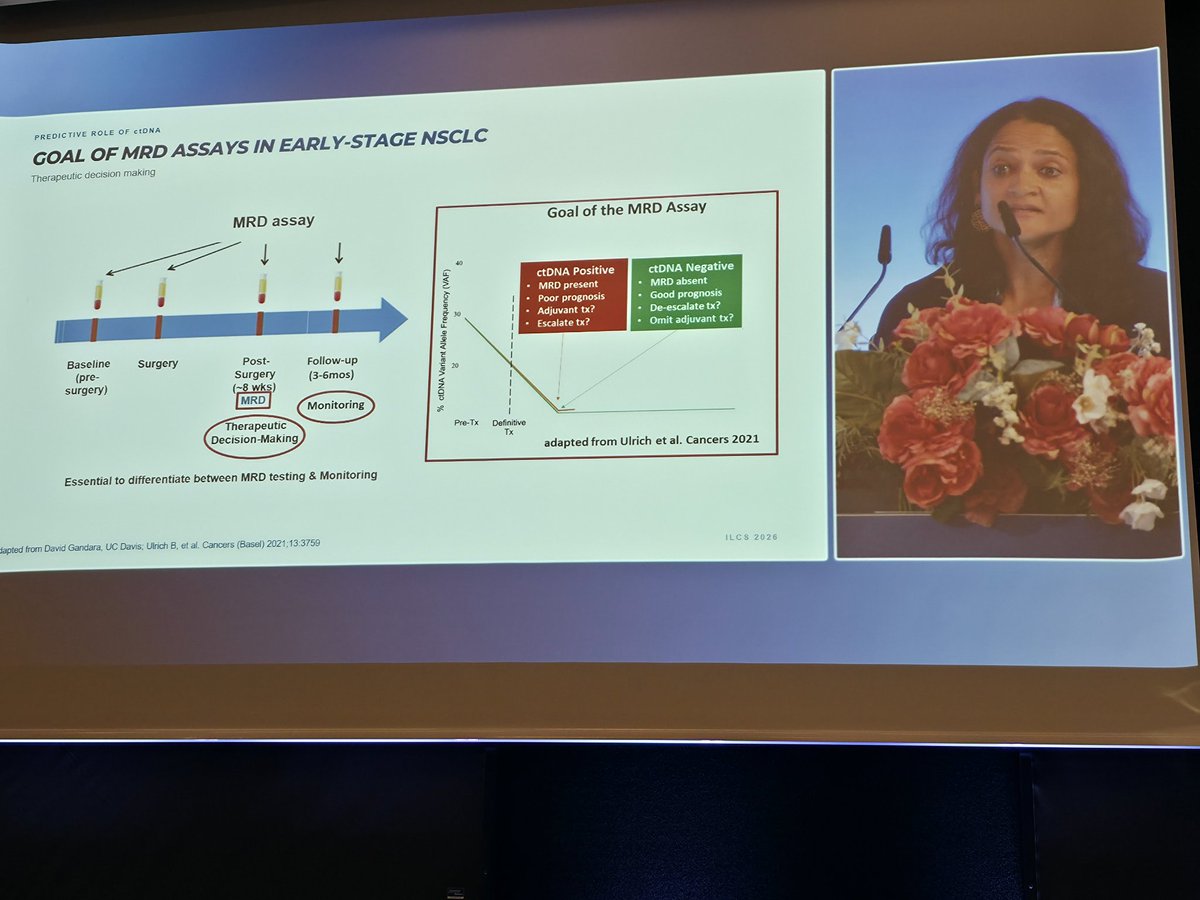
After surgery for NSCLC, a positive ctDNA test predicts recurrence, often months before a scan. Whether acting on it helps patients is still unproven.
Millie Das (@DasMillie11), of Stanford, called for prospective trials at the International Lung Cancer Summit (ILCS) 2026 in Lausanne. Her talk is now on demand.
Watch the talk: https://t.co/ivZQfIoARA
#ILCS2026 #LungCancer #NSCLC
New data arrive quickly, and deciding what they mean for one patient is the hard part. That is why the International Lung Cancer Summit (ILCS) 2026 ended on a panel of patient cases from the audience.
Alfredo Addeo (@Alfdoc2), of Geneva University Hospitals, chaired with Solange Peters (@peters_solange). The panel is now on demand.
Watch the panel: https://t.co/9DxdeZGgVr
#ILCS2026 #LungCancer #NSCLC #SCLC
The International Lung Cancer Summit (ILCS) 2026 covered ctDNA, targeted therapy, ADCs, early-stage IO and TCEs in SCLC in one day, then closed on a debate and a panel built on cases from the audience.
Solange Peters (@peters_solange), of CHUV, opened it and chaired with Alfredo Addeo (@Alfdoc2). Every talk is now on demand.
Watch the opening: https://t.co/xiToiEDJNI
#ILCS2026 #LungCancer #NSCLC #SCLC
After first-line chemo-immunotherapy for extensive-stage SCLC, maintenance can now add a chemotherapy or a DLL3 T-cell engager. Which should it be?
Giannis Mountzios (@g_mountzios) and Anne-Marie Dingemans (@a_dingemans) debated it at ILCS 2026 on efficacy, toxicity, brain metastases, and whether a new drug reaches patients in every country.
The debate is on demand for Lung Summit members:
https://t.co/2NQwwe3u8U
#ILCS2026 #LungCancer #SCLC https://t.co/KMde7rhRLQ
DLL3 T-cell engagers are reaching first-line SCLC.
At ILCS 2026, Nikolaj Frost looked at the cytokine release and neurotoxicity that come with them and at their activity in the brain. B7-H3 ADCs, he noted, still need confirmation in global trials. His forecast is biomarker-guided SCLC treatment within 5 years.
If you missed it, the recording is on demand for Lung Summit members:
https://t.co/EJ8tGKmnuq
#ILCS2026 #LungCancer #SCLC https://t.co/6fYZ8kWTQp
🆙 #ILCS2026@LungSummit
🔥The Emerging Role of T-Cell Engagers and ADCs in SCLC
🎙️ Dr. Nikolaj Frost
▶️Registration is open: https://t.co/rT1LOMpbMW
#LCSM@OncoAlert
Comprehensive genomic profiling should reach the tumour suppressor genes and not only the actionable drivers, and @FSkoulidis, of @UTMDAnderson in Houston, puts STK11 and KEAP1 at the centre of that second group before a first-line decision in metastatic non-squamous NSCLC.
His centre asks for liquid and tissue both. The liquid biopsy is worth doing up front where a practice returns it within a week or two, because these patients often present with a high disease burden and critical organ involvement; tissue confirms it wherever a biopsy site is feasible.
For a KRAS-mutant tumour with STK11 or KEAP1 mutations he goes to dual checkpoint blockade, provided the performance status allows it, which he calls critical. The exception he allows is a KEAP1 alteration alone, no KRAS mutation, high PD-L1 and high TMB, where he might feel comfortable with PD-1 based chemoimmunotherapy such as KEYNOTE-189.
Region-specific NSCLC recommendations for South Asia, agreed by Delphi vote and built for systems in which newer drugs are hard to afford. The paper, led by Kumar Prabhash and Ahmad Javid Zarang, includes our faculty member Vanita Noronha (@VanitaNoronha) among its authors.
🔬 Delphi consensus: 32 experts from 8 SAARC countries voted on 174 NSCLC statements
📊 A statement passed when more than 75% accepted it, completely or with reservation
📌 Statements run from diagnosis to follow-up, including older patients, brain and bone metastases, oligometastatic disease
📌 Evidence-based low-cost and low-dose options were written in because of affordability problems
⚠️ The abstract lists no individual recommendations and no count of statements that passed
Check the panel's voting rule in our article.
https://t.co/XYlKdCQIeh
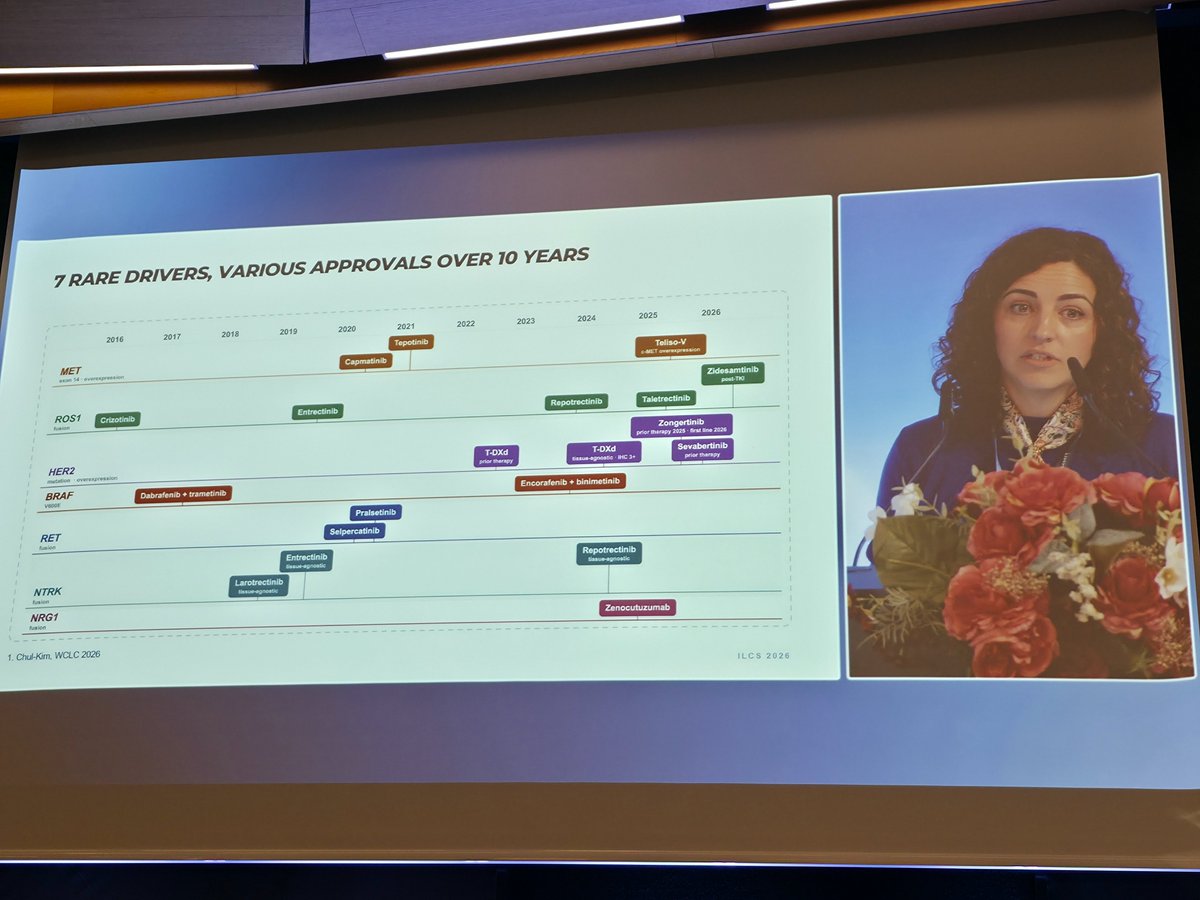
Rare drivers in NSCLC are uncommon one at a time and common together. At ILCS 2026, Telma Sequeira (@TelmaSequeiraMD) began with broad NGS testing, then turned to the harder part: what to give first.
For ROS1, the next-generation TKIs differ in brain activity and resistance. For HER2-mutant disease, the choice is a TKI or an ADC. HER2 overexpression she treated as a separate disease.
Lung Summit members can watch the recording on demand:
https://t.co/SW4GM9wZ6w
#ILCS2026 #LungCancer #NSCLC https://t.co/G3rkeg95bm
In advanced NSCLC without a targetable driver, resistance to PD-(L)1 drugs has many causes, and the drugs in development go after several of them.
Alessio Cortellini (@ACortelliniMD) covered bispecifics led by PD-(L)1/VEGF, new checkpoint targets, drugs for tumours with MTAP loss, vaccines and cell therapies. His caution at ILCS 2026: new biology does not guarantee clinical benefit.
Lung Summit members can catch up on demand:
https://t.co/nnwpvng7gE
#ILCS2026 #LungCancer #NSCLC https://t.co/yqemKe4h8z
ETOP Slide Deck of ESMO Congress 2026 now online.
Also, do not forget to register to our ETOP Live Webinar: Highlights of WCLC and ESMO 2026.
https://t.co/tjNrQ4NJry
🔥Cancer vaccines in the era of immunotherapy: from antigen delivery to immune ecosystem engineering
🆙 @NatRevClinOncol
🎯Vaccines reliably induce tumor-specific immunity, but translation into durable control is limited by biological bottlenecks (antigen selection, T-cell priming, infiltration, suppression)
🎯Neoantigen vaccines improve outcomes esp. in earlier disease & within broader immunotherapy strategies
🎙Dr. Adrien Mouren
@OncoAlert@Larvol
https://t.co/ImdSsF4p9z
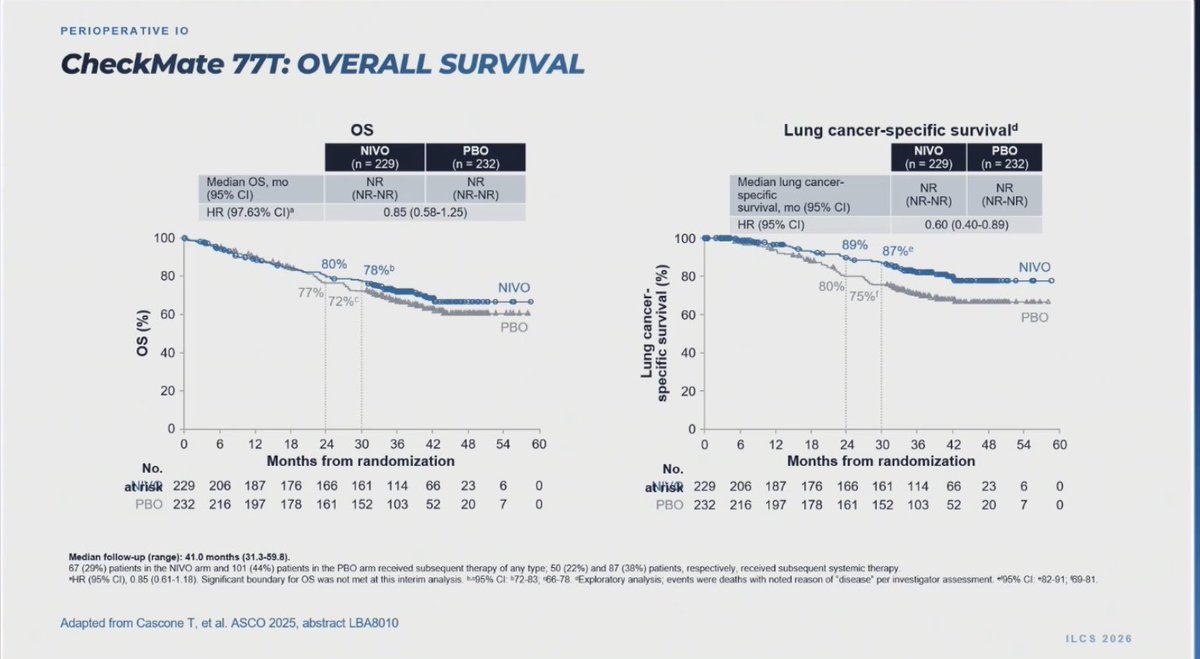
Should a patient with resectable NSCLC who had immunotherapy before surgery get more of it afterwards?
Sandip Patel (@PatelOncology) weighed the evidence at ILCS 2026 by stage, pathological response and PD-L1, and put EGFR, ALK and PD-L1 testing ahead of any treatment decision.
Watch it on demand as a Lung Summit member:
https://t.co/qOvjIAxDer
#ILCS2026 #LungCancer #NSCLC https://t.co/Y3M7hoEUwU
Dr. @PatelOncology provides an updated overview of immunotherapy in early stage NSCLC; compares and contrasts to melanoma. Neoadjuvant and perioperative have been more consistent than adjuvant but many questions remain including approach to borderline resectable cases. #ILCS26
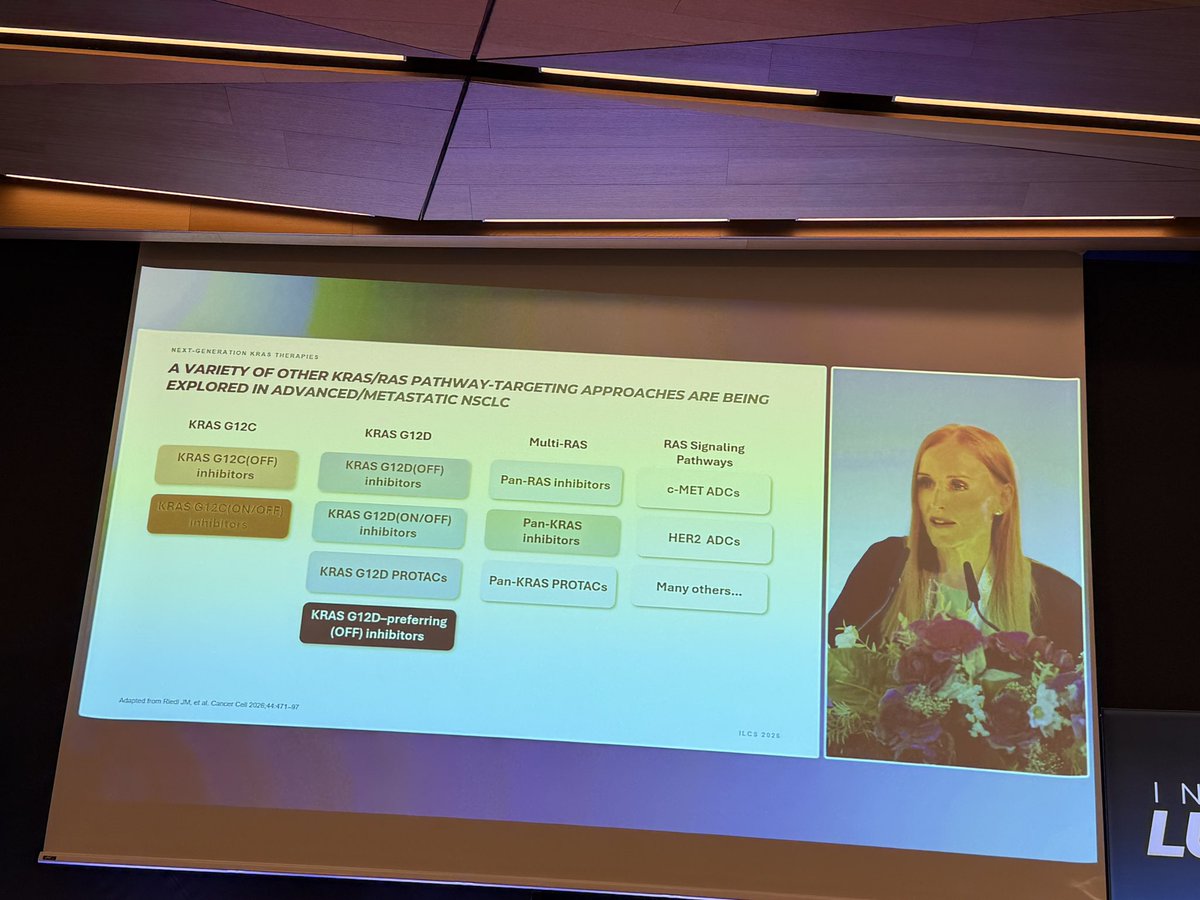
KRAS G12C inhibitors work after first-line treatment, but resistance limits how deep and how durable the responses are.
At ILCS 2026, Christine Lovly (@christine_lovly) looked past the first G12C drugs to newer G12C compounds, RAS(ON) inhibitors, and drugs aimed at G12D or at every RAS form. The first-line role is for the phase 3 trials now running to settle.
The full talk is on demand for Lung Summit members:
https://t.co/M3kU4UPooj
#ILCS2026 #LungCancer #NSCLC https://t.co/PDWCgob5N4
#ILCS26@christine_lovly delivering a comprehensive overview of #KRAS inhibitors in #NSCLC emphasizing on target selectivity, co-mutations, patient subgroups and combinations with chemo+/- moving to the 1L setting . Exciting times to follow
Rare drivers in NSCLC are uncommon one at a time and common together. At ILCS 2026, Telma Sequeira (@TelmaSequeiraMD) began with broad NGS testing, then turned to the harder part: what to give first.
For ROS1, the next-generation TKIs differ in brain activity and resistance. For HER2-mutant disease, the choice is a TKI or an ADC. HER2 overexpression she treated as a separate disease.
Lung Summit members can watch the recording on demand:
https://t.co/SW4GM9wZ6w
#ILCS2026 #LungCancer #NSCLC https://t.co/G3rkeg95bm
Region-specific NSCLC recommendations for South Asia, agreed by Delphi vote and built for systems in which newer drugs are hard to afford. The paper, led by Kumar Prabhash and Ahmad Javid Zarang, includes our faculty member Vanita Noronha (@VanitaNoronha) among its authors.
🔬 Delphi consensus: 32 experts from 8 SAARC countries voted on 174 NSCLC statements
📊 A statement passed when more than 75% accepted it, completely or with reservation
📌 Statements run from diagnosis to follow-up, including older patients, brain and bone metastases, oligometastatic disease
📌 Evidence-based low-cost and low-dose options were written in because of affordability problems
⚠️ The abstract lists no individual recommendations and no count of statements that passed
Check the panel's voting rule in our article.
https://t.co/XYlKdCQIeh
After surgery for lung cancer, ctDNA can signal a recurrence before imaging does. Whether treating on that signal helps patients has not yet been shown in prospective trials.
Millie Das (@DasMillie11) opened ILCS 2026 on this question. She set tumour-informed against tumour-naive assays and MRD testing against ongoing monitoring, and asked what a result does to the patient who receives it.
The recording is on demand for Lung Summit members:
https://t.co/ivZQfIoARA
#ILCS2026 #LungCancer #NSCLC #SCLC https://t.co/UPTepqKw3E
PECATI gave lenvatinib plus pembrolizumab to patients with B3 thymoma or thymic carcinoma after platinum; Jordi Remon (@JordiRemon) and colleagues report the final analysis. Among the authors are our faculty members Nicolas Girard (@nicogirardcurie) and Noemí Reguart (@NReguart).
🔬 PECATI single-arm phase 2: lenvatinib plus pembrolizumab in 43 platinum-refractory B3 thymoma or thymic carcinoma
📊 mPFS 22.1 mo; primary endpoint, a 5-month PFS rate of 88.0%, met
📊 mOS 40.2 mo; 53.0% alive at 36 mo; confirmed ORR 25.6%
📊 Gr ≥3 treatment-related AEs in 44.2%; discontinuation for toxicity in 27.9%
⚠️ One arm with no comparator, and 84% of patients had thymic carcinoma
Read why the histology mix limits the B3 thymoma reading, in our article.
https://t.co/KpR09hqpOU
Suppression or eradication? An early question in #ADAURA and adjuvant TKIs in NSCLC
At 8 years, adjuvant osimertinib maintains an OS benefit (79% vs 64%; HR 0.52), 5 years beyond treatment completion.
https://t.co/EuTyK47GOB
Not proof of eradication, but increasingly hard to explain by delayed recurrence alone.
@IASLC@JTOonline
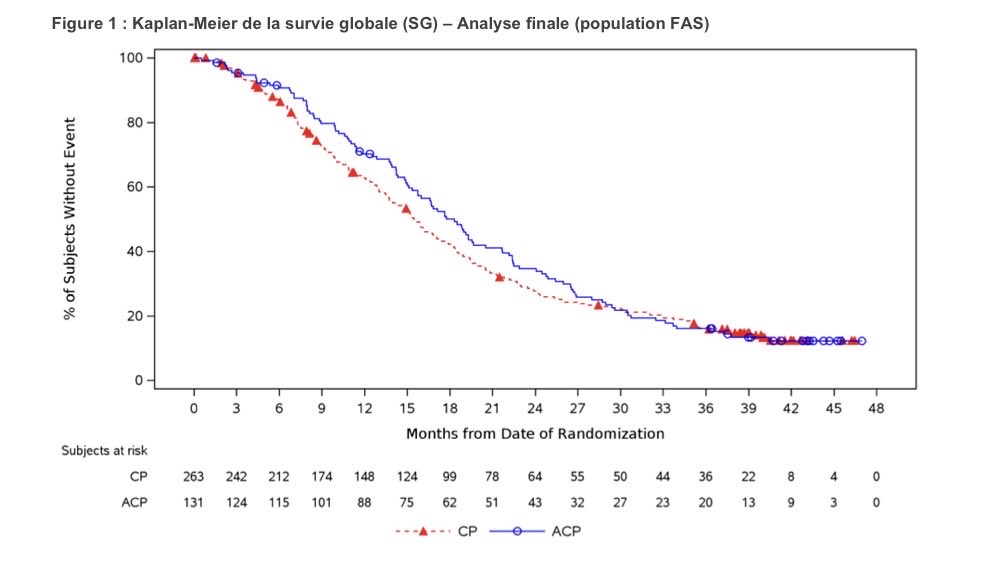
EGFRm NSCLC after osimertinib:
How should we weigh PFS when OS is not statistically significant?
Recent HAS & FDA decisions on amivantamab and ivonescimab raise a key question:
Is delaying progression enough?clinical benefit?
Final OS curves from MARIPOSA-2 attached. #LungCancer
A trial built to pre-empt small cell transformation in TP53/RB1-deficient, EGFR-mutant NSCLC still saw it in nearly half of its patients. The paper, led by Lena Morrill Gavarró and Helena Alexandra Yu, includes our faculty member Charles Rudin (@charlesrudin) among its authors.
🔬 Prospective trial: 1L osimertinib plus platinum and etoposide in EGFR-mutant, TP53/RB1-deficient NSCLC
📊 SCLC transformation in 5 of 11 patients despite SCLC-directed chemotherapy
📊 mPFS 11 mo; mOS 33 mo
📌 Profiling also found mesenchymal and squamous histologies, tied to progressive RB pathway disruption
⚠️ 11 patients and 1 arm, so no comparison with osimertinib alone
Find the single-cell findings on mesenchymal and squamous change in our article.
https://t.co/cTAmq24mBY