We gave our AI system a spec, and in under 2 weeks, it designed, verified, and deployed a chip that beats NVIDIA.
It’s built for low-power physical AI workloads. We’re running live inference on >B+ parameter models like Llama, Qwen, and Kimi, serving at 3.4x better perf/watt than NVIDIA Jetson.
From just a specification, our AI system autonomously generated all of the RTL Design, UVM verification, formal proofs, firmware, drivers, and kernels, co-designing the model, software and silicon as one optimization loop.
Better AI can now design better chips to run AI, leading to a loop of recursive-self improvement towards our path to abundant intelligence.
@paulg@garrytan Translating: “The dems made a huge mistake by positioning against structural violence and identity politics that don’t help me are worthless”
Why do moderates feel threatened by pronouns and land acknowledgments and why does that justify supporting fascist tomfoolery
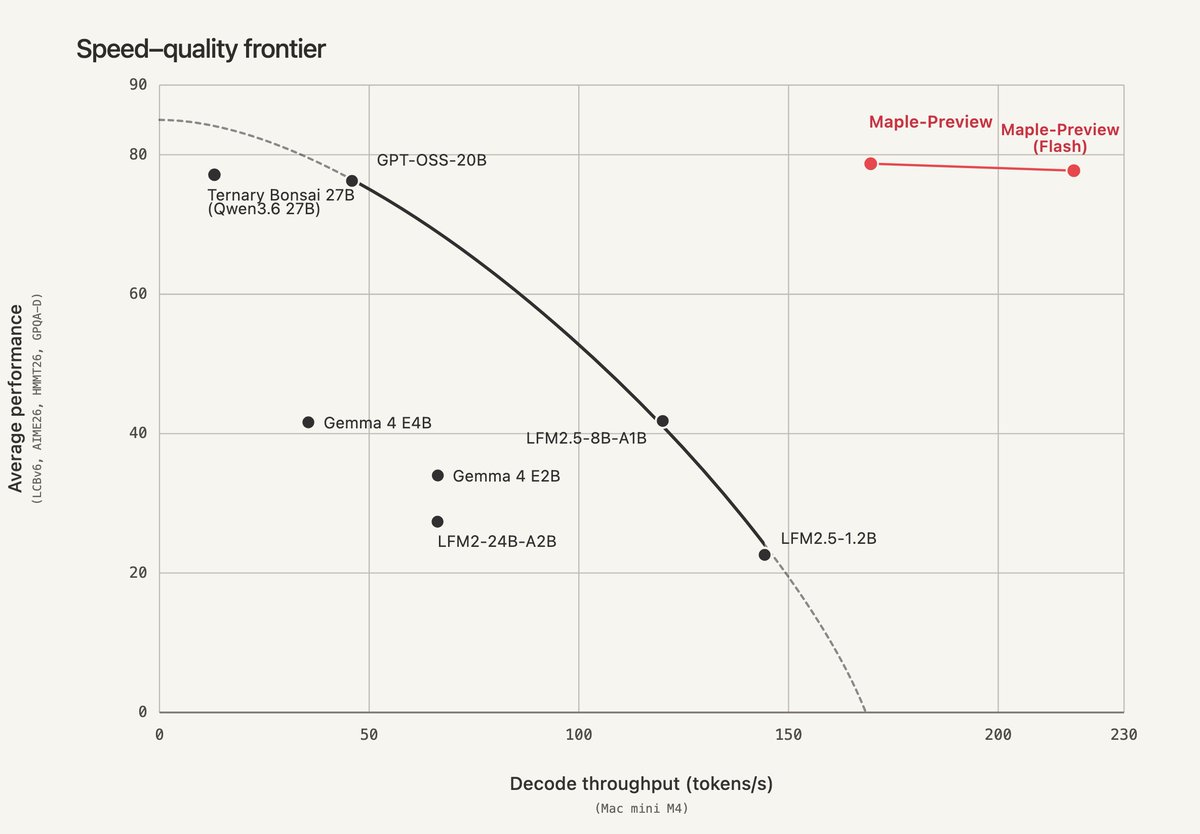
We introduce Maple-Preview, an open-source 20B-A1B ternary-weight reasoning LLM, SOTA in its weight class.
It solves IMO-level problems and runs at 200+ tokens/s on a Mac Mini M4, 5–16× faster than efficient models like Gemma 4, Qwen3.5, and gpt-oss.
https://t.co/l2y5eZTVS4
Today, we're introducing @Intelligence_ai.
In 6 months, as a team of 10, we scaled from $5M to $60M ARR and 5.5M users across 190+ countries.
We raised a $7.9M seed, led by @IndexVentures with participation from @conviction, @A_StarVC, and @combinator to build DesignArena, a universal interface for accessing and evaluating the world's AI capabilities.
Most evaluations try to simulate the real-world. We believe the real-world is the ultimate verifier.
People come to @DesignArena with a request. Models compete to fulfill the request, and users determine what works best for them.
Their live user behavior evaluates the models, improves how work is routed, and helps people access the right intelligence.
We've helped the world's leading frontier labs break the news on their SOTA capabilities.
What's the limit? Join us and find out.
HELLO im in ICML @ seoul this week!
Please reach out if you are interested in:
- agent to agent interactions
- training optimization theory
- edge of stability
- human agent interaction
- applied research startups
- VC or early stage startups
- AI safety
- me
Today, @aadityasubedi_ and I are excited to introduce @architectlabs.
We are building the AI system to design and provably verify chips for the world's most demanding workloads.
AI scaling is fundamentally changing the economics of hardware infrastructure. As models scale, become more capable, and more widely deployed, the bottleneck is shifting from software and models alone to the physical infrastructure that runs it: specialized compute, memory, networking, interconnects, and full-stack system design.
General-purpose hardware is no longer enough, and the world is racing to spin up new chip programs. This is not just true across datacenter training and inference, but everywhere AI enters the physical world: robotics, autonomous systems, spatial computing, defense, personal devices, industrial automation, and scientific instruments.
But designing a chip today remains one of the most gated efforts in modern technology.
A modern chip program takes years, costs hundreds of millions of dollars, and depends on a shrinking pool of expertise concentrated inside a small number of companies.
Architect Labs is a foundational lab building an AI system that designs and provably verifies chips end-to-end. We partner with semiconductor and workload companies, AI labs, and nations to turn demanding workloads into purpose-built chips, on demand at scale. We aim to drastically accelerate chip design, so that the models, software and chip designs can co-evolve together, accelerating the industry’s path to superintelligence.
Two decades ago, the fabless revolution made it possible to build a chip company without owning a fab. TSMC made world-class manufacturing available to anyone with a design. We aim to do the same for chip design itself: enable any organization with a workload, or specification, to get a purpose-built chip design that unlocks scale and distribution of intelligence impossible with current hardware paradigms.
Our founding team collectively has taped out 80+ production chips, led $10B datacenter product lines, been core contributors to Meta’s AI silicon, architected and designed one of the first neuromorphic chips out of Intel, led research teams at Anthropic, xAI, and Google DeepMind, and contributed to fundamental AI research across nearly every frontier lab.
We have already partnered with semiconductor companies to accelerate their chip programs, and some of our AI-generated chip designs are going to tape out on leading-edge foundry nodes later this year.
We’ve also raised a $24M seed round led by @stevejang from @KindredVentures , with participation from @TQVentures , @RaceCapital , @scaletogether , @ora, and Link Ventures.
We are grateful for the support of our angels and advisors, including @snsf , @lukaszkaiser , @AravSrinivas , Kunle Olukotun, @tlbtlbtlb, @alexwg, Siddharth Nath, Thierry Tambe, @arashf , @ekaurghar, @CHHubbell, Selene Casabal, @semiDL , and engineering leaders from OpenAI, NVIDIA, Google DeepMind, Intel and more.
The next great scaling law may not come from the models alone. It will come from making the physical substrate of intelligence programmable. We exist to bring this future to life.
The US government, citing national security authorities, has issued an export control directive to suspend all access to Fable 5 and Mythos 5 by any foreign national, whether inside or outside the United States, including foreign national Anthropic employees.
The net effect of this order is that we must abruptly disable Fable 5 and Mythos 5 for all our customers to ensure compliance.
Access to all other Claude models is not affected.
We apologize for this disruption to our customers. We believe this is a misunderstanding and are working to restore access as soon as possible.
Read our full statement: https://t.co/bwn0sximKZ
Learned so much about research, optimization, and training dynamics.
* having knowledgeable PIs with theories to test is invaluable. don’t need to be an expert but working with one helps a ton
* a lot of modern training is still not well characterized or completely understood
Our new paper was accepted at ICML!
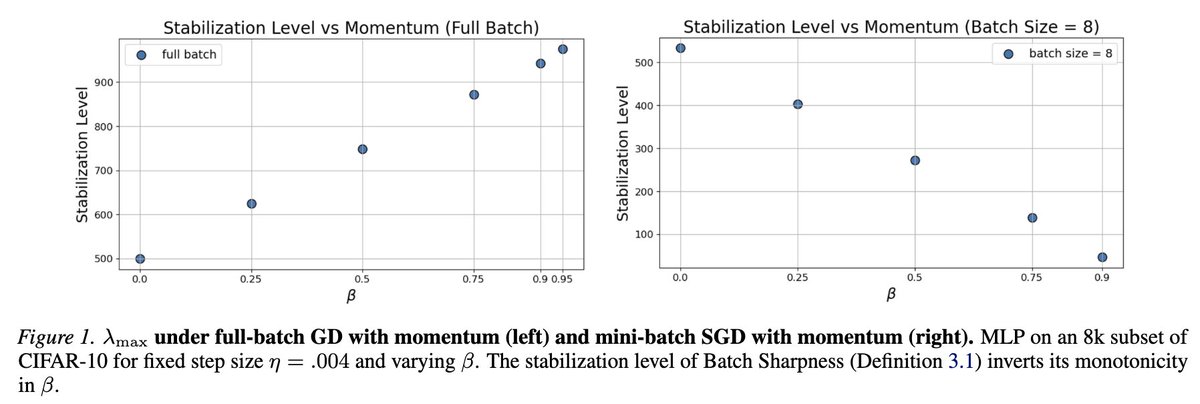
1) Momentum isn’t just “SGD but faster”.
It affects sharpness (of orders of magnitude!)
2) The usual story says momentum lets you train in sharper regions.
That’s true for large batches only! The opposite is true for minibatches!
Our new paper was accepted at ICML!
1) Momentum isn’t just “SGD but faster”.
It affects sharpness (of orders of magnitude!)
2) The usual story says momentum lets you train in sharper regions.
That’s true for large batches only! The opposite is true for minibatches!