Postdoc at UMD, working at NASA Goddard. Lunar exploration scientist. Space Outreach! Ten Outstanding Young Americans 2018. WVU alum. Views are my own.
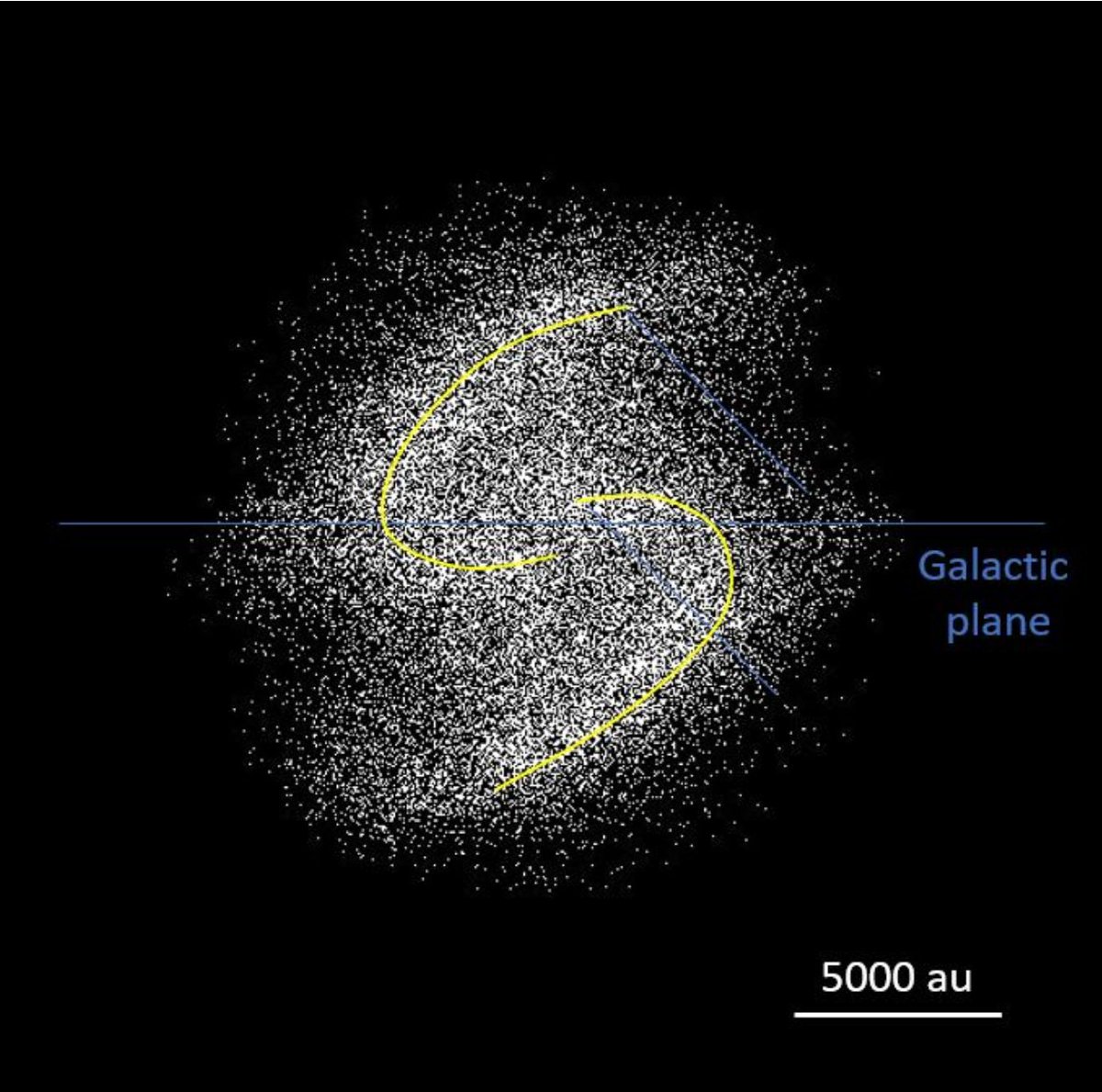
Far beyond Pluto, trillions of cold comets circle the sun in a lazy swarm called the Oort Cloud. A new simulation indicates what this comet-cloud looks like: a loose spiral that resembles a miniature galaxy.
https://t.co/261RPMuvki
The Artemis II crew has recently been immersed in flight operations reviews and simulating @NASA_Orion’s return to Earth.
The crew wants to extend a special thank you to all the different teams across the country that are coming together to build the @NASA_SLS rocket.
The crew of Apollo 14 found it difficult to sleep - partly due to the angle at which they landed.
They felt they were slipping down into a crater, and Ed Mitchell would regularly lift the blinds to check they were not.
Wonderful clarity in this small section of the full panorama.
Apollo Next Generation Sample Analysis (ANGSA) Samples: Preliminary Examination of Double Drive Tube Samples 73001 and 73002 and Lessons Learned for Returning to the Moon With Artemis. https://t.co/0lGT3X4rVk This study discusses the first modern dissection of an Apollo core.
✨Editor's Pick✨
The first machine learning-derived global-scale survey of #Mercury’s hollows suggests they are young features that may be active and will continue to evolve.
🔗Learn more in @AGU_Eos: https://t.co/4VWa8obJH9
#AGUPubs @wileyearthspace @wileyinresearch
Ghost riders in the sky.
@fireflyspace’s Blue Ghost lander recently completed a maneuver to adjust its orbit around the Moon. We are on track for a landing on March 2.
Your package is scheduled for delivery 📦
@fireflyspace’s Blue Ghost lunar lander is set to land on the near side of the Moon on March 2 at 3:45am ET (0845 UTC) with NASA science and tech aboard. Watch the landing live with us! https://t.co/UUhv9gYa9n
Ever noticed how the Moon seems HUGE when it’s near the horizon but smaller when it’s overhead?
Trick of the eye or something more? Scientists have debated this for 2,000+ years, and we still don’t have a definitive answer! Find out what we do know: https://t.co/tW0dRmCOT5
European member of the Astronaut Reserve, John McFall and the team at @ESA have shown it is possible for someone with a physical disability to live and work on the @Space_Station. 🛰️
Read more about the Fly! Mission Ready phase 👉 https://t.co/EdfkWq9mbC
Hear from John 👇
Tomorrow is Galileo Galilei's birthday! 🎂🎉
Did you know Apollo 15 commander David Scott conducted Galileo's famous Hammer-Feather Experiment while on the lunar surface? 🔨
Click the link to learn more & see science in action!
https://t.co/pxZSNfZDE2
Development and Evolution of Icy Layer Outcrops on Mars' North Polar Ice Cap: Observations of Vertical and Lateral Variability. https://t.co/CIIR1rUg39 Study finds lateral variability on the meter-scale in the protrusion of individual marker beds that reflect local conditions.
Encyclopædia Britannica will continue to use ‘Gulf of Mexico’ for a few reasons:
-We serve an international audience, a majority of which is outside the U.S.
-The Gulf of Mexico is an international body of water, and the U.S.’s authority to rename it is ambiguous.
🧵⬇️
MEDIA: You are invited to visit @NASAKennedy on March 7 to capture imagery of the @NASA_Orion spacecraft and @NASA_SLS solid rocket boosters for the Artemis II mission to the Moon. https://t.co/nqabi6e7SL
Life as we know it needs water to survive, so as we search for life outside our solar system, astrobiologists are often guided by the phrase “follow the water.” Learn how the SPHEREx mission will help in that quest across our Milky Way galaxy: https://t.co/G1gQDgJG2c
Aqueous Alteration as an Origin of Martian Magnetization. https://t.co/IrlVt3rpnH Study finds that aqueous alteration of dunites at low water-to-rock ratios can generate sufficient magnetite to account for the strongest magnetic anomalies.