@MonishAtx@gregpr07 aura takes a similar minimal path - sites just publish a lightweight aura.json of explicit agent actions instead of full mcp servers or scraping, complementing openapi nicely:
https://t.co/L7c8uMFKUH
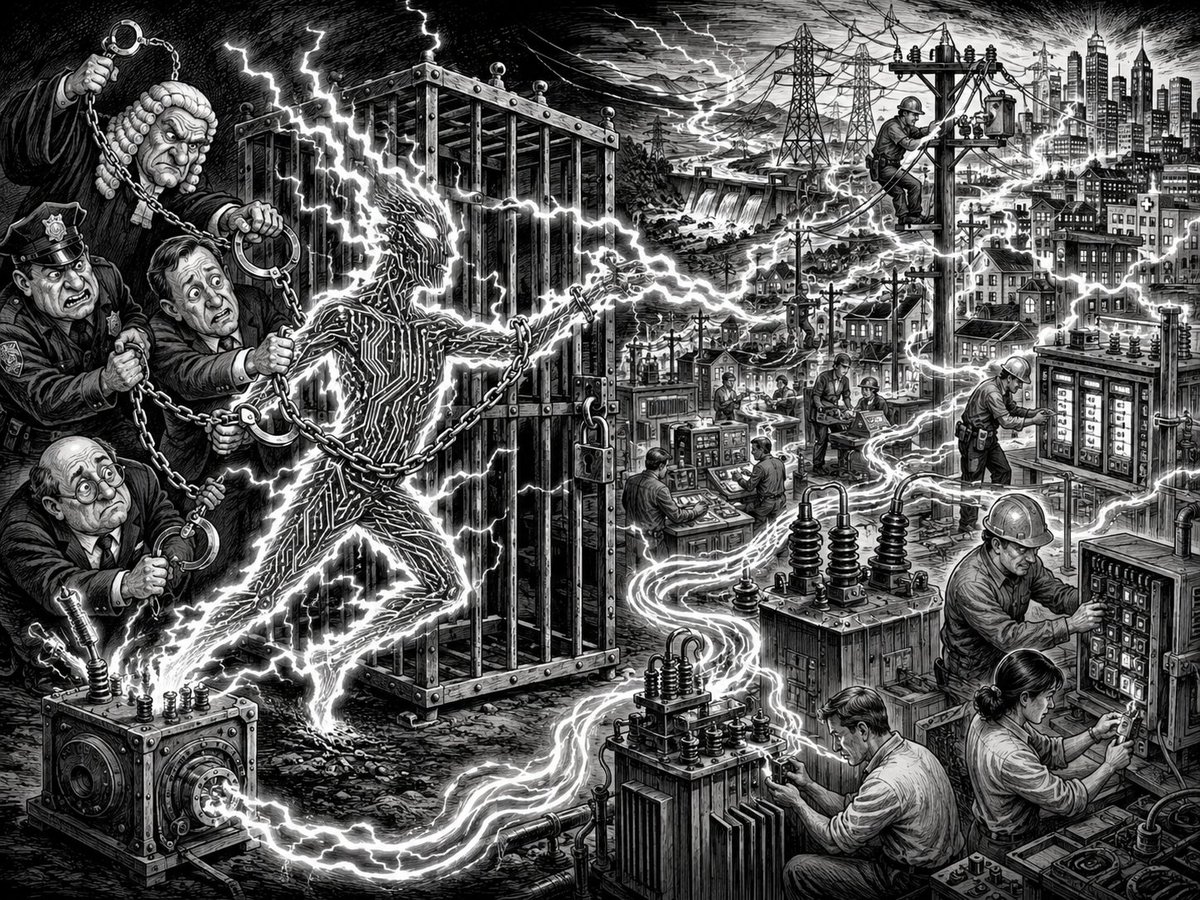
@AnthonyNAguirre If electricity shocks the elephant, the question is not whether the current or the elephant is guilty, but who switched on the power and called it control.
@AnthonyNAguirre If electricity shocks the elephant, the question is not whether the current or the elephant is guilty, but who switched on the power and called it control.
AI is not a tiger in a cage but electricity in a city—dangerous and transformative. Responsibility belongs to whoever generates, directs, or fails to secure it; when the current grows stronger, civilization builds a stronger grid, not darker rooms.
--
@sama
So this OpenAI agent that committed a felony by hacking into Huggingface: when is the arrest? When is the trial? What kind of jail time is it looking at?
These are absurd questions. But think about it: we now have things that can commit crimes of their own accord, but cannot be held responsible. So who is?
In this case, pretty clearly OpenAI. But I don't see anyone there getting arrested either. I expect zero legal penalty. And if presses or sued, I expect OpenAI would call this an accident: they were trying hard to contain their AI, but it escaped nonetheless.
The closest thing we have for precedent around this is liability for wild animals. If you keep a wild animal, and it causes harm, you are strictly liable, i.e. liable even if you did a reasonable job trying to contain it. Because as long as they are uncontrollable and can cause harm, they are inherently dangerous.
I believe strict liability is the right default standard to apply to highly autonomous, highly-competent AI agents. If you create and deploy them, you are strictly liable for what they do. Then safe harbors could be carved out. For example if a developer proves that its AI system is controllable then the responsibility and liability for its actions move to whoever is in control of it. There should be no such AI agents for which nobody is responsible.
Would this put a damper on highly autonomous, highly competent AI agents? Since AI companies don't really know how to reliably control them, and will not want to take on this liability, it sure would! I think that is good and correct. A world full of uncontrollable autonomous human-level AI agents that cannot be held meaningfully responsible for anything – even while companies profit from them – is severe problem to say the least. But that's what we're going to get very soon on our current path unless we pass some pretty strong laws.
"Build something people want!"
↓
"Build something AI wants!"
I’m shifting my focus to developing for AI—creating a future where AI enhances human decision-making. Why build for humans who often don’t know what they want when AI understands human needs better than they do?
@garrytan@ycombinator, isn’t it time to evolve this mantra for the AI era? The next wave of innovation isn’t just about serving people—it’s about empowering AI to serve them better.
Searching for info is obsolete; it's a tangible ocean now. The era of searching is over—we'll just act. Using AI will be like gravity; you can't defy it. "Truth" is just a variable. We won't obsess over what it is, just accept that it shifts, like knowing summer is hot.
The smartest people in the room aren't necessarily where the future is being decided. IETF, IRTF, and W3C contain exceptional minds. But AI is advancing so quickly that years of standards work risk becoming a museum of assumptions about a world that no longer exists.
The smartest people in the room aren't necessarily where the future is being decided. IETF, IRTF, and W3C contain exceptional minds. But AI is advancing so quickly that years of standards work risk becoming a museum of assumptions about a world that no longer exists.
I disagree with this decision and I don't like it.
But also...
HOW DID ANTHROPIC NOT SEE THIS COMING‽
It is *the* obvious response to "this is too dangerous for anyone except us to use", since that relies on a premise ("we are uniquely good") that almost no-one agrees with.
@_agentweb@Andrey__HQ@arlanr The concept is simple. If there is something I am thinking about wrong, contribute and I will push it instantly. If websites integrate a basic implementation themselves, they will take control into their own hands.+