@signulll Interested to hear your thoughts on why none of the AI labs built a multiplayer experience … seems such an obvious way to make your product more sticky, get network effects etc
Opportunity has been there in plain sight for ages
Is there a technical reason?
I built https://t.co/UvXxZ75YBq over the weekend.
Pick all the teams you want to follow in the world cup, it will create a custom calendar for you and sync all their games to your calendar. Updates as the tournament unfolds.
A Norwegian neuroscientist spent 20 years proving that the act of writing by hand changes the human brain in ways typing physically cannot, and almost nobody outside her field has read the paper.
Her name is Audrey van der Meer.
She runs a brain research lab in Trondheim, and the paper that closed the argument was published in 2024 in a journal called Frontiers in Psychology. The finding is brutal enough that it should have changed every classroom on Earth.
The experiment was simple. She recruited 36 university students and put each one in a cap with 256 sensors pressed against their scalp to record brain activity. Words flashed on a screen one at a time.
Sometimes the students wrote the word by hand on a touchscreen using a digital pen, and sometimes they typed the same word on a keyboard. Every neural response was recorded for the full five seconds the word stayed on screen.
Then her team looked at the part of the data most researchers had ignored for years, which is how different parts of the brain were communicating with each other during the task.
When the students wrote by hand, the brain lit up everywhere at once.
The regions responsible for memory, sensory integration, and the encoding of new information were all firing together in a coordinated pattern that spread across the entire cortex. The whole network was awake and connected.
When the same students typed the same word, that pattern collapsed almost completely.
Most of the brain went quiet, and the connections between regions that had been alive seconds earlier were nowhere to be found on the EEG.
Same word, same brain, same person, and two completely different neurological events.
The reason turned out to be something nobody had really paid attention to before her work. Writing by hand is not one motion but a sequence of thousands of tiny micro-movements coordinated with your eyes in real time, where each letter is a different shape that requires the brain to solve a slightly different spatial problem.
Your fingers, wrist, vision, and the parts of your brain that track position in space are all working together to produce one letter, then the next, then the next.
Typing throws all of that away. Every key on a keyboard requires the exact same finger motion regardless of which letter you are pressing, which means the brain has almost nothing to integrate and almost no problem to solve.
Van der Meer said it plainly in her interviews.
Pressing the same key with the same finger over and over does not stimulate the brain in any meaningful way, and she pointed out something that should scare every parent who handed their kid an iPad.
Children who learn to read and write on tablets often cannot tell letters like b and d apart, because they have never physically felt with their bodies what it takes to actually produce those letters on a page.
A decade before her, two researchers at Princeton ran the same fight using a completely different method and ended up at the same answer. Pam Mueller and Daniel Oppenheimer tested 327 students across three experiments, where half took notes on laptops with the internet disabled and half took notes by hand, before testing everyone on what they actually understood from the lectures they had watched.
The handwriting group won by a wide margin on every question that required real understanding rather than surface recall.
The reason was hiding in the transcripts of what the two groups had actually written down.
The laptop students typed almost word for word, capturing more total content but processing almost none of it as they went, while the handwriting students physically could not write fast enough to transcribe a lecture in real time, which forced them to listen carefully, decide what actually mattered, and put it in their own words on the page.
That single act of choosing what to keep was the learning itself, and the keyboard had quietly skipped the choosing and skipped the learning along with it.
Two studies. Two countries. Same answer.
Handwriting makes the brain work. Typing lets it coast.
Every note you have ever typed instead of written went into your brain through a thinner pipe. Every meeting, every book highlight, every idea you captured on your phone instead of on paper was processed at half depth.
You did not forget those things because your memory is bad. You forgot them because typing never woke the part of the brain that would have made them stick.
The fix is the thing your grandmother already knew.
Pick up a pen. Write the thing down. The slower road is the faster one.
I'm an absolute sleezebag with AI tools. Zero loyalty. Constantly cheating on them with the competitors. Suspect most people are the same and I have no idea how you build a good consumer product in this context.
🎯
When I got my first management role, the dominant philosophy was:
- hire good people and get out of the way
- coach don't manage
It didn't work for me at all.
The team's output only improved when I got in the detail of the work and injected some 'creative director' energy
Brian on why pure people managers won't survive AI:
"I don't think people that only manage people will have any value in the future.
Everyone's going to have to be a hybrid people manager or manager IC.
In other words, even the managers need to code. You can't just be these managers where you're people's therapists and you're just doing meetings, just one-on-ones.
People who have lots of recurring one-on-ones are not going to survive.
That kind of leadership style is not gonna work. You need to have context.
I hear about heads of design, they don't actually manage the design. Johnny Ive manages the design. He designs and he leads people. A design leader who only manages the people that's crazy to me.
The way Frank Lloyd managed his design team is through the work. You don't manage the people, you manage the work.
I think a lot of people will survive this age of AI.
The two types of people that will not survive are pure people managers, and people that are rigid and don't want to change and evolve."
Brian on why pure people managers won't survive AI:
"I don't think people that only manage people will have any value in the future.
Everyone's going to have to be a hybrid people manager or manager IC.
In other words, even the managers need to code. You can't just be these managers where you're people's therapists and you're just doing meetings, just one-on-ones.
People who have lots of recurring one-on-ones are not going to survive.
That kind of leadership style is not gonna work. You need to have context.
I hear about heads of design, they don't actually manage the design. Johnny Ive manages the design. He designs and he leads people. A design leader who only manages the people that's crazy to me.
The way Frank Lloyd managed his design team is through the work. You don't manage the people, you manage the work.
I think a lot of people will survive this age of AI.
The two types of people that will not survive are pure people managers, and people that are rigid and don't want to change and evolve."
Pica is a fully native app for managing your fonts on MacOS.
Organize into collections, test color themes and logos, watch folders, manage what's installed, and much more.
Available for free at https://t.co/8CqZi0hyIO
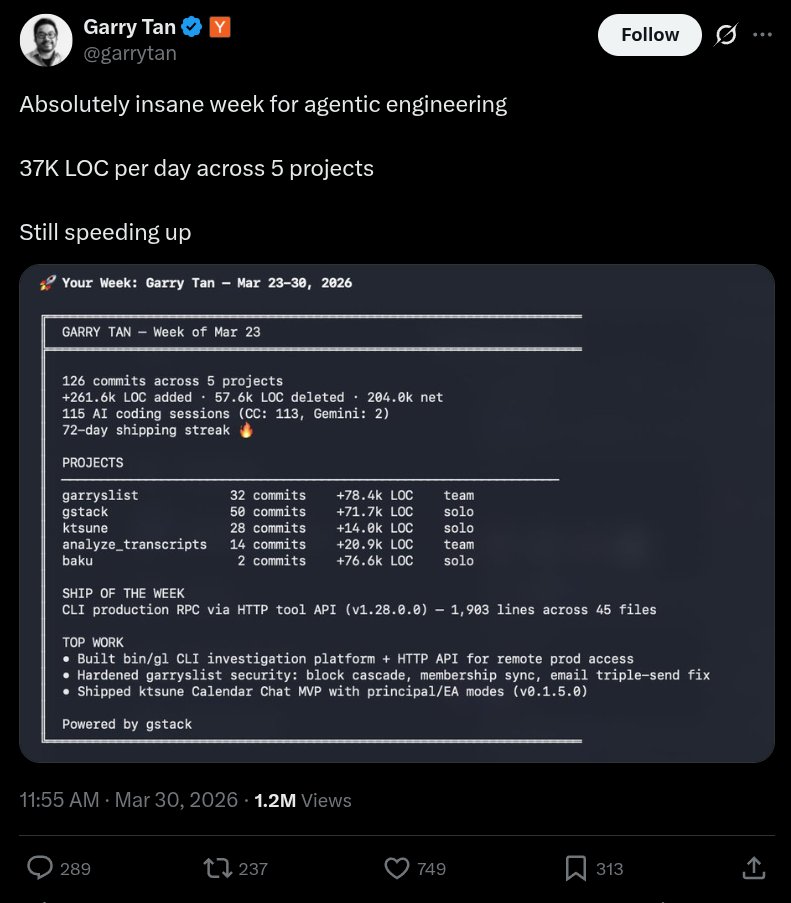
so... I audited Garry's website after he bragged about 37K LOC/day and a 72-day shipping streak.
here's what 78,400 lines of AI slop code actually looks like in production.
a single homepage load of https://t.co/TqaEZsF44N downloads 6.42 MB across 169 requests.
for a newsletter-blog-thingy.
1/9🧵
@thenanyu@pdotcv I don’t think it’s that simple.
Am sure most designers have experienced the ‘get back in your box’ pressure when leaning in to broader conversations in the org.
Agree design has somewhat retreated from the wider scope and purview of past, but not purely by choice
A part of the explanation…
- Headcount decisions for design are usually made by product leaders
- Product people naturally have a bias towards their own tribe
- Whenever there’s headcount pressure/prioritisation guess which function gets squeezed 🤷♂️ (also applies to UX research)
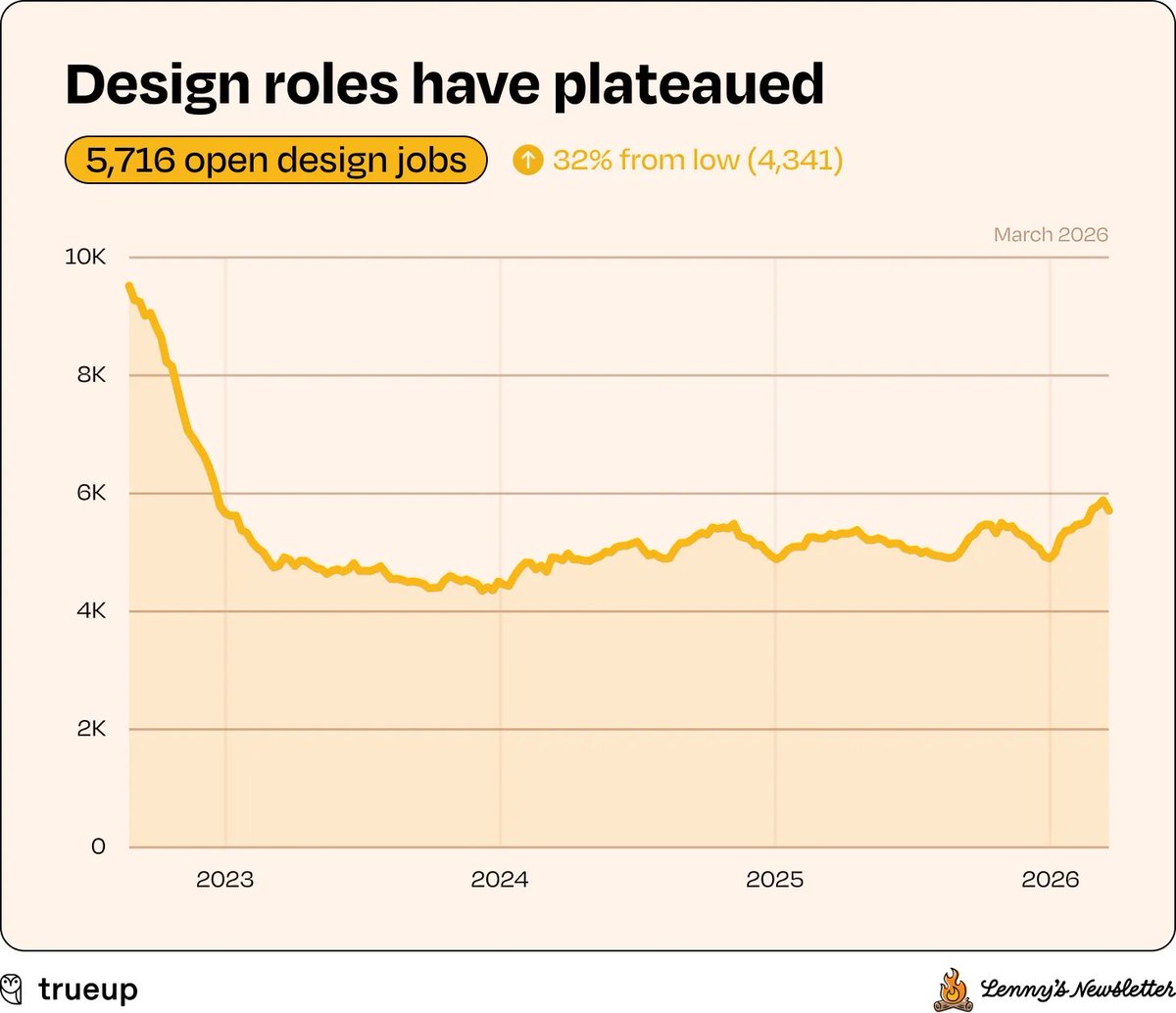
4/ Design roles have plateaued
Unlike PM and engineering, open design jobs have been relatively flat since early 2023, and there are also fewer of these roles than PMs and engineers in absolute terms (about 5,700 globally).
I genuinely think that coming on twitter back in the day made me smarter. Exposed to so many good ideas and interesting people.
The feed now is full of trash/brain rot. I feel like I get dumber when I hang out here
Love this. Apprenticeship model is perfect way to learn product design.
Hope this catches on with more teams as its rough cracking into the industry these days.
I feel lucky someone took a chance on me back in the day despite my lack of experience/ qualifications
You don’t just wake up a world-class designer. It takes reps, mentors, and environments that raise your bar.
Those opportunities have been disappearing — so we’re bringing them back. Introducing DAP: Shopify’s new
Design Apprenticeship Program. Apply Oct 20 – 27 → link in reply
🎩 @katarinabatina
@ariel_n@benblumenrose@designerfund Lol I have been thinking about this as well. Thought I was the only weirdo day dreaming about it!
there’s an opportunity to mix screens with physical ctrls + use rive to build nice interfaces for the appliances. Incumbents are doing a terrible jon rn with controls/interfaces.