What is the pre-tax payment a player gets for playing in the Super Bowl and how much do they get after taxes … when playing in California if they never play in California during the calendar year in which they play in the Super Bowl?
A player gets $103,000 for losing and $178,000 for winning.
If a player’s salary for the rest of the year is $10 million, my calculation is that they pay approximately $95,400 in taxes (federal and state) if they lose, netting a gain of $7,600 for playing in the Super Bowl.
If they win they keep $54,000 of $178,000.
A higher or lower salary changes this accordingly.
For example at $15M in salary you pay $22,000 for the privilege of losing. (Calcs assume 9 duty days out of 225 in a year, 37% federal, 14.6% all in state tax)
Let me say a bit more about different shoppers seeing different prices on Instacart for the same products. The framing treats this as alarming evidence that "the notion of a single price is breaking down."
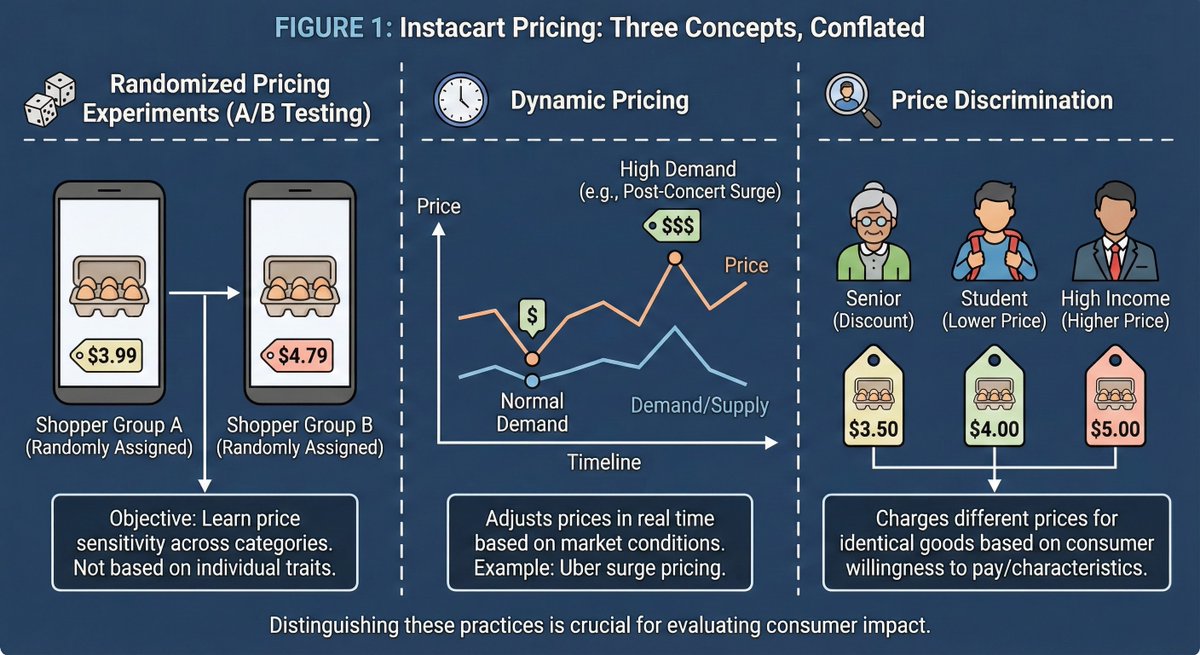
The article involves at least three distinct concepts that economists analyze differently: randomized pricing experiments, dynamic pricing, and price discrimination.
Let me untangle them:
https://t.co/89siwgrb9A
Randomized Pricing Experiments (A/B Testing)
What Instacart says it's doing is running pricing tests. Some shoppers randomly see $3.99 for eggs; others see $4.79. The purpose is to learn how price-sensitive the market is across different product categories.
This is standard A/B testing, the same methodology that virtually every online company uses to improve its products. Netflix tests different thumbnail images. Amazon tests button placements. Retailers test prices. The randomization means the prices are not based on any individual characteristics. You get $4.79 for eggs because a random number generator assigned you to that treatment group, not because an algorithm profiled you.
Why would you do that? Well, we draw the demand curve for a monopolist and assume they know that curve and pick the optimal price. But you don't know the demand curve so you want to learn how quantity demanded changes with price.
Dynamic Pricing
The article discusses "dynamic pricing" where prices adjust over time. As I wrote when Wendy's considered dynamic pricing https://t.co/JlbociwMNO, dynamic pricing means adjusting prices over time. Sometimes this reflects genuine cost differences (workers at lunch rush are more expensive per burger produced).
Usually we think about this as being based on supply and demand. I mean everything is, but this is based on the curves moving through the day/week/month/year.
Uber's surge pricing is the canonical example: when demand spikes after a concert, prices rise to attract more drivers. Uber, in this example, isn't randomizing across time. They are responding to observed supply and demand factors.
Other times, it's an attempt to extract more from consumers willing to pay more. The line between "just supply and demand" and price discrimination isn't always clear. I'll say more on that.
Instacart said that prices "never change in real time, including in response to supply and demand." So the Instacart case isn't dynamic pricing in the Uber sense.
Price Discrimination
Price discrimination means charging different prices for goods that are identical from the seller's perspective, based on consumers' willingness to pay. Senior discounts, student pricing, and coupons are all forms of price discrimination. This is what everyone seems to worry about.
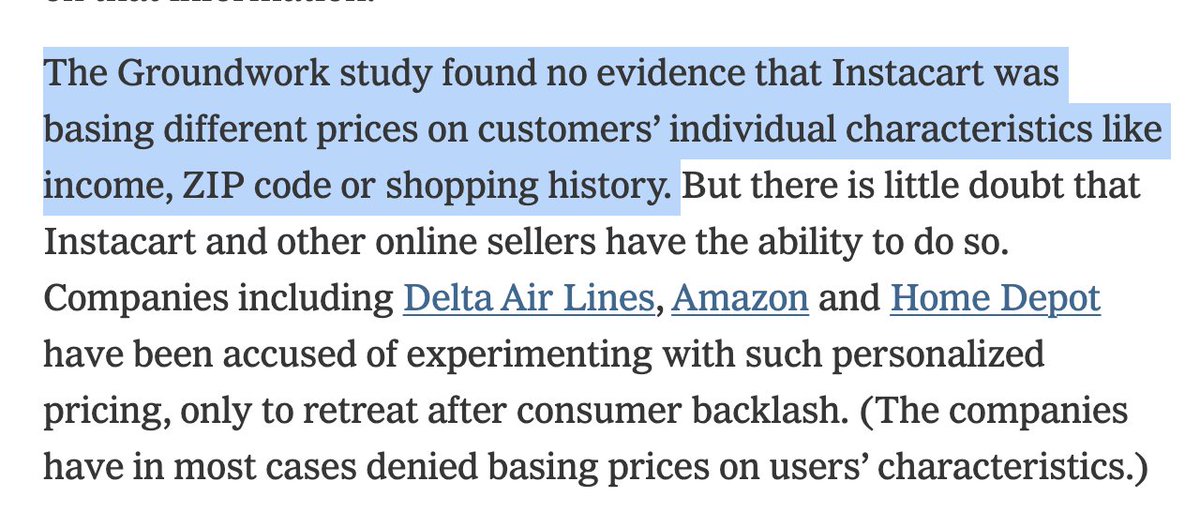
It's also not what the study found.
But that's not really the narrative of the piece, let alone the Groundwork piece or More Perfect Union.
It's all worry about price discrimination. "But there is little doubt that Instacart and other online sellers have the ability to do so." It then notes that "Companies including Delta Air Lines, Amazon and Home Depot have been accused of experimenting with such personalized pricing."
A random person speculates "We're going to tailor the price to you".. "We're going to get the maximum amount of money out of you that you're prepared to pay and drain your pocketbook." And the article cautions that frequent price changes "could make it easier for companies to adopt personalized pricing strategies in the future."
Then there are a handful of other things topics touched on. There's a paper the Times cites about "algorithmic coercion" is about something specific: when all competitors use algorithms that can instantly match price cuts, firms have less incentive to cut prices in the first place. Algorithms are worth studying. But it's about competitors coordinating on high prices, not about firms extracting personalized prices from individuals.
Why Price Discrimination Isn't Always Bad
Even if we were talking about price discrimination, and there's no evidence we're not talking about A/B testing, the article's framing assumes any variation in prices harms consumers. This is an empirical question but clearly not always wrong.
@_amackay point out the key trade off "many pricing strategies resulted in higher costs for less price-sensitive — and therefore potentially higher-income — consumers, while lower-income consumers paid less." Price discrimination is discriminatory, usually progressive, but never strictly worse for everyone.
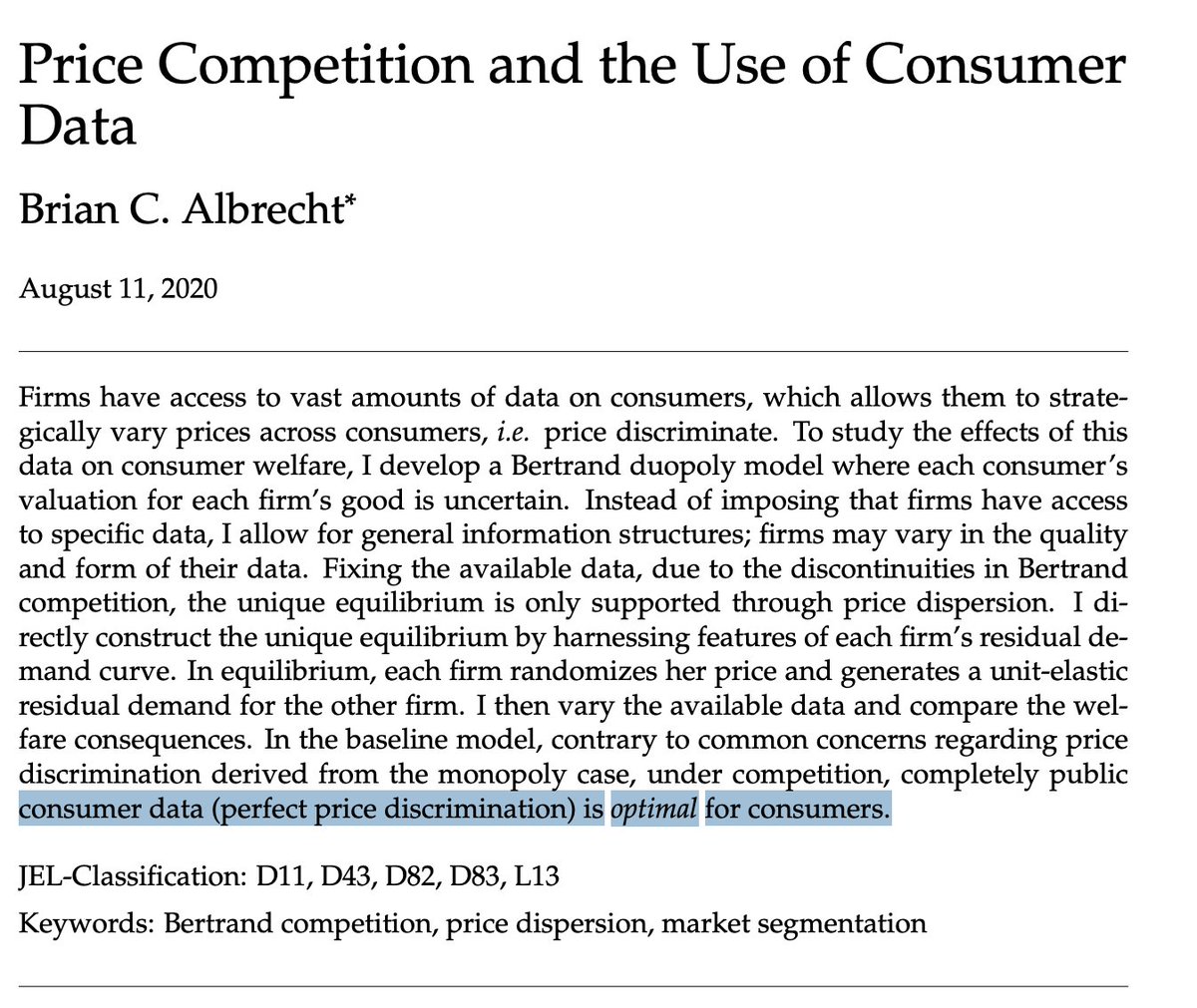
In my research and writing on price discrimination https://t.co/uBaY5KUJB3 https://t.co/aj5g2UCdqr I've found that with competition, price discrimination can even maximize consumer surplus. That's a particular model but at least should give some pause.
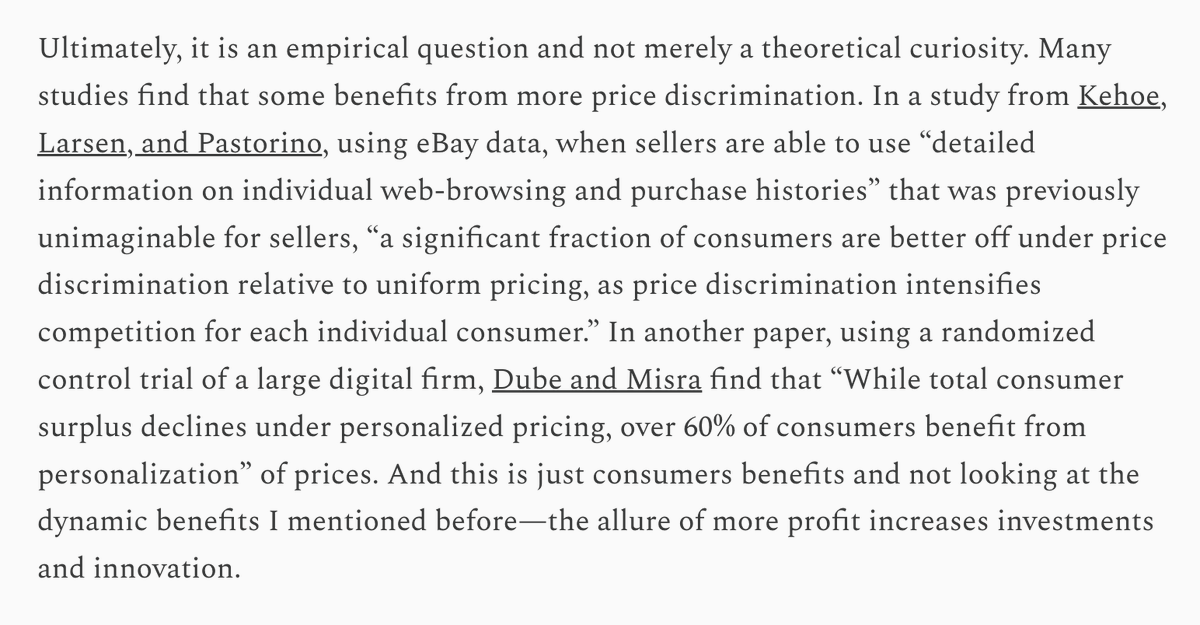
Empirically, its a big mixed bag but papers find real benefits from price discrimination.
On the theory side, even without competition, I think there's a good case for wanting more price discrimination
https://t.co/bbb7gK8CCV
But there are qualifications, like the algorithmic coercion paper above.
The type of pricing matters for thinking about counterfactuals. Those pesky counterfactuals.
The Groundwork piece found the price variation could add up to $1,200 over a year of grocery shopping. That calculation compares a world with randomized testing to a world where everyone gets the lowest tested price.
To be kind, that's not a plausible counterfactual.
Without A/B testing, Instacart doesn't charge the lowest price in the range, it charges some uniform price, probably near the middle. Under randomization, a chunk of consumers pay more than they would under uniform pricing, a chunk pay less. One question is whether the average price would rise or fall. That's an empirical question but clearly $1,200 isn't plausible.
Personalized price discrimination is different. If you ignore the people who gain from price discrimination because the price was dropped for them (seniors who don't go when they don't get the discount), there's at least a story about the algorithm systematically extracts more from people willing to pay more. That's a coherent concern about how the pricing system is just driving up prices. But it's not what the study found!
It’s fun to look at our first post COVID user conference and remember how fun it was and see how far the #NAVLIN by EVERSANA user conference #ppic has come. Four years in the books and busy planning for the fifth year
Day 1 of the #PharmaPricingInnovation Conference in Basel, Switzerland. Global industry executives are convening to learn, share best practices and see #NAVLIN by EVERSANA™, our integrated price & market access platform, hard at work. Excited to be hosting this inaugural event!
Okay so you probably had to have owned a Mac and liked assembly coding to appreciate this story but all Mac Classic IIs shipped with a bug that kept it from booting except for a secret instruction in the 68030 that accidentally fixed that bug is wild.
https://t.co/lq4t7omUcv
Well, wild to a certain kind of mind lol.
Been true for a while. If part of drug value is healthcare cost offsets in other areas then drug pricing and expenditures are going to reflect this.
Why Japan is 20% and the UK only 9% is a question worth exploring as well - a function of price, health system and efficiency, population health or something else? Understanding efficiency in healthcare systems is devilishly tricky but can give clues to reform - which is also tricky.
Counterintuitive #healthcare fact: Across 12 major countries, net #drug spending accounts for just 9% to 21% of total #healthcare costs.
Despite the overheated political rhetoric, U.S. drug spending is (and has been) squarely in the middle of the pack. Everything in the U.S. healthcare system is more expensive.
Source: @IQVIA_global https://t.co/TB0PdTFeAj
Note: Figures include spending on retail and non-retail drugs net of rebates and discounts
@iowahawkblog You probably know this one better than me, but how about the Iowa 80 Truckstop? How many gas stations have a truck museum with vintage trucks. (photo below from their website)
Interesting thought. As an investor or payer or patient, I would of course prefer a cure to symptomatic relief. But the full health economic value of a product is complex.
Pain medicines are symptomatic - new non-opioid pain medicines are a boon. Proton pump inhibitors for excess stomach acid may not address root causes of a medical issue - or a non-medical issue like too much food.
And anti-nausea medicine for chemotherapy improves quality of life meaningfully.
I don’t mean to imply that the author below is somehow mistaken or disagrees with the value in the above examples - just illustrating that symptomatic vs curative distinction is a complex spectrum. Symptomatic relief products exist that are also likely not beneficial at all.
It’s an area worth discussing and refining more at length - and very much is in the HEOR and biopharma circles.
From @EVERSANAcompany: The End of the Blockbuster Era: Unlocking Growth with Direct-to-Patient Commercialization
Schedule a meeting with EVERSANA at the Asembia Summit: https://t.co/Cn8kqY16ws
Read the article: https://t.co/vqHUgGnBQx
#sponsored
It’s worth looking at the similarities - and differences - in “low price” used in open source as a competitive tactic vs. other high R&D goods made in China. Professor Z. John Zhang of Wharton wrote this almost 20 years ago and I still find it a useful lens to evaluate pricing tactics at a Chinese firm whether consumer tech or other high R&D areas … https://t.co/NKP8i7iCI4
Ahead of the election and potential impact on US drug prices, it’s worth looking at the landscape globally.
France has proposed $1 Bn EUR in additional cuts
More at:
https://t.co/DkbvC0eW4V