🗣️ Our conference "Testing Grounds: The Kill Cloud, AI & Migration Control" is starting in 1 week!
➡️ Fri. 27/Sat. 28 November: A two-day conference at Kunstquartier Bethannien (Mariannenplatz)
➡️ Sun. 29 November: A day of workshops at Stadtwerkstatt (Alexanderplatz)
This week, governments missed an opportunity to regulate autonomous weapons systems. But the call from their citizens, scientists and the industry is clear, and they must immediately correct course, work harder on common red lines before it is too late.
https://t.co/mYqNU5KMUi
Iraq on Sunday opened the trials of thousands of ISIS suspects transferred from Syria, starting with six Syrians accused of joining the group and fighting against the former Assad regime and Kurdish forces. #Iraq#Syria#ISIS https://t.co/tizM5M93au
Slaughterbots are here. They're killing civilians and proliferating to bad actors just as we warned in this 2017 film. Countries have now been discussing this issue for 13(!) years in a Geneva forum called the CCW that's useless because it requires unanimity for every decision. This week, they could have agreed to start negotiations on the first international treaty on AI, something that would create new international law on autonomous weapons. They failed to do that.
Instead, states agreed to a weak and impotent approach. It is not a binding treaty. It is not enough. The situation will only get worse, and we need clear legal rules more than ever.
Time is up - the issue of Slaughterbots must be put to a majority vote. Over 130 states want clear legal rules, and they must take this issue to a forum where their voices will be heard.
Statement from FLI Chair @Tegmark following the conclusion of the @UNGeneva Convention on Certain Conventional Weapons 7th Review Conference:
"Like hundreds of scientists, world leaders, civil society orgs, the UN Secretary General and the Pope, the Future of Life Institute has repeatedly sounded the alarm about the unacceptable risks posed by autonomous weapons. Those risks are now our reality. Slaughterbots are killing innocent civilians and proliferating to bad actors. Recognizing the lethal urgency of this crisis, the vast majority of countries want to immediately launch negotiations towards a legally binding international instrument.
This week, States failed to meet this moment. Rather than listening to the voices of the majority, the consensus principle of the CCW has led to an empty agreement that will drag out discussions for years with no meaningful solution in sight. States have agreed it is sufficient to just talk about the issue, for the 14th year, while these weapons enable atrocities.
We are constantly told that tensions are too high to create new international law. But history has shown that multilateral disarmament can succeed even during times of deep geopolitical adversity - so long as our leaders have the courage, tools, and political will to act.
The majority of states, CSOs, faith leaders, and the general public want legal, global rules on Slaughterbots. We implore States frustrated with this shambolic, decade-long process to take the issue elsewhere, to an assembly where their voices will be heard. The CCW has not met the urgency the situation requires.
Enough is enough."
“Despite an overwhelming majority of states at the Review Conference on Conventional Weapons at the UN in Geneva wanting to agree a negotiating mandate leading to a legally binding treaty, the need for consensus forced the conference to adopt a much weaker option” @patrickwintour
International talks on controlling use of autonomous weapons collapse
Week-long efforts fail to establish negotiating mandate on AI warfare after Russian ‘filibustering’
*And an outcome the same states sought, 13 years ago. Two obvious comments:
1) The applicability or sufficiency of existing IHL does not make new protocols unnecessary.
2) Recommending, at a later stage, whether the instrument should take the form of a protocol, means it won’t.
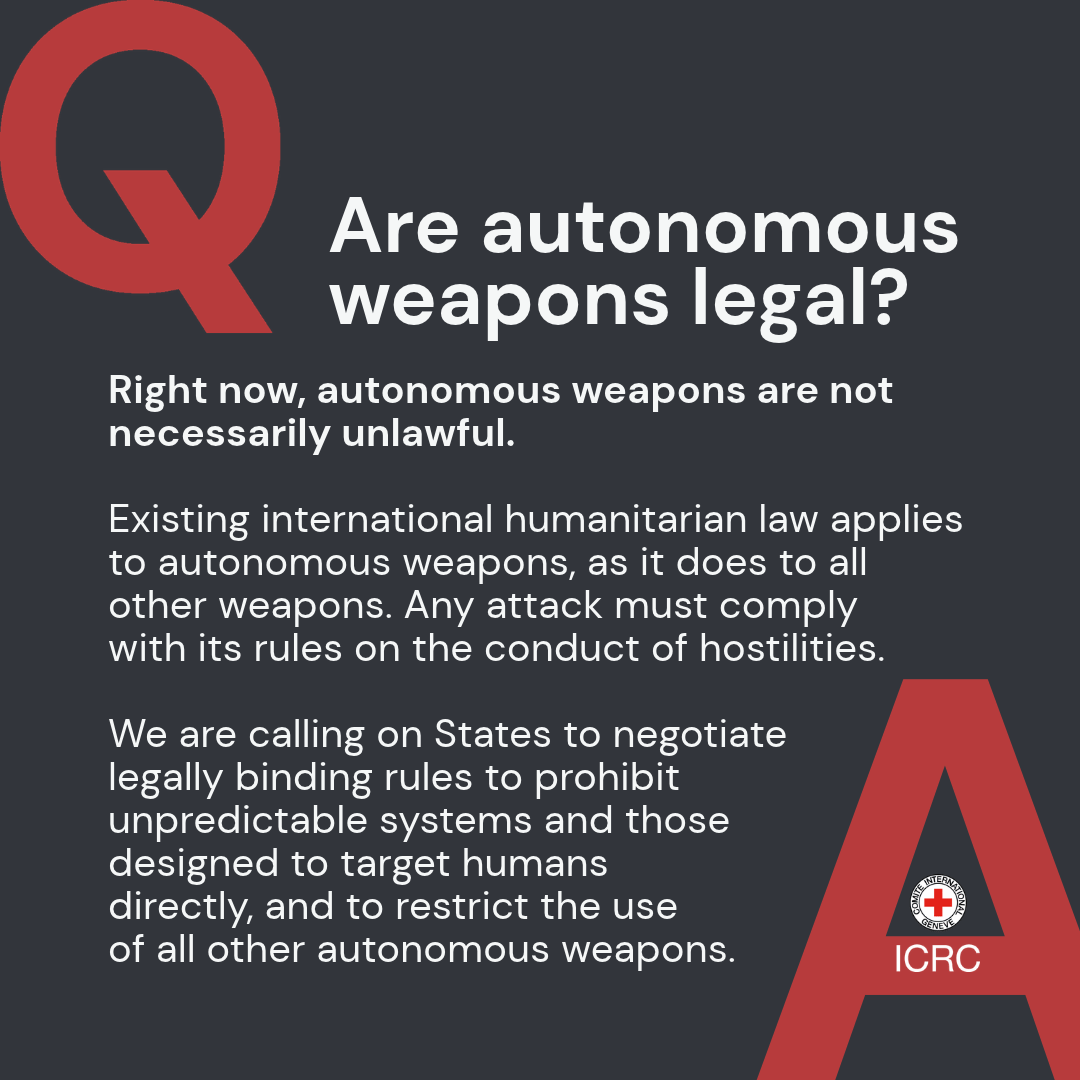
The use of autonomous weapons can make armed conflict more unpredictable, increasing the risk of harm to civilians.
Clear prohibitions and restrictions are needed to prevent practices that could undermine the protections international humanitarian law provides.
Learn more about autonomous weapons 👉🏼 https://t.co/Wv7RLHkMMS
It's time for the majority of governments to move forward with negotiating an instrument, and refuse to let a few small group of countries hold new rules on AI weapons back. AI should never be allowed to kill people, make that a law now!
We are already seeing it in Ukraine, Sudan, Gaza, Iran, Lebanon. We know many governments wanted more, but the current working methods allow for a few actors to block, delay and lower the bar so far that we're basically standing still.
The agreement today is an inadequate response to the urgency we are facing, it’s an inadequate response to what people wanted from their governments. And people will die because the pace of rolling out AI weapons on battlefields will only increase if we don't set rules now.
AI weapons are starting to be deployed on battlefields. As the UNSG and ICRC president said in August, “a failure to act quickly and decisively will cost lives”.
This was a failure to act quickly and decisively.
Some will try to call this a success but it falls far short of what people around the world expected of their governments this week. It falls short of what the UNSG & ICRC have called for. & it fell short of what many states themselves described earlier this week as bare minimum
Early this morning, states failed to agree to negotiations on a new treaty on AI weapons. Despite strong public pressure and majority of states wanting a new treaty, the text was watered down to only “elaborate” on “an instrument” with unclear content & no settled legal status
After governments missed the opportunity to start to negotiate a treaty on autonomous weapons systems, we must not be distracted: the direction of travel is clear, the majority of states support a treaty and so do their citizens. We will get there. #AWS
https://t.co/YHO3rJu9q0
The failure of states to agree on a mandate to negotiate legally binding rules on autonomous weapons is a missed opportunity to address the serious humanitarian, legal and ethical risks these weapons pose.
We renew our urgent call for states to prohibit autonomous weapons that pose unacceptable risks and to restrict the development and use of others.
Read more: https://t.co/jCuv1Fy9Kt