One of the more extreme local examples:
Amtrak sounding the horn while transiting East Bay most nights (~2am?), at most intersections. We clearly hear it from 2 miles away, and it's incredibly loud near the tracks.
As a second order effect, it also forces people to close their windows → higher CO2 concentration → reduced sleep efficiency.
Like many forms of pollution, it also disproportionally affects lower-income communities adjacent to the tracks.
(Obviously sounding the horn has benefits too.)
@daylightco Two more thoughts: (1) can be powered by laptop via USB-C, like existing travel monitors but bigger (2) lay-flat for large canvas sketching eg https://t.co/dlGp7WOpfh
@daylightco Whenever I carry my monitor around, it has a long power cord and long USB-C cord dangling. Coiling them around the screen doesn't work well. A few solutions could be: (1) cords recoil/retract inside, like a vacuum cleaner cord, (2) cords clip to back, (3) *very* short USB cord.
Our journey at Forward came to a close a week ago. For many of us, we've spent the better part of a decade dedicated to making Forward work. A few thoughts:
First, healthcare still needs fixing. Half of the planet has little-to-no adequate healthcare, and here in the US, most of us are sick. It may sound dramatic, yet it's true — ~80% of US adults and many of our youth are living with one or more serious preventable diseases. These illnesses also impact mental health, and ultimately societal and civic health.
Second, this team was incredible. They unequivocally showed up for the mission, with dedication, selflessness, intelligence, and deep care. I'm grateful for the bonds built while wrestling with behaviour change protocols for lowering cholesterol, debugging wireless sensor interference, and finding cost optimizations to scale diagnostics — and for the friendships built over a deeply held, shared mission. Healthcare is hard, and we gave it our all.
Third, Forward’s clock ran out, but we proved a new model could work. Some proofs:
(1) People engaged with productized (digital and hardware-based) healthcare, including diagnosis and treatment plans. This is crucial to scale healthcare beyond the limitations of 1:1 doctor consultations. Why? We have a worsening doctor shortage, millions of people can’t afford 1:1 consults, and healthcare works better with continuous guidance. This can work in tandem with doctor-led complex care.
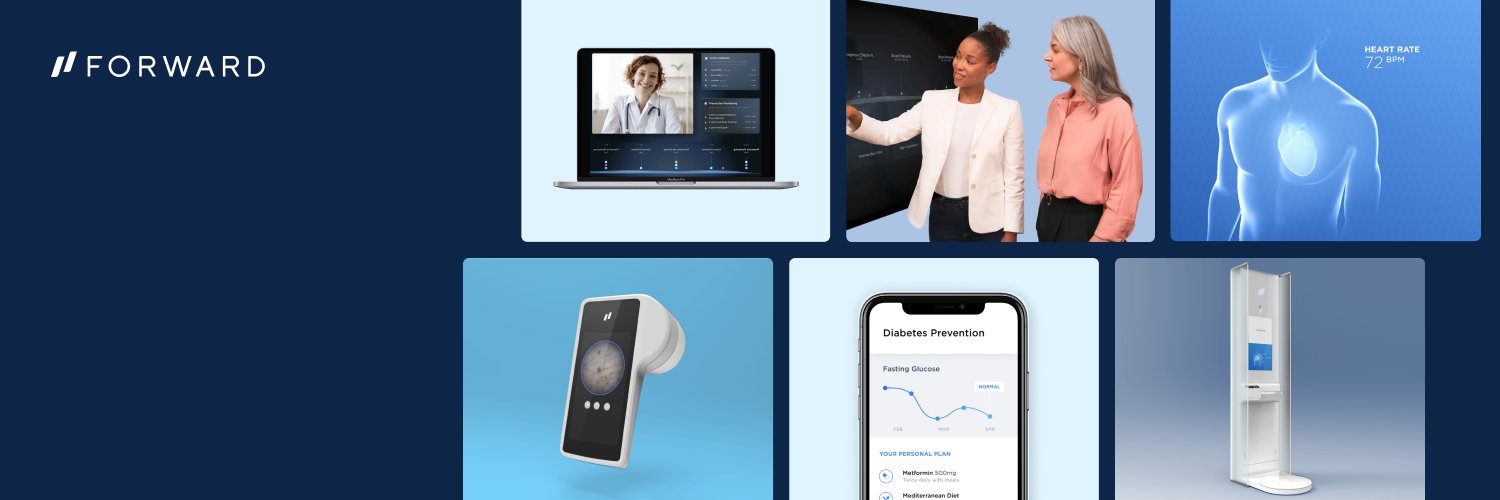
(2) People will engage with self-serve diagnostics: self-serve blood draw, heart exam, swabs, body scan and more. This matters to lower costs and get care to remote and under-served populations.
(3) People value and will pay for preventive care and lifestyle-based behaviour change. This is the path out of "sick care". Today most healthcare dollars go to the treatment of avoidable conditions, when much of the damage is already done. We proved people want to get ahead and will pay for it. This also solves for the US's ballooning ~20% of GDP spent on sick care vs. other investments.
(4) Radically consumer-first UX matters. Some of what Forward built may appear frivolous. All of it was still early. Yet the proof is there: people joined Forward to engage with their health after years (or decades) of avoiding it. Lives were saved. Whether it was fear of blood draws, scepticism of healthcare institutions, or simply inconvenience, we saw that better UX routinely broke through these barriers.
I'm deeply disappointed we're wrapping up, however I hope Forward inspires many audacious bets. To every startup that's building scalable, preventive, consumer-first solutions to our healthcare crisis, more power to you. And to every health company working in different ways to do more.
See my reply for great team members I've worked closely with.
I'm starting to explore freelance and full-time roles, and look forward to what's next. I'd love to connect.
From our Medical Director at @goforward:
Worth the read and mirrors my experience (also near 6 years).
Directing my Design background to the cause of reinventing healthcare for humanity is incredibly focusing and rewarding.
Shout out to @mds launching the https://t.co/qa38rZF0Vg visual design course—I've been working through the beta and it's seriously great. Learning MANY tips and tricks, at your own pace. @shiftnudge
We’re excited to introduce Forward Thinking, a roundtable discussion series with leading industry voices from health, technology, and economics to discuss #COVID19 recovery efforts and the most pressing issues of the crisis. Join us Friday at 1:30pm PT: https://t.co/sTd02pXUzN
In the market for a new design role? We're hiring at @goforward and I'm preeetty excited about what we're doing. Forward is on a mission to redesign healthcare from the ground up, and we're continuing to expand nationwide with what we're building. Take a look 👇
Happy to have @IDEO cover my point of view on hand-sketching UX, and the important role it plays. Always keep a pen and paper on hard. https://t.co/P11B9Yl4sB
Modern UX design software is incredibly powerful, but it’s also a largely solo experience. Putting pen to paper creates an environment where the group can react and iterate on the fly. https://t.co/wOswWY1s7Q
Making use of the awesome Avataaars mix + match character illustrations from the talented @pablostanley—comes with a Sketch library: https://t.co/0JcDnXgQ1q