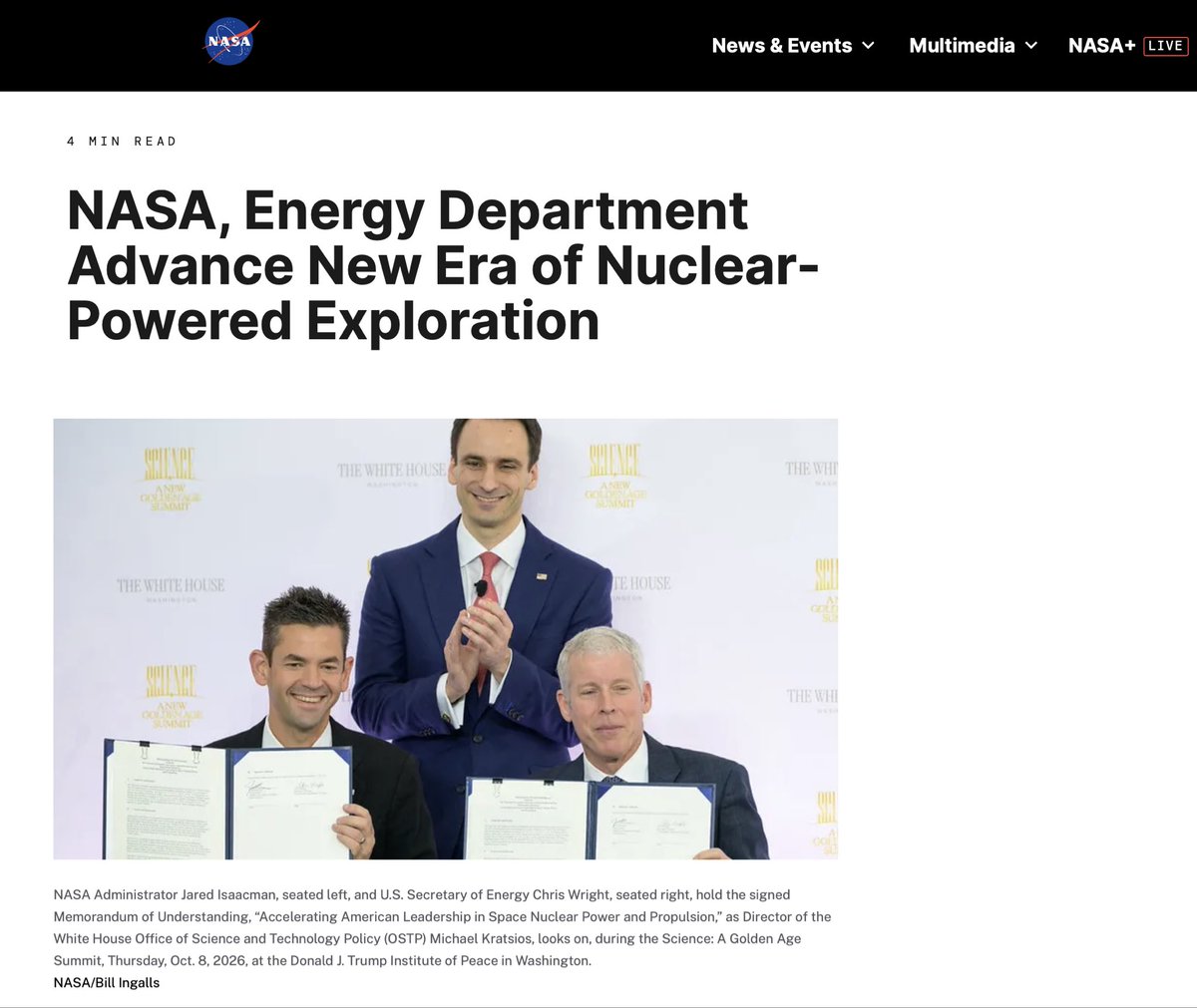
Last week, @NASA and the @ENERGY signed a Memorandum of Understanding that formalizes what many of us in the space nuclear community have been building toward for years.
The MOU - "Accelerating American Leadership in Space Nuclear Power and Propulsion" - establishes end-to-end collaboration between the two agencies, from fuel production and advanced research through testing, launch integration, and operations.
Here's what matters:
Space Reactor-1 Freedom launches in 2028. That's not a study. Not a concept. An operational nuclear propulsion system going to deep space.
Lunar Reactor-1 follows - a fission surface power system designed to sustain a permanent Moon Base through the 14-day lunar night. Power for habitats, communications, rovers, ISRU, and the critical infrastructure that makes sustained presence possible.
This is backed by a presidential executive order directing a launch-ready lunar surface reactor by 2030.
NASA Administrator Isaacman called it the "Nuclear NASA-era." He's right. Solar has taken us far, but it can't power what comes next. Not on the lunar south pole. Not on Mars. Nuclear is the only path to sustained human presence beyond Earth.
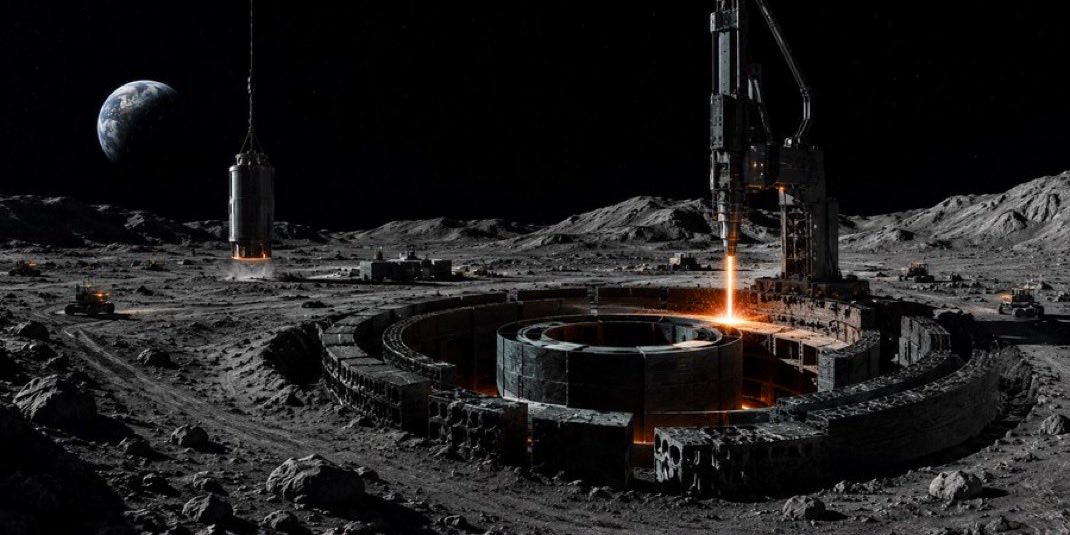
At @LunarForgeSpace, this is exactly the problem we're solving for. The 28 kg uranium core launches from Earth. Everything around it - radiation shielding, containment vessels, berms, Stirling engine housings, heat management hardware - we sinter directly on the lunar surface from local regolith. Fission surface power and autonomous construction aren't parallel efforts. They're two halves of the same system.
The industrial base is being built right now. The question isn't whether nuclear space power is coming. It's whether the rest of the nuclear infrastructure stack will be ready when the core arrives.
The race to put nuclear reactors on the Moon is real - and @nytimes just laid out exactly why it's harder than most people think.
The U.S. wants a reactor ready for launch by 2030. Russia and China are targeting 2036. The motivation is clear: you can't sustain a permanent lunar presence without reliable power through the 14-day lunar night.
But here's what the article gets right that most coverage misses - the reactor isn't the hard part. Shielding, heat removal, structural containment, autonomous installation on a surface we've barely touched. These are the unsolved problems. The article describes lunar containment structures as expensive and technically difficult to build. That's an understatement.
You can design the most elegant fission system in the world, and it means nothing if you can't build the infrastructure to protect it, contain it, and keep it running - autonomously, on the Moon, with no crew standing by.
This is exactly the problem we're solving at @LunarForgeSpace - in America, for America 🇺🇸 . Autonomous construction of lunar infrastructure - including the structures that will house and shield systems like these. The reactor gets the headline. The infrastructure makes it work.
The geopolitical race is on. If the U.S. is going to win it, we need the infrastructure to back it up. That's where the real opportunity lives.
One thing nobody tells you about fundraising: founder support is everything. I have several friends - founders running companies valued at $2B+ each - making warm intros, opening doors, vouching for us. They don't have to do any of it. They just do. That kind of generosity from people who've been in the trenches changes the game. Grateful doesn't even begin to cover it.
In less than 3 months, @LunarForgeSpace went from coming out of stealth on @payloadspace to a company @NASA, @ENERGY (DOE), and the aerospace & defense primes are paying attention to.
We built a team of 12 from Blue Origin, SpaceX, NASA, Draper, Johns Hopkins, and Colorado School of Mines. We signed five LOIs, representing up to $1.65B in potential contracts, for reactor shielding, 60-meter structures, sensor-node protection, and habitats. We met with all three primes and were invited to collaborate on submissions with them. We began working with our first terrestrial customers as well.
We were accepted into @NVIDIA Inception and received $2M in non-dilutive capital offers.
At the request of NASA’s GNC team, we wrote a paper on how laser-sintered landing pads can prevent plume-driven dust clouds, preserve sensor performance through final descent, and give landers a predictable target for precise, repeatable landings. We also wrote a second paper showing how laser-sintered vertical walls can reduce the excavation required for berms and landing surfaces while creating durable, erosion-resistant infrastructure. @DrPhiltill posted about our work on X, and it went viral with 44K views and 1.3K likes.
Our technical papers reached NASA’s Deputy Administrator. I presented Lunar Forge directly to NASA’s Administrator @NASAAdmin Jared Isaacman last Wednesday.
And DOE asked us to build a full-scale model of fission-reactor infrastructure: a proving ground for autonomous construction, built entirely by rovers and solar and radioisotope-powered lasers. NASA Deputy Administrator Matt Anderson asked us to build it at Texas A&M.
We are not pitching a vision anymore. We are executing on one: building the infrastructure America needs to deploy its first nuclear reactor on the Moon - and make permanent human presence there possible.
Launch the core. Build everything else on the Moon.
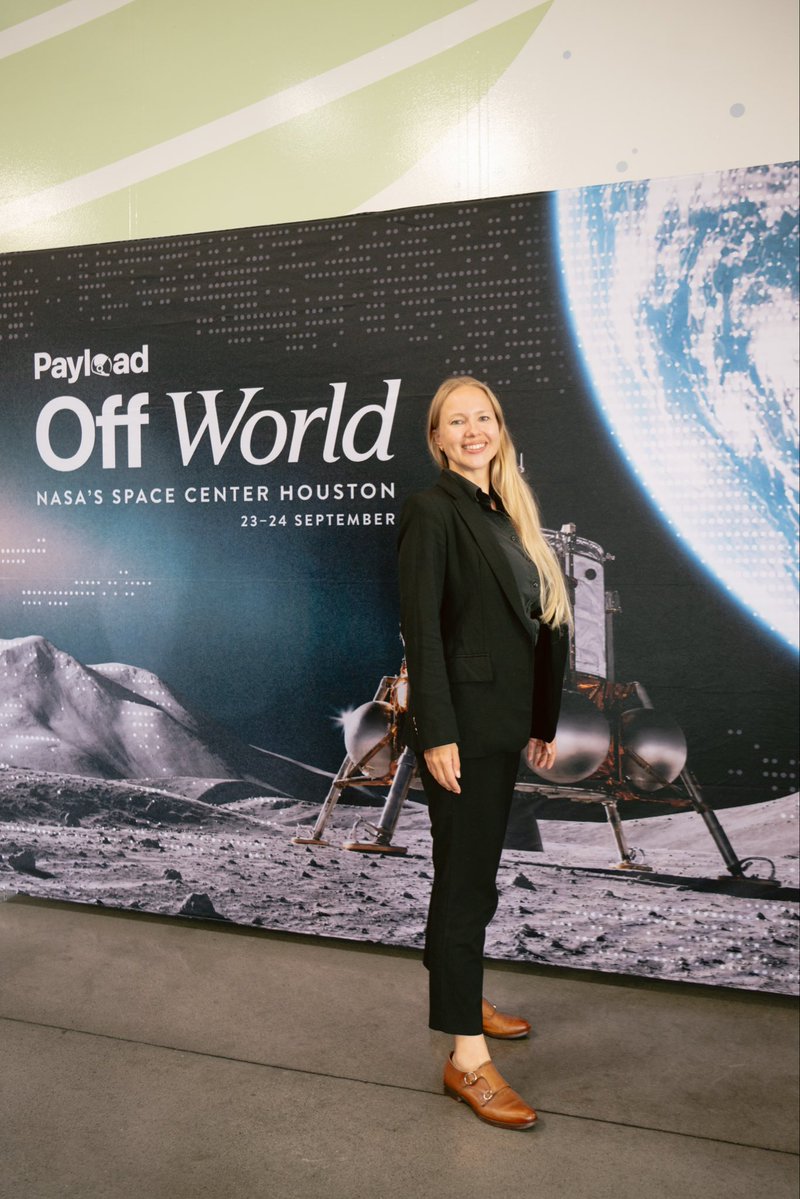
Met Jared Isaacman @NASAAdmin at @payloadspace’s Off World in Houston. Definitely a highlight of my week!
At @LunarForgeSpace, we’re building autonomous robots that turn lunar regolith into landing pads, foundations, and reactor shielding. I spend most of my time on what it takes to build on the Moon. Days like this are a chance to appreciate why I love doing it.
And yes, the smile says it all. 🚀
Thanks, Payload, for making this happen!
I’ll be in Houston this week for @payloadspace’s Off World, September 23-24 at Space Center Houston.
Getting to the Moon is one challenge. Building what we need once we’re there is another.
At @LunarForgeSpace, we’re developing autonomous robots that turn lunar regolith into infrastructure - from landing pads to reactor shielding. I’m looking forward to conversations about what gets built first, how we build it, and the partnerships that will make it happen.
If you’re attending - or you’re in Houston this week - send me a message. Let’s grab a coffee and talk space.
P.S. Image inspired by Kevin Coggins’ post.
#OffWorld #SpaceEconomy #LunarInfrastructure
Why we’re building fission reactor housing on the Moon.
Every plan for permanent lunar presence runs into the same physics: fission is the only viable power source through 14-day lunar nights. NASA’s KRUSTY program proved a 10 kW reactor runs on a 28 kg uranium core - small enough to launch.
But the infrastructure around that core - radiation shielding, containment vessels, heat exchangers, structural foundations - weighs thousands of kilograms. At $1M+ per kg to the lunar surface, launching it is economically impossible at scale.
So don’t launch it. Build it there.
@LunarForgeSpace is developing mobile autonomous laser sintering systems that manufacture reactor-grade infrastructure directly from lunar regolith. The system surveys the terrain, reads regolith composition in real time, and sinters structural components with adaptive process control - fully autonomous, no human operators required.
Launch the core. Build the rest on the Moon.
This isn’t a nice-to-have. Without surface power, there is no lunar economy. Every mining operation, propellant depot, research station, and logistics hub depends on continuous energy. Fission is the backbone - and in-situ manufactured reactor infrastructure is what makes the unit economics of everything else on the Moon work.
We are the critical manufacturing layer that unlocks the entire lunar economy.
A lunar construction company just came out of stealth mode: Lunar Forge.
Laser-sintering regolith into structural material, aimed at fission-reactor housing and shielding. Their first demo is targeted for 2027.
https://t.co/aRV1J5JXsg
Thrilled to visit Peter Cabauy and the City Labs team at their headquarters in Miami.
City Labs is the leader in nuclear micropower - their NanoTritium betavoltaic batteries deliver continuous, maintenance-free power for over 20 years, and their BOHR satellite is the first commercial nuclear-powered satellite in orbit. They also hold a @DARPA contract under the Rads to Watts program for next-gen nuclear micropower development.
A month and a half ago, @LunarForgeSpace and City Labs signed a Letter of Intent for a strategic partnership to advance nuclear micropower deployment on the lunar surface. The logic is simple: Lunar Forge builds infrastructure on the Moon from lunar regolith. City Labs builds the power and thermal systems that keep hardware alive through the 14-day lunar night. Neither company can close this gap alone.
Together, we're working toward integrating City Labs' NanoTritium batteries and radioisotope heat units into Lunar Forge's near-term lunar missions - persistent power, thermal management, and autonomous sensor networks, all housed in structures manufactured directly on the Moon.
This is what building for the Moon actually looks like.
I watched a launch from Cape Canaveral today while having a beer with a colleague. It never gets old.
First, the flame appears and the rocket begins to climb. Then the sound reaches you, and you feel the rumble in your chest. Minutes later, the booster threads its way back through the atmosphere and lands on a pinpoint as if it were the most ordinary thing in the world.
We have normalized the impossible.
And that is the whole point. Every launch is a reminder that today’s extraordinary engineering becomes tomorrow’s infrastructure, and that there is still so much ahead of us.
@LunarForgeSpace landed in Washington, D.C. 🌒
We were invited to exhibit at Deep Tech Week alongside some of the most ambitious companies working across aerospace, defense, robotics, advanced materials, and infrastructure.
I spent the day having exactly the conversations a founder wants to have - with investors, government leaders, and other builders who understand that permanent operations on the Moon will require far more than rockets and landers.
The Moon needs landing pads, radiation shielding, foundations, habitats, roads, and power infrastructure.
Launching all of it from Earth is not the answer.
Building it from lunar regolith is.
Thank you to @squadra_vc , https://t.co/sU3Tf6c9Uu, @SiliconVlyBank, and the National Innovation Quarter for bringing us to D.C.
“Make no little plans.”
Last night, I joined @TheNuclearCo for The Gigawatt Age at Deep Tech Week in Washington, DC.
The premise was simple: America needs to start building big again.
AI, advanced manufacturing, defense, and the reindustrialization of the country will require power at a scale we have not contemplated in decades. Meeting that demand means moving beyond one-off nuclear projects and learning to deploy entire fleets.
This event was especially meaningful because The Nuclear Company is also one of @LunarForgeSpace’s terrestrial partners. Together, we are exploring how the autonomous laser technology we are developing for the Moon can address critical manufacturing challenges in the terrestrial nuclear supply chain.
And the connection goes deeper.
A permanent lunar economy will require reliable fission power. But the reactor core is only the beginning. Shielding, foundations, thermal systems, roads, landing pads, and protective structures will require thousands of tons of infrastructure.
At more than $1 million per kilogram delivered to the lunar surface, launching that infrastructure from Earth would turn every reactor into a multibillion-dollar logistics problem. It has to be built on the Moon, from materials already there.
The scale changes. The principle does not.
Build bigger. Build faster. Build what the next era requires.
Thank you to @TheNuclearCo for bringing together an incredible group of people working toward that future, both on Earth and beyond it.
Launch the core. Build everything else on the Moon. 🌒
You're asking the right questions. Yes - we're working with high-fidelity simulants first to characterize exactly those variables before anything flies. But here's the thing - regolith simulants are based on samples taken 50+ years ago, 2,000 km north of the South Pole. Regolith composition varies by location, so our process needs to be tunable - real calibration happens based on data from our three planned lunar missions. Radiation shielding performance comes from mass and geometry more than material chemistry, which is good news for sintered regolith - it's dense and you've got plenty of raw material.
Agree it doesn't make sense on Earth - you've got Home Depot down the road. But when your nearest hardware store is 384,000 km away, sintering the ground beneath your feet starts looking pretty rational. The constraints are completely different off-world, and that's where this tech shines.
We wrote about why 3D printing won't work on the Moon: https://t.co/hPgrvgSUlr
And why polymers aren't the answer either (49K views on this one): https://t.co/fQdzqIXmiB
For now we're sintering rock, not alloying metals - think ceramics. Lunar regolith actually sinters into surprisingly strong stuff because of how the grain shapes interlock under heat. Metals are absolutely on our roadmap, but they require significantly more energy to extract and process. Ceramics first, metals later once the power infrastructure catches up. One step at a time 🤙
@CrainTim@DrPhiltill That's exactly the bet we're making. The first ton of lunar-made structure changes the entire calculus for everything that comes after.
@malanxbt@DrPhiltill Not a coincidence 👀 EO calls for a lunar reactor ready by 2030. Government and industry are actually rowing in the same direction on this.
Well, this was an incredible notification to receive on a plane to DC 😱
Thank you for posting about what we’re building, @DrPhiltill. Coming from someone whose work has shaped how we think about lunar regolith and surface infrastructure, this means a lot to me and the entire @LunarForgeSpace team.
Amaze, amaze, amaze.
Dr. Phil Metzger posted about @LunarForgeSpace, and somehow 40,000 people have now seen it.
Two months ago, we came out of stealth with a rather ambitious idea: launch the core and build everything else on the Moon.
Apparently, the idea is resonating. 🌒
A lunar construction company just came out of stealth mode: Lunar Forge.
Laser-sintering regolith into structural material, aimed at fission-reactor housing and shielding. Their first demo is targeted for 2027.
https://t.co/aRV1J5JXsg