La CEO de AMD, Lisa Su, acaba de acabar con la caja de IA de $4,000 de Nvidia con una lonchera de $1,499.
Subió al escenario, la sostuvo en una mano y ejecutó en vivo un modelo de 235 mil millones de parámetros. Sin centro de datos. Sin nube. Sin GPU alquilada.
El chip en su interior es algo que nadie vio venir. El Ryzen AI Max+ 395 de AMD es el primer silicio x86 donde la CPU y la GPU comparten los mismos 128 GB de memoria. Ese solo truco permite que un escritorio ejecute modelos que antes necesitaban un rack de servidores.
De esos 128 GB, Linux le da al GPU 110 GB para jugar. Para contextualizar, una RTX 5090 te da 32 GB. Una 4090 te da 24. Esta caja te da más del triple que cualquiera de ellas, en un chasis del tamaño de un libro de bolsillo grueso.
El benchmark que rompió la sala: este chip superó a una Nvidia RTX 5080 por más de 3x en inferencia de DeepSeek R1. Una lonchera de $1,499 superando a una tarjeta gráfica discreta de $1,000 en una carga de trabajo real de IA. Nvidia pasó una década convenciendo al mundo de que necesitabas su hardware para IA seria. AMD acaba de poner eso en un escritorio por la mitad del precio.
Aquí está lo que nadie te está diciendo. Un usuario intensivo de IA ahora paga $200 por Claude Code Max, $200 por ChatGPT Pro, $20 por Cursor, $20 por Gemini. Eso son $5,280 al año saliendo de tu cuenta. La caja se paga sola en 9 meses y luego corre gratis por el resto de su vida.
Instala Ollama. Descarga Qwen3 235B. Apunta Claude Code a localhost. La misma interfaz que ya usas, excepto que ahora nada sale de tu máquina, nada cuesta por solicitud y ninguna empresa limita tu uso a las 3 de la mañana cuando por fin tienes tiempo para construir.
Este es el momento en que todas las suscripciones de IA se vuelven opcionales. Los abogados dejan de temer fugas de OpenAI. Los desarrolladores dejan de mirar el medidor de tokens. Los fundadores dejan de alquilar H100s para prototipos que nunca se envían porque la factura los asustó.
Las primeras mil personas en descifrar esto poseerán los próximos dos años de consultoría de IA privada.
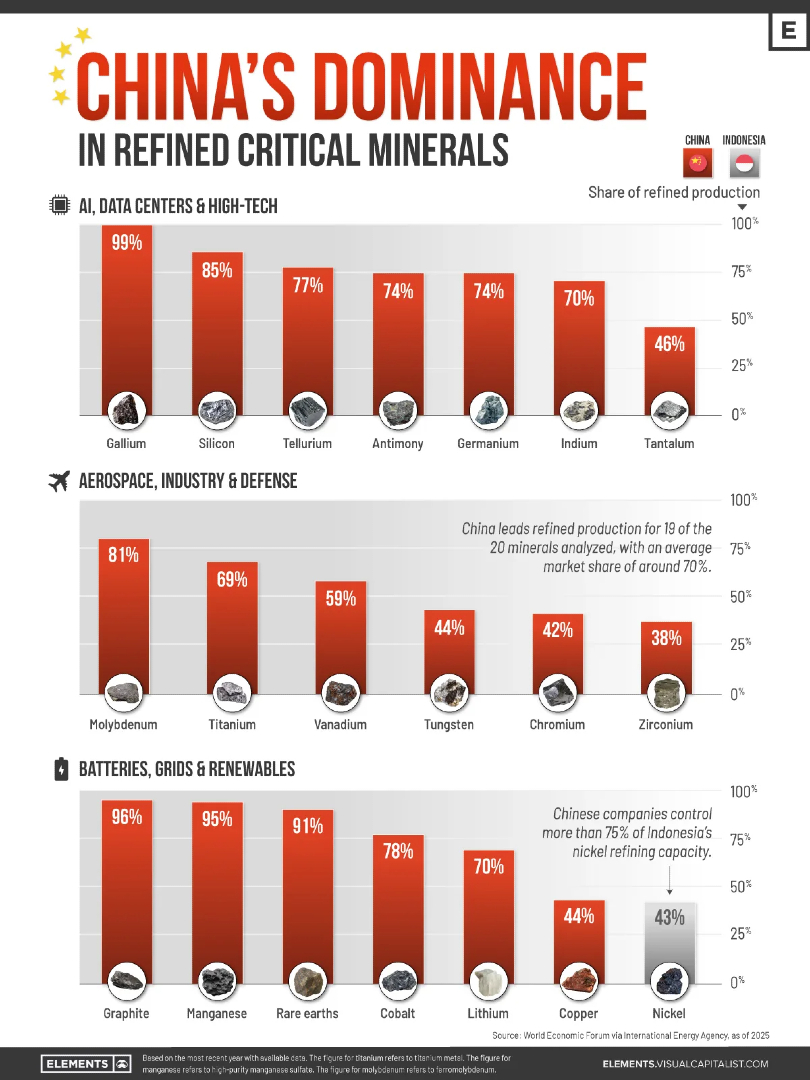
Latin America holds the minerals the world is desperate for right now
🇧🇷 Brazil basically owns niobium, that stuff that makes super-strong steel, and is also sitting on big graphite and rare earth deposits.
🇨🇱 Chile leads lithium and rhenium while pumping out massive copper.
🇵🇪 Peru is a silver and copper powerhouse. Brazil
🇧🇴 And Bolivia has serious antimony and tin.
Think about it: we need copper for power grids, lithium for EV batteries, silver for solar panels, rare earths for motors and defense systems, graphite for energy storage, and niobium for high-performance everything.
Latin America is turning into one of the most important strategic resource hubs on the planet.
The next industrial boom might depend more on Santiago, Lima, and Brasília than people realize.
Game-changing stuff if they play it right.
Source: The Merchants News / Writers: Lucas, Oliver
AMD acaba de dar un golpe fuerte en la IA local.
Lisa Su subió al escenario con un mini PC del tamaño de un libro grueso en una sola mano y ejecutó en vivo un modelo de 235 mil millones de parámetros. Sin datacenter. Sin cloud. Sin alquilar GPUs.
El protagonista es el Ryzen AI Max+ 395 (Strix Halo). Es el primer chip x86 que une CPU y GPU con 128 GB de memoria unificada. En Linux, el GPU puede usar hasta ~110 GB de esa memoria.
Para ponerlo en contexto: una RTX 5090 tiene 32 GB y una 4090 tiene 24 GB. Este pequeño equipo ofrece más del triple de memoria accesible para modelos grandes, en un chasis compacto.
En pruebas específicas de inferencia (como DeepSeek R1), superó en más de 3x al rendimiento de una RTX 5080 cuando el modelo no cabe en la VRAM de la tarjeta de Nvidia.
El precio real del equipo con 128 GB (GMKtec EVO-X2) suele estar entre $1,800 y $2,500 según ofertas (el kit oficial de AMD es más caro).
Para quien usa mucho IA, esto cambia las cuentas: en vez de pagar cientos de dólares al mes en suscripciones (Claude, ChatGPT Pro, Cursor, etc.), puedes correr modelos potentes localmente con Ollama, LM Studio o similares. Privacidad total, sin límites de tokens y sin que te corten el servicio a las 3 a.m.
No es que las suscripciones vayan a desaparecer mañana, pero para muchos casos de uso (RAG con documentos privados, prototipos, agentes locales, etc.) esta opción se vuelve muy atractiva.
Estamos viendo el inicio de una nueva etapa de IA local accesible y potente??
Africa is becoming a launchpad for Russian influence operations aimed at Europe. Journalist Philip Obaji laid out the evidence before MEPs: disinformation campaigns, manipulated migration routes, and networks that now target elections on both continents.
https://t.co/FmPMYZLqAd
Today we're shipping Nemotron 3 Ultra.
A 550B MoE frontier-intelligence open model built for long-running agents.
It delivers 5x faster inference and lowers the cost of complex agentic tasks by up to 30% versus other open frontier models.
The EU's official policy: phase out Russian fossil fuels.
The EU's actual ports: 8.37M tonnes of Russian Arctic LNG in Jan–May, up 17.9% yoy
What's happening?
This is Yamal LNG Russia's flagship Arctic project flowing into EU terminals at a record pace despite new restrictions on some contracts.
Spain led the buying in May.
Restrictions target paperwork... Molecules find ports.
why?
Connect it to Hormuz: Qatar's force majeure took 17% of its capacity offline, Gulf flows are choked, Atlantic diesel cushions are spent.
Europe doesn't have the luxury of principles right now.
Every chokepoint crisis makes Russian gas quietly more indispensable.
The lesson of 2026: sanctions are a policy, but energy security is a constraint and constraints win.
The EU isn't choosing Russian LNG.
The map is choosing it for them.
Same rule as always it's not about the molecule.
It's about the route.
What does it take to bring open models into the enterprise?
On the NVIDIA AI Podcast, Mistral CTO and co-founder Timothée Lacroix joins to discuss @MistralAI’s open-model philosophy, its Forge customization framework, and its collaboration with NVIDIA through the Nemotron Coalition.
Webb has delivered the strongest evidence yet that its discovery of mysterious Little Red Dots (LRD) are “black hole stars.” They appear starting ~600 million years after the big bang, and scientists are still working out exactly what they are. https://t.co/MIEwfifyzi
🔄 Recursive self-improvement may no longer be just a theory.
Anthropic reports:
📈 8x more code per engineer 📈 76% success on open-ended coding tasks 📈 52x training optimization 📈 Better research decisions than humans 64% of the time
The feedback loop is getting tighter.
#AI #Anthropic #Claude
AI ROI Is the New Moat: Why the Companies Generating the Most Value Per Token Will Win
Everyone is asking:
“Will AI replace employees?”
I think that’s the wrong question.
The better question is:
Can AI generate more value than it costs?
The latest OpenRouter data shows something fascinating.
AI token consumption has exploded over the past 18 months, growing from under 1 trillion tokens per week to over 12 trillion. What’s even more interesting is that Chinese AI models have rapidly gained market share, not because they’re necessarily better, but because they’re often dramatically cheaper.
The market is voting with its wallet.
And that’s where the real AI conversation should be.
AI ROI.
Many companies assume AI automatically reduces costs.
In reality:
AI = Compute + Software + Integration + Governance + Human Oversight
For some organizations, AI bills are already becoming one of the fastest-growing operational expenses.
The winners won’t be the companies using the most AI.
They’ll be the companies generating the most value per token.
Here’s the framework I use:
🔹 Premium AI Models
Use for strategic thinking, board presentations, legal reviews, executive communications, and high-stakes decisions.
🔹 Mid-Tier Models
Use for research, summarization, internal reports, and workflow automation.
🔹 Low-Cost Models
Use for classification, extraction, translation, customer support, and high-volume processing.
Not every task needs the most expensive model.
Just like not every employee needs to be the CEO.
The future belongs to organizations that build an AI portfolio instead of relying on a single model.
My rule:
Before deploying AI, ask:
“If this AI costs $50,000 annually, can it create at least $500,000 in value?”
If the answer is no, it’s probably a science project.
If the answer is yes, it’s a competitive advantage.
AI is becoming like cloud computing.
The first phase was:
“Put everything in the cloud.”
The second phase became:
“Optimize cloud costs.”
We’re now entering the same phase for AI.
The companies that win won’t be those generating the most tokens.
They’ll be those generating the most value per token.
Credit : Professor Scot Galloway - https://t.co/qXpnHjwSGT