Check out our new paper describing rAcrVIA1: an RNA anti-CRISPR that mimics guide RNAs to inhibit Cas13. Very fun project with stellar UW undergrad Victoria Hayes and collaboration with Ning Jia's group! https://t.co/EFI2d2wm2W
We want you to be our colleague! UW Dept. of Microbiology Tenure-track Assistant Professor position (in bacteriology or virology, broadly defined). Applications are due by August 1st 2026. https://t.co/4tYMgBShS8
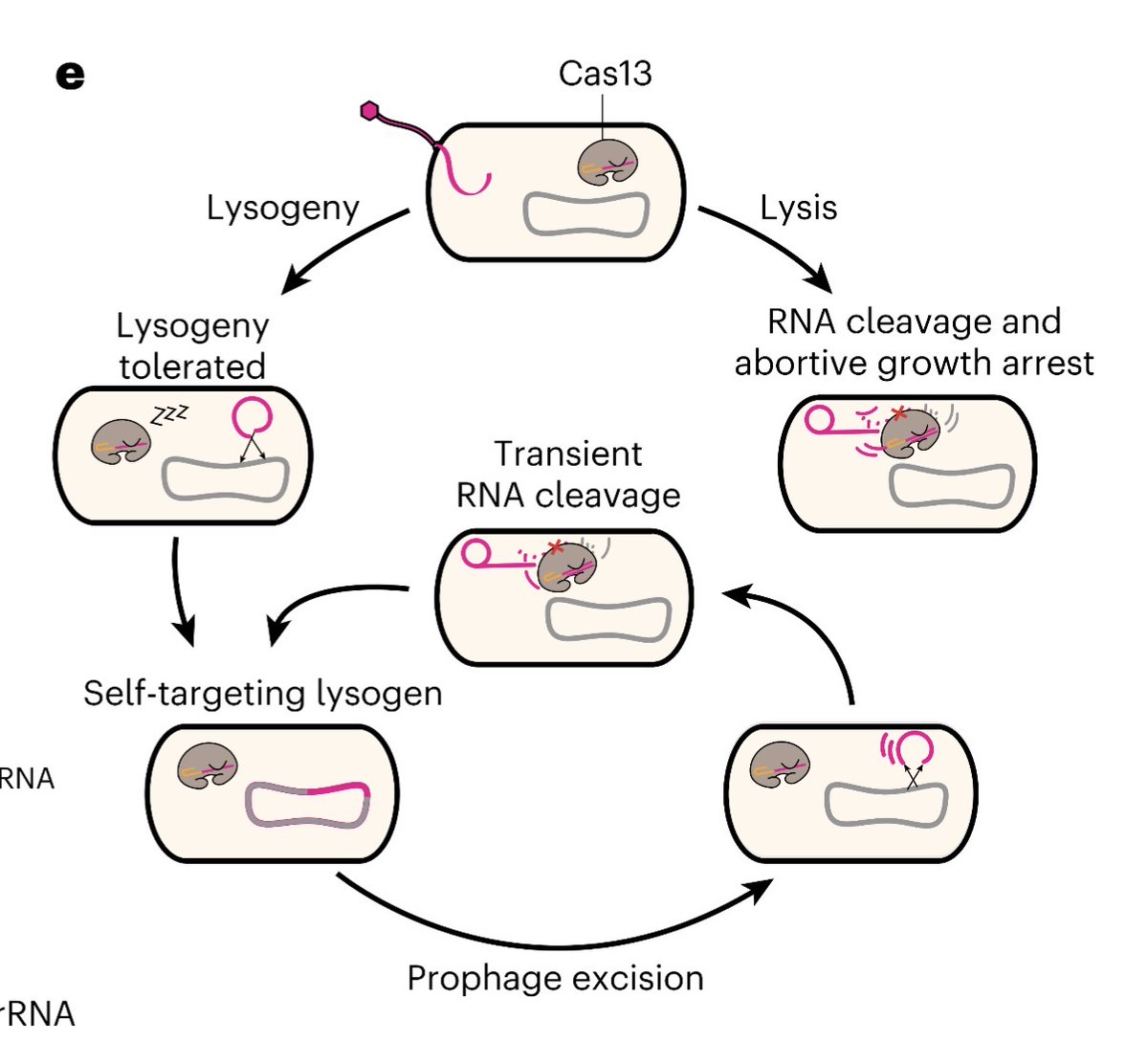
Our new paper on lysogeny enforcement by RNA-targeting CRISPR is out in Nature Micro! When prophages induce, Cas13 transiently activates and causes them to re-integrate. Link below for a great story from my student Marshall Godsil. https://t.co/RjKgGosSwL
Check out our latest preprint reporting a widespread group of phage-encoded anti-CRISPRs that bind specifically to cas gene coding regions to block transcription! Congrats to Edith @edithmsawyer and the whole team!
Excited to share our last collab paper, now out in print @ScienceMagazine!🎉
We reveal how dITP synthesis activates a SIR2 NADase effector to block phage infection! 🛡️🧬
https://t.co/pcBDNqW9zq
Is it “winner-takes all” when the simplest living things compete? Check out my fresh publication on phage coexistence in Science and a thread below🧵 https://t.co/3qQNKT0LVd
Many bacteria have >1 CRISPR system, and they affect each other! @shallymarg found a 3-way interaction that leads to primed adaptation in the RNA-targeting type VI system, check it out:
We are hosting the NW ASM Branch Meeting here in Seattle November 9-10! Microbiologists of the Northwest, please register and submit your abstracts at https://t.co/30beQfIS0v
The final version of our paper on anti-CRISPRs "in disguise" as Cas proteins is out today in Nature! Congrats to Mark, Edith and the whole team! https://t.co/e1SmItuSIQ
We wrote a Preview on the excellent recent paper from the @hauryliuk@gem__atkinson groups, check it out!
https://t.co/gkKHxBXOFz
https://t.co/qtnQfdBWzm
News on the Zorya defense system: anchors to the peptidoglycan and detects membrane disruption by phage. It has a flagella-motor-like device that rotates once activated. So cool! I've been waiting for insights on Zorya since we first described it 5 years ago. Congrats Tylor&co!
@JukeBaRosh Just checked my thesis - no signature from advisor, just committee members, program head, and dean. If there's a rule on being silent I don't think it (was) enforced.