Data centers are being blamed for surging electricity bills and grid strain. But decades of regulation, endless permitting delays, and state net-zero mandates are undermining markets, preventing new power plants from being built, and forcing early retirements of reliable power.
We can have AI, environmental progress, and affordable energy. We just need the freedom to do it.
My @PostOpinions op-ed with @realsampeterson:
Imagine a world where both parties limited themselves to ending the other party's stupidest policies.
In practice, the main reason they point out the other side's stupidest policies is to distract people while they impose incredibly stupid policies of their own.
Painful irony. Controlled burns (CB) are an effective strategy for reducing the risk of large wildfires. Avoiding wildfires reduces the risk of major PM2.5 air pollution spikes. But, the Clean Air Act's non-attainment status mandate limits a county's ability to engage in CB.
Dominion's new filing to recover RGGI costs indicates that it will cost the typical residential consumer an additional $13 per month ($156 per year). Filing linked below. Business and industrial customers will see increased bills as well.
https://t.co/lBjuD4yFAK
As I wrote in 2023, “it’s undeniable that a cascade of social sorting effects, professional imperatives and media biases has compounded to create climate science and communications apparatuses that stoke our anxiety instead of moderating it.”
10M Barrels Off Market: "10 million barrels a day is still a huge number that's cut off from the market. We're absorbing it with oil on water, drawing down commercial inventories, and pulling from SPR inventories."
"We can do that for another month or two, but at some point the gears start to grind on each other. We're gonna hit tank bottoms or the effective tank bottoms."
"All of those different routes for crude export are buying you some time. It's just not clear to me how much time it's buying you."
"If we got to shut down a bunch of demand, that's a dramatically high price — $125, $150, I don't know what the number is — but it isn't $89, which is where we're sitting today."
•PEP CIO @pickeringenergy
This seems like a good point, and is worth addressing.
Our system for producing nurses, and doctors, is broken. We restrict supply, for dumb reasons, and make it hard to move among states.
THEN, they do get paid a lot. But they are overworked and abused in their jobs.
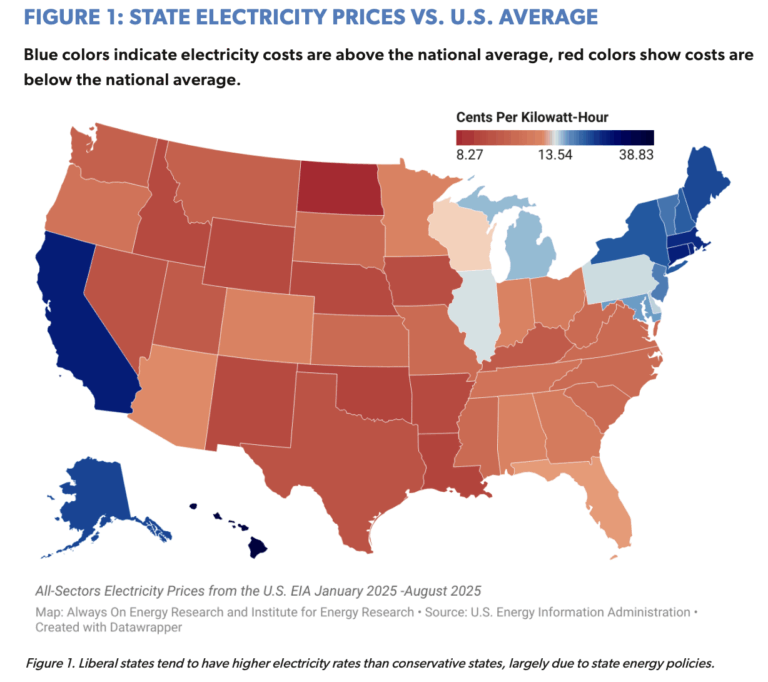
IER's report on the blue-state, red-state divide in electricity prices was cited in a @reviewjournal editorial: "Green energy hasn’t been saving Nevadans green."
I'll add to the Piketty dunking in one small way.
His plan is to plunder valuable assets from the USA and hand them to less productive regions until outcomes are equalized.
But, for the USA, he allots 0.115% annual growth (4590->5000/74 years).
I'm sure he's aware that those assets are valued, generally, by the net present value of future free cash flows. And that by capping growth so low destroys the value he hopes to steal. And that baking this error into his model invalidates all the math that follows.
It's difficult to steelman Piketty's arguments. By all indications, he's simply an anti-human zealot, neurotically and wrongly guilt-driven, with extinction as his goal.
What Phil is pointing out about the abuse of evidence by historians who want to disparage classical liberals would be a good example for the recent report on the ills of replacing scholarly standards with activist criteria. The academic filters go away when the audience likes the conclusions, even if they are complete fabrications of original ideas.
And these are particularly egregious as the classical liberals in these cases were explicit, using plain language, to reject imperialism, colonialism, slavery, apartheid, etc.
If a historian on the right abused evidence in this way, they'd face career ruination.
When Boston University's Quinn Slobodian does it, he gets a Guggenheim fellowship, book awards, and a Hewlett Foundation grant.
Academia's rot runs far deeper than a simple crisis of rigor.
When Gabriel Zucman manipulated tax rate stats to show the wealthy paying less than the poor and tried to memory hole his own previously published numbers that undermined this claim, academia cheered him on because they liked his political narrative and gave him the Clark Medal.
When Kevin Kruse plagiarized multiple passages in his published works over the past two decades, academia circled the wagons around him, attacked the person who discovered it (i.e. me) as "politically motivated," and dismissed overwhelming evidence as "accidental copying and pasting."
When Quinn Slobodian got caught altering the text of Mises quotations to make them sound racist, academia made him co-editor of the journal where he did it and showered him with prizes.
When Nancy MacLean got caught engaging in wholesale fabrications of evidence (as well as egregious incompetence) in her book about James M. Buchanan, academia made her a finalist for the National Book Award.
When Nikole Hannah-Jones got caught denying and ghost-editing one of her most controversial claims out of the 1619 Project, academia handed her a cushy endowed professorship with full tenure despite her having nonexistent scholarly research outputs and zero teaching experience.
When Michael Bellesiles falsified historical documents to make an anti-second amendment argument as part of his history of gun ownership in America, academia gave him the Bancroft Prize and only rescinded it after the evidence became so overwhelming that they could not deny it anymore.
When Claudine Gay plagiarized multiple scholarly works over her career, academia made her president of Harvard and also tried to circle the wagons until the evidence became so overwhelming that they could not deny it anymore.
Yes, higher ed has a politicization problem and it often shows through in the exceedingly low standards of rigor in many of these fields. But it also manifests in other ways that are much more serious than a simple lack of rigor.