Excited to share our new preprint!
How do animals transform internal representations into step-by-step navigation to goals? Decoding these strategies directly from behavior is challenging because these internal states are not directly observable.
https://t.co/FZn0ANfBc7
🧵1/n
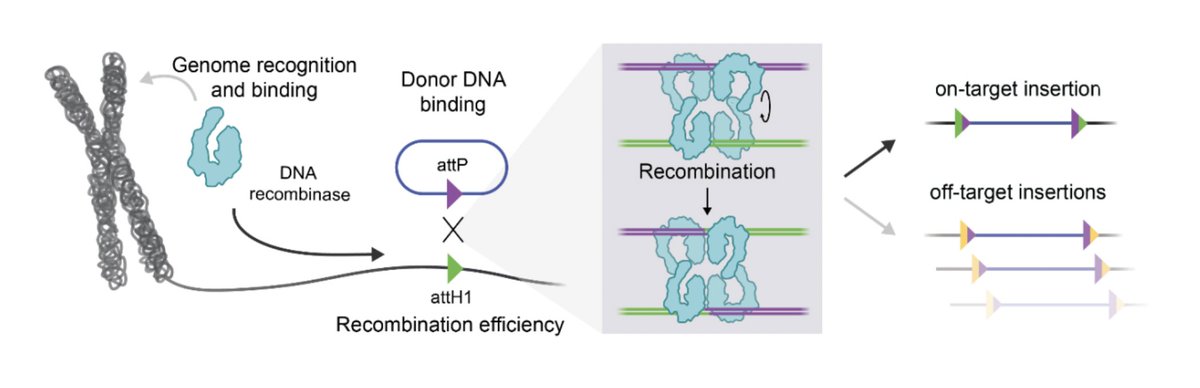
Thrilled to share our paper, now out in Nature Biotechnology! We engineered recombinases to enable efficient, specific genome insertion of multi-kb DNA cargoes at an endogenous locus. Grateful to all my amazing co-authors!
A study published today in @NatureBiotech from the @pdhsu lab presents a new way to insert large DNA sequences into the genome using engineered recombinases that don’t require DNA cutting or rely on the cell's repair machinery.
🧬 Thrilled to share our latest work on engineering precise DNA recombinases for targeted genome integration! Through directed evolution & protein fusions, we achieved over 50% efficiency & 97% specificity for multi-kb DNA cargo insertions. Big thanks to all co-authors -
🧵In new work, we report a systematic engineering roadmap to optimize large serine recombinases (LSRs) for direct, site-specific insertion into the human genome 🧬. We achieved over 50% insertion efficiency and 97% genome-wide specificity, a 10X improvement over our previous work
@cyrus_tau and I are so excited to share our work on developing a CRISPR protein-guided, trans-splicing system for making versatile RNA edits!!! See the highlights in Cyrus' thread and the preprint for details!
Amazing week @KeystoneSymp ! So much fun to finally share our work. It’s been an awesome scientific journey characterizing this system with @mgdurrant and our team
Some notes on our bridge recombination system from our preprint 🧵:
The ability of molecular biologists to control DNA has relied on enzymes derived from the phage-microbe arms race. In this new work, we systematically mined thousands of new serine integrases (LSRs) and developed them for human genome editing. 🧬
https://t.co/tjJKBvRPYc