Excited to share my major PhD work: https://t.co/aolLfPhSTV!
(right before my defense and critical time for my postdoc search😊) Summary: an accurate CNN model for Cas13d guide efficiency prediction + a new non-toxic and highly specific enzyme (DjCas13d) for RNA targeting!
Delighted to share a landmark preprint from our lab, using genome language models and AI agents for biological discovery and genome mining!
The stretches of DNA between protein-coding genes are often called the genome’s “dark matter,” but they are far from empty. They encode RNA molecules that sense metabolites, regulate genes, and control some of molecular biology's most important tools (such as programmable genome editors e.g. CRISPR/bridge)
Much of this biology is unexplored. One reason is that RNAs can retain similar structures and functions even as their DNA sequences change dramatically, making their relationships difficult to recognize with conventional computational tools
The annual CASP competition -- with data generated specifically for the challenge -- was critical to advance the field of protein structure prediction over the past 30+ years to where it is today.
We're in our second year of doing the same for predicting how cells respond to perturbations with our 2026 Annual Virtual Cell Challenge.
Arc teams have again generated unusually high quality single cell CRISPRi perturbation data -- this time across 6 cell types -- specifically for this year's competition.
The Challenge: Can you get to experimental accuracy zero shot in predicting how different cell types respond when you target a specific gene? Sign up here to participate and win: https://t.co/RNAbPcHFRD
We release 300 million single cells (and counting) for virtual cell modeling, our first AI agent work @arcinstitute, and 100 million perturbed cells with @vevo_ai
This is the largest repository available, open source, and hopefully an ImageNet for cell biology
Excited to be launching this resource @arcinstitute for the scientific community today with the first 300M cells, including 100M cells with chemical perturbations!
Thrilled to share that EVOLVEpro is now published @ScienceMagazine Since our preprint, we now demonstrate low-N eningeering of both antibody and enzymes. We hope this model will broadly useful to the protein engineering field. https://t.co/vMzLFNkcnD
I am excited to join storied biotech pioneer @Amgen as Chief Scientific Officer and Head of Research. I look forward to partnering with my new colleagues to deepen understanding of biology and develop solutions to the most pressing medical challenges https://t.co/Vqmsv68Q9Z
Today we report Evo, a generalist foundation model for biology, on the cover of @ScienceMagazine. Trained on billions of DNA nucleotides, Evo was designed to capture two key aspects of biology: the multi-modality of the central dogma and the multi-scale nature of evolution.
Excited to share my major PhD work: https://t.co/aolLfPhSTV!
(right before my defense and critical time for my postdoc search😊) Summary: an accurate CNN model for Cas13d guide efficiency prediction + a new non-toxic and highly specific enzyme (DjCas13d) for RNA targeting!
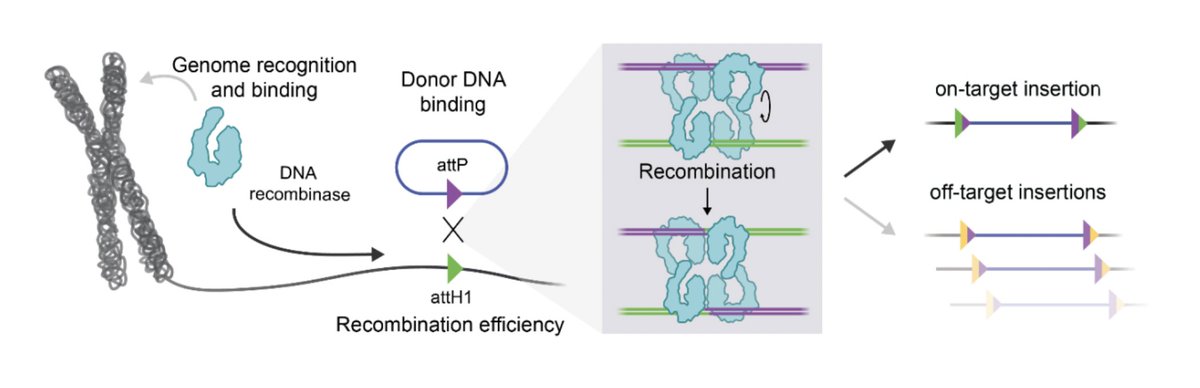
🧵In new work, we report a systematic engineering roadmap to optimize large serine recombinases (LSRs) for direct, site-specific insertion into the human genome 🧬. We achieved over 50% insertion efficiency and 97% genome-wide specificity, a 10X improvement over our previous work
Levels of gene expression matter! So how can you control a transgene precisely? Is there a tool that can ensure uniform control & the ability to adjust the setpoint of expression from a single promoter? Introducing DIAL! 🧵 (1/n)
Link: https://t.co/MeEmOzMptv
Excited to share our preprint "Multiome Perturb-seq unlocks scalable discovery of integrated perturbation effects on the transcriptome & epigenome". This work extends single-cell CRISPR screens to simultaneously profile gene expression & chromatin accessibility.
Please RT! @BrianHie and I are hiring joint @arcinstitute postdocs to work on ML in biology. Projects include reimagining synthetic gene circuits, mechanistic interpretability, and controllability. Recent work includes genome design with Evo, an AI foundation model trained on DNA to learn the language of evolution
patrick[]https://t.co/l7LF6bP2Ym
brianhie[]https://t.co/VPBj2jhqWn
What if we could universally recombine, insert, delete, or invert any two pieces of DNA?
In back-to-back @Nature papers, we report the discovery of bridge RNAs and 3 atomic structures of the first natural RNA-guided recombinase - a new mechanism for programmable genome design