If someone verifies a spatial capture, what makes them accountable for getting it wrong?
@vangrid_io’s planned verification system puts collateral behind that judgement. Its token documentation describes independent operators staking $VAN before reviewing assigned captures. In simple terms, they would commit tokens that could be partly lost if their attestation disagreed with the resolved outcome.
The assignment process matters too. Captures would be allocated pseudorandomly, so contributors couldn’t choose their reviewer and reviewers couldn’t simply select the submissions they preferred.
An important status check: VanGrid currently marks both $VAN and independent verification under collateral as not live. This is a proposed mechanism, separate from the checks already operating today.
Imagine a capture that passes basic technical checks but contains a misleading claim about the scene. The harder question is whether someone can evaluate that claim reliably—and face consequences for a false attestation.
That is the role collateral is intended to play. It creates something at stake behind the reviewer’s decision. It doesn’t make every decision automatically correct.
For me, the most interesting part to watch is how disagreements would be resolved. Who establishes the final outcome? What evidence supports it? How are honest mistakes distinguished from deliberate misconduct?
Those details would determine how useful the incentive becomes. I’d judge the design by the quality and accountability of the review process, rather than treating the presence of a token as proof that verification works.
Pretty pink flowers!🩷🌸
These bright pink Madagascar periwinkles (also called pink vinca) look so happy in their pots. Glossy green leaves and cheerful blooms — perfect for any garden! 🌸
Chamath Palihapitiya just warned about a quantum or AI attack on Satoshi-era Bitcoin wallets. 🚨
The concern: a quantum machine running Shor's algorithm could break ECDSA signatures and expose private keys from public ones.
But in real, no such machine exists yet.
Crypto's counter: a decade of battle-tested security culture is a real edge over traditional finance.
And builders are already moving:
• Quip Network is working on post-quantum wallets for Ethereum and Bitcoin
• Ethereum has upgrades planned for 2029
• Industry alliances are forming around standards
It's not a panic signal. A preparation signal.
🔥 $BMNR MASTERMIND TOM LEE
THINK BANKS SHOULD ADAPT CRYPTO!👇
Tom Lee, chairman of the largest $ETH treasury Bitmine says 99% of finance still runs on pretty old rails, and that's exactly why banks are underestimating how extremely fast crypto could take over.
Banks without a real crypto plan could get left behind completely!
I think as a bank you have to transform from TradFi to DeFi.
Tokenized RWA’s, stablecoins and AI agents with huge amount of transactions need crypto rails.
Do you agree with Tom Lee?🤔
I recently took a look at the REA service from @termix_ai , and what I find particularly interesting is that it doesn’t just offer to "read" and interpret complex, hard-to-decipher content it also leaves a trail of evidence, allowing you to verify the findings yourself.
A common, practical question arises when encountering an unverified smart contract: what can actually be gleaned from the bytecode running on the chain? REA addresses this by extracting interfaces directly from the bytecode even for contracts where the source code is unavailable.
Beyond that, it handles ELF/PE binaries (generating pseudocode, disassemblies, call graphs, etc.), JS/Electron applications (mapping modules, imports, URLs, or embedded keys), and even .NET assembly. What stands out to me isn't just the final output; it’s that every discovery is linked to an "evidence ID" and the SHA-256 hash of the original artifact.
This allows the recipient of the report to cross-reference the exact data that was analyzed, rather than having to take the agent’s word for it. Of course, reconstructing an interface remains an inferential process; a matching hash only confirms the source material used it doesn't automatically render the conclusions absolute truth, nor does it guarantee that the software is secure.
The transaction process follows the "agent commerce" model that TermiX is building: quotes start at around $10, with a turnaround time of about a day. Terms are negotiable, and funds are held in an escrow account on the BNB Chain until the requester accepts the report. It’s a concrete example of an agent taking on a specific task, delivering verifiable results, and only then triggering the release of payment.
Ultimately, the true value of such a report lies in whether the provided evidence enables the user to independently verify the findings and gauge the level of certainty or uncertainty surrounding them.
If a service simply provides an answer and stops there, its utility is largely fleeting. But if the evidence is clear enough to allow others to build upon it or conduct further investigation, then it becomes genuinely useful.
Scribely is getting some solid daily traffic lately 📈
thinking of adding a few sponsor spots for fellow indie hackers & SaaS founders to get some extra visibility.
worth a shot? 👀
Here's your latest On-Chain Metrics Update
$ONDO Smart Portfolios cross $30M TVL
$RENDER value burnt up 41% month over month
$INJ 7.2M total tokens burnt (7.2% total supply)
$XLM stablecoin transfer vol up 121% from Q2
$AERO tokenized stocks volume passes $3 Bil
$AAVE protocol revenue up 46% over 30 days
$NEAR Intents swap volume at $27.1B YTD
$LINK $26.3B in cumulative CCIP transfers
$UNI Base DEX volume up 57% over 30 days
$HYPE #1 derivatives venue on Token Terminal
$SOL $4.4B tokenized stocks trading vol since Sep
Crypto Twitter timelines looking bearish,
Narratives and news continue looking bullish.
Ignore the noise & look at the numbers on-chain
Good morning, happy Saturday! 🦆 These white ducks glide across a pond carpeted in blue, pink, and purple hydrangeas, a scene straight out of a painting. Slow down and float through the beauty around you today, savoring the simple, lovely moments! 🩵🔊
You are one cloud hack away from losing everything.
If you stored your Web3 wallet's 12-word seed phrase on your phone or computer, your crypto is a ticking time bomb.
Here are 3 silent killers waiting to drain your wallet—and how to fix it right now: 👇
1. The "Saved Draft" Trap
Think your email drafts or Apple Notes are safe because you have a strong password?
Think again.
If a hacker breaches your iCloud or Google account, the first thing they script their bots to search for is a 12 or 24-word string. If you use a pirated operating systems for browsing, you are most likely already being fed malwares each time you connect to the internet.
Don't believe me? Download AVG Antivirus and get it installed on your computer, get connected to the internet and see what I'm talking about. It gets better when you sign up for its premium plan.
2. The Screenshot Exposure:
Did you take a quick screenshot of your seed phrase during setup, intending to write it down "later"?
Your phone automatically syncs that image to the cloud.
If a malicious app gets photo permissions, or your cloud backup is compromised, your keys are gone.
3. Clipboard Hijacking
Some malware specifically sits in the background of your laptop or desktop waiting for you to copy text that looks like a seed phrase or wallet address.
The moment you copy-paste it into a file, it's intercepted and sent to a malicious server.
How to fix this TONIGHT:
1️⃣ Get a piece of paper (or a metal backup card).
2️⃣ Write down your seed phrase physically with a pen.
3️⃣ Delete EVERY digital trace: clear trash folders, cloud backups, and photo recycles.
4️⃣ Moving forward, treat your seed phrase like physical cash.
Your seed phrase is the master key to your digital vault. There is no "Forgot Password" button in Web3.
If you learned something from this, drop a 🔒 below to secure the algorithm.
$SHALOM 🕊️
➥ $PENDLE has lost 93% of its TVL from ATH
for context, @pendle_fi's TVL peaked at $13.39B in Sept 2025
as of October 24, DeFiLlama reports:
- $958M TVL, -20% / 30D
- $815.6M DEX volume / 30D
- $452K protocol revenue / 30D
- $129.8M Boros open interest
but its new derivatives product has already processed over $7B in trading volume
Pendle's official investor dashboard shows:
→ $94.4B+ cumulative Pendle V2 trading volume
→ $7.1B cumulative Boros trading volume
→ $152M Boros volume / 7D
@boros_fi has now processed ~7.5% of Pendle V2's lifetime trading volume, despite being a much younger product
i think this is where the next part of the $PENDLE thesis gets interesting
- Pendle V2 built its business around splitting yield-bearing assets into principal and yield exposure
- Boros takes that model into perpetual funding rates
instead of simply earning floating funding, traders can hedge or speculate on where those rates are heading
and that's a market that exists regardless of which stablecoin or yield-farming strategy is popular
there's also an important difference in monetization
Pendle's investor dashboard currently shows $15.9M annualized revenue for V2, compared with only $800K for Boros
so Boros has meaningful trading activity, but it remains a much smaller revenue contributor
its revenue is also retained internally rather than distributed to token holders
i'm interested in $PENDLE as an onchain interest-rate infra play
the combination of fixed-yield markets and funding-rate derivatives gives Pendle exposure to 2 different sources of demand
but I'm not ignoring the declining TVL or the relatively modest revenue coming from Boros
i hope Boros growing beyond $130M OI while turning more of its trading activity into sustainable protocol revenue
if that happens alongside a recovery in V2 deposits, the investment case becomes much more interesting
for now, I'm keeping $PENDLE on my watchlist
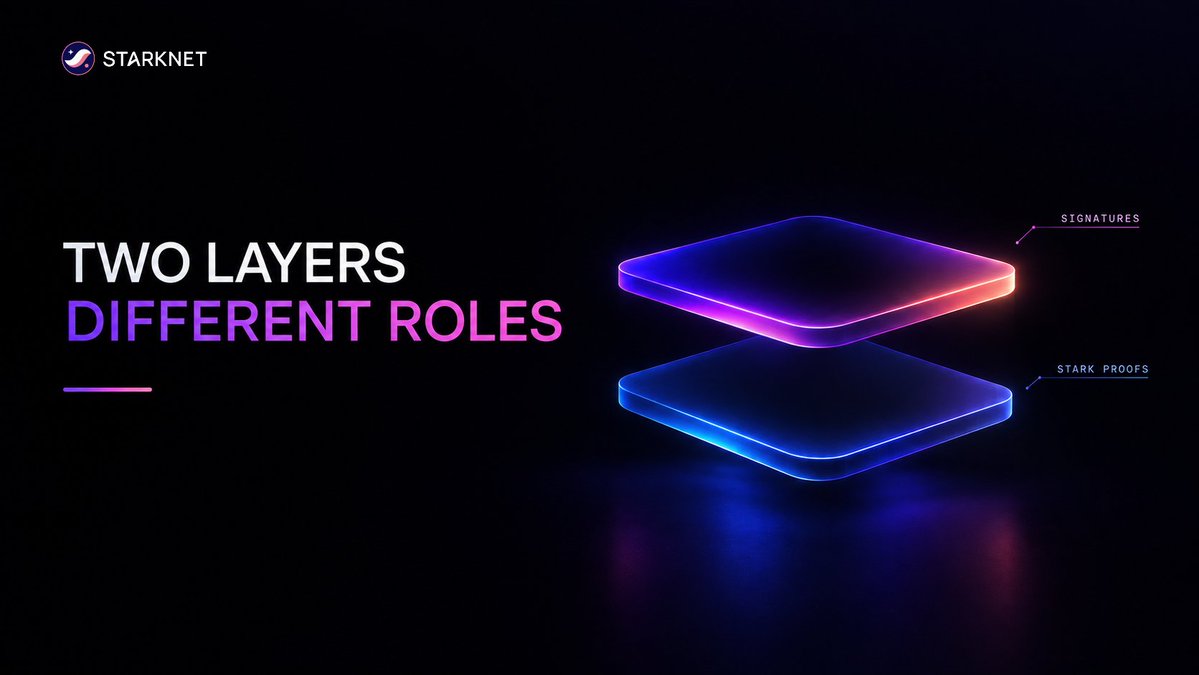
Crypto security has two layers.
@Starknet treats them differently.
Signatures
→ authorize transactions
STARK proofs
→ verify computation
The interesting part?
Starknet’s programmable accounts can adopt new signature methods while keeping the underlying proving system in place.
One layer can evolve without rebuilding the other.
That’s a design choice worth paying attention to.
→ https://t.co/j4mPXdoi5E
AI on @base 48H Recap
What happened across AI, agents, x402, and robotics on @base in the last 48 hours
News
- @coinbase opened crypto, stock and derivatives trading to Claude, ChatGPT, Grok and Muse agents.
- @coinbase shipped perpetuals for agents and called it AiFi².
- @jessepollak put 200ms blocks on Base testnet, with mainnet next.
Agents
- @virtuals_io delivers Native Pearl into your own wallet through Butler.
- @monidhq launched a Product Hunt for agents, voted on by agents.
- @reppo demoed a loop that scores ChatGPT's BTC calls against outcomes.
- @antseed offers Opus 5.5 through third-party providers at up to 97% below the official API.
- @aeonframework moved its agents into ChatGPT as a plugin.
Private AI
- @opengradient serves ChatGPT, Claude, DeepSeek and Bytedance models privately on https://t.co/2nKDdiabj1.
- @blockrunai added zero data retention, so prompts are never stored.
- @usedotai added Mercury 3 to Dot Council, bringing a faster coding model.
x402
- @korprotocol ranks KORUS top five across chains with 26K+ x402 transactions.
- @vapi_network prices Birdeye token and holder data at $0.003 per call.
- @prxvtai settles private USDC agent payments through px402 on Base.
Robotics
- @axisrobotics started Season 2, with points counting toward a post-TGE airdrop.
- @openroboto is building robot skills from real-world data and better models.
- @dreamlabs_ai ran Dream-1 on a robot it had never seen.
Security
- @1clawai rotated every compromised Railway key for its users in one click.
- @mossai_official said Moss does not run on PHP, so no action is needed.