3D Tissue Braiding for robot hands! 🧬
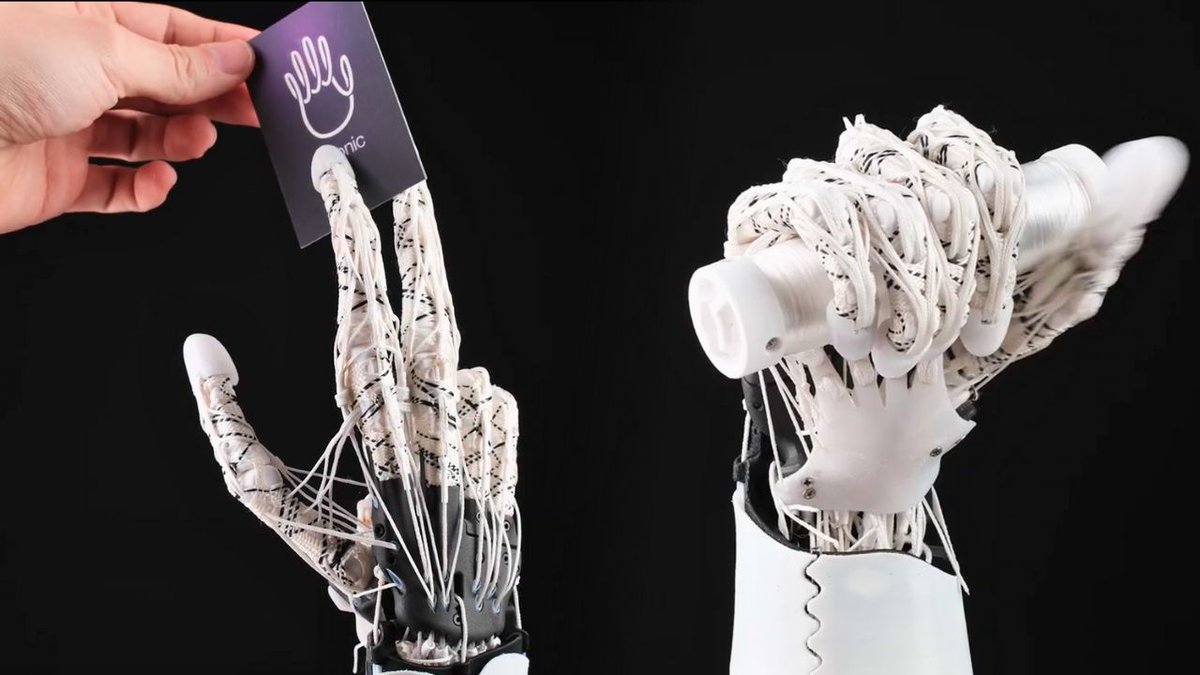
@AllonicRobotics created a 3D tissue braiding machine.
The machine is weaving high-strength fibers around a minimal rigid skeleton, exactly how human connective tissue wraps around bone.
There are no screws, no cables, and no fiddly joints. A continuous automated process creates tendons, soft tissue, and compliant structure all at once.
Digital design to physical part in minutes. Cost drops dramatically, so that end-effectors could eventually be swapped like disposable gloves.
Dexterous manipulation has been one of the last great unsolved problems in humanoid robotics.
Hands are expensive, slow to iterate, and hard to scale. 3D Tissue Braiding attacks every single one of those constraints simultaneously.
They also raised $7.2M in the largest Pre-Seed round in Hungarian history. 🇭🇺
This feels like the moment robotic bodies get their own 3D printing revolution.
@benedektasi let's go! 😮💨
~~
♻️ Join the weekly robotics newsletter, and never miss any news → https://t.co/GoA3ZuwoPB
🚨 @AllonicRobotics is transforming how humanoids are built 🤖
> Braided robot bodies
> A new manufacturing stack for robotics
> Cheaper, lighter, more compliant
⚡Exclusive chat with @benedektasi, @GoingBallistic5@anatomyumea & @Hmorvaridi 👇🏽
https://t.co/e44cm16JDH
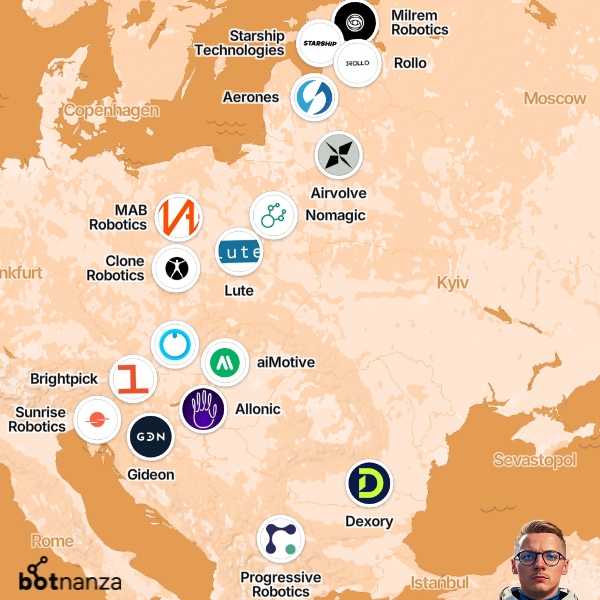
Robotics in CEE is cooking and nobody's talking about it! 🧯
Eastern Europe is quietly building a robot ecosystem, and it's serious!
The Central and Eastern Europe (CEE) region is becoming an emerging hub for robotics startups thanks to its growing technical talent, lower costs, and rapidly developing ecosystem.
Many countries in the region, such as Poland, Estonia, and Romania, have strong traditions in engineering, mathematics, and manufacturing.
Universities and technical schools produce highly skilled engineers who are increasingly moving into robotics, AI, and automation. 🎓
Another advantage is cost efficiency. Compared with Western Europe, startups in CEE can build teams, develop hardware, and run operations at significantly lower cost while still maintaining high technical quality.
The CEE region has a strong global tech diaspora. Founders from the region are building leading AI and robotics companies abroad, such as @hausman_k at @physical_int and @matiii at @elevenlabs, helping bring expertise, networks, and inspiration back to the CEE ecosystem.
That's a huge boost to have a playbook on how to build EXCEPTIONAL companies.
The region also benefits from a growing startup and investment ecosystem. In cities like Warsaw, Prague, and Bucharest, new accelerators, venture funds, and EU-supported innovation programs are helping deep-tech and robotics startups get off the ground. 💰
Also big kudos to @CredoVentures, InovoVC, @otb_ventures and many others!
Because of these factors, CEE is increasingly seen as an emerging robotics market!
The space is growing too fast for one map, If I missed you, you're building in a good place. Next edition, you're on it. 👊
List of companies in the comments! ⬇️
~~~
♻️ Join the weekly robotics newsletter, and never miss any news → https://t.co/GoA3ZuwoPB
Next Thursday, we're sitting down for a fireside with @martonsn at @START_Summit in St. Gallen, to share more on the founding story behind @AllonicRobotics.
Come find us there at 15:45! Also hosting an "Ask me anything!" after (use my code ALPS for 20% off!)
We're hiring a Mechatronics Engineer!
This role is all about 3D Tissue Braiding, at the center of our engineering team: creating the automated manufacturing platform that will be the foundation of the new robotics category we’re building. Apply here: https://t.co/st8gT03AV2
Rigid robot hands may be holding robotics back.
I’ve watched many humanoid demos. They walk smoothly. They balance well. Then they try to pick up something simple… and I start to doubt how close we really are.
That is why this caught my attention.
A Hungarian startup, Allonic, is building robotic hands using 3D Tissue Braiding.
→ Fingers braided as one integrated structure
→ Tendons woven directly into the design
→ Force distributed across the surface
→ Adjustable stiffness, closer to how human hands behave
Maybe our obsession with rigid precision has limited progress. Maybe adaptability is the real breakthrough.
I am not certain this is the answer. But I suspect the future of robotics will look less like metal joints and more like woven intelligence.
If you were building the next generation of humanoids, would you bet on rigid strength or adaptive softness?
#AI #Robotics #Humanoids #Innovation #Biomimicry #ArtificialIntelligence
We’re looking for a Robotics Engineer with category-defining ambitions to join us at our Budapest HQ!
This is a high-trust, crucial role at the heart of our Solutions Team – hands-on with 3D Tissue Braiding to build a new generation of robots.
Apply here: https://t.co/Aa8DsngL3v
New Episode: @benedektasi is leading Allonic, a Hungarian robotics startup leveraging textile technology to create humanoid hands that mimic human anatomy.
We discuss their 3D braiding process, engineering complexities, and Benedek’s vision for the future of robotics.
0:52 Intro
1:32 Prior work in bio-inspired solutions
4:05 Drawing inspiration from textile industries
6:01 Innovations in braiding manufacturing
7:46 Speed of production
9:03 Physics of load distribution in fibers
9:45 Inherent limitations of tendon-driven systems
12:51 Solving precision and dexterity challenges
14:58 Full musculoskeletal humanoid robots?
17:14 Growth plans and technological expansion
18:38 Long-term vision for robotic infrastructure
We're hiring!
Looking for a few exceptional people across robotics, machine design, software, and business ops to join us at our Budapest HQ.
Check open roles and apply here: https://t.co/HqvaOFCsre
Massive week in robotics.
I went through everything from Apptronik, Weave Robotics, Allonic, and more
Get your coffee and see what happened in robotics space:
Allonic Robotics built a robot hand using 3D Tissue Braiding — weaving fibers instead of assembling screws and joints.
Strong yet soft. Dexterous. Built in minutes from a digital file.
Could this be robotics’ 3D printing moment? 🤖💪
🎥 @AllonicRobotics
A Hungarian startup is generating buzz with its automated manufacturing system for building robots that's straight out of Westworld.
Budapest-based Allonic just raised $7.2 million to develop its so-called 3D tissue braiding system designed to replace traditional robot assembly. The pre-seed funding round, reportedly the largest in Hungary's history, was led by Visionaries Club, a European early-stage investor group, with other participants including Day One Capital, Prototype, SDAC Ventures, TinyVC, and angel investors affiliated with OpenAI and Hugging Face.
Instead of machining and assembling rigid components, Allonic's system weaves robot bodies in a way that's closer to making clothing than industrial machinery. It braids high strength fibers, elastic materials, tendons, cables, and other wiring around a simple internal frame. The result is a robot that's mechanically complete and ready for activation.
The startup shared footage of the system creating a five-fingered robotic hand capable of grasping and manipulating objects. Allonic says the structure resembles musculoskeletal anatomy, with its structural support, movement, and internal routing formed together.
The 3D tissue system differs from additive manufacturing. Instead of stacking material layer by layer like a 3D printer, it intertwines fibers that are braided and tensioned for strength and flexibility. According to Allonic, the method simplifies the production of next-gen robots by reducing part count and eliminating failure points.
Allonic is focused on robotic hands, manipulators, and limbs for now but says the system is meant to scale to larger humanoid robot bodies over time. The startup is reportedly in talks with major US robotics and technology firms to scale deployments.
New humanoid startup out of Hungary: Allonic
The unique hand design moves away from rigid industrial design toward a biomimetic approach.
- Each finger is braided around like a rope in a single autonomous process; this process also includes the threading of the tendons through the braided "tissues."
- The braidings wrap around and provide distributed load across the surface of the finger rather than a single point of failure.
- The hand naturally conforms to objects during a grip and allows for variable stiffness like human hands.
The cost of the hand (not including motors) could be as low as $50.