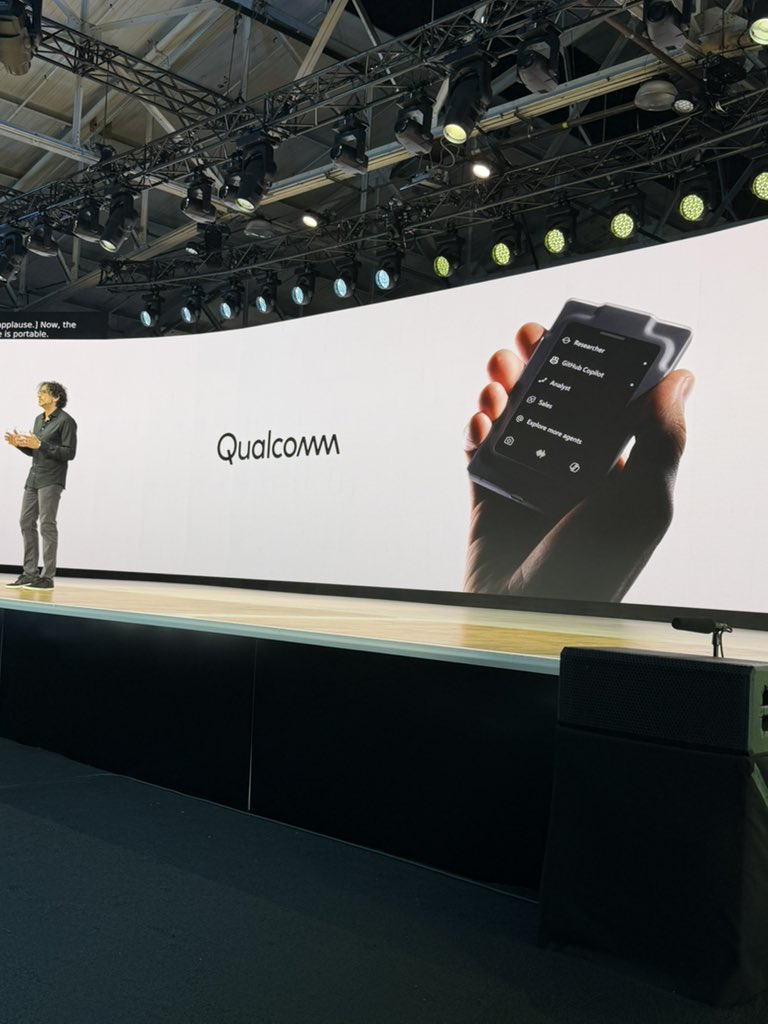
شركة ميكروسوفت تعلن عن جهاز ذكاء اصطناعي، يشتغل مباشرة مع وكلاء الذكاء الاصطناعي. يساعدك في إنجاز المهام. أعتقد أنا الآن بدأنا مرحلة جديدة، مرحلة الأجهزة المختصة للذكاء الاصطناعي، ثم تأتي الأشياء الأخرى مثل الهاتف والتطبيقات وغيرها.
⬛️ The Power of Leadership | #Blog4Managers
Leadership is often described through powerful words: influence, inspiration, empowerment, direction, responsibility, connection. These concepts appear in presentations and across leadership frameworks. They are easy to understand, widely accepted, and rarely questioned. Yet the real power of leadership does not reveal itself in agreement with these ideas.
1⃣ It reveals itself in the moments when they are difficult to apply. Because leadership is not a conceptual exercise. It is a practical discipline - one that unfolds under conditions that are rarely ideal: uncertainty, time pressure, conflicting goals, and incomplete information. In these situations, leadership is no longer about aligning with principles. It is about making decisions that inevitably prioritize one principle over another. This is where the power of leadership begins.
2⃣ In everyday organizational life, leadership is defined less by intention and more by behavior. Not by what leaders say, but by what they consistently do - especially when faced with tension. A leader may value empowerment, but how do they act when results are at risk? A leader may emphasize connection, but how do they behave when speed becomes critical? A leader may advocate for responsibility, but do they take ownership when outcomes are uncertain? Leadership is tested precisely at these intersection points.
3⃣ In the context of digital transformation, these tensions become more pronounced. Organizations operate in increasingly complex environments where stability is temporary and change is continuous. Decision cycles accelerate, information becomes fragmented, and the predictability that once supported traditional leadership approaches begins to erode. Under these conditions, leadership cannot rely on hierarchy alone:
▪️Authority does not automatically create alignment.
▪️Expertise does not guarantee better decisions. ▪️Processes do not ensure meaningful outcomes.
4⃣ Instead, leadership becomes a dynamic capability - the ability to create orientation without certainty, to enable progress without full control, and to maintain cohesion in the absence of stability. The power of leadership, therefore, lies in navigating complexity rather than reducing it. This requires a shift in perspective - one that is often underestimated: Leadership is not a title or a position.
📢 Leadership is a privilege.
5⃣ It is the privilege to influence how others experience their work. The privilege to shape decisions that affect more than oneself. The privilege to create clarity where others experience uncertainty. And the privilege to carry responsibility that cannot be delegated. This privilege is not granted once. It is earned continuously - through behavior. Leadership is no longer about having the right answers. It is about asking the right questions, framing the right problems, and enabling others to contribute effectively within a shared direction. It is about holding accountability while distributing ownership. It is about enabling autonomy without losing coherence. These are not static skills. They are continuous practices. At its core, leadership manifests in small, repeated actions:
▪️In how decisions are communicated. In how uncertainty is addressed.
▪️In how mistakes are treated. In how listening is practiced.
▪️In how pressure is handled - whether it is absorbed, amplified, or passed on.
6⃣ These micro-behaviors shape organizational reality far more than formal strategies or declared values. They define how people experience leadership on a daily basis. And over time, they define culture. Culture, in this sense, is not an abstract construct. It is the accumulation of consistent leadership behavior. The power of leadership becomes visible when leaders are able to hold contradictions without simplifying them away. When they resist the urge to choose convenience over consistency. When they maintain clarity without pretending certainty. When they empower others without withdrawing responsibility. When they prioritize long-term capability over short-term optimization.
7⃣ This form of leadership is demanding because it cannot be reduced to formulas or best practices. It requires situational judgment, self-awareness, and the willingness to act deliberately - even when trade-offs are uncomfortable. It also requires reflection. Leaders must continuously examine not only what they decide, but how they decide and what consequences their behavior creates beyond the immediate outcome. In this sense, leadership is not defined by singular moments of excellence, but by patterns of behavior over time. The true power of leadership is not visible in frameworks or titles. It is visible in consistency under pressure. In the ability to remain aligned with principles when circumstances make this difficult. In the capacity to create trust, direction, and stability without relying on certainty.
📢 Leadership shows its true strength not when everything works as expected, but when things become unclear, difficult, or contested - every single day.
✨ @Khulood_Almani@AkwyZ@MaryRich78@rwang0@timo_vi@drsharwood@TamaraMcCleary@DrHolzwarth@HelenBevan@phinifa@pierrecappelli@JimHarris@jenstirrup@GlenGilmore@subare@Ronald_vanLoon@enilev@Scobleizer@AndrewYNg@YuHelenYu ✨
#Leadership #Responsibility #Privilege #Mindset #LeadershipUnderPressure #DecisionMaking #DigitalTransformation #Complexity #OrganizationalCulture #ChangeLeadership #FutureOfWork
Image by @thomas_dettling | @grok