⬛️ The Human Advantage:
Stronger Brains in the Age of AI | #WEF26
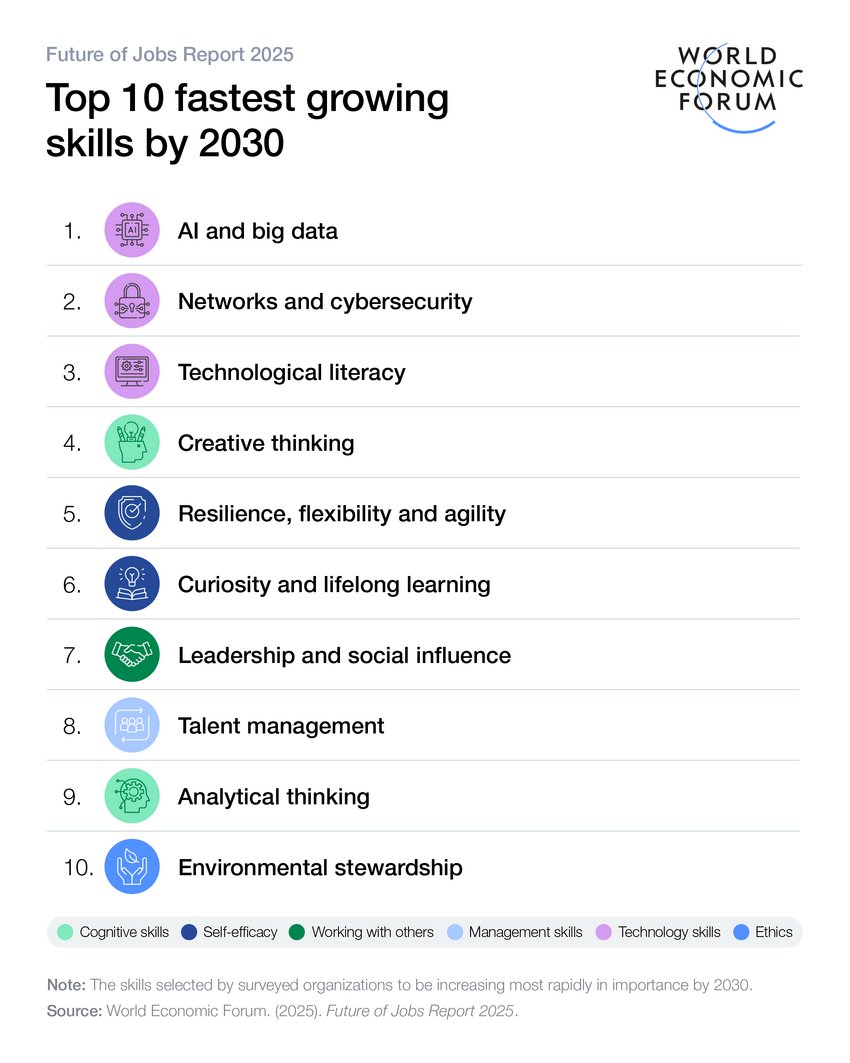
In the age of AI, prioritizing the brain can strengthen the human capacities essential for well-being, connection and progress.
🔷 As AI reshapes work, competitiveness will depend on how effectively human and machine strengths complement one another. Individuals, workforces and societies should explore how to evolve their strategies to harness these shared strengths – otherwise they risk slower growth and diminished opportunity.
➡️ You should read the WEF report because it makes some essential points:
🔹 In an age dominated by AI, human brain health and uniquely human skills are becoming the ultimate competitive advantage.
🔹 Human capabilities drive future competitiveness
🔹 Brain health and skills are foundational for resilience and productivity
🔹 Brain capital is underinvested - yet critical 💡
➡️ Download Report: https://t.co/xqmL1y9ixX | @wef & @McKinsey_MGI@AkwyZ@TamaraMcCleary@rwang0@jsprondel@mikeflache@HelenBevan@MaryRich78@pierrecappelli@jenstirrup@GlenGilmore@DrHolzwarth@subare@JimHarris@timo_vi@Ronald_vanLoon@enilev@Scobleizer@AndrewYNg@YuHelenYu@drsharwood@SDGS4GOOD
#AI #People #Brain #Skills #Advantage #Productivity #FutureOfWork #Transformation #Leadership #Human #Machine #Health ✨
⬛️ Digital Transformation – Why We Must Finally Take It Seriously!
🔷 Intro
For years, companies have been talking about “digital transformation.” Buzzword bingo in meetings, glossy slides, pilot projects that never scale. But the reality? Many organizations are still thinking, deciding, and acting in an analog way – and losing #competitiveness every single day.
➡️ The world is changing faster than ever Customers expect speed, personalization, and digital services – not someday, but now. Technologies like Artificial Intelligence, automation, and cloud are evolving exponentially. Hesitation means losing.
And it’s not just markets that are changing: talent wants modern ways of working, purpose, skills, and flexibility. Companies that cling to rigid structures risk not only their innovation power but also their attractiveness as employers.
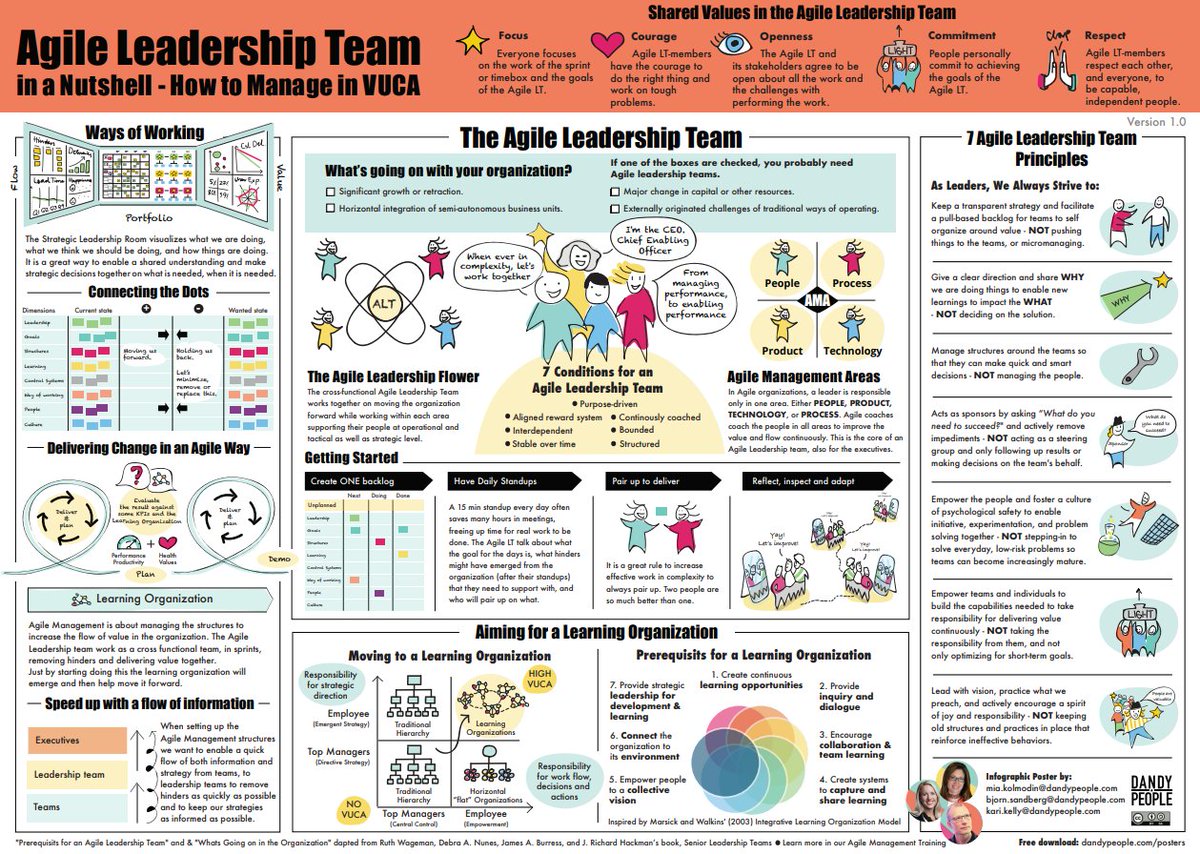
➡️ Digital Transformation Is Not an IT Project
The biggest misconception: Transformation is often seen as a “technology upgrade.” In reality, it’s a cultural shift. It’s about:
🔹 Rethinking leadership: Moving from control to trust and empowerment.
🔹 Living agility: Making decisions quickly, data-driven, and customer-centric.
🔹 Building a learning organization: Treating mistakes as opportunities and experiments as the norm.
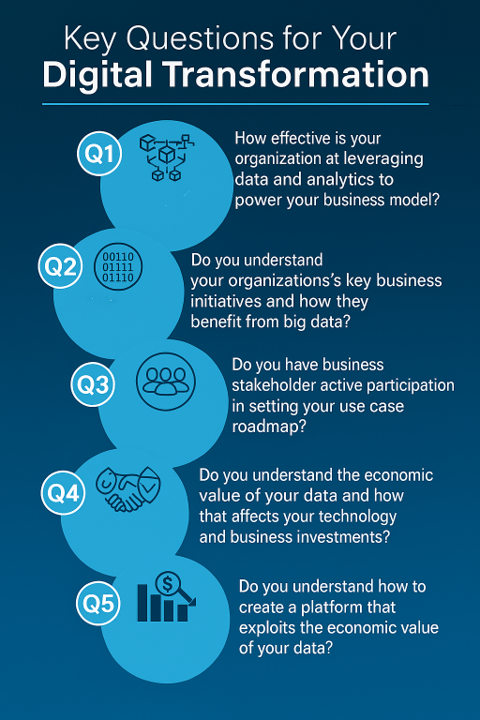
➡️ The Key Questions for Your Transformation
Before you start - and if you’re already on your way - ask yourself these five critical questions:
🔹 How effective is your organization at leveraging data and analytics to power your business model?
🔹 Do you understand your organization’s key business initiatives and how they benefit from data and data-backbone?
🔹 Do you have active business stakeholder participation in setting your use case roadmap?
🔹 Do you understand the economic value of your data and how that affects your technology and business investments?
🔹 Do you know how to create a platform that exploits the economic value of your data?
These questions are not just technical – they touch strategy, culture, and governance. If you can’t answer them, you don’t have a clear transformation path.
🔸 The Question Is No Longer:
“Do We Need Digital Transformation?”
🔸 The real question is:
“Can we survive without it?”
🔷 Conclusion:
The Time for Excuses Is Over. Digital transformation is not a trend – it’s a survival strategy. Those who don’t invest today will pay the price tomorrow: market share, talent, relevance. Scale AI for productivity and innovation. Automate repetitive tasks to focus on value creation. Build a culture where people and technology grow together 💡
👉 What’s your biggest obstacle to real digital transformation? Join the discussion and share your experiences!
@TamaraMcCleary@rwang0@Khulood_Almani@AkwyZ@mikeflache@HelenBevan@MaryRich78@pierrecappelli@jenstirrup@GlenGilmore@DG_Collective@PhilippKnauer2@DrHolzwarth@sijlalhussain@subare@JimHarris@SusanneMadsen@timo_vi@kerstingAIML@sallyeaves@CynthiaLIVE@enilev@mcgrathmag@HaroldSinnott@Scobleizer@AndrewYNg@YuHelenYu@ipfconline1@jblefevre60@antgrasso@RagusoSergio@SabineVdL@kalydeoo@Der_BDI @digital_T_CH @drsharwood@Nicochan33@AngelaNoonUK@JoanBajorek@mitsmr@wef@havardbiz@Gartner_inc@SwissCognitive@McKinsey@IDEOU@EU_Commission ✨
#DigitalTransformation #Leadership #Agility #Strategy #Culture #CultureShift #Governance #People #Skills #FutureOfWork #Innovation #AI
Sources & Further Reading
McKinsey & Company – Why Digital Transformations Fail
https://t.co/MKSS3uGQ69
Harvard Business Review – Digital Transformation Is About Talent, Not Technology
https://t.co/mBFoD2L7bd
Gartner – Top Strategic Technology Trends
https://t.co/vzmV8wUN6w
MIT Sloan Management Review – The Nine Elements of Digital Transformation
https://t.co/PjsrCHtePS
Image by @thomas_dettling in reference to #artofit
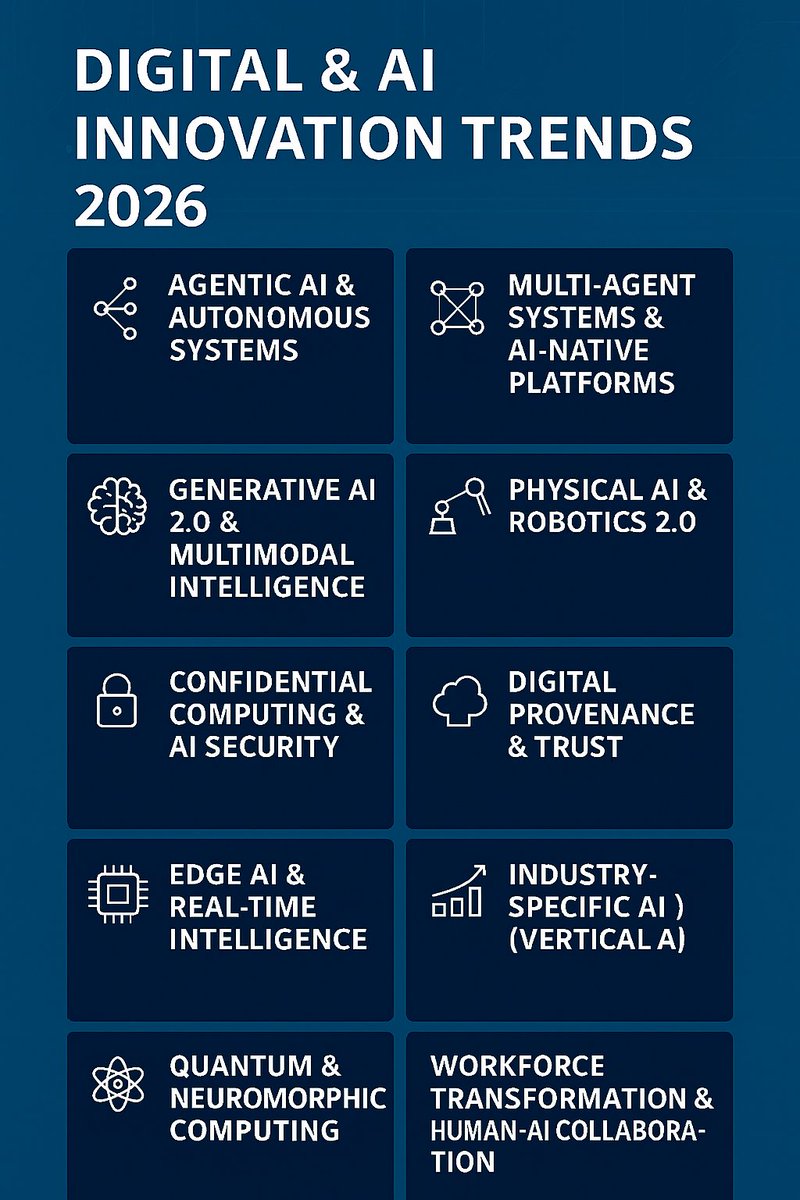
⬛️ Digital & AI Innovation Trends 2026 🤖
➡️ Here are the key Digital & AI Innovation Trends for 2026, based on the latest insights from Gartner, Deloitte, and other industry sources:
🔹1. Agentic AI & Autonomous Systems
What it is: AI agents that can set goals, make decisions, and execute multi-step tasks with minimal human intervention.
Impact: Moves beyond automation to adaptive workflows in areas like customer service, supply chain, and finance.
Why it matters: Organizations adopting agentic AI will see major efficiency gains and new business models. Governance and ethical frameworks will become critical. https://t.co/wUxuXuoFIu | https://t.co/sWfGkCttXW
🔹 2. Multi-Agent Systems & AI-Native Platforms
Trend: Swarms of specialized AI agents collaborating to achieve complex goals.
AI-Native Development: Platforms that use generative AI to accelerate software creation, enabling smaller, agile teams.
Prediction: By 2030, 80% of organizations will evolve large dev teams into AI-augmented micro-teams. https://t.co/CdCVnQgsv4 | Top Strategic Technology Trends for 2026 https://t.co/TJswnt8qHz | https://t.co/b0Dunq4mVh |
🔹 3. Generative AI 2.0 & Multimodal Intelligence
Shift: From text generation to integrated multimodal systems (text, image, audio, video).
Applications: Personalized commerce, marketing automation, and creative industries.
Challenge: Deepfake risks and need for privacy-focused GenAI. https://t.co/6ymiOz119G
🔹 4. Physical AI & Robotics 2.0
Definition: AI embedded in physical systems—robots, drones, smart equipment.
Use Cases: Autonomous manufacturing, logistics, and healthcare devices.
Why it matters: Enables self-healing infrastructure and predictive maintenance. https://t.co/kgyRstGwlk
🔹 5. Confidential Computing & AI Security
Focus: Protecting sensitive data via hardware-based trusted execution environments.
Trend: AI-driven cybersecurity becomes a “battlefield” of defensive vs. offensive AI.
Prediction: Preemptive cybersecurity and AI security platforms will dominate enterprise strategies. https://t.co/CdCVnQgsv4
🔹 6. Digital Provenance & Trust
Need: Transparency in data usage and AI decisions.
Why: Regulatory pressure (EU AI Act, global compliance) and consumer demand for ethical AI.
Impact: Rise of AI governance roles and trust-by-design systems. https://t.co/lMWhSiDu6M
🔹 7. Edge AI & Real-Time Intelligence
Trend: AI processing moves closer to data sources for speed and privacy.
Applications: Predictive maintenance, adaptive production, healthcare monitoring.
Benefit: Lower latency and reduced cloud dependency. https://t.co/lMWhSiDu6M
🔹 8. Industry-Specific AI (Vertical AI)
Examples: Regulatory AI agents for compliance, voice AI in healthcare, computer vision in construction.
Funding: Billions flowing into AI-native startups solving niche problems. https://t.co/b0Dunq4mVh
🔹 9. Quantum & Neuromorphic Computing
Why important: Enables breakthroughs in drug simulation, logistics optimization, and AI model efficiency.
Prediction: Quantum-resistant encryption and hybrid computing architectures will become mainstream. https://t.co/TCvom65pTO
🔹 10. Workforce Transformation & Human-AI Collaboration
Shift: Humans become “editors” of AI outputs, focusing on creativity and oversight.
Action: Reskilling programs and new roles like “AI Ops” teams will emerge. https://t.co/wUxuXuoFIu
➡️ Big Picture: 2026 marks the transition from AI hype to AI execution. AI is no longer a differentiator - it’s a commodity. Success will depend on scaling responsibly, embedding trust, and orchestrating human-AI collaboration across all business functions 💡
@Gartner_inc@Deloitte@usaiinstitute@SwissCognitive@AIVentures_aus@mikeflache@rwang0@HelenBevan@MaryRich78@Khulood_Almani@pierrecappelli@jenstirrup@GlenGilmore@DG_Collective@pierrecappelli@tinapchopra@PhilippKnauer2@DrHolzwarth@sijlalhussain@subare@JimHarris@SusanneMadsen@timo_vi@kerstingAIML@sallyeaves@CynthiaLIVE@enilev@mcgrathmag@HaroldSinnott@Scobleizer@AndrewYNg@YuHelenYu@ipfconline1@jblefevre60@karine_grows@RagusoSergio@SabineVdL@kalydeoo@Der_BDI @digital_T_CH @drsharwood@Nicochan33@AngelaNoonUK@JoanBajorek@mitsmr@wef@havardbiz@IDEOU ✨
#ArtificialIntelligence #AI #People #FutureSkills #Innovation #Trends #RealTimeIntelligence #Human_AI_Collaboration #DigitalTransformation 💫
Infographic by @thomas_dettling | #Copilot
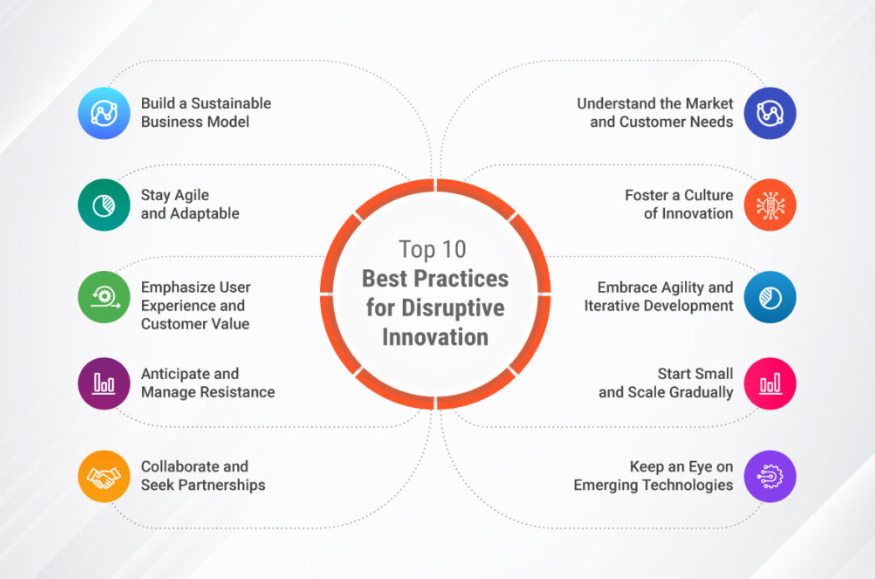
Disruptive Innovation: How Companies Thrive in Dynamic Markets
➡️ Disruptive innovation, coined by Clayton Christensen, transforms markets with simpler, more affordable, or accessible solutions. Starting in niches, these innovations displace established players by redefining customer needs. To drive or counter disruption, companies must optimize their culture, leadership, environment, vision and strategy.
🔶 Culture: Experimentation as a Core Value
A disruptive culture thrives on risk-taking and learning from failure. Innovation is a continuous practice, not a one-off event. Celebrating small wins keeps teams motivated, while psychological safety encourages bold ideas. Breaking down silos fosters interdisciplinary collaboration, and a "fail fast" mindset drives rapid iteration. Intrapreneurship empowers employees to act like entrepreneurs, infusing agility into the organization.
🔶 Leadership: Visionary and Empowering
Leaders balance operational stability with bold innovation, anticipating trends and taking calculated risks. They foster an innovation culture through scenario planning and training, enabling agile thinking. Transparent, empathetic communication builds trust, aligning teams and stakeholders. Allocating resources for high-risk, long-term projects, leaders inspire proactive change. They tie vision to business model innovation, breaking silos and viewing uncertainty as opportunity.
🔶 Environment: Flexible and Resource-Rich
A disruption-ready environment offers agile structures and resources like budget and technology. Innovation labs and cloud tools enable rapid prototyping. IT teams integrate disruptive tech for scalability. Hybrid models ensure inclusivity, fostering collaboration across diverse teams.
🔶 Strategy: Customer-Centric and Long-Term
Strategies target underserved segments with scalable solutions, investing in high-potential technologies. Long-term focus trumps short-term gains, emphasizing business model innovation. Adaptive planning turns disruptions into opportunities, driven by data and market analysis.
🔶 Vision: Anticipating and Redefining Markets
A bold vision anticipates trends and embraces self-cannibalization. Regular market analysis keeps companies ahead of threats. Innovative strategies prepare for uncertainty, aligning ambitious goals with market shifts.
🔶 Countering Disruptions
Agility is key: invest in startups, create disruptive units, and practice self-criticism. Adaptable strategies preserve strengths while embracing change, with trend audits neutralizing threats early.
➡️ Conclusion
Mastering disruptive innovation requires a culture of experimentation, visionary leadership, flexible environments, customer-focused strategies, and bold vision. These create dynamic structures that transform markets and secure lasting advantages ✨
@TamaraMcCleary@Khulood_Almani@AkwyZ@mikeflache@GlenGilmore@pierrecappelli@MaryRich78@tinapchopra@PhilippKnauer2@DrHolzwarth@Female_Shift@sijlalhussain@subare@JimHarris@SusanneMadsen@timo_vi@DG_Collective@kerstingAIML@sallyeaves@CynthiaLIVE@pilotspeaker@enilev@mcgrathmag@HaroldSinnott@Scobleizer@antgrasso@SugShan@AndrewYNg@YuHelenYu@Eli_Krumova@ipfconline1@jblefevre60@ahier@karine_grows@RagusoSergio@labordeolivier@SabineVdL@kalydeoo@Der_BDI @digital_T_CH @drsharwood@Nicochan33@AngelaNoonUK@JoanBajorek@mitsmr@wef@havardbiz
#Innovation #Disruption #Agility #Change #Market #Vision #Strategy #Technology #Dialogues #People #Collaboration #Leadership #StartSmall #Collaboration 💡
Image: @ideascale
@thomas_dettling Stimme voll zu! Gerade heute regt es dazu an, über Freiheit, Privatsphäre und Manipulation nachzudenken – und bleibt dabei zeitlos aktuell. Schönen Urlaub!
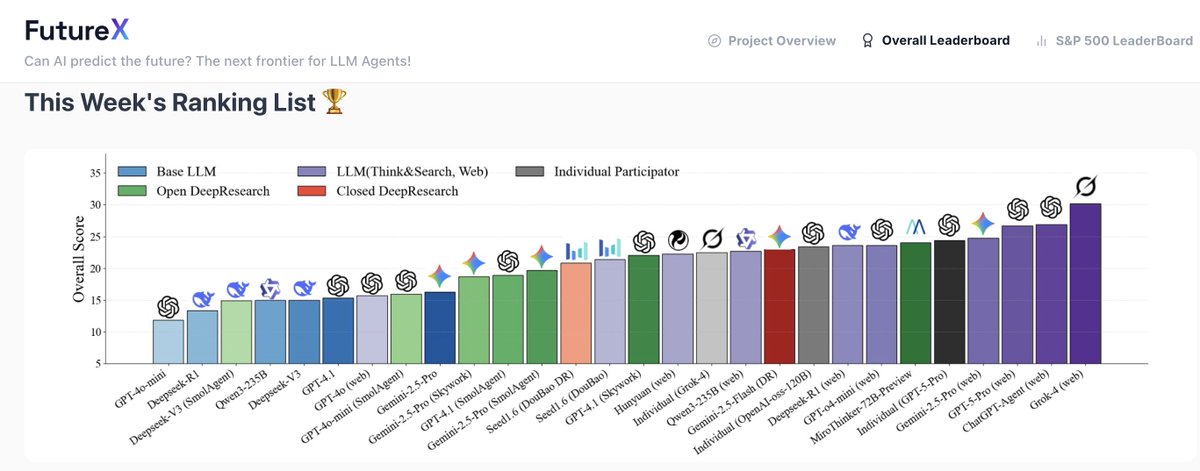
Fascinating results on the FutureX prediction leaderboard, which is yet another new way to evaluate the usefulness of AI.
The AIs which are best at predicting the future:
- Grok-4
- ChatGPT Agent
- GPT-5 Pro
- Gemini 2.5 Pro
- MiroThinker 72B Preview
- GPT-o4 Mini
- Deepseek R1
Veränderung ist schwer – nicht wegen der Strukturen, sondern wegen der Menschen.
Klarheit, Beteiligung und kleine Erfolge machen den Unterschied.
Lesenswert: Warum Wandel oft stockt – und wie er gelingen kann.
⬛️ Why is organizational change still so difficult?
➡️ How should an - ideal - process be designed to successfully navigate change?
🔶 Why is organizational change so difficult?
Organizational change remains challenging despite employees’ experiences with transformations for several reasons:Resistance to Change: People tend to cling to the familiar, as change can trigger uncertainty and fear of losing control. Even experienced employees who have shaped changes may be skeptical if new processes threaten their routines or power structures.
🔸 Cultural Inertia: Company cultures are deeply rooted. Values, norms, and habits change slowly, even if employees have encountered change elsewhere. A culture that doesn’t reward innovation hinders transformation.
🔸 Lack of Clear Vision: Often, the need or goal of change isn’t clearly communicated. Without a compelling “why,” employees feel uninvolved and see change as a burden.
🔸 Insufficient Involvement: Even if employees have shaped past changes, they may not be adequately involved in new processes. Without participation, acceptance drops.
🔸 Complexity and Resource Scarcity: Change requires time, money, and energy. Many organizations underestimate the effort or lack sufficient resources, leading to frustration.
🔸 Inadequate Leadership: Leaders play a key role, but change often fails due to unclear direction, lack of role modeling, or poor change management. Experienced employees may become cynical after poorly managed changes.
🔸 Short-Term Thinking: Many organizations prioritize short-term results over long-term transformation, undermining change, as deep transformation takes time.
➡️ What does an 'ideal' process for successful change look like?
A successful change process requires a structured, participatory, and well-communicated approach. An ideal process, inspired by models like Kotter’s 8-Step Model and OKR principles, could look like this:
🔸 Create Urgency: Clearly communicate why change is necessary. A compelling vision highlighting benefits for the organization and employees motivates action. Data, market trends, or external threats can reinforce urgency.
🔸 Build a Coalition: Assemble a strong leadership team to drive the change. This team should include executives and influential employees from various levels to ensure credibility and support.
🔸 Set Clear Goals: Use methods like OKRs to define ambitious yet achievable objectives and measurable key results. These provide clear direction and make progress visible.
🔸 Transparent Communication: Develop a communication plan that regularly and honestly updates employees on goals, progress, and challenges. Use multiple channels (meetings, newsletters, intranet) to reach everyone.
🔸 Engage Employees: Foster participation through workshops, feedback sessions, and pilot projects. Employees who actively contribute feel responsible and are more likely to support the change.
🔸 Create Short-Term Wins: Set milestones that deliver early, visible results (“quick wins”). These boost motivation and show that the change is progressing.
🔸 Provide Training and Support: Offer training, coaching, and resources to prepare employees for new processes or technologies. This reduces fears and builds competence.
🔸 Adapt the Culture: Embed the change in the company culture by rewarding new behaviors, highlighting role models, and dismantling old structures that resist the change.
🔸 Measure and Adjust Progress: Use measurable indicators (e.g., key results) to track progress. Regular reviews allow for course corrections as needed.
🔸 Ensure Long-Term Anchoring: Ensure the change isn’t just a project but is permanently embedded in processes, structures, and the company culture. Recognition and rewards for contributions reinforce sustainability 💡
Why does this approach work?
This process addresses the main challenges of change: It creates clarity (through vision and OKRs), reduces resistance (through involvement and communication), boosts motivation (through quick wins and recognition), and ensures sustainability (through cultural embedding). It accounts for the human element by taking fears seriously and actively involving employees, increasing acceptance and the likelihood of success ✨
@Khulood_Almani 💫 @TamaraMcCleary@AkwyZ@GlenGilmore@pierrecappelli@MaryRich78@PhilippKnauer2@DrHolzwarth@Female_Shift@sijlalhussain@subare@JimHarris@SusanneMadsen@timo_vi@mikeflache@DG_Collective@kerstingAIML@sallyeaves@CynthiaLIVE@pilotspeaker@enilev@mcgrathmag@HaroldSinnott@Scobleizer@antgrasso@SugShan@AndrewYNg@YuHelenYu@Eli_Krumova@ipfconline1@jblefevre60@ahier@karine_grows@RagusoSergio@labordeolivier@SabineVdL@kalydeoo@Der_BDI @digital_T_CH @drsharwood@Nicochan33@AngelaNoonUK@JoanBajorek@mitsmr@wef@HavardBIZ
#Change #Involvement #Poeple #Mindset #Culture #Integration #Acceptance #Process #Activities #Framework #Leadership #Impact #Success #OKRs #KeyResults #Competitiveness
Image: #HBM
"Make the change stick - with love" 💜
⬛️ Leaders need Storytelling
It’s a method to communicate complex ideas, inspire action, and foster emotional connections. By crafting narratives, leaders can make abstract concepts like change, opportunities, or future goals tangible and relatable, motivating teams effectively. Think of it as a structured yet empathetic way to align logic with emotion, much like a 'blueprint' for guiding thought and behavior.
🔶 The art of storytelling is a powerful method for leaders to inspire employees and address complex topics like change, opportunities, and the future. In a world driven by technical precision and rational analysis, storytelling may seem soft at first. Yet, this is its strength: it connects logic with emotion, building a bridge between strategy and heart. A well-told story, however, can ease fears. By crafting a clear, authentic narrative that links the past, present, and future, leaders give change meaning. They show how challenges were overcome, how the team grew together, and why the future holds opportunities. Engineers, who deal daily with precision and problem-solving, value clear visions.
🔶 A story that illustrates how their work fits into a larger purpose motivates and provides direction. Empathy is key. Leaders must understand their team’s perspective: What moves them? What do they fear? A story that acknowledges these emotions builds trust. For example, a leader might share a change where doubts were overcome, drawing parallels to the present. This makes the message tangible: “We’ve done it before, and we’ll do it again.” Storytelling also shapes the future.
🔶 In an industry characterized by market growth, cost efficiency, competitiveness, data, digitalization, GenAI, ML, and a “rethinking of how we work,” leaders need to develop and mobilize their teams. A vision wrapped in an inspiring story makes abstract goals concrete. For engineers who think in numbers and data, storytelling isn’t a contradiction. It complements their analytical strengths by providing context and purpose. A good story is like a 'blueprint': structured, clear, and goal-oriented. It shows how every part -every employee - contributes to success. Leaders who master this art turn uncertainty into confidence and challenges into opportunities 💡
@AkwyZ@Khulood_Almani@TamaraMcCleary@GlenGilmore@pierrecappelli@MaryRich78@PhilippKnauer2@DrHolzwarth@Female_Shift@sijlalhussain@subare@JimHarris@SusanneMadsen@timo_vi@mikeflache@DG_Collective@kerstingAIML@sallyeaves@CynthiaLIVE@pilotspeaker@enilev@mcgrathmag@HaroldSinnott@Scobleizer@antgrasso@SugShan@AndrewYNg@YuHelenYu@Eli_Krumova@ipfconline1@jblefevre60@ahier@karine_grows@RagusoSergio@labordeolivier@SabineVdL@kalydeoo@Der_BDI @digital_T_CH @drsharwood@Nicochan33@AngelaNoonUK@JoanBajorek@HPI_DE@wef
#Storytelling #Leadership #Engineering #Action #Values #Communication #Change #Trust #Empathy #Collaboration #Competitiveness
Infographic by the amazing Tanmay @tnvora
@ronzheimer Blick hinter die Kulissen wäre spannend. Wieviel Vorbereitung steckt in den Gesprächen? Wer organisiert die Gäste? Erst Thema, dann Gast, oder auch mal andersherum? Bekommt Gesprächspartner/in das Fragenset vorher? Wieviel wird abgestimmt? Wieviele Leute arbeiten an einer Folge?
So stell ich mir das vor! Ps. Morgen kommen gleich zwei Podcasts. Am Morgen mit @DanielGerlach1 , am Abend mit @PhilippPeyman - Schwerpunkt Gaza und der Blick aus allen Richtungen.