Discussed the possibility of #Kurds becoming involved on @fox5sandiego this morning: “The Iranian population has nationalist sentiments which insist on the territorial integrity of #Iran, so if it’s perceived that a threat of separatism, however real or not, is emerging, that could potentially dissuade Iranians from coming back onto the streets at the final phase of this campaign.”
CNN's Clarissa Ward spoke with a senior Kurdish Regional Government official in Erbil, Iraq, who said they are '"really frightened" about possible retaliatory strikes by Tehran, if their territory is used as a launch pad for a potential ground offensive into Western Iran.
Read more: https://t.co/kRii211F68
A friendly reminder to all parties structuring this memorandum of misunderstanding.
The $300B private fund to invest in Iran has a statutory problem: the Trump administration formally determined and reported to Congress in 2020 and 2025 that Iran's construction sector is IRGC-controlled.
Set aside the criminal exposure from IRGC's FTO designation. IFCA §1245 imposes mandatory sanctions on the sector. The President can waive, but only 180 days at a time. No serious investor commits billions on a rolling six-month waiver cycle.
So which is it? Will the administration return to Congress claiming the IRGC vacated Iran's construction sector overnight? Or will it revoke the IRGC's FTO designation to clear the path?
The deal's architects need to explain how $300B in committed funds navigates this, or they need every Member of Congress to look the other way.
Downblend Recoverable Enriched Uranium to What? Better Just Ship It Out
The public discussion about downblending Iran's recoverable enriched uranium always leaves out the biggest factor: Downblending to what? Then what? The logical choice is natural uranium hexafluoride and then ship it out.* Other choices, such as downblending the 20 and 60 percent to 4 to 5 percent enriched uranium, would still leave Iran with a tremendous breakout capability. This material would be over 70 percent of the way to weapon-grade uranium and require the material to be shipped out. Proposals to downblend only the 60% to 20% enriched uranium are laughable, unless it and all other enriched uranium hexafluoride were rapidly shipped out to another country. If that is the case, why bother downblending at all; just ship out any recoverable enriched uranium in its present form.
The relatively small amount of 20% enriched uranium fuel already in or made for the Tehran Research Reactor (TRR) fuel could remain in Iran. Moreover, we showed recently that Iran has enough TRR fuel in hand, in pieces, or in Russia (under JCPOA) in pieces for many years of TRR operation. There is no need to make more; and Iran can’t make any more in any case due to damage from the war. Thus, there is no need for Iran to keep any 20 percent enriched uranium hexafluoride or any 20 percent enriched uranium oxide outside existing TRR fuel rods or elements.
* In theory, because of mass conservation, Iran has enough depleted uranium hexafluoride to down blend all its enriched uranium hexafluoride to natural uranium hexafluoride. If for practical reasons, it cannot recover enough depleted uranium hexafluoride from the wreckage, there are zillions of tons of depleted uranium in many countries, including Russia, that could be sent to Iran for use in downblending enriched uranium down to natural uranium.
🎯STRUCK: Several infrastructure sites at the petrochemical complex in Mahshahr, in southwestern Iran.
These facilities were used by the armed forces of the Iranian terror regime to produce and export raw materials for weapons production.
The targeted infrastructure produced unique materials that serve as critical components for the development of ballistic missiles.
⭕️🛩️ STRUCK: The IDF completed a large-scale strike on strategic defense systems belonging to the Iranian terror regime.
Recently, defense systems were deployed across Iran to restore the regime’s capabilities degraded during Operation Roaring Lion. The strike led to the dismantling of these systems.
🚫 CLAIM: Iran’s Islamic Revolutionary Guard Corps claims they struck U.S. 5th Fleet headquarters in Bahrain and a U.S. air base in the region with missiles and drones today. FALSE.
✅ TRUTH: All Iranian attacks on American forces failed. U.S. forces remain vigilant and ready to defend against unwarranted Iranian aggression.
From the @TheGoodISIS
New passive defense measures taken at Fordow: Between May 10 and May 18th, Iran added passive defensive measures in the shape of earthen/rocky mounds and other objects on the roads leading to the tunnel entrances of the destroyed Fordow underground enrichment plant. The alternate placings of the piles/objects are very precise, which creates a series of chicanes, indicating they are not intended as obstruction, but a means to prevent rapid ingress and egress by any vehicles (i.e. hindering offensive forces once onsite). The placement indicates that Iranians still want access onsite for themselves, otherwise we would likely see berms all the way across the roads, as previously seen on the roads leading to the Esfahan tunnel entrances.
It is unclear why some of the chicanes leading to the single eastern tunnel entrance may have only been temporary, as several were removed by May 26.
This entrance was backfilled by Iran and hit by Israel in June 2025, with a crater, but no penetration hole visible above the tunnel entrance. All tunnel entrances appear to remain buried as of May 26.
At 10:17 p.m. ET on May 27, Iran launched a ballistic missile toward Kuwait that was successfully intercepted by Kuwaiti forces. This egregious ceasefire violation by the Iranian regime occurred hours after Iranian forces launched five one-way attack drones that posed a clear threat in and near the Strait of Hormuz. All drones were successfully intercepted by U.S. forces which also prevented a sixth drone launch from an Iranian ground control site in Bandar Abbas.
U.S. Central Command and regional partners remain vigilant and measured as we continue to defend our forces and interests from unjustified Iranian aggression.
So long as the Islamic Republic remains entrenched in Tehran, its challenge for American presidents will continue. New @CNN analysis examines this driver of conflict. https://t.co/HTsM6iErJH
CENTCOM officials told me battle damage assessments support Admiral Cooper’s testimony about the level of degradation of Iran’s missile, drones, industrial base, navy, and Air Force. Iran still retains some capabilities but they are once point where they can be defended against.
Adm. Brad Cooper, the chief of U.S. Central Command, knocked down news reports that Iran retains 70% to 75% of its prewar missiles and launchers as “not accurate.” https://t.co/u6UE1P9UOc
Iran's proposal to the US to end the war, according to Al Mayadeen:
- Ending the blockade
- Freedom to export oil
- Ceasefire in Lebanon
- Removing US sanctions
- Iranian control of the Strait of Hormuz
- Unfreezing Iranian assets
Informed European source has told me that Iran refused to acknowledge nuclear talks in its recent peace proposal response, leading talks to break down again.
BREAKING | Now we know what's in Iran's response. WSJ and Al Mayadeen are publishing the contents.
Iran asks for: end of the naval blockade, freedom to export oil, ceasefire in Lebanon, sanctions removed, Iranian control of the Strait of Hormuz, frozen assets released.
On the nuclear file: part of the uranium diluted, the rest transferred to a third country, not the US, with a guarantee it comes back if talks collapse or if Washington exits the agreement.
No direct talks, everything through Pakistan.
Nuclear negotiations only during the 30 days after the war ends, not before.
WSJ calls it a "lengthy response that leaves gaps between the two sides."
Bottom line: Iran publicly confirmed the three red lines it announced yesterday (Hormuz, enrichment, uranium to the US) and offered concessions where it had room, partial dilution, third country instead of the US, guarantee of return.
Exactly what yesterday's post had framed as likely. The thing to watch is Lebanon: Iran put it in as part of the Iran-US deal, and Israel will never sign that. Possible rupture point even if Washington wanted to sign.
Why does Iran have an HEU stockpile? Because the regime chose leverage over livelihoods. There is no civilian or economic justification for enrichment at this level or at all, only coercive diplomacy from a government caught running an actual nuclear weapons program.
The price tag: over $500 billion and nuclear power still generated ~1–2% of Iran’s electricity. Now it’s almost all gone.
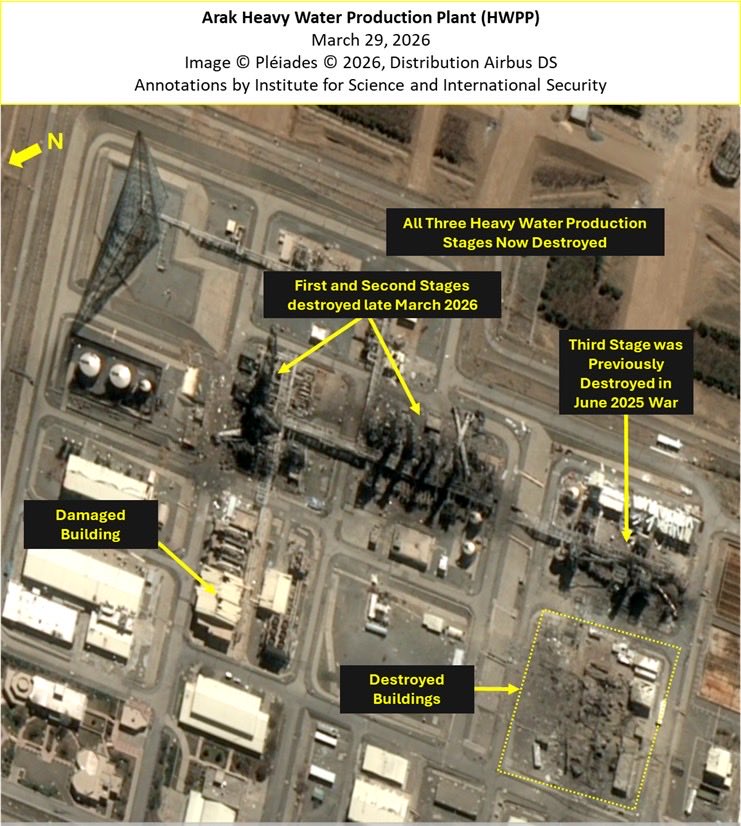
We (@TheGoodISIS) released a comprehensive study today jam packed with satellite imagery that analyzed all the nuclear related facilities targeted during this 2026 phase of the Iran war.
This is an incredibly important study and really shows the power of open-source intel. We used satellite imagery to assess the damage done to Irans nuclear program. Let me be clear, Irans program has suffered widespread destruction and devastation. Many facilities related to the research and development process involved in actually building a nuclear weapon (weaponization) have been destroyed or heavily damaged. Scientists have been killed, eliminating their tacit knowledge/know-how that was built up over years of experience and must be relearned and retrained in a new generation of experts. And other factors occurred, but those are discussed in the report. This is all on too of the fact that Iran does not maintain a uranium enrichment program, which was destroyed in June 2025 (although that could be rebuilt at huge expense). These new factors will undoubtedly extend the time needed to finish a nuclear weapon and raise the chance of failure if such a decision is taken (which would be incredibly risky for Iran and have no clear guarantee of success).
Ultimately, we found that current IC assessment (as reported by Reuters) that since the June 2025 war, the amount of time the program has been set back by hasn’t changed is a very hard assessment to defend or justify given the facts we outline in the report. When looking at the scale of the new damage and new sites hit, especially those involved in nuclear weaponization work, it’s its clear that the damage is significant and pushes back the timetable. We would love for the IC to release how they reached their conclusion that it remained the same few month timetable to a bomb.
To be clear, a pathway to a bomb still exists for Iran, we see it now as a very dubious and increasingly challenging pathway.
What worries us still is the status of the enriched uranium stockpiles. As long as the enriched uranium remains within Iran and Iran insists it has a right to enrich uranium and rebuild its destroyed program, a longterm pathway to a nuclear weapon is an option. Iran must give up its enriched uranium stocks and abandon its enrichment program. Pickaxe Mountain and the status of the newly declared enrichment plant in the tunnel complex at Esfahan adds further worry. All of this must be dealt with during negotiations, dismantled, and then strictly verified and monitored by the IAEA to ensure no cheating occurs.
P.s. I added some teaser images below.
Read our full COMPREHENSIVE imagery report here: https://t.co/pw63W4lAM0