🔎 ¿Qué tienen en común el nejayote, las aguas residuales, los desastres, la ingeniería sísmica y las nuevas generaciones?
Todos son parte del nuevo episodio de #IngenieríaAlDía.
🏆 Investigación
🌎 Colaboración internacional
🔬 Innovación
🎓 Divulgación
▶️ Dale play
🏗️ ¿Quién fue Bernardo Quintana Arrioja?
Te invitamos a conocer, a través de este video, la trayectoria y el legado de una figura destacada de la ingeniería y la construcción en México.
🎥 Conoce su historia.
#IIUNAM#UNAM#IngenieríaMexicana
#ÚLTIMAHORA 🚨 La producción de autos cae en México y Nissan, Mazda y Mercedes-Benz encabezan los retrocesos
La producción de vehículos ligeros en México hiló una baja en el acumulado del año, mientras las exportaciones dejaron atrás el crecimiento y ya registran una ligera contracción. https://t.co/OHSulw8Ag6
🚨 | GRAVÍSIMO: TELEFÓNICA QUE TRABAJA DIRECTO CON LA 4T EXHIBE DATOS DE TODOS SUS CLIENTES QUE VINCULAN SU LÍNEA
La falla es brutal por lo simple: un sistema de ABIB, que también opera para el programa Internet para el Bienestar, responde a CUALQUIER número de teléfono de la compañía sin pedir usuario, contraseña, ni verificación de ningún tipo.
Cambias un dígito en la barra del navegador y te entrega el expediente completo de otra persona.
Incluso te da todos los datos de su reciente vinculación al registro telefónico. ¡Increíble!
Almost every argument about energy comes down to one number: energy density.
How much energy is stored per kilogram of fuel or material.
The numbers in MJ/kg:
• Wood: 15
• Coal: 24
• Crude oil: 44
• Natural gas: 54
• Hydrogen (compressed): 120
• Lithium-ion battery: 0.7
• Uranium (fission): 80,000,000
• Hydrogen (fusion): 690,000,000
Read those last two again.
A kilogram of uranium contains more energy than 3,000 tonnes of coal.
A kilogram of hydrogen fusion fuel contains 45 million times more energy than a kilogram of oil.
This is why:
• Batteries struggle to replace liquid fuels in aviation and shipping. Energy density is 60x lower.
• Nuclear submarines can run for 25 years without refuelling.
• Fusion, if cracked, ends energy scarcity permanently – not just for decades, but for the lifetime of the Sun.
The energy transition debate isn't about ideology.
It's about physics.
Every energy source is competing against millions of years of chemistry packed into fossil fuels – and, eventually, against the nucleus itself.
Know the numbers. The debate becomes clearer.
A 33-year-old woman at MIT wrote the code that ran inside the Apollo 11 lunar lander, and 20 seconds before Neil Armstrong touched the moon, her program made a decision the astronauts didn't know was happening that was the only reason the mission didn't crash.
Her name was Margaret Hamilton.
She led the team writing every line of code that would fly humans to the moon and back. The part almost nobody knows is that she had to fight to be allowed to do the work at all.
Code in 1965 was not treated as real work.
Rockets were serious. Circuits were serious. Writing code was something the men at NASA thought secretaries could do on the side. Hamilton was told this to her face more than once.
So she started calling what her team did "software engineering."
She used the phrase on purpose. In meetings. In memos. To force people to treat it as a discipline instead of a chore. Colleagues laughed at her the first few times she said it out loud.
That phrase is now the name of the biggest engineering profession on earth.
The story of what her code did on July 20, 1969 is the one every kid should be taught.
Neil Armstrong and Buzz Aldrin were 3 minutes from touching down when the computer inside the lunar module started flashing an alarm.
1202.
Then again. Then 1201. Five alarms in four minutes. The computer was telling the astronauts it could not finish everything it had been asked to do.
The computer they were flying with had less memory than a modern microwave.
Someone on the checklist had left a switch in the wrong position, and a radar the astronauts did not even need right then was flooding the computer with data. It was eating around 13% of the machine's brain at the exact moment every second mattered.
In almost any other system, that overload would have frozen the machine.
A frozen machine 30,000 feet above the moon means a crash. It means two dead astronauts and a third one orbiting alone above them, waiting for a signal that would never come.
Hamilton's code did something else.
She had built the software with a rule almost nobody in her field was using at the time. When the machine ran out of room, it would not treat every task as equally important. It would look at the list of jobs it had been asked to do, throw out the ones that could wait, and keep running only the ones keeping the crew alive.
The radar was the low priority job.
The landing was the highest.
So the computer did what she had told it to do. It dumped the radar. It kept flying. The alarm was not a failure. It was the machine reporting that it was handling the overload exactly the way she had designed it to.
Down in Houston, a 24-year-old engineer named Jack Garman recognized the alarm from a test his team had run months earlier. He shouted "Go" to the flight controller. The controller shouted it up to the crew. The landing kept going.
Armstrong touched the surface with 25 seconds of fuel left.
The part that gets lost in every retelling is why Hamilton had built that safety net in the first place.
NASA had not asked for it.
She had added it on her own, years earlier, because her 4-year-old daughter Lauren had once crashed the simulator by pressing a button during a test. The button was one the astronauts had been told they would never press.
Hamilton wanted the code to survive that button press anyway.
Her bosses told her it was a waste of time. Astronauts do not make mistakes.
She insisted. The safety net went in.
Two years later, on the way to the moon, an astronaut left a switch in the wrong position. The exact class of mistake she had been told would never happen.
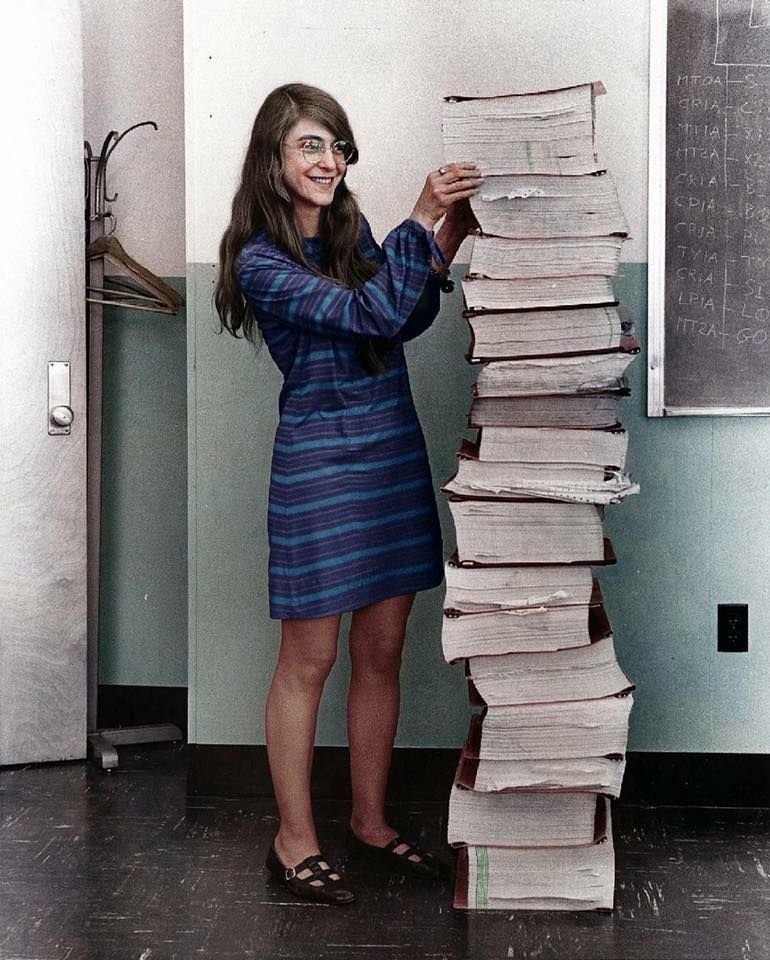
There is a photograph of her from that period.
She is standing next to a stack of paper as tall as she is. Every page in that stack is the code her team wrote for the mission. She is smiling at the camera like she knows something the rest of the aerospace industry has not figured out yet.
In 2016, Barack Obama put the Presidential Medal of Freedom around her neck and said the astronauts did not have much time, but thankfully, they had Margaret Hamilton.
Every autopilot in every plane you have ever flown on uses a version of what she invented. Every pacemaker. Every self driving car. Every satellite in orbit.
The idea that a machine should know which job matters most and drop the rest when it runs out of room is now the foundation of almost every safety system on the planet.
She wrote it because a 4 year old crashed a simulator and nobody else thought it was worth fixing.
The men in the room laughed at her for calling it engineering.
Then her code was the only thing in the sky that did not fail.
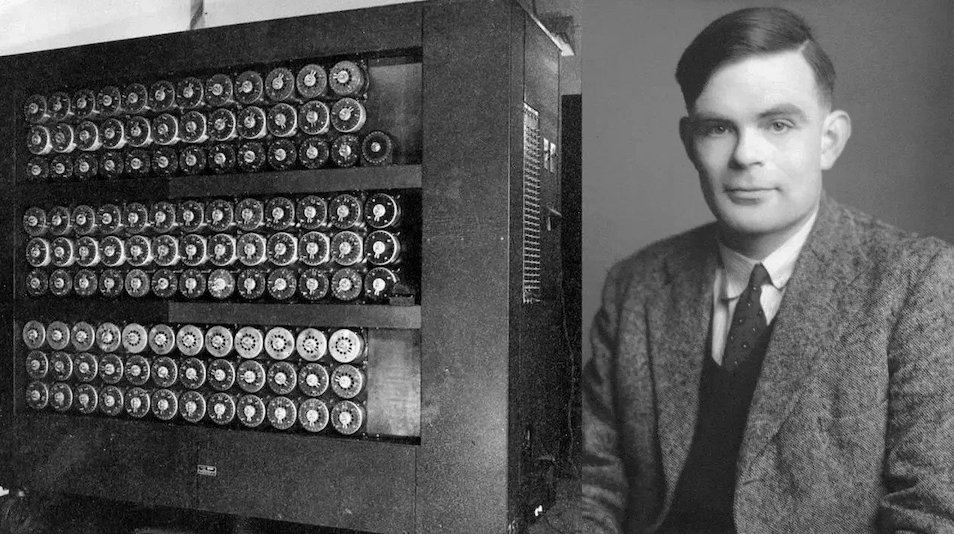
A British mathematician invented the computer at 24, won the war at 30, was chemically castrated at 40, and was dead at 41.
I went down this rabbit hole expecting a story about science. What I found was the most brutal betrayal in the history of modern technology.
His name was Alan Turing.
In 1936 he was a 24-year-old graduate student at Cambridge working on an obscure logic problem nobody outside academia cared about. The German mathematician David Hilbert had asked whether a single procedure could exist that, given any mathematical statement, would tell you whether it was provable.
Turing answered no. But to prove the answer was no, he first had to define exactly what a procedure was. So he invented an abstract machine to capture the idea.
The paper is called On Computable Numbers. It is 36 pages long. It is the most important paper in the history of computer science.
What he sketched on paper that year is now called a Turing machine. A device that reads instructions off a tape, modifies what it reads, and moves to the next instruction.
Every CPU on Earth is a physical implementation of this idea. Every programming language is a way of writing instructions for one. He proved, on paper, that there could exist a single universal machine capable of simulating any other machine. That single proof is the reason your laptop can run thousands of different programs without being redesigned for each one.
Hardware and software are different things because Turing proved they could be, nine years before there was such a thing as a stored-program computer.
Then the war happened.
In 1939 he was recruited to Bletchley Park, the British codebreaking center where the most secret work of World War II was done. The Germans were using a cipher machine called Enigma to encode every military order moving across Europe. The number of possible Enigma settings was 158 quintillion. The Polish had cracked an earlier version. The new German naval Enigma was considered unbreakable.
Turing led the team that broke it.
He designed a machine called the Bombe that could systematically eliminate impossible cipher settings until only the correct one remained. By 1943 his team was decrypting roughly 84,000 German messages per month.
The British Admiralty could read U-boat positions in the Atlantic before the U-boats reached them. Historian Sir Harry Hinsley, who served at Bletchley Park and later wrote the official British intelligence history of the war, estimated that the work shortened the war by two to four years. Millions of people who would have died are alive because of what one small team did in a country house outside London.
Almost none of them ever knew his name.
The work was classified for 30 years. Turing went back to civilian life, took a position at the University of Manchester, and in 1950 wrote a second paper that would do for artificial intelligence what his 1936 paper had done for computing.
It is called Computing Machinery and Intelligence. The opening line is famous. "I propose to consider the question, can machines think." Then he did something nobody had ever done with that question. He pointed out that the question itself is meaningless until you define what thinking is, and that nobody can define what thinking is even for humans.
So he proposed replacing it with an operational test. If a machine could hold a conversation indistinguishable from a human conversation, the question of whether the machine "really" thinks becomes a philosophical preference, not a scientific one.
ChatGPT, Claude, Gemini, every large language model in production today, every conversation about AI alignment, every benchmark measuring whether a model has crossed some threshold of capability all of it traces back to the test he proposed in that single 1950 paper.
He defined the entire vocabulary of the field he never lived to see exist.
In 1952 he was arrested.
A young man named Arnold Murray had stayed at his house. Murray's friend later broke in to steal something. Turing reported the burglary to the police. Under questioning, he admitted he had been in a relationship with Murray. Homosexuality was a crime in Britain under the 1885 gross indecency law, the same statute that had been used to imprison Oscar Wilde 57 years earlier.
Turing did not deny what he had done. He told the police it should not be against the law. He was convicted.
The court gave him a choice. Prison, or a year of forced estrogen injections to chemically suppress his sex drive. He chose the injections so he could keep working. The treatment caused weight gain. It gave him breasts. It stripped his security clearance. The country that had used his mind to win the war was now using its laws to destroy the body that mind lived inside.
On the morning of June 8, 1954, his housekeeper found him dead in his home in Wilmslow. He had died the previous day, June 7. He was 41 years old. A half-eaten apple was on the bedside table. The autopsy found cyanide in his system. The inquest ruled it suicide.
Some historians dispute the ruling. Jack Copeland, a leading Turing scholar at the University of Canterbury, has argued that the apple was never tested for cyanide, that Turing was in good spirits in the days before his death, that he had been making plans for the week ahead, and that the cause of death is consistent with accidental inhalation of cyanide vapor from a home electroplating experiment he had been running in his spare bedroom. We will probably never know which version is correct.
What is certain is that he died alone, in a small house outside Manchester, a year after the British government finished injecting hormones into his body, in a country whose existence depended on the work he was no longer allowed to do.
In 2009 the British government issued an official apology. Prime Minister Gordon Brown wrote that the treatment Turing received was "appalling" and that he deserved "much better." In 2013 Queen Elizabeth II granted him a posthumous royal pardon. In 2021 his face was placed on the Bank of England's 50 pound note.
Sixty years. That is how long it took the country that owed him everything to put his face on its money.
The 1936 paper is free online. The 1950 paper is free online. Both have been read by every serious computer scientist who has ever lived. The man who wrote them did not live to see a personal computer, did not live to see the internet, did not live to see a single one of the machines whose architecture he had defined while still in his twenties.
Every algorithm running on every machine on Earth right now traces back to a graduate student who got 41 years on this planet before the country he saved decided they could no longer tolerate the way he loved.
Essa usinagem de 5 eixos é o nível máximo da engenharia moderna. O que parece um movimento simples é na verdade um cálculo constante de trajetórias em micrômetros para evitar que o metal sofra qualquer deformação térmica enquanto é esculpido com essa precisão absurda.
For XPENG IRON, we developed a general-purpose framework that mimics human skeletal geometry and utilized a muscle-like lattice structure to replicate actual muscular movement.
[Producto] Erwin Junker North America desarrolla soluciones de rectificado orientadas a componentes críticos utilizados en sistemas de transmisión lineales y rotativos para robots humanoides. 🔴 Conozca los detalles: https://t.co/1nAYGJIt6D
#Rectificadoras#MáquinasHerramienta
Max Planck and Albert Einstein showed that energy is quantized and light behaves as both a wave and a particle.
Louis de Broglie extended this idea to matter, meaning everything has a wavelength. For large objects this wavelength is negligible, but for electrons it is significant, so they must be treated as both particles and waves.
An electron in an atom can be understood as a standing wave around the nucleus. This wave must fit perfectly, so it can only contain whole numbers of wavelengths. This explains why electrons have discrete energy levels, as described in the model of Niels Bohr.
When an electron absorbs energy, it moves to a higher level with more wavelengths, a process called excitation. Wave interactions between atoms also help explain chemical bonding.
In 1925, Erwin Schrödinger developed the Schrödinger equation to describe this wave behavior. It calculates a wave function that represents the system. The Hamiltonian in the equation accounts for the system’s total energy and interactions.
Big engines, bigger numbers… and yes, you’re still expected to remember them 😅✈️
1. GE90 Series (General Electric)
Models: GE90-76B, -85B, -94B, -110B1, -115B
Thrust: 76,000 to 127,900 lbf
The GE90-115B? Still the most powerful commercial jet engine out there 💪
Found on: 777-200LR, 777-300ER, 777F
2. Trent 800 Series (Rolls-Royce)
Models: Trent 875, 877, 884, 892, 895
Thrust: 75,000 to 95,000 lbf
Classic choice for the 777-200 and 777-300
3. PW4000 Series (Pratt & Whitney)
Models: PW4074, 4077, 4084, 4090, 4098
Thrust: 74,000 to 98,000 lbf
Also powering the 777-200 and 777-300
Same aircraft… three different ways to get you off the ground 🚀
With @AirheadAtpl
Hoy conmemoramos el natalicio de Carl Friedrich Gauss (1777-1855), cuya mente brillante sentó las bases de gran parte de la ingeniería moderna. Desde la estadística con su famosa campana, hasta el electromagnetismo y la geodesia, el legado de Gauss vive en cada cálculo
One of the most astonishing facts about the Apollo 11 Moon Landing is how little computing power was available. The onboard computer had only about 72 kilobytes of memory. In comparison, a modern 64 GB smartphone has more than a million times that capacity.
This is why a famous photo of Margaret Hamilton standing next to stacks of printed code has become so iconic. She and her team at NASA wrote the software for the mission by hand and helped establish the field now known as software engineering.
Hamilton led the team that built the flight software, laying the foundation for future space missions. Her work proved critical during the landing. Just three minutes before touchdown, the computer triggered the “1202 alarm,” signaling an overload. The mission was close to being aborted, which could have allowed the Soviet Union to reach the Moon first.
However, the system had been designed to prioritize essential tasks and ignore less important ones. Thanks to this, the landing was able to continue safely. Reflecting on the moment, Hamilton later said they had no choice but to find a solution, and they did. Remarkably, she was only 25 years old at the time.
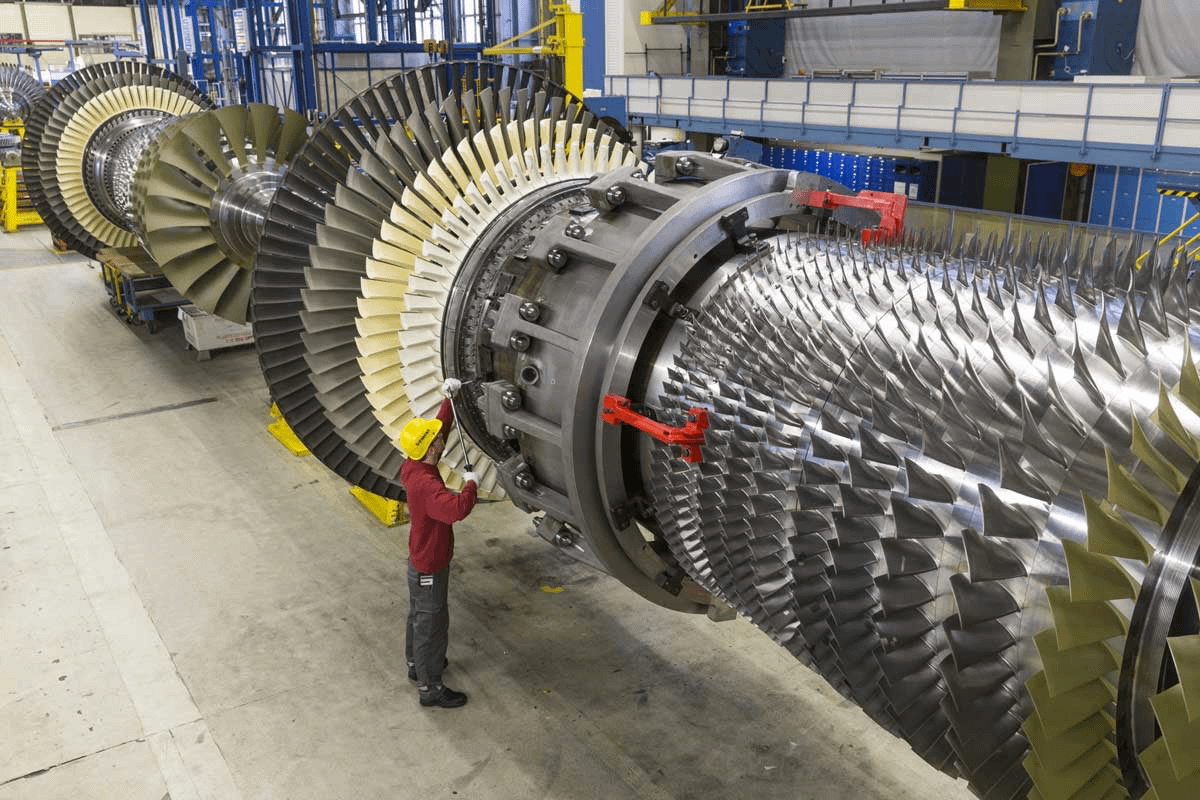
You cannot buy a new gas turbine until 2030. Order books at GE, Siemens, and Mitsubishi stretch to 2029. Turbine prices have nearly tripled since 2019. Every AI data center needs power and every gas plant needs a turbine. And every turbine has one part that bottlenecks the entire industry: The blade. It has to survive in gas 500°C above the melting point of the metal it's made from and spin at up to 20,000 RPM under 10,000 g of centrifugal force. Each blade is grown as a single crystal of nickel superalloy, pulled through a vacuum furnace at 3 mm per minute. A set of blades costs $600,000 and takes 90 weeks to grow. The same metallurgy powers modern jet engines. Only 3 companies on Earth can build one. China spent $42 billion trying to catch up. They bought a Russian fighter engine, took it apart, and copied every part. Their copy ran 30 hours between overhauls versus 400 for the original. Modern Western engines run 4,000. You can reverse engineer the shape of a turbine blade. You cannot reverse engineer 60 years of metallurgy.
El rectificado no es un proceso simple, es un sistema de variables en equilibrio. Aunque se percibe como una operación de acabado, el rectificado permite remover material mediante abrasión con niveles de precisión. 🔎Léalo aquí: https://t.co/xmcJnv7T9K
#MecanizadoCNC
¿Necesitas más pruebas de que llegamos a la Luna? Aquí las tienes, capturadas desde el espacio.
Esta impresionante compilación muestra los seis sitios de alunizaje del programa Apollo (11, 12, 14, 15, 16 y 17) tal como se ven hoy desde la cámara de alta resolución del Lunar Reconnaissance Orbiter (LRO) de la NASA.
En cada imagen puedes distinguir:
🔸La etapa de descenso del módulo lunar (el LM que quedó en la superficie)
🔸Los experimentos científicos (ALSEP)
🔸El Lunar Roving Vehicle (rover) en las últimas misiones
🔸Las huellas de los astronautas y las marcas dejadas por sus actividades
🔸Detalles únicos como la bandera de Apollo 17, el Surveyor 3 en Apollo 12 o el retroreflector láser
Estas fotos no son de los años 60… fueron tomadas entre 2009 y la actualidad por una sonda en órbita lunar, con resolución de hasta 25-50 cm por píxel. Las perturbaciones en el regolito lunar siguen visibles décadas después.
La Luna guarda las huellas de nuestra primera gran aventura fuera de la Tierra. Y la tecnología actual sigue confirmando lo que hicimos.
Entonces…
¿Es tan grande el escándalo de la barredora, Miss Universo, Pemex y los nexos de Raúl Rocha con Morena, incluido Adán Augusto, que tuvieron que tomar la Fiscalía antes de que todo estalle?
Van de escándalo en escándalo,
Y todavía hay quien los defiende.